

Enterprises should combine routine driver and .NET servicing with Windows monthly quality updates when Microsoft’s unified restart model becomes commercially manageable, but they should keep firmware in a separately governed, hardware-specific approval lane until administrator controls and OEM recovery procedures are documented and validated.
Microsoft is coordinating restart timing; it has not yet documented independent commercial approvals for quality, .NET, driver, and firmware payloads. Fewer interruptions are useful across a large fleet, but one restart should remain the execution point for several independently approved changes—not one approval decision covering every layer of the device.
WindowsForum’s coverage of Windows 11 Insider Experimental Preview Build 26300.8687 describes the immediate benefit: Microsoft is testing coordination of driver, .NET, and firmware work with the monthly quality update so that a PC can complete the approved work through a single monthly restart. WindowsForum’s reporting on predictable Windows 11 restarts places that experiment in the broader 2026 effort to give users clearer installation, pause, shutdown, restart, and setup choices.
The enterprise recommendation is straightforward:
The unresolved question is not whether one restart is more convenient than several. It is whether administrators can coordinate restart timing while retaining separate authority over eligibility, deadlines, deployment cohorts, evidence, and recovery for each payload.
The tested design coordinates driver, .NET, and firmware updates with the monthly Windows quality update. The user-facing objective is understandable: collect work that might otherwise require separate installation or restart events and complete it during one predictable maintenance event.
That is a meaningful improvement for consumers and can also help enterprises. WindowsForum’s Build 26300.8687 reports focus on the operational value of fewer system reboots, while its enterprise-oriented coverage emphasizes the possibility of moving more update activity into a recognizable monthly rhythm.
Enterprise servicing, however, is not consumer servicing at a larger scale. Administrators divide deployments into rings because different changes have different dependencies, owners, validation requirements, and recovery procedures. The ability to share a restart does not establish that the payloads should share an approval policy.
The appropriate model separates orchestration from governance. Windows may coordinate several approved payloads into one restart, but the organization should decide independently whether each payload is eligible for that event.
That distinction produces a workable policy:
Bringing routine driver and .NET servicing into that rhythm can reduce parallel maintenance cycles. It can also make endpoint state easier to interpret: after the monthly event, a device should be closer to the organization’s approved Windows, application-platform, and hardware-support baseline.
The change does not remove compatibility risk. A driver update could affect a device-specific function or workload. A .NET update could expose an application dependency that was not represented in testing. The point is not that these updates are harmless; it is that enterprises can place them into familiar validation structures.
For drivers, that structure must be hardware-aware. “Windows 11 pilot” is not a sufficient cohort definition for a fleet containing different processors, network components, storage configurations, docks, cameras, biometric devices, and specialized peripherals.
The first driver cohort should include representative devices from the organization’s major hardware families. It should also include intentionally selected unusual configurations and systems attached to business-critical equipment. A convenient group of IT volunteers is useful only if its hardware reflects the production estate.
The next cohort should broaden coverage while preserving a stop point. Expansion should depend on collected evidence such as installation outcome, boot status, device health, connectivity, sleep and resume behavior, peripheral operation, workload stability, and support volume.
.NET updates should follow application-validation rings. The organization does not need a separate bureaucracy merely because Microsoft may coordinate the restart. Existing application owners should validate critical applications, endpoint engineers should validate Windows behavior, and support teams should watch for incidents. After those checks pass, .NET servicing can converge with the monthly quality-update schedule.
This is where Microsoft’s proposed model has the clearest enterprise value. Approved changes can complete during one planned interruption without erasing ownership or validation responsibility.
For more background on the emerging experience, WindowsForum’s earlier coverage of Insider Build 26300.8687 examined Microsoft’s fewer-restarts objective, while our analysis of predictable Windows 11 restarts explored the broader shift toward a monthly maintenance rhythm. The enterprise task is to convert that rhythm into a controlled process rather than a single undifferentiated update action.
Potential failure scenarios must be evaluated rather than assumed. Depending on the device and failure condition, a firmware problem could affect startup, platform functions, or the organization’s ability to reach its normal Windows support environment. The relevant recovery procedure may also depend on the OEM, model, configuration, and physical location of the endpoint.
These are risk scenarios, not predictions that every firmware update will fail or that every failure will make a device unreachable. They are sufficient, however, to justify a more restrictive approval model.
Before a firmware payload enters a coordinated monthly event, the enterprise should be able to answer:
Routine Windows rings may include thousands of devices after validation. An initial firmware cohort should remain narrower and tied to a defined hardware family. Expansion should occur only after the expected firmware state and post-restart device health have been verified.
A companion WindowsForum report frames the test as an attempt to move PCs toward one monthly restart by coordinating these update classes. Another WindowsForum article on Windows 11 update controls describes the wider objective of more predictable monthly restarts and clearer user-facing choices around installing, pausing, shutting down, restarting, and completing setup.
Those reports support a narrow conclusion: Microsoft is testing coordinated restart timing. They do not establish the final commercial approval model, reporting schema, management integration, policy precedence, or firmware recovery workflow.
Microsoft has not yet documented commercial availability or administrator controls. That wording matters. It avoids treating every unanswered question as a confirmed product omission while recognizing that enterprises cannot approve production adoption without the details.
Production machines should not be placed in an experimental Insider channel merely to obtain the experience early. Organizations that want direct exposure should use isolated lab devices representing supported hardware families. Results from those devices should be treated as product evaluation, not as validation of a commercial deployment contract that Microsoft has not yet published.
The preview can help IT teams understand the proposed servicing flow and prepare their requirements. It cannot yet answer how the final feature will interact with commercial policies, deployment services, reporting systems, safeguards, or existing maintenance deadlines.
Unified updates should not enter broad production use until Microsoft’s commercial documentation and the organization’s own testing can answer the following criteria.
A hold on one update class should not be interpreted internally as approval to delay or accelerate every other class. The organization must be able to preserve its quality-update decision while separately evaluating a driver or firmware payload.
Microsoft must document how quality-update deadlines, .NET deployment timing, driver availability, and firmware authorization interact. Enterprises also need an explicit description of what occurs when a user selects an earlier installation or restart option on a managed device.
The required answer is not an assumption that user action will apply staged firmware. The required answer is documented policy behavior: which administrator-approved payloads are eligible on each restart path, and whether user acceleration can change their timing.
A single “restart completed” result is insufficient for enterprise evidence. Required telemetry should identify the quality update, .NET update, each driver, and each firmware payload individually.
At minimum, the enterprise should require these fields:
A device might complete its Windows quality update while a driver or firmware payload does not reach the intended state. Commercial reporting must make that distinction clear enough for automated queries, cohort stops, incident routing, and compliance evidence.
Microsoft must explain the supported administrative surfaces and policy relationships. Enterprises should require end-to-end testing through the same tools and services used for production rather than validating only the local Windows Update interface.
The final documentation should distinguish between an update being downloaded, staged, authorized, restart-ready, and eligible for user acceleration. Enterprise communications must accurately describe what a user-initiated action will do.
The internal policy should be: users may accelerate updates that administrators have authorized, but user action must not be treated as authorization for a held update class.
Microsoft must document the supported remediation behavior for the coordinated workflow. The enterprise must separately document its operational response for each update class, including who owns the incident, what evidence triggers a rollout stop, and how affected devices are returned to an approved state.
Firmware acceptance additionally requires an OEM recovery runbook for every participating hardware family. The organization should verify that the instructions are usable under its real configuration and support model rather than merely storing a link to an OEM document.
If independent approval, per-payload evidence, policy behavior, and tested recovery cannot be demonstrated, the organization should not enable full convergence. It can still use coordinated servicing for update classes that meet the acceptance test while leaving firmware in its existing approval lane.
The deployment record should identify both the business ring and the hardware cohort. For example:
Driver convergence should occur after the relevant hardware cohorts pass their checks. Firmware should use the same inventory structure but narrower initial populations, separate approval, and verified recovery documentation.
The ring decision should rely on recorded evidence rather than the absence of visible complaints. Installation results, resulting versions, device health, support cases, application signals, and hardware-specific checks should all contribute to the expansion decision.
A coordinated restart may contain several changes, so the organization should preserve a complete manifest for each endpoint. If a post-restart problem appears, the support team needs the exact quality, .NET, driver, and firmware payloads attempted on that device—not only its final Windows build number.
If a device returns with a problem after receiving a quality update, .NET update, drivers, and firmware, the support team must determine which payload—or which interaction—produced the result. The organization should therefore record what was offered, approved, staged, attempted, completed, rejected, or failed for every payload.
The rollout schedule also needs an observation period between cohorts. The next ring should not begin simply because devices restarted. Expansion should depend on evidence that the expected updates reached their target states and that monitored functions remain healthy.
Each update class should have explicit stop criteria. Examples include an unexpected installation-failure pattern, a resulting version mismatch, a cluster of related incidents, loss of a required device function, or failure of a tested recovery procedure.
The thresholds will differ by organization and payload. What matters is that they are written before the rollout rather than negotiated during an incident.
Support ownership must also be explicit. Application teams should receive .NET-related findings, endpoint teams should own Windows and routine driver investigation, and the designated platform or hardware team should own firmware escalation and OEM coordination.
Which Windows editions, releases, device states, update sources, and management configurations will support coordinated updates? What prerequisites will apply? How will organizations enable, disable, or scope the behavior?
How will quality, .NET, driver, and firmware approvals be represented? Can each class retain its own deployment rings, deadlines, holds, and authorization status while sharing a restart?
How will safeguards affect individual payloads? What happens when one update is blocked while other approved updates are ready? How will conflicting deadlines be resolved?
What information will administrators receive before deployment? For firmware in particular, enterprises need enough identity and applicability data to map the offered payload to a hardware family and an approved recovery runbook.
What will the commercial reporting model expose after the restart? Administrators need per-payload results, resulting state, failure attribution, retry status, and a correlation record for the coordinated event.
What user actions can change installation timing on a managed endpoint, and how will administrator authorization constrain those actions?
Finally, what remediation behavior is supported when one payload succeeds and another fails? The answer may differ among quality, .NET, driver, and firmware updates, but the distinctions need to be documented.
Until those questions are answered, unified updates remain a promising scheduling mechanism rather than a complete enterprise servicing model.
The acceptance decision should be made by update class rather than as a single yes-or-no judgment.
Quality updates pass when existing validation, deployment, deadline, and reporting requirements continue to work within the coordinated event.
.NET passes when application-validation rings can operate independently and approved payloads can converge with the monthly schedule without losing application-owner accountability.
Routine drivers pass when deployment can be scoped to representative hardware cohorts, resulting driver state can be verified, and the organization can stop expansion based on per-payload evidence.
Firmware passes only when it retains separate approval, narrow hardware-family cohorts, sufficient payload identity, clear managed-device timing behavior, per-payload results, and a validated OEM recovery runbook.
If administrators cannot separately authorize update classes, identify exactly what each endpoint attempted, constrain deployment by hardware family, and execute a tested recovery process, firmware should not join the general monthly convergence policy.
That conclusion does not require rejecting Microsoft’s objective. One predictable restart can be an enterprise improvement. The condition is that Microsoft coordinate execution without collapsing distinct change-control decisions.
Microsoft is coordinating restart timing; it has not yet documented independent commercial approvals for quality, .NET, driver, and firmware payloads. Fewer interruptions are useful across a large fleet, but one restart should remain the execution point for several independently approved changes—not one approval decision covering every layer of the device.
WindowsForum’s coverage of Windows 11 Insider Experimental Preview Build 26300.8687 describes the immediate benefit: Microsoft is testing coordination of driver, .NET, and firmware work with the monthly quality update so that a PC can complete the approved work through a single monthly restart. WindowsForum’s reporting on predictable Windows 11 restarts places that experiment in the broader 2026 effort to give users clearer installation, pause, shutdown, restart, and setup choices.
The enterprise recommendation is straightforward:
| Update class | Recommended enterprise treatment |
|---|---|
| Windows quality updates | Use normal validation and production rings. |
| .NET updates | Use application-validation rings, then converge with the monthly quality-update schedule. |
| Routine drivers | Use hardware-cohort rings, then converge after device-family validation. |
| Firmware | Require separate approval and narrower hardware-specific rings until commercial controls and OEM recovery validation exist. |
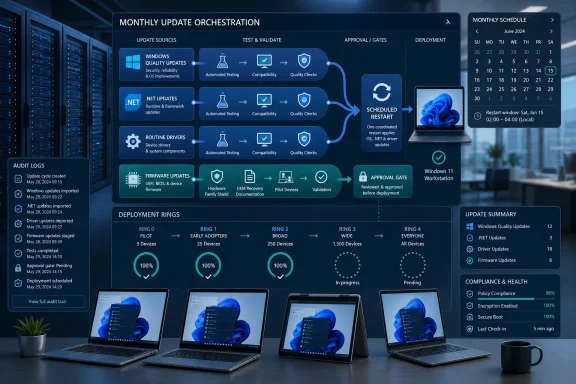 One Restart Should Not Mean One Approval Decision
The tested design coordinates driver, .NET, and firmware updates with the monthly Windows quality update. The user-facing objective is understandable: collect work that might otherwise require separate installation or restart events and complete it during one predictable maintenance event.That is a meaningful improvement for consumers and can also help enterprises. WindowsForum’s Build 26300.8687 reports focus on the operational value of fewer system reboots, while its enterprise-oriented coverage emphasizes the possibility of moving more update activity into a recognizable monthly rhythm.
Enterprise servicing, however, is not consumer servicing at a larger scale. Administrators divide deployments into rings because different changes have different dependencies, owners, validation requirements, and recovery procedures. The ability to share a restart does not establish that the payloads should share an approval policy.
The appropriate model separates orchestration from governance. Windows may coordinate several approved payloads into one restart, but the organization should decide independently whether each payload is eligible for that event.
That distinction produces a workable policy:
- Quality updates continue through the organization’s established Windows rings.
- .NET updates join the monthly schedule after application validation.
- Routine drivers join after representative hardware-cohort testing.
- Firmware retains a separate authorization record and a narrower deployment population.
The Monthly Calendar Can Simplify Routine Servicing
Patch Tuesday already functions as an organizational clock. Security teams prepare remediation decisions, endpoint teams stage deployments, application owners validate critical workloads, support desks prepare for incidents, and business units receive restart communications.Bringing routine driver and .NET servicing into that rhythm can reduce parallel maintenance cycles. It can also make endpoint state easier to interpret: after the monthly event, a device should be closer to the organization’s approved Windows, application-platform, and hardware-support baseline.
The change does not remove compatibility risk. A driver update could affect a device-specific function or workload. A .NET update could expose an application dependency that was not represented in testing. The point is not that these updates are harmless; it is that enterprises can place them into familiar validation structures.
For drivers, that structure must be hardware-aware. “Windows 11 pilot” is not a sufficient cohort definition for a fleet containing different processors, network components, storage configurations, docks, cameras, biometric devices, and specialized peripherals.
The first driver cohort should include representative devices from the organization’s major hardware families. It should also include intentionally selected unusual configurations and systems attached to business-critical equipment. A convenient group of IT volunteers is useful only if its hardware reflects the production estate.
The next cohort should broaden coverage while preserving a stop point. Expansion should depend on collected evidence such as installation outcome, boot status, device health, connectivity, sleep and resume behavior, peripheral operation, workload stability, and support volume.
.NET updates should follow application-validation rings. The organization does not need a separate bureaucracy merely because Microsoft may coordinate the restart. Existing application owners should validate critical applications, endpoint engineers should validate Windows behavior, and support teams should watch for incidents. After those checks pass, .NET servicing can converge with the monthly quality-update schedule.
This is where Microsoft’s proposed model has the clearest enterprise value. Approved changes can complete during one planned interruption without erasing ownership or validation responsibility.
For more background on the emerging experience, WindowsForum’s earlier coverage of Insider Build 26300.8687 examined Microsoft’s fewer-restarts objective, while our analysis of predictable Windows 11 restarts explored the broader shift toward a monthly maintenance rhythm. The enterprise task is to convert that rhythm into a controlled process rather than a single undifferentiated update action.
Firmware Requires a Separate Governance Lane
Firmware changes the analysis because it is platform-specific and its recovery characteristics vary by device family. A firmware payload may be delivered through Windows Update and processed during a restart, but the enterprise still needs to understand what the platform will change and how that hardware can be recovered.Potential failure scenarios must be evaluated rather than assumed. Depending on the device and failure condition, a firmware problem could affect startup, platform functions, or the organization’s ability to reach its normal Windows support environment. The relevant recovery procedure may also depend on the OEM, model, configuration, and physical location of the endpoint.
These are risk scenarios, not predictions that every firmware update will fail or that every failure will make a device unreachable. They are sufficient, however, to justify a more restrictive approval model.
Before a firmware payload enters a coordinated monthly event, the enterprise should be able to answer:
- Which manufacturer, model, board revision, or device family is targeted?
- What current firmware state makes the device eligible?
- What payload is being offered, and what is its intended resulting state?
- What power, battery, or platform prerequisites apply?
- Which pilot devices represent the target population?
- How will an attempted update, successful completion, rejection, or failure be recorded?
- What OEM-supported recovery procedure applies to that hardware family?
- Has the organization tested that procedure under its actual security and support configuration?
- Who can authorize expansion to the next cohort?
- What evidence automatically stops the rollout?
Routine Windows rings may include thousands of devices after validation. An initial firmware cohort should remain narrower and tied to a defined hardware family. Expansion should occur only after the expected firmware state and post-restart device health have been verified.
Build 26300.8687 Shows the Orchestration Direction
WindowsForum reported that Microsoft released Windows 11 Insider Experimental Preview Build 26300.8687 on June 12, 2026, to test a unified Windows Update experience. The reports describe coordination of driver, .NET, and firmware work with the monthly quality update, with the objective of reducing separate restart events.A companion WindowsForum report frames the test as an attempt to move PCs toward one monthly restart by coordinating these update classes. Another WindowsForum article on Windows 11 update controls describes the wider objective of more predictable monthly restarts and clearer user-facing choices around installing, pausing, shutting down, restarting, and completing setup.
Those reports support a narrow conclusion: Microsoft is testing coordinated restart timing. They do not establish the final commercial approval model, reporting schema, management integration, policy precedence, or firmware recovery workflow.
Microsoft has not yet documented commercial availability or administrator controls. That wording matters. It avoids treating every unanswered question as a confirmed product omission while recognizing that enterprises cannot approve production adoption without the details.
Production machines should not be placed in an experimental Insider channel merely to obtain the experience early. Organizations that want direct exposure should use isolated lab devices representing supported hardware families. Results from those devices should be treated as product evaluation, not as validation of a commercial deployment contract that Microsoft has not yet published.
The preview can help IT teams understand the proposed servicing flow and prepare their requirements. It cannot yet answer how the final feature will interact with commercial policies, deployment services, reporting systems, safeguards, or existing maintenance deadlines.
Define One Dense Enterprise Acceptance Test
Instead of maintaining separate lists of “missing controls,” user-choice concerns, reporting questions, and recovery concerns, enterprises should place all of them into one acceptance test.Unified updates should not enter broad production use until Microsoft’s commercial documentation and the organization’s own testing can answer the following criteria.
1. Independent approval
Can administrators approve or hold quality, .NET, driver, and firmware payloads independently?A hold on one update class should not be interpreted internally as approval to delay or accelerate every other class. The organization must be able to preserve its quality-update decision while separately evaluating a driver or firmware payload.
2. Deadline and restart behavior
How are deadlines calculated when several eligible payloads share a restart?Microsoft must document how quality-update deadlines, .NET deployment timing, driver availability, and firmware authorization interact. Enterprises also need an explicit description of what occurs when a user selects an earlier installation or restart option on a managed device.
The required answer is not an assumption that user action will apply staged firmware. The required answer is documented policy behavior: which administrator-approved payloads are eligible on each restart path, and whether user acceleration can change their timing.
3. Per-payload telemetry
Does the commercial workflow expose a separate state for every payload included in the event?A single “restart completed” result is insufficient for enterprise evidence. Required telemetry should identify the quality update, .NET update, each driver, and each firmware payload individually.
At minimum, the enterprise should require these fields:
- Device identifier
- Hardware family and model
- Update class
- Payload identifier
- Vendor or publisher
- Offered version or revision
- Previous version or state
- Target version or state
- Approval record
- Deployment ring or cohort
- Download status
- Staging status
- Restart-required status
- Attempt timestamp
- Completion timestamp
- Result code
- Result classification
- Resulting installed state
- Retry status
- Safeguard or hold status, when applicable
- Recovery or remediation action
- Correlation identifier for the coordinated event
4. Failure isolation
Can IT determine which payload failed when other payloads in the same event succeeded?A device might complete its Windows quality update while a driver or firmware payload does not reach the intended state. Commercial reporting must make that distinction clear enough for automated queries, cohort stops, incident routing, and compliance evidence.
5. Management integration
How will independent approvals, rings, deadlines, holds, and results appear in the organization’s management tools?Microsoft must explain the supported administrative surfaces and policy relationships. Enterprises should require end-to-end testing through the same tools and services used for production rather than validating only the local Windows Update interface.
6. User acceleration
What may a user accelerate on a managed endpoint?The final documentation should distinguish between an update being downloaded, staged, authorized, restart-ready, and eligible for user acceleration. Enterprise communications must accurately describe what a user-initiated action will do.
The internal policy should be: users may accelerate updates that administrators have authorized, but user action must not be treated as authorization for a held update class.
7. Recovery and remediation
What happens when one payload fails, is rejected, or produces an unacceptable result?Microsoft must document the supported remediation behavior for the coordinated workflow. The enterprise must separately document its operational response for each update class, including who owns the incident, what evidence triggers a rollout stop, and how affected devices are returned to an approved state.
Firmware acceptance additionally requires an OEM recovery runbook for every participating hardware family. The organization should verify that the instructions are usable under its real configuration and support model rather than merely storing a link to an OEM document.
If independent approval, per-payload evidence, policy behavior, and tested recovery cannot be demonstrated, the organization should not enable full convergence. It can still use coordinated servicing for update classes that meet the acceptance test while leaving firmware in its existing approval lane.
Use Hardware-Cohort Rings for Drivers and Firmware
A conventional Windows ring often groups devices by business impact: IT, early adopters, broad production, and critical systems. That remains useful for quality and .NET updates, but hardware changes require an additional dimension.The deployment record should identify both the business ring and the hardware cohort. For example:
- Validation ring, laptop family A
- Validation ring, laptop family B
- Representative pilot, laptop family A
- Representative pilot, laptop family B
- Broad production, laptop family A
- Broad production, laptop family B
Driver convergence should occur after the relevant hardware cohorts pass their checks. Firmware should use the same inventory structure but narrower initial populations, separate approval, and verified recovery documentation.
The ring decision should rely on recorded evidence rather than the absence of visible complaints. Installation results, resulting versions, device health, support cases, application signals, and hardware-specific checks should all contribute to the expansion decision.
A coordinated restart may contain several changes, so the organization should preserve a complete manifest for each endpoint. If a post-restart problem appears, the support team needs the exact quality, .NET, driver, and firmware payloads attempted on that device—not only its final Windows build number.
Do Now: Create Five Concrete Artifacts
Enterprises do not need to wait for Microsoft’s commercial documentation to prepare. They can create the following artifacts today.- [ ] Hardware-family inventory: Export manufacturer, model, device identifiers, processor class, firmware state, major device components, support location, business criticality, and assigned owner. Map every managed endpoint to a named hardware family rather than relying on free-form model strings.
- [ ] OEM recovery-runbook validation record: For each hardware family, record the OEM recovery procedure, required prerequisites, responsible support team, test device, test date, observed result, limitations, and approval status. Mark untested families as ineligible for coordinated firmware deployment.
- [ ] Firmware pilot cohort: Select a small, representative set of devices for every eligible hardware family. Include both typical configurations and any business-critical variants. Record the cohort owner, user communication plan, observation period, expansion gate, and stop conditions.
- [ ] Approval matrix by update class: Identify who requests, validates, approves, deploys, monitors, pauses, and closes quality, .NET, driver, and firmware changes. Specify whether each class may share a restart without sharing authorization.
- [ ] Per-payload telemetry schema: Define the required fields for every coordinated event, including payload identity, prior state, target state, approval, cohort, attempt time, result, resulting state, failure classification, and remediation. Compare Microsoft’s eventual commercial reporting against this schema.
The Maintenance Event Needs an Observation Period
A coordinated restart concentrates activity into one maintenance event. That reduces disruption, but it can make diagnosis more complex when several layers change together.If a device returns with a problem after receiving a quality update, .NET update, drivers, and firmware, the support team must determine which payload—or which interaction—produced the result. The organization should therefore record what was offered, approved, staged, attempted, completed, rejected, or failed for every payload.
The rollout schedule also needs an observation period between cohorts. The next ring should not begin simply because devices restarted. Expansion should depend on evidence that the expected updates reached their target states and that monitored functions remain healthy.
Each update class should have explicit stop criteria. Examples include an unexpected installation-failure pattern, a resulting version mismatch, a cluster of related incidents, loss of a required device function, or failure of a tested recovery procedure.
The thresholds will differ by organization and payload. What matters is that they are written before the rollout rather than negotiated during an incident.
Support ownership must also be explicit. Application teams should receive .NET-related findings, endpoint teams should own Windows and routine driver investigation, and the designated platform or hardware team should own firmware escalation and OEM coordination.
Microsoft Still Owes Administrators the Commercial Specification
Microsoft’s commercial documentation needs to answer a focused set of questions.Which Windows editions, releases, device states, update sources, and management configurations will support coordinated updates? What prerequisites will apply? How will organizations enable, disable, or scope the behavior?
How will quality, .NET, driver, and firmware approvals be represented? Can each class retain its own deployment rings, deadlines, holds, and authorization status while sharing a restart?
How will safeguards affect individual payloads? What happens when one update is blocked while other approved updates are ready? How will conflicting deadlines be resolved?
What information will administrators receive before deployment? For firmware in particular, enterprises need enough identity and applicability data to map the offered payload to a hardware family and an approved recovery runbook.
What will the commercial reporting model expose after the restart? Administrators need per-payload results, resulting state, failure attribution, retry status, and a correlation record for the coordinated event.
What user actions can change installation timing on a managed endpoint, and how will administrator authorization constrain those actions?
Finally, what remediation behavior is supported when one payload succeeds and another fails? The answer may differ among quality, .NET, driver, and firmware updates, but the distinctions need to be documented.
Until those questions are answered, unified updates remain a promising scheduling mechanism rather than a complete enterprise servicing model.
Enterprises Should Write the Acceptance Test Before Microsoft Ships the Switch
Organizations can use the preview period to define what will make unified updates acceptable. This avoids writing policy reactively after commercial devices begin receiving the behavior.The acceptance decision should be made by update class rather than as a single yes-or-no judgment.
Quality updates pass when existing validation, deployment, deadline, and reporting requirements continue to work within the coordinated event.
.NET passes when application-validation rings can operate independently and approved payloads can converge with the monthly schedule without losing application-owner accountability.
Routine drivers pass when deployment can be scoped to representative hardware cohorts, resulting driver state can be verified, and the organization can stop expansion based on per-payload evidence.
Firmware passes only when it retains separate approval, narrow hardware-family cohorts, sufficient payload identity, clear managed-device timing behavior, per-payload results, and a validated OEM recovery runbook.
If administrators cannot separately authorize update classes, identify exactly what each endpoint attempted, constrain deployment by hardware family, and execute a tested recovery process, firmware should not join the general monthly convergence policy.
That conclusion does not require rejecting Microsoft’s objective. One predictable restart can be an enterprise improvement. The condition is that Microsoft coordinate execution without collapsing distinct change-control decisions.
Frequently Asked Questions
Should enterprises enable unified Windows updates as soon as they become commercially available?
Not fleet-wide. Begin with a lab evaluation and then approve each update class separately. Quality updates can remain in normal rings, .NET can move through application-validation rings, routine drivers can use hardware-cohort rings, and firmware should remain separately governed until controls and recovery procedures pass the enterprise acceptance test.Should firmware always be excluded from the monthly restart?
No. Firmware may eventually share the same restart after it has received separate approval. The recommendation is to separate governance, not necessarily restart timing. An approved firmware payload may use the monthly maintenance event if the target hardware cohort, telemetry, timing behavior, and recovery procedure are acceptable.Why treat .NET differently from routine drivers?
.NET validation is primarily tied to application dependencies, while driver validation is tied to hardware families and device-specific workloads. Both can converge with the monthly quality-update schedule, but they require different pilot populations and approval evidence.Can an IT pilot ring validate drivers for the whole organization?
Only if its hardware and workloads represent the production estate. A pilot dominated by one laptop model does not validate a driver across unrelated device families. Record hardware cohorts explicitly and ensure that each affected family has representative devices in the pilot.Does Build 26300.8687 define the final enterprise behavior?
No. It demonstrates Microsoft’s coordinated-update experiment in an Insider Experimental Preview build. Microsoft has not yet documented commercial availability or administrator controls, so organizations should not infer final policy, reporting, or management behavior from the preview alone.Will a user-initiated restart apply every staged update on a managed device?
The available facts do not establish that behavior for commercial managed environments. Microsoft needs to document which administrator-approved payloads are eligible when a user accelerates installation or restart timing and how holds on other update classes are enforced.What telemetry should enterprises require?
Require a separate record for each quality, .NET, driver, and firmware payload. That record should include payload identity, prior state, target state, approval, cohort, staging and attempt status, timestamps, result, resulting state, failure classification, retry status, and remediation action.What should an enterprise do before Microsoft publishes the commercial controls?
Create a hardware-family inventory, validate OEM recovery runbooks, define firmware pilot cohorts, write an approval matrix by update class, and establish a per-payload telemetry schema. Those artifacts will let the organization evaluate Microsoft’s final implementation against documented requirements.What is the final recommendation?
Adopt selective convergence. Keep quality updates in normal rings. Move .NET through application-validation rings and then into the monthly schedule. Move routine drivers through hardware-cohort rings and converge after validation. Keep firmware under separate approval and narrower rings until commercial controls, managed-device behavior, telemetry, and OEM recovery procedures are documented and tested.References
- Primary source: learn.microsoft.com
Windows 11 Insider Experimental Preview Build 26300.8687 - Windows Insider Program | Microsoft Learn
Release notes for Windows 11 Insider Experimental Preview Build 26300.8687learn.microsoft.com - Primary source: WindowsForum
Loading…
windowsforum.com