

Americans are moving toward refurbished laptops, smartphones, and game consoles because new-device prices have jumped while recent used hardware can still handle everyday work. Marketplace data suggests buyers react quickly when prices rise: Back Market said US MacBook sales increased 62% the day after Apple announced higher prices, compared with the previous week, while PayMore president Erik Helgesen reported a 30% increase in demand for computers and computer parts over the preceding three to six months.
Business Insider senior correspondent Amanda Hoover reported the same shift at the individual-seller level. Longtime electronics reseller Angie Cardona-Nelson said laptops that once remained listed on eBay for weeks had recently begun selling within hours, often at the full asking price.
The practical conclusion is not that every used device is a bargain. It is that buyers now have a stronger reason to compare a new machine with a properly tested, supported refurbished alternative—and to pay only for features their work actually requires.
The immediate pressure is the widening price difference between new and recent used hardware. According to the figures reported by Business Insider, Apple raised prices by 20% on some Macs and 25% on some iPads, including a $300 increase for the MacBook Pro. The same reporting said some Microsoft Surface PCs cost as much as $500 more than two years earlier and described a planned Xbox console increase of about $150.
These increases should not all be attributed to one cause. Apple CEO Tim Cook specifically connected Apple’s higher costs to memory-chip shortages amid the AI infrastructure buildout and said higher prices were unavoidable. That statement does not independently establish why Microsoft or other manufacturers changed their prices.
For shoppers, however, the immediate calculation is straightforward: What does the higher new-device price buy that a less expensive recent model cannot provide?
Cardona-Nelson’s experience illustrates the effect at street level. She told Business Insider that customers were looking for value as new technology became more expensive. The notable detail was the speed: systems that had previously taken weeks to sell were moving within hours.
That does not prove a permanent transformation of the entire hardware market. It does show that at least some buyers are responding to price increases by entering the used market immediately rather than postponing a purchase or accepting the new price.
Benton also said the purchases overindexed among new Back Market customers. If that pattern continues, it would matter because the refurbished market would be gaining buyers rather than merely accelerating purchases by its established audience.
The choice is not necessarily between premium hardware and a low-end substitute. A buyer may instead compare a current premium laptop with an older version of the same product line. The earlier model may retain the keyboard, display quality, construction, application compatibility, and general performance the buyer values while omitting newer features that are not necessary for that person’s workload.
The same comparison can apply to Windows PCs, but only after a model-by-model support check. A refurbished business laptop can be a strong option for office work, browsing, video meetings, school portals, and cloud applications. It is not automatically a better purchase than a new consumer laptop. Its value depends on the exact processor and configuration, official Windows 11 support, physical condition, battery health, seller warranty, and remaining update life.
Cloud-hosted AI also changes the calculation for some users. Someone who accesses a chatbot or other AI service through a browser may not need hardware designed for local AI processing. Other buyers may genuinely benefit from local acceleration, offline operation, stronger privacy controls, specialized software, or demanding creative and technical workloads. The correct question is not whether an “AI PC” label is good or bad, but whether its local capabilities solve a problem the buyer actually has.
Ask the seller for a photograph of Settings > System > About. Record the model, processor, installed RAM, system type, and Windows edition. Compare those details with the manufacturer’s specifications and Microsoft’s Windows 11 requirements. If the seller will not provide the exact model number and processor, do not assume the computer is supported.
After receiving the device, run Windows Update and then open:
Settings > Windows Update > Advanced options > Optional updates
Review available driver updates, but also check the PC manufacturer’s support page or update utility for firmware, BIOS, chipset, graphics, wireless, and audio updates. A clean Windows desktop does not prove that the firmware and drivers are current.
An 8 GB system can still handle light use, but buyers should avoid paying a premium for a configuration with soldered memory that cannot be upgraded. Storage should be an SSD, not a mechanical hard drive, for a primary Windows 11 computer.
Windows will generate an HTML battery report and display its location, commonly under the current user’s folder. Open that report and compare Design Capacity with Full Charge Capacity.
A lower full-charge capacity is normal on a used laptop, but a large gap means shorter runtime and may justify a lower price or immediate battery replacement. Also inspect recent usage and capacity history. Treat the report as one part of the test: unplug the laptop, use it normally, confirm that the charge percentage falls consistently, and watch for sudden shutdowns.
Other warning signs include a swollen battery, cracked hinges, liquid damage, screen pressure marks, unreliable charging, missing keys, damaged USB-C ports, storage errors, unexpected shutdowns, or a charger that is underpowered or not safety-certified. A device can also be a poor value when the battery and SSD both need replacement, when essential memory is soldered and insufficient, or when the used price is too close to a new computer with a full warranty.
For consoles and phones, check for activation locks, account restrictions, controller drift, damaged ports, blocked device identifiers, and missing accessories. Factory reset the product during the return window and test every feature before transferring personal data.
Browsing, email, document editing, streaming, accounting tools, school portals, and many business applications can run well on recent supported systems. Other tasks—including current games, advanced video production, engineering software, local AI models, and specialized creative work—may justify new processors, more memory, stronger graphics, or dedicated acceleration.
PayMore’s Helgesen said buyers were becoming more educated about the capabilities they needed. PayMore’s reported 30% demand increase for computers and parts suggests that more customers are at least considering component and configuration details rather than automatically choosing the newest product generation.
For Windows buyers, support status is one of those essential details. A cheap PC that cannot run a supported version of Windows without bypasses is a risky primary computer. Windows 10 reached the end of its standard support lifecycle on October 14, 2025, making unsupported hardware particularly difficult to recommend for buyers who expect several years of secure everyday use.
Condition can matter as much as processor speed. Battery wear, SSD health, damaged ports, poor cooling, loose hinges, display defects, and missing firmware updates can turn an apparently inexpensive laptop into a repair project. Conversely, a properly tested business-class machine with a sound battery, supported processor, clean firmware state, adequate memory, and a meaningful warranty may be a strong office or household computer.
IDC forecast 3.2% year-over-year growth in used smartphone shipments for 2025. Its comparison projected slower growth for new smartphones. Counterpoint Research separately reported that pre-owned smartphone sales grew 4% in 2024 and 3% in 2025, with preliminary figures indicating a 13% increase during the first half of 2026. Counterpoint also forecast a decline in new smartphone shipments.
Those measurements should not be combined as though they came from one dataset. Taken directionally, however, they indicate stronger reported momentum for pre-owned phones than for new ones during the periods examined.
A newer phone will generally offer some combination of improved performance, cameras, battery efficiency, connectivity, or software features. The purchasing question is whether those improvements justify the difference between the price of a new device and a recent supported used model.
AI features are part of that comparison, but they are not relevant to every buyer. Apple Intelligence, for example, requires particular recent Apple devices. A customer who wants those features must shop accordingly. Someone who primarily needs messaging, navigation, banking, photography, media, and browser access may reach a different conclusion.
The findings describe a divided audience. They do not show that AI skepticism by itself caused refurbished-device demand. They do help explain why an AI-oriented feature list may not persuade every shopper to pay more.
Buyers who use browser-based AI services can often access them from supported older hardware. That does not eliminate the value of local AI processing. Local features may offer lower latency, offline access, privacy advantages, reduced cloud dependence, or better performance in applications designed to use them.
Manufacturers and retailers therefore need to explain the practical benefit rather than relying on the category label. Buyers should ask which programs use the local hardware, whether those programs matter to them, and what performance or privacy improvement they will receive.
If those questions do not produce a clear answer, the buyer should compare the AI-oriented machine with a less expensive supported model.
Cardona-Nelson’s report that laptops were selling within hours at full asking price is an early warning for bargain hunters: demand can reduce both comparison time and negotiating leverage.
The market also includes buyers seeking older products for reasons other than price. According to eBay figures cited by Business Insider, searches for iPods rose 20% year over year in 2025. The same reporting said prices for some iPod Nano models released in 2007 increased 60% between 2023 and 2025, while iPod Shuffle listings grew by nearly 30%.
That demand may reflect nostalgia, physical controls, collectibility, or interest in devices with fewer connected features. It should not be treated as proof that consumers broadly want less capable technology. It does show that used-device value can rise for reasons unrelated to benchmark performance.
Back Market’s reported 62% MacBook sales increase after Apple’s announcement is the clearest supplied example of that comparison happening quickly. Microsoft’s broader Windows ecosystem gives PC buyers even more alternatives: a shopper priced out of a new Surface can consider used Surface hardware, refurbished systems from other manufacturers, or a less expensive new Windows PC.
None of those choices should be automatic. The best purchase may still be new when the buyer needs maximum battery life, current graphics performance, local AI acceleration, a long manufacturer warranty, specialized accessibility features, or many years of predictable support. Used hardware is also a poor fit when the buyer cannot inspect it, verify its identity, or return it.
But factory-sealed packaging is no longer a sufficient reason to absorb a large price difference. Buyers now have marketplace demand data, better access to technical specifications, built-in Windows diagnostics, and a growing supply of professionally resold devices.
The next phase of the refurbished market will depend less on whether used technology is socially acceptable and more on whether sellers can prove quality. Clear grading, exact model information, battery reports, meaningful warranties, support verification, and straightforward returns will separate reliable refurbished equipment from hardware that has simply been reset and relisted.
For WindowsForum readers, the rule is simple: confirm the exact model supports Windows 11, record the specifications under Settings > System > About, inspect optional drivers under Windows Update > Advanced options > Optional updates, run
Business Insider senior correspondent Amanda Hoover reported the same shift at the individual-seller level. Longtime electronics reseller Angie Cardona-Nelson said laptops that once remained listed on eBay for weeks had recently begun selling within hours, often at the full asking price.
The practical conclusion is not that every used device is a bargain. It is that buyers now have a stronger reason to compare a new machine with a properly tested, supported refurbished alternative—and to pay only for features their work actually requires.
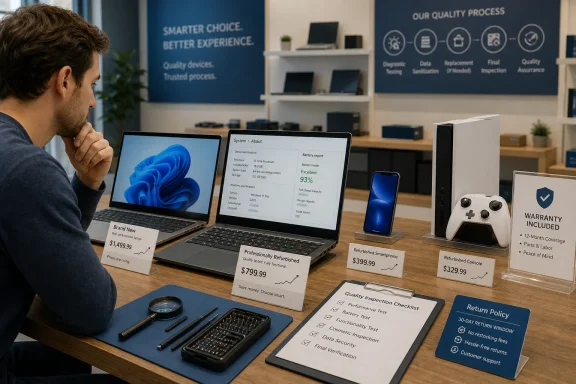 Higher Prices Are Sending Buyers to the Used Market
The immediate pressure is the widening price difference between new and recent used hardware. According to the figures reported by Business Insider, Apple raised prices by 20% on some Macs and 25% on some iPads, including a $300 increase for the MacBook Pro. The same reporting said some Microsoft Surface PCs cost as much as $500 more than two years earlier and described a planned Xbox console increase of about $150.These increases should not all be attributed to one cause. Apple CEO Tim Cook specifically connected Apple’s higher costs to memory-chip shortages amid the AI infrastructure buildout and said higher prices were unavoidable. That statement does not independently establish why Microsoft or other manufacturers changed their prices.
For shoppers, however, the immediate calculation is straightforward: What does the higher new-device price buy that a less expensive recent model cannot provide?
| Product or market | Reported change | Source attribution | Buying implication |
|---|---|---|---|
| Some Apple Macs | Prices up 20% | Business Insider’s reporting on Apple’s announcement | Compare new pricing with recent refurbished inventory |
| Some Apple iPads | Prices up 25% | Business Insider’s reporting on Apple’s announcement | Older supported models may offer larger savings |
| MacBook Pro | Price up $300 | Business Insider’s reporting on Apple’s announcement | Back Market reported a 62% MacBook sales jump the next day |
| Microsoft Surface PCs | As much as $500 more than two years earlier | Business Insider | Used Surface and competing Windows models deserve comparison |
| Xbox consoles | Planned increase of about $150 | Business Insider | Check used-console prices, warranty coverage, and controller condition |
| PayMore computers and parts | Demand up 30% over three to six months | PayMore president Erik Helgesen | Demand extends beyond phones and online marketplaces |
That does not prove a permanent transformation of the entire hardware market. It does show that at least some buyers are responding to price increases by entering the used market immediately rather than postponing a purchase or accepting the new price.
Back Market’s 62% Jump Shows How Fast Buyers Can React
Back Market US general manager Lauren Benton called new-device price increases an “unintentional advertising campaign” for the refurbished marketplace. According to Back Market, US MacBook sales rose 62% the day after Apple’s announcement compared with the previous week.Benton also said the purchases overindexed among new Back Market customers. If that pattern continues, it would matter because the refurbished market would be gaining buyers rather than merely accelerating purchases by its established audience.
The choice is not necessarily between premium hardware and a low-end substitute. A buyer may instead compare a current premium laptop with an older version of the same product line. The earlier model may retain the keyboard, display quality, construction, application compatibility, and general performance the buyer values while omitting newer features that are not necessary for that person’s workload.
The same comparison can apply to Windows PCs, but only after a model-by-model support check. A refurbished business laptop can be a strong option for office work, browsing, video meetings, school portals, and cloud applications. It is not automatically a better purchase than a new consumer laptop. Its value depends on the exact processor and configuration, official Windows 11 support, physical condition, battery health, seller warranty, and remaining update life.
Cloud-hosted AI also changes the calculation for some users. Someone who accesses a chatbot or other AI service through a browser may not need hardware designed for local AI processing. Other buyers may genuinely benefit from local acceleration, offline operation, stronger privacy controls, specialized software, or demanding creative and technical workloads. The correct question is not whether an “AI PC” label is good or bad, but whether its local capabilities solve a problem the buyer actually has.
A WindowsForum Buying Guide for Refurbished PCs
A low price should be the beginning of the inspection, not the end. Before buying a used Windows laptop, confirm the exact model—not merely the product family—is supported by Windows 11. Closely related configurations can use different processor generations, displays, wireless adapters, or storage devices.Ask the seller for a photograph of Settings > System > About. Record the model, processor, installed RAM, system type, and Windows edition. Compare those details with the manufacturer’s specifications and Microsoft’s Windows 11 requirements. If the seller will not provide the exact model number and processor, do not assume the computer is supported.
After receiving the device, run Windows Update and then open:
Settings > Windows Update > Advanced options > Optional updates
Review available driver updates, but also check the PC manufacturer’s support page or update utility for firmware, BIOS, chipset, graphics, wireless, and audio updates. A clean Windows desktop does not prove that the firmware and drivers are current.
Minimum targets by workload
| Workload | Practical RAM target | Practical storage target | What else to prioritize |
|---|---|---|---|
| Basic browsing, email, and documents | 8 GB minimum | 256 GB SSD | Supported Windows 11 model and replaceable battery if possible |
| School, office work, and frequent video calls | 16 GB preferred | 512 GB SSD preferred | Good webcam, microphone, keyboard, Wi-Fi, and battery |
| Heavy multitasking, coding, or large spreadsheets | 16 GB minimum; 32 GB where justified | 512 GB to 1 TB SSD | Upgradeability, cooling, ports, and processor capability |
| Photo, video, CAD, gaming, or local AI | Workload-specific; often 32 GB or more | 1 TB may be appropriate | Dedicated graphics or supported accelerator where the software requires it |
Inspect laptop battery health
On the laptop, open Terminal or Command Prompt and run:powercfg /batteryreportWindows will generate an HTML battery report and display its location, commonly under the current user’s folder. Open that report and compare Design Capacity with Full Charge Capacity.
A lower full-charge capacity is normal on a used laptop, but a large gap means shorter runtime and may justify a lower price or immediate battery replacement. Also inspect recent usage and capacity history. Treat the report as one part of the test: unplug the laptop, use it normally, confirm that the charge percentage falls consistently, and watch for sudden shutdowns.
Require a real return policy
For an online purchase, favor a seller that provides:- At least a 30-day return period
- A written hardware warranty, preferably 90 days or longer
- Clear responsibility for return shipping when the device is defective or misdescribed
- A stated battery-health standard
- An itemized description of cosmetic grade, included charger, RAM, storage, screen resolution, and keyboard layout
- A serial number or service tag that can be checked before purchase
- Confirmation that activation locks, firmware passwords, and organizational management enrollment have been removed
When a used PC is a bad purchase
Walk away when the model is not officially supported by Windows 11, the seller conceals the exact processor, the machine has a firmware password, or Windows reports that it is managed by an organization you do not control.Other warning signs include a swollen battery, cracked hinges, liquid damage, screen pressure marks, unreliable charging, missing keys, damaged USB-C ports, storage errors, unexpected shutdowns, or a charger that is underpowered or not safety-certified. A device can also be a poor value when the battery and SSD both need replacement, when essential memory is soldered and insufficient, or when the used price is too close to a new computer with a full warranty.
For consoles and phones, check for activation locks, account restrictions, controller drift, damaged ports, blocked device identifiers, and missing accessories. Factory reset the product during the return window and test every feature before transferring personal data.
Recent Hardware Can Be Enough—After It Passes the Tests
The case for refurbished technology rests on matching the device to the workload, not on declaring old hardware universally equal to new hardware.Browsing, email, document editing, streaming, accounting tools, school portals, and many business applications can run well on recent supported systems. Other tasks—including current games, advanced video production, engineering software, local AI models, and specialized creative work—may justify new processors, more memory, stronger graphics, or dedicated acceleration.
PayMore’s Helgesen said buyers were becoming more educated about the capabilities they needed. PayMore’s reported 30% demand increase for computers and parts suggests that more customers are at least considering component and configuration details rather than automatically choosing the newest product generation.
For Windows buyers, support status is one of those essential details. A cheap PC that cannot run a supported version of Windows without bypasses is a risky primary computer. Windows 10 reached the end of its standard support lifecycle on October 14, 2025, making unsupported hardware particularly difficult to recommend for buyers who expect several years of secure everyday use.
Condition can matter as much as processor speed. Battery wear, SSD health, damaged ports, poor cooling, loose hinges, display defects, and missing firmware updates can turn an apparently inexpensive laptop into a repair project. Conversely, a properly tested business-class machine with a sound battery, supported processor, clean firmware state, adequate memory, and a meaningful warranty may be a strong office or household computer.
Smartphones Provide a Longer View of Resale Growth
Research firms have also reported growth in the pre-owned smartphone market, although their figures use different periods and methodologies.IDC forecast 3.2% year-over-year growth in used smartphone shipments for 2025. Its comparison projected slower growth for new smartphones. Counterpoint Research separately reported that pre-owned smartphone sales grew 4% in 2024 and 3% in 2025, with preliminary figures indicating a 13% increase during the first half of 2026. Counterpoint also forecast a decline in new smartphone shipments.
Those measurements should not be combined as though they came from one dataset. Taken directionally, however, they indicate stronger reported momentum for pre-owned phones than for new ones during the periods examined.
A newer phone will generally offer some combination of improved performance, cameras, battery efficiency, connectivity, or software features. The purchasing question is whether those improvements justify the difference between the price of a new device and a recent supported used model.
AI features are part of that comparison, but they are not relevant to every buyer. Apple Intelligence, for example, requires particular recent Apple devices. A customer who wants those features must shop accordingly. Someone who primarily needs messaging, navigation, banking, photography, media, and browser access may reach a different conclusion.
Reported market timeline
- 2023–2025: Prices for certain 2007 iPod Nano models reportedly increased 60%, according to the resale figures cited by Business Insider.
- 2024: Counterpoint Research reported 4% growth in pre-owned smartphone sales.
- 2025: Counterpoint reported another 3% increase in pre-owned smartphone sales, while eBay recorded a 20% year-over-year increase in iPod searches.
- First half of 2026: Counterpoint’s preliminary figures indicated a 13% increase in pre-owned smartphone sales.
- After Apple’s price announcement: Back Market reported that US MacBook sales were 62% higher the following day than during the comparable day of the previous week.
AI Interest Does Not Create One Hardware Requirement
Pew Research Center found that about a quarter of Americans used AI chatbots daily, while half said they did not use them at all. Pew also reported more negative than positive expectations about AI’s effects on society and personal life over the next 20 years, with younger adults more likely than people aged 50 and older to express negative views.The findings describe a divided audience. They do not show that AI skepticism by itself caused refurbished-device demand. They do help explain why an AI-oriented feature list may not persuade every shopper to pay more.
Buyers who use browser-based AI services can often access them from supported older hardware. That does not eliminate the value of local AI processing. Local features may offer lower latency, offline access, privacy advantages, reduced cloud dependence, or better performance in applications designed to use them.
Manufacturers and retailers therefore need to explain the practical benefit rather than relying on the category label. Buyers should ask which programs use the local hardware, whether those programs matter to them, and what performance or privacy improvement they will receive.
If those questions do not produce a clear answer, the buyer should compare the AI-oriented machine with a less expensive supported model.
A Short Refurbished-PC Checklist for IT Teams
Organizations should apply the same model-by-model discipline as household buyers, with additional controls for licensing, security, and fleet consistency.- Set an approved floor for Windows 11 support, processor generation, RAM, SSD capacity, firmware features, ports, and wireless capability.
- Require documented battery-health and storage-health standards.
- Obtain consistent model and configuration identifiers rather than relying on a broad product-family name.
- Retain purchase, serial-number, warranty, and Windows licensing records.
- Wipe and reimage every device through the organization’s trusted deployment process.
- Install Windows, driver, firmware, and BIOS updates before assignment.
- Test the display, keyboard, camera, microphone, wireless connection, ports, charger, battery, sleep behavior, and docking support.
- Pilot each supplier and hardware batch before a larger deployment.
- Compare purchase, inspection, repair, support, and disposal costs—not only the unit price.
Stronger Demand Could Reduce the Best Discounts
Used inventory depends on trade-ins, lease returns, retailer returns, corporate refreshes, and individual sellers. If owners keep devices longer while more buyers enter the resale market, recent desirable models can become harder to find and discounts can narrow.Cardona-Nelson’s report that laptops were selling within hours at full asking price is an early warning for bargain hunters: demand can reduce both comparison time and negotiating leverage.
The market also includes buyers seeking older products for reasons other than price. According to eBay figures cited by Business Insider, searches for iPods rose 20% year over year in 2025. The same reporting said prices for some iPod Nano models released in 2007 increased 60% between 2023 and 2025, while iPod Shuffle listings grew by nearly 30%.
That demand may reflect nostalgia, physical controls, collectibility, or interest in devices with fewer connected features. It should not be treated as proof that consumers broadly want less capable technology. It does show that used-device value can rise for reasons unrelated to benchmark performance.
The Upgrade Cycle Is Becoming a Comparison Exercise
Hardware companies compete not only with one another but also with their own previous products. When a price increase appears, shoppers can immediately compare the new device with years of existing inventory.Back Market’s reported 62% MacBook sales increase after Apple’s announcement is the clearest supplied example of that comparison happening quickly. Microsoft’s broader Windows ecosystem gives PC buyers even more alternatives: a shopper priced out of a new Surface can consider used Surface hardware, refurbished systems from other manufacturers, or a less expensive new Windows PC.
None of those choices should be automatic. The best purchase may still be new when the buyer needs maximum battery life, current graphics performance, local AI acceleration, a long manufacturer warranty, specialized accessibility features, or many years of predictable support. Used hardware is also a poor fit when the buyer cannot inspect it, verify its identity, or return it.
But factory-sealed packaging is no longer a sufficient reason to absorb a large price difference. Buyers now have marketplace demand data, better access to technical specifications, built-in Windows diagnostics, and a growing supply of professionally resold devices.
The next phase of the refurbished market will depend less on whether used technology is socially acceptable and more on whether sellers can prove quality. Clear grading, exact model information, battery reports, meaningful warranties, support verification, and straightforward returns will separate reliable refurbished equipment from hardware that has simply been reset and relisted.
For WindowsForum readers, the rule is simple: confirm the exact model supports Windows 11, record the specifications under Settings > System > About, inspect optional drivers under Windows Update > Advanced options > Optional updates, run
powercfg /batteryreport, and test everything before the return window closes. If the machine passes those checks and meets the workload at a meaningfully lower total cost, refurbished hardware can be a sensible purchase. If it fails any of them, the low sticker price is not a bargain.References
- Primary source: aol.com
Published: 2026-07-11T01:52:10.597911
Loading…
www.aol.com - Related coverage: pewresearch.org
Loading…
www.pewresearch.org - Related coverage: yougov.com
Loading…
yougov.com - Related coverage: linkedin.com
Loading…
www.linkedin.com - Related coverage: commercial.yougov.com
Loading…
commercial.yougov.com - Related coverage: asiantelecom.com
Loading…
asiantelecom.com
- Related coverage: malaysia.news.yahoo.com
Loading…
malaysia.news.yahoo.com - Related coverage: tech.yahoo.com
Loading…
tech.yahoo.com - Related coverage: windowscentral.com
Loading…
www.windowscentral.com - Related coverage: news.xbox.com
Loading…
news.xbox.com - Related coverage: breitbart.com
Loading…
www.breitbart.com - Related coverage: washingtonpost.com
Loading…
www.washingtonpost.com - Related coverage: forbes.com
Loading…
www.forbes.com - Related coverage: dotesports.com
Xbox raises prices by up to $150 amid memory cost crisis
Xbox console prices are increasing by up to $150 from August 1, 2026, as memory costs soar. The 2TB model is also being discontinued.dotesports.com - Related coverage: tomshardware.com
Loading…
www.tomshardware.com - Related coverage: techrepublic.com
Xbox Console Prices Rise Again as Microsoft Cites Memory Costs - TechRepublic
Microsoft is raising Xbox console prices worldwide on August 1 as memory and storage costs climb, with the Xbox Series X reaching $800.www.techrepublic.com