

Gear Patrol’s Tucker Bowe has updated the publication’s rolling guide to the best gadgets and hi-fi releases of 2026 as July approaches its midpoint, assembling cameras, headphones, speakers, portable players, computer accessories and specialist audio components into a single continuously maintained product tracker for enthusiasts and buyers. The list’s real value is not that every entry is essential, but that its breadth exposes the shape of the current hardware market: convenience is improving, physical media is refusing to disappear, and manufacturers are finding ever more elaborate ways to sell both accessibility and exclusivity.
That makes the guide more than a parade of attractive objects. Read as a snapshot of the industry, it shows a market splitting in two directions at once—toward inexpensive, flexible devices that work with almost anything, and toward luxury hardware whose price, materials and limited availability are central to the proposition.
The traditional technology calendar used to offer moments of relative calm. Major computers arrived around predictable corporate events, televisions gathered around the big trade shows, and audio manufacturers operated on schedules that seemed almost leisurely compared with smartphones and software.
That distinction has largely collapsed. Gear Patrol describes tracking every new gadget and hi-fi release as a tall order even for dedicated enthusiasts, which is why Bowe’s article is explicitly a rolling list, routinely updated throughout the year rather than published as a finished annual verdict.
The distinction matters. A conventional “best of the year” article attempts to close the argument: products have been tested, competitors compared and winners chosen. A rolling release guide does something different. It documents the argument while manufacturers are still making it, capturing new models, special editions, category experiments and unusually expensive flagships before the market has decided which ones matter.
Other technology publications divide this work into narrower forms. TechRadar, for example, publishes collections centered on products its staff has tested and rated, while more specialist audio outlets concentrate on equipment currently under review or products aimed at a particular kind of system. Gear Patrol’s guide is broader and closer to an edited launch ledger: it mixes practical consumer devices with aspirational hi-fi and gives readers enough context to decide what deserves deeper investigation.
That breadth is both its strength and its limitation. A camera, foldable mouse, gaming headset and moving-coil phono cartridge do not compete with one another in any meaningful purchasing decision. They do, however, compete for the same finite supply of consumer attention, which is precisely what a list like this is designed to organize.
These products are united by little beyond their reliance on electricity, sound or both. Yet their coexistence is revealing because it shows how technology publishing now serves two markets simultaneously: readers looking for something affordable that solves an immediate problem, and readers fascinated by engineering pursued far beyond the point of conventional value.
The danger in presenting these products side by side is obvious. “Best” can imply a hierarchy where none exists. A $17,000 cartridge is not a better version of a $70 gaming headset any more than a workstation is a better version of a network switch; the products solve unrelated problems for audiences with radically different expectations.
The more useful interpretation is that “best new” means editorially notable rather than universally recommendable. Some entries represent aggressive value, others unusual engineering, and still others a brand’s first move into a category. Readers should treat inclusion as a prompt to investigate, not as a buying instruction.
That is particularly important because many entries are summarized from launch information and manufacturer claims. Gear Patrol appropriately attributes claims about sonic performance, reduced muscle strain and engineering improvements to the companies making them. The wording is a reminder that an announcement is not a review, however persuasive the specifications may appear.
Sony’s RX10 V is perhaps the clearest example. Gear Patrol describes it as the long-awaited successor to the RX10 IV, a camera released in 2017. It retains the basic proposition of a compact body, a 20.1-megapixel 1-inch stacked sensor and a 24–600mm optical zoom lens, but introduces a new processor, AI-assisted tracking, substantially improved autofocus and video capture up to 4K at 120 frames per second.
The interesting part is not simply that Sony has made a faster camera. It is that the company apparently still sees value in an all-in-one long-zoom device during an era dominated by smartphones at the casual end and interchangeable-lens systems at the enthusiast end. The $2,300 starting price, up from the predecessor’s $1,700, makes this a committed purchase rather than a casual alternative to a phone.
Shanling’s M0 Pura takes the reverse approach. Instead of adding cloud services and applications, the $129 player removes them. It is an iPod Nano-sized device built around locally stored music on a microSD card, intended for digitized CDs, vinyl transfers and downloaded files rather than streaming applications.
That omission is the product. The M0 Pura is not trying to be a small smartphone; it is offering a controlled environment where the library belongs to the listener, playback is the device’s principal job and notifications cannot interrupt the album. In a market that equates progress with adding services, a deliberate lack of services can itself become a premium feature.
Denon’s DP-500BT performs a similar reconciliation between old and new media. It is a belt-drive turntable with conventional analog connections and a switchable phono preamplifier, but it is also the company’s first turntable to support Bluetooth streaming. Support for aptX, aptX HD and aptX Adaptive allows it to feed compatible wireless headphones and speakers without preventing integration into a conventional hi-fi setup.
That combination may offend analog purists, but it addresses the reason many people never build a traditional vinyl system: the additional amplifier, cabling and speaker requirements. A turntable that can enter an existing wireless listening environment lowers the barrier to physical media, even if a fully wired system remains the more orthodox route.
The pattern continues across amplifiers and speakers. Emotiva’s BasX TA2+ adds HDMI ARC and USB-C to a component that already combines an amplifier, preamplifier, DAC and tuner. Elipson’s Prestige Facet II 6 Active BT speakers integrate USB-C, HDMI ARC, Bluetooth and a moving-magnet phono stage, allowing one speaker system to serve a computer, television, turntable and wireless source.
These are not attempts to replace the stereo system so much as admissions that the stereo system now has to accommodate everything. A modern listening room may contain a turntable, television, work laptop, phone and games console. Hardware that insists on only one of those worlds risks becoming an enthusiast’s secondary system rather than the center of the room.
That culture still exists at the high end, as the cartridges and flagship headphones in Gear Patrol’s guide demonstrate. But many of the most consequential releases move in the opposite direction, compressing multiple boxes into one or adding consumer-friendly connections to components that once required specialized knowledge.
PSB’s iQ Series, for example, consists of two active speaker systems, the iQ1 and iQ2. Gear Patrol reports that both use the same drivers and a 270-watt Burr-Brown Class-D amplifier while sharing their principal connections and streaming capabilities. The more premium iQ2 distinguishes itself by avoiding the cable that would otherwise connect the speakers and by offering additional finishes.
The important transition is from passive loudspeakers, which require a separate amplifier, to complete systems that can accept modern sources directly. This is not new technology in isolation, but its spread through established hi-fi brands changes who can realistically install a credible audio system.
The same simplification is evident in portable DACs. Schiit Audio’s Vestri connects by USB-C to a phone, laptop or tablet and is the company’s first portable hi-fi product. AudioQuest’s DragonFly Copper continues a familiar dongle-style design, using USB-A with an included USB-C adapter to bypass the source device’s internal audio circuitry and drive wired headphones with a dedicated DAC and amplifier stage.
Portable DACs remain niche compared with wireless earbuds, but their logic is straightforward. Most computers are built around size, battery, cost and general-purpose performance rather than exceptional analog audio output. A small external device lets the owner upgrade sound without replacing the computer or abandoning a preferred pair of wired headphones.
For Windows users, this is where the hi-fi story stops being remote audiophile theater and becomes practical peripheral purchasing. USB audio devices, active speakers, gaming headsets and HDMI-connected systems all sit at the boundary between PC hardware and consumer electronics. Their quality depends not only on acoustic design but on driver behavior, power management, connection stability and application compatibility.
Fiio’s FG3 makes that crossover explicit. It is the company’s first gaming headset and uses a 50mm dynamic driver for low and midrange frequencies with a 16mm driver for higher frequencies. Gear Patrol reports compatibility with major consoles, current Windows PCs and smartphones, placing a traditionally audio-focused manufacturer in direct competition with gaming-peripheral brands.
The product’s significance will depend on more than its stated 10Hz-to-40kHz frequency response. Windows buyers need to know how reliably its microphone is detected, whether controls behave consistently across applications, how it handles long sessions and whether its tuning remains clear when game audio, voice chat and system sounds overlap. Those are review questions, not launch-specification questions.
Logitech’s $80 Mobi Fold is a direct example. The company’s first foldable mouse transforms from a pocket-friendly object into a wireless mouse and is compatible with Windows, macOS, ChromeOS and Linux. Logitech reportedly claims it can reduce muscle strain by 22 percent compared with a laptop trackpad, but that claim will require independent testing across different hands and working positions.
Satechi’s Slim LX3 wired keyboard and Slim LX wired mouse take a more conventional route. Both use USB-C, include USB-A adapters and are designed to match familiar computer finishes. The keyboard includes a physical operating-system switch for moving between Mac and Windows layouts, a small feature that could matter more in mixed-device offices than cosmetic styling or wireless connectivity.
Mophie’s 3-in-1 Wireless Charge Stand similarly illustrates the convergence of desk accessories and charging infrastructure. It uses the company’s StealthCharge Technology, which Mophie says reduces heat while maintaining full-speed 25-watt wireless charging for an iPhone. The same architecture appears in a larger charging station and a foldable travel charger.
For IT departments, none of these accessories is strategically important alone. Together, however, they represent the sprawling hardware edge that support teams are increasingly expected to manage. A laptop deployment now attracts docks, external displays, USB audio devices, wireless chargers, keyboards, trackers, portable batteries and cross-platform peripherals, each with its own firmware, cable and support assumptions.
BenQ’s MA270S monitor is positioned directly in that environment. The 27-inch display offers a true 5K Nano Gloss panel, wide P3 color support and single-cable Thunderbolt connectivity, while costing $600 less than the Apple display it is intended to challenge. Gear Patrol notes that it omits an integrated speaker system and sophisticated webcam, which means the price advantage may narrow once a buyer restores those functions with external devices.
The central purchasing question is therefore not whether one product costs less. It is whether the complete desk costs less after every missing component, adapter, cable and support burden is counted. Consumer gadget lists naturally present devices one at a time; IT has to assemble them into systems.
The Ruark R410 Anniversary Edition is a clear case. It is functionally very close to the standard all-in-one wireless speaker, but its white-oak cabinet, ebonized inlay and grille distinguish it as a commemorative model. Only 500 are to be produced.
Bang & Olufsen’s Fragment Design version of the Beosystem 9000c pushes the same idea much further. The system combines a refurbished Beosystem 9000 CD player with Beolab 28 wireless speakers, finished in matte black, natural aluminum and Fragment’s lightning-bolt branding. It is listed at $69,500, substantially above the original system’s $55,000 price.
Technics, Victrola, Beats, Casio and Xbox also appear in the guide with products that use special finishes or collaborations to make familiar hardware collectible. Technics applies a Mulberry Green finish and gold detailing to its SL-1200M7ALD turntable collaboration. Victrola and Third Man Records use a black-and-yellow treatment for a turntable and powered-speaker system, while Beats and Nike produce a special edition of the Powerbeats Pro 2 without changing the $250 price.
These releases make more sense when considered as fashion and cultural merchandise than as pure technical upgrades. The internal hardware may be unchanged or only modestly revised, but the exterior communicates membership, taste or attachment to a particular brand history.
That does not make the products illegitimate. Industrial design has always been part of consumer electronics, and a speaker or turntable occupies physical space in a home in a way that software does not. The problem arises when visual scarcity is mistaken for performance or when a limited finish obscures the fact that a less expensive standard model provides the same functional experience.
The most extreme specialist components present a different kind of exclusivity. Audio-Technica calls its $11,000 AT-MCD1 the finest phono cartridge it has produced, while Ortofon describes advanced geometry, diamond-on-diamond construction and precision manufacturing in the $17,000 MC Vertex. These claims address measurable engineering challenges, but the products also exist in a realm where system matching, setup quality and the rest of the signal chain become inseparable from the component itself.
A buyer cannot rationally assess such a cartridge as an isolated product card. It requires a compatible tonearm, turntable, phono stage, amplification chain and loudspeakers capable of exposing whatever improvement the cartridge delivers. At that level, the purchase is less like choosing an accessory and more like modifying one element of an interdependent instrument.
Andover Audio’s FreePlay is a nine-pound, boombox-style Bluetooth speaker that produces stereo sound, carries an IP67 rating and claims 24 hours of battery life. It also includes a 3.5mm auxiliary input, bidirectional USB-C charging and an integrated Qi wireless charger, allowing the speaker to supply power to smaller devices.
That is less a portable speaker than a self-contained entertainment and power hub. The nine-pound weight makes “portable” a description of movability rather than pocketability, but the combination is practical for outdoor use, temporary workspaces and events where separate speakers and battery packs would add complexity.
Marshall’s Bromley 450 follows a similar philosophy at a larger scale. Despite being described as a smaller and more affordable sibling to the Bromley 750, it still weighs 27 pounds. Bluetooth, 360-degree sound and microphone or instrument inputs position it as a movable party or performance system rather than a personal speaker.
Twelve South’s PowerClip takes the opposite approach. Roughly the size of an AirPods Pro case, its 2,000mAh battery is intended to provide a partial smartphone charge rather than replace a high-capacity power bank. Integrated USB-C cables, passthrough power, a ring and an attachable carabiner prioritize availability and convenience over maximum capacity.
The split reflects a broader reality: portability is no longer one category. It can mean equipment that travels between rooms, equipment that fits in luggage, or equipment that remains attached to a keychain. Products should be judged against the specific movement they are designed to support, not simply whether the manufacturer calls them portable.
This is not merely nostalgia. Physical and local media answer problems created by service-dependent listening: catalogs change, subscriptions rise in price, applications are redesigned and accounts can become the gateway to music the listener once considered permanently available.
The Shanling M0 Pura embodies the local-library argument in its purest form. It does not support streaming applications; users supply their own music on a microSD card. That requires more effort than opening a subscription service, but it also makes the collection portable across time and independent of a licensing agreement.
The resurgence of CD-capable and vinyl-oriented hardware follows the same logic, although with different rituals. Vinyl offers a tactile, deliberately inconvenient form of listening. CDs offer inexpensive physical ownership, straightforward digital extraction and a vast secondhand catalog. Dedicated hardware lets manufacturers sell the experience around those formats again, often with wireless or USB connectivity added to avoid recreating the limitations of earlier systems.
Windows remains quietly important here. PCs are still among the most flexible tools for organizing local libraries, editing metadata, creating backups, ripping permitted personal media and transferring files to portable players. A “distraction-free” player is only as orderly as the library loaded onto it, and that organizational work will often happen on a computer.
This also raises a preservation issue. Local music requires storage management and backups; physical media requires suitable playback hardware; proprietary applications may be needed to update some devices. Ownership removes dependence on a streaming catalog but does not eliminate technical responsibility. It transfers that responsibility to the user.
Experience, however, does not transform launch material into laboratory evidence. Some entries contain clearly attributed manufacturer claims, while others summarize product positioning and specifications. The correct response is not distrust but classification: understand whether the information describes what a product is, what its maker claims, or how it performed under independent testing.
A frequency-response figure can describe a headset without demonstrating that it sounds balanced. A battery-life claim can establish a target without revealing performance at high volume. A camera’s processor and autofocus system may indicate a major generational improvement, but handling, heat, image quality and reliability still require hands-on evaluation.
Price cards also need context. A discount can change after publication, regional availability can differ, and an apparently inexpensive component may require costly supporting hardware. Conversely, an expensive all-in-one system may replace several separate boxes and cables.
The rolling format creates another complication: the article is never entirely finished. Earlier entries remain while new products arrive, and the editorial center of gravity shifts over time. A device that looked important near the start of the year may seem incremental by July; a seemingly minor accessory may prove more influential after competitors adopt the same idea.
That is not a flaw so much as the nature of the document. Readers should use the list as a map of announcements, then consult complete reviews, official documentation and compatibility information before making a decision. Bookmarking the page makes sense, but so does remembering why it needs to be bookmarked: the market has not stopped moving.
That makes the guide more than a parade of attractive objects. Read as a snapshot of the industry, it shows a market splitting in two directions at once—toward inexpensive, flexible devices that work with almost anything, and toward luxury hardware whose price, materials and limited availability are central to the proposition.
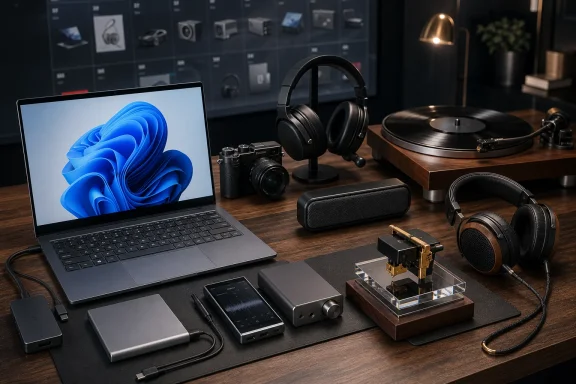 The Gadget Calendar Has Become a Permanent Feed
The traditional technology calendar used to offer moments of relative calm. Major computers arrived around predictable corporate events, televisions gathered around the big trade shows, and audio manufacturers operated on schedules that seemed almost leisurely compared with smartphones and software.That distinction has largely collapsed. Gear Patrol describes tracking every new gadget and hi-fi release as a tall order even for dedicated enthusiasts, which is why Bowe’s article is explicitly a rolling list, routinely updated throughout the year rather than published as a finished annual verdict.
The distinction matters. A conventional “best of the year” article attempts to close the argument: products have been tested, competitors compared and winners chosen. A rolling release guide does something different. It documents the argument while manufacturers are still making it, capturing new models, special editions, category experiments and unusually expensive flagships before the market has decided which ones matter.
Other technology publications divide this work into narrower forms. TechRadar, for example, publishes collections centered on products its staff has tested and rated, while more specialist audio outlets concentrate on equipment currently under review or products aimed at a particular kind of system. Gear Patrol’s guide is broader and closer to an edited launch ledger: it mixes practical consumer devices with aspirational hi-fi and gives readers enough context to decide what deserves deeper investigation.
That breadth is both its strength and its limitation. A camera, foldable mouse, gaming headset and moving-coil phono cartridge do not compete with one another in any meaningful purchasing decision. They do, however, compete for the same finite supply of consumer attention, which is precisely what a list like this is designed to organize.
One List Now Has to Cover a $70 Headset and a $17,000 Cartridge
Nothing demonstrates the fragmentation of the gadget market better than the price range represented in Gear Patrol’s selection. Fiio’s FG3 gaming headset is listed at $70, Shanling’s M0 Pura portable music player at $129 and Schiit Audio’s Vestri portable DAC and headphone amplifier at $99. At the other end sits Ortofon’s MC Vertex phono cartridge at $17,000, alongside Audio-Technica’s $11,000 AT-MCD1 cartridge and Final Audio’s $8,499 DX10000 CL headphones.These products are united by little beyond their reliance on electricity, sound or both. Yet their coexistence is revealing because it shows how technology publishing now serves two markets simultaneously: readers looking for something affordable that solves an immediate problem, and readers fascinated by engineering pursued far beyond the point of conventional value.
| Product | Category | Price | Defining feature | Intended use | Windows relevance |
|---|---|---|---|---|---|
| Fiio FG3 | Wired gaming headset | $70 | Coaxial dual-driver arrangement | Consoles, PCs and smartphones | Compatible with current Windows PCs |
| Schiit Audio Vestri | Portable DAC/headphone amp | $99 | USB-C connection and Mesh conversion technology | Improving wired-headphone playback | Connects to laptops and other USB-C sources |
| Shanling M0 Pura | Portable music player | $129 | MicroSD-based, distraction-free playback | Local music libraries | Useful for files managed on a PC |
| Andover FreePlay | Portable Bluetooth speaker | Not listed | Stereo playback, IP67 rating and 24-hour battery | Portable and outdoor listening | Bluetooth or 3.5mm connection |
| Sony RX10 V | Compact camera | $2,300 | 20.1MP sensor and 24–600mm optical zoom | Long-range stills and video | Produces media likely managed on PCs |
| Final DX10000 CL | Closed-back wired headphones | $8,499 | 40mm True Diamond diaphragm driver | Private flagship listening | Works with suitable PC audio hardware |
| Ortofon MC Vertex | Moving-coil phono cartridge | $17,000 | Newly developed Vertex diamond stylus | Elite analog systems | No direct Windows integration |
The more useful interpretation is that “best new” means editorially notable rather than universally recommendable. Some entries represent aggressive value, others unusual engineering, and still others a brand’s first move into a category. Readers should treat inclusion as a prompt to investigate, not as a buying instruction.
That is particularly important because many entries are summarized from launch information and manufacturer claims. Gear Patrol appropriately attributes claims about sonic performance, reduced muscle strain and engineering improvements to the companies making them. The wording is a reminder that an announcement is not a review, however persuasive the specifications may appear.
The Most Interesting Products Are Rebuilding Old Ideas
A large portion of the 2026 list is not about inventing unfamiliar categories. It is about rebuilding familiar ones with modern interfaces, processors, wireless standards or materials.Sony’s RX10 V is perhaps the clearest example. Gear Patrol describes it as the long-awaited successor to the RX10 IV, a camera released in 2017. It retains the basic proposition of a compact body, a 20.1-megapixel 1-inch stacked sensor and a 24–600mm optical zoom lens, but introduces a new processor, AI-assisted tracking, substantially improved autofocus and video capture up to 4K at 120 frames per second.
The interesting part is not simply that Sony has made a faster camera. It is that the company apparently still sees value in an all-in-one long-zoom device during an era dominated by smartphones at the casual end and interchangeable-lens systems at the enthusiast end. The $2,300 starting price, up from the predecessor’s $1,700, makes this a committed purchase rather than a casual alternative to a phone.
Shanling’s M0 Pura takes the reverse approach. Instead of adding cloud services and applications, the $129 player removes them. It is an iPod Nano-sized device built around locally stored music on a microSD card, intended for digitized CDs, vinyl transfers and downloaded files rather than streaming applications.
That omission is the product. The M0 Pura is not trying to be a small smartphone; it is offering a controlled environment where the library belongs to the listener, playback is the device’s principal job and notifications cannot interrupt the album. In a market that equates progress with adding services, a deliberate lack of services can itself become a premium feature.
Denon’s DP-500BT performs a similar reconciliation between old and new media. It is a belt-drive turntable with conventional analog connections and a switchable phono preamplifier, but it is also the company’s first turntable to support Bluetooth streaming. Support for aptX, aptX HD and aptX Adaptive allows it to feed compatible wireless headphones and speakers without preventing integration into a conventional hi-fi setup.
That combination may offend analog purists, but it addresses the reason many people never build a traditional vinyl system: the additional amplifier, cabling and speaker requirements. A turntable that can enter an existing wireless listening environment lowers the barrier to physical media, even if a fully wired system remains the more orthodox route.
The pattern continues across amplifiers and speakers. Emotiva’s BasX TA2+ adds HDMI ARC and USB-C to a component that already combines an amplifier, preamplifier, DAC and tuner. Elipson’s Prestige Facet II 6 Active BT speakers integrate USB-C, HDMI ARC, Bluetooth and a moving-magnet phono stage, allowing one speaker system to serve a computer, television, turntable and wireless source.
These are not attempts to replace the stereo system so much as admissions that the stereo system now has to accommodate everything. A modern listening room may contain a turntable, television, work laptop, phone and games console. Hardware that insists on only one of those worlds risks becoming an enthusiast’s secondary system rather than the center of the room.
Hi-Fi Is Winning by Becoming Easier to Connect
For decades, specialist audio treated complexity as a kind of initiation ritual. Buyers were expected to understand cartridges, impedance, amplification, source selection, speaker placement and a vocabulary of connectors that rarely appeared on ordinary consumer electronics.That culture still exists at the high end, as the cartridges and flagship headphones in Gear Patrol’s guide demonstrate. But many of the most consequential releases move in the opposite direction, compressing multiple boxes into one or adding consumer-friendly connections to components that once required specialized knowledge.
PSB’s iQ Series, for example, consists of two active speaker systems, the iQ1 and iQ2. Gear Patrol reports that both use the same drivers and a 270-watt Burr-Brown Class-D amplifier while sharing their principal connections and streaming capabilities. The more premium iQ2 distinguishes itself by avoiding the cable that would otherwise connect the speakers and by offering additional finishes.
The important transition is from passive loudspeakers, which require a separate amplifier, to complete systems that can accept modern sources directly. This is not new technology in isolation, but its spread through established hi-fi brands changes who can realistically install a credible audio system.
The same simplification is evident in portable DACs. Schiit Audio’s Vestri connects by USB-C to a phone, laptop or tablet and is the company’s first portable hi-fi product. AudioQuest’s DragonFly Copper continues a familiar dongle-style design, using USB-A with an included USB-C adapter to bypass the source device’s internal audio circuitry and drive wired headphones with a dedicated DAC and amplifier stage.
Portable DACs remain niche compared with wireless earbuds, but their logic is straightforward. Most computers are built around size, battery, cost and general-purpose performance rather than exceptional analog audio output. A small external device lets the owner upgrade sound without replacing the computer or abandoning a preferred pair of wired headphones.
For Windows users, this is where the hi-fi story stops being remote audiophile theater and becomes practical peripheral purchasing. USB audio devices, active speakers, gaming headsets and HDMI-connected systems all sit at the boundary between PC hardware and consumer electronics. Their quality depends not only on acoustic design but on driver behavior, power management, connection stability and application compatibility.
Fiio’s FG3 makes that crossover explicit. It is the company’s first gaming headset and uses a 50mm dynamic driver for low and midrange frequencies with a 16mm driver for higher frequencies. Gear Patrol reports compatibility with major consoles, current Windows PCs and smartphones, placing a traditionally audio-focused manufacturer in direct competition with gaming-peripheral brands.
The product’s significance will depend on more than its stated 10Hz-to-40kHz frequency response. Windows buyers need to know how reliably its microphone is detected, whether controls behave consistently across applications, how it handles long sessions and whether its tuning remains clear when game audio, voice chat and system sounds overlap. Those are review questions, not launch-specification questions.
The Windows PC Is Becoming the Universal Source Component
The recurring presence of USB-C throughout the guide is not incidental. It reflects the computer’s increasingly important role as a source, control surface, charging hub and library manager even in products that are not marketed primarily as PC accessories.Logitech’s $80 Mobi Fold is a direct example. The company’s first foldable mouse transforms from a pocket-friendly object into a wireless mouse and is compatible with Windows, macOS, ChromeOS and Linux. Logitech reportedly claims it can reduce muscle strain by 22 percent compared with a laptop trackpad, but that claim will require independent testing across different hands and working positions.
Satechi’s Slim LX3 wired keyboard and Slim LX wired mouse take a more conventional route. Both use USB-C, include USB-A adapters and are designed to match familiar computer finishes. The keyboard includes a physical operating-system switch for moving between Mac and Windows layouts, a small feature that could matter more in mixed-device offices than cosmetic styling or wireless connectivity.
Mophie’s 3-in-1 Wireless Charge Stand similarly illustrates the convergence of desk accessories and charging infrastructure. It uses the company’s StealthCharge Technology, which Mophie says reduces heat while maintaining full-speed 25-watt wireless charging for an iPhone. The same architecture appears in a larger charging station and a foldable travel charger.
For IT departments, none of these accessories is strategically important alone. Together, however, they represent the sprawling hardware edge that support teams are increasingly expected to manage. A laptop deployment now attracts docks, external displays, USB audio devices, wireless chargers, keyboards, trackers, portable batteries and cross-platform peripherals, each with its own firmware, cable and support assumptions.
BenQ’s MA270S monitor is positioned directly in that environment. The 27-inch display offers a true 5K Nano Gloss panel, wide P3 color support and single-cable Thunderbolt connectivity, while costing $600 less than the Apple display it is intended to challenge. Gear Patrol notes that it omits an integrated speaker system and sophisticated webcam, which means the price advantage may narrow once a buyer restores those functions with external devices.
The central purchasing question is therefore not whether one product costs less. It is whether the complete desk costs less after every missing component, adapter, cable and support burden is counted. Consumer gadget lists naturally present devices one at a time; IT has to assemble them into systems.
Action checklist for admins
- Verify Windows support, required drivers and firmware-update methods before approving USB audio, Thunderbolt or Bluetooth peripherals.
- Test sleep, wake, docking and reconnection behavior on the organization’s deployed PC models.
- Calculate the cost of omitted features such as webcams, speakers, chargers, adapters and cables.
- Standardize USB-C power requirements so employees do not interchange underpowered or unsuitable chargers.
- Record which peripherals require a mobile application or personal cloud account for configuration.
- Pilot audio devices with conferencing, voice-chat and accessibility software rather than testing music playback alone.
- Treat manufacturer performance claims as provisional until they are confirmed in the organization’s actual environment.
Luxury Audio Is Selling Scarcity as Aggressively as Sound
At the high end, technical specifications explain only part of the product. Scarcity, craftsmanship, collaboration and historical reference have become equally important selling tools.The Ruark R410 Anniversary Edition is a clear case. It is functionally very close to the standard all-in-one wireless speaker, but its white-oak cabinet, ebonized inlay and grille distinguish it as a commemorative model. Only 500 are to be produced.
Bang & Olufsen’s Fragment Design version of the Beosystem 9000c pushes the same idea much further. The system combines a refurbished Beosystem 9000 CD player with Beolab 28 wireless speakers, finished in matte black, natural aluminum and Fragment’s lightning-bolt branding. It is listed at $69,500, substantially above the original system’s $55,000 price.
Technics, Victrola, Beats, Casio and Xbox also appear in the guide with products that use special finishes or collaborations to make familiar hardware collectible. Technics applies a Mulberry Green finish and gold detailing to its SL-1200M7ALD turntable collaboration. Victrola and Third Man Records use a black-and-yellow treatment for a turntable and powered-speaker system, while Beats and Nike produce a special edition of the Powerbeats Pro 2 without changing the $250 price.
These releases make more sense when considered as fashion and cultural merchandise than as pure technical upgrades. The internal hardware may be unchanged or only modestly revised, but the exterior communicates membership, taste or attachment to a particular brand history.
That does not make the products illegitimate. Industrial design has always been part of consumer electronics, and a speaker or turntable occupies physical space in a home in a way that software does not. The problem arises when visual scarcity is mistaken for performance or when a limited finish obscures the fact that a less expensive standard model provides the same functional experience.
The most extreme specialist components present a different kind of exclusivity. Audio-Technica calls its $11,000 AT-MCD1 the finest phono cartridge it has produced, while Ortofon describes advanced geometry, diamond-on-diamond construction and precision manufacturing in the $17,000 MC Vertex. These claims address measurable engineering challenges, but the products also exist in a realm where system matching, setup quality and the rest of the signal chain become inseparable from the component itself.
A buyer cannot rationally assess such a cartridge as an isolated product card. It requires a compatible tonearm, turntable, phono stage, amplification chain and loudspeakers capable of exposing whatever improvement the cartridge delivers. At that level, the purchase is less like choosing an accessory and more like modifying one element of an interdependent instrument.
Portability Now Means Carrying an Entire System
Portable technology once implied a compromise: smaller sound, shorter battery life, fewer inputs or a fragile design. Several entries in the Gear Patrol list suggest manufacturers are now trying to remove those tradeoffs rather than merely disguise them.Andover Audio’s FreePlay is a nine-pound, boombox-style Bluetooth speaker that produces stereo sound, carries an IP67 rating and claims 24 hours of battery life. It also includes a 3.5mm auxiliary input, bidirectional USB-C charging and an integrated Qi wireless charger, allowing the speaker to supply power to smaller devices.
That is less a portable speaker than a self-contained entertainment and power hub. The nine-pound weight makes “portable” a description of movability rather than pocketability, but the combination is practical for outdoor use, temporary workspaces and events where separate speakers and battery packs would add complexity.
Marshall’s Bromley 450 follows a similar philosophy at a larger scale. Despite being described as a smaller and more affordable sibling to the Bromley 750, it still weighs 27 pounds. Bluetooth, 360-degree sound and microphone or instrument inputs position it as a movable party or performance system rather than a personal speaker.
Twelve South’s PowerClip takes the opposite approach. Roughly the size of an AirPods Pro case, its 2,000mAh battery is intended to provide a partial smartphone charge rather than replace a high-capacity power bank. Integrated USB-C cables, passthrough power, a ring and an attachable carabiner prioritize availability and convenience over maximum capacity.
The split reflects a broader reality: portability is no longer one category. It can mean equipment that travels between rooms, equipment that fits in luggage, or equipment that remains attached to a keychain. Products should be judged against the specific movement they are designed to support, not simply whether the manufacturer calls them portable.
The List Captures a Market That Cannot Let Go of Physical Media
Perhaps the strongest theme running through the audio selections is the persistence of physical and locally controlled media. Turntables, phono cartridges, CD-oriented systems, wired headphones and dedicated music players occupy substantial space alongside Bluetooth speakers and wireless accessories.This is not merely nostalgia. Physical and local media answer problems created by service-dependent listening: catalogs change, subscriptions rise in price, applications are redesigned and accounts can become the gateway to music the listener once considered permanently available.
The Shanling M0 Pura embodies the local-library argument in its purest form. It does not support streaming applications; users supply their own music on a microSD card. That requires more effort than opening a subscription service, but it also makes the collection portable across time and independent of a licensing agreement.
The resurgence of CD-capable and vinyl-oriented hardware follows the same logic, although with different rituals. Vinyl offers a tactile, deliberately inconvenient form of listening. CDs offer inexpensive physical ownership, straightforward digital extraction and a vast secondhand catalog. Dedicated hardware lets manufacturers sell the experience around those formats again, often with wireless or USB connectivity added to avoid recreating the limitations of earlier systems.
Windows remains quietly important here. PCs are still among the most flexible tools for organizing local libraries, editing metadata, creating backups, ripping permitted personal media and transferring files to portable players. A “distraction-free” player is only as orderly as the library loaded onto it, and that organizational work will often happen on a computer.
This also raises a preservation issue. Local music requires storage management and backups; physical media requires suitable playback hardware; proprietary applications may be needed to update some devices. Ownership removes dependence on a streaming catalog but does not eliminate technical responsibility. It transfers that responsibility to the user.
A Rolling Guide Is Useful Only If Readers Keep Their Skepticism
Gear Patrol’s article is written by an editor with a long history at the publication. Tucker Bowe has been on its editorial team since 2014 and covers a range spanning headphones and turntables to smartphones and wearables. That continuity matters in a category where product names proliferate faster than readers can reasonably remember them.Experience, however, does not transform launch material into laboratory evidence. Some entries contain clearly attributed manufacturer claims, while others summarize product positioning and specifications. The correct response is not distrust but classification: understand whether the information describes what a product is, what its maker claims, or how it performed under independent testing.
A frequency-response figure can describe a headset without demonstrating that it sounds balanced. A battery-life claim can establish a target without revealing performance at high volume. A camera’s processor and autofocus system may indicate a major generational improvement, but handling, heat, image quality and reliability still require hands-on evaluation.
Price cards also need context. A discount can change after publication, regional availability can differ, and an apparently inexpensive component may require costly supporting hardware. Conversely, an expensive all-in-one system may replace several separate boxes and cables.
The rolling format creates another complication: the article is never entirely finished. Earlier entries remain while new products arrive, and the editorial center of gravity shifts over time. A device that looked important near the start of the year may seem incremental by July; a seemingly minor accessory may prove more influential after competitors adopt the same idea.
That is not a flaw so much as the nature of the document. Readers should use the list as a map of announcements, then consult complete reviews, official documentation and compatibility information before making a decision. Bookmarking the page makes sense, but so does remembering why it needs to be bookmarked: the market has not stopped moving.
What This Gadget Flood Actually Says About 2026
The most valuable lesson in Gear Patrol’s guide is not that any single camera, speaker or cartridge deserves immediate purchase. It is that the hardware industry is advancing through combinations—old formats with wireless output, traditional amplifiers with USB-C, portable players without streaming, and specialist audio brands entering gaming and computer-centered listening.- Gear Patrol’s guide is a continuously updated release tracker, not a final annual ranking.
- The strongest mainstream trend is easier connectivity across televisions, PCs, phones, turntables and speakers.
- Local files, CDs, vinyl and wired headphones remain active product categories rather than historical curiosities.
- Special editions increasingly sell materials, scarcity and cultural identity without necessarily changing core performance.
- Windows users benefit from the growth of USB-C audio and cross-platform peripherals but still need to verify drivers and application behavior.
- Buyers should prioritize compatibility and lifecycle costs over launch-day novelty or a single headline price.
References
- Primary source: Gear Patrol
Published: 2026-07-10T17:52:09.827075
Loading…
www.gearpatrol.com - Related coverage: techradar.com
Loading…
www.techradar.com - Related coverage: podcast.gearpatrol.com
Loading…
podcast.gearpatrol.com - Related coverage: signalhire.com
Loading…
www.signalhire.com - Related coverage: daringfireball.net
Loading…
daringfireball.net - Related coverage: t3.com
Loading…
www.t3.com