

Fidji Simo stepped down Thursday as OpenAI’s Chief Executive Officer of Applications, saying a worsening chronic condition had made returning from medical leave impractical, while agreeing to remain a part-time adviser on consumer products, advertising, and health rather than resume day-to-day operational control. The decision is first and foremost a health decision, not evidence of a strategic dispute. But because OpenAI had concentrated an extraordinary share of its product and business machinery beneath Simo, her departure also exposes how quickly the company’s carefully constructed division of power has given way to another improvised leadership structure.
The timing makes the organizational problem harder to dismiss. OpenAI announced Simo’s departure on the same day it launched the GPT 5.6 model family and ChatGPT Work, an office-focused agent pitched against Anthropic—exactly the kind of commercial product push that the applications organization was created to coordinate.
Simo said the medical leave she began in April, after a severe flare of postural orthostatic tachycardia syndrome, had taken longer to resolve than expected. POTS is described in the source reporting as a neuroimmune condition, and Simo said she was diagnosed with it in 2019.
Her explanation should be taken plainly. Simo did not announce a move to a competitor, signal disagreement with Sam Altman, or present her departure as a judgment on OpenAI’s strategy. She said her condition had worsened, recovery would require more time, and a full-time executive position was no longer compatible with what that recovery demanded.
“I failed to make this decision many times before,” she wrote. That sentence carries more weight than the conventional language of an executive transition because it describes not a sudden rupture but a repeatedly deferred acknowledgment that the job had become unsustainable.
Altman responded to Simo’s post on X by expressing gratitude for her contributions and wishing her a speedy recovery. Simo will retain a formal connection to OpenAI through a part-time advisory role focused on consumer products, advertising, and health—three areas that reflect both her professional background and the broad commercial brief she had been given inside the company.
The humane interpretation and the corporate interpretation are not in conflict. A senior leader can leave for an entirely genuine medical reason while the resulting vacancy still reveals weaknesses in organizational design. In OpenAI’s case, the problem is that Simo’s position was not merely one executive seat among many; it was the central junction through which much of the company’s product, financial, operational, and commercial authority had recently been rerouted.
OpenAI’s official announcement of her appointment described a widening leadership structure rather than Altman surrendering the chief executive role. Altman remained responsible for the company as a whole, but he was expected to concentrate more heavily on research, compute, and safety while Simo ran the applications side.
That distinction was more consequential than the word applications might suggest. Chief Operating Officer Brad Lightcap, Chief Financial Officer Sarah Friar, and Chief Product Officer Kevin Weil began reporting to Simo when she took the role. Product, finance, and operations were therefore being gathered beneath one executive who reported directly to Altman.
It was, in effect, an attempt to create two tightly connected centers of gravity. Altman would oversee the frontier—models, infrastructure, research direction, and safety—while Simo would turn that frontier into products, businesses, and consumer experiences.
The arrangement made strategic sense. OpenAI was no longer simply a research laboratory that occasionally released a model or API. It was operating consumer software, enterprise services, developer platforms, and increasingly ambitious agent products, all of which required decisions about pricing, distribution, support, marketing, partnerships, and monetization.
But the structure was also unusually dependent on the executive occupying the applications role. Simo was not placed over one product line with narrow boundaries; she was positioned over a collection of functions that normally create their own competing constituencies inside a technology company. Finance wants predictability, product wants speed, operations wants repeatability, and commercial teams want features that can be sold now rather than after another research cycle.
Her job was to reconcile those pressures before they reached Altman. With Simo gone from full-time work, OpenAI has not simply lost an executive. It has lost the person around whom its effort to separate frontier development from commercial execution had been organized.
2024 — Simo joined OpenAI’s board, establishing a relationship with the company before moving into an executive position.
May 2025 — She took the newly created Chief Executive Officer of Applications role, reporting to Altman and assuming authority over major product, financial, and operating functions.
April — Simo began medical leave after a severe flare of POTS, and President Greg Brockman absorbed product strategy during her absence.
Thursday — Simo stepped down from full-time executive work and moved into a part-time advisory role as OpenAI launched GPT 5.6 and ChatGPT Work.
When Simo began medical leave in April, Brockman absorbed product strategy. That gave OpenAI a familiar senior figure with deep institutional authority, but it did not recreate Simo’s role in full. Product strategy is only one part of a job that also connected business operations, financial priorities, and product commercialization.
Simo’s remaining duties are now being divided among Brockman, Friar, and Chief Strategy Officer Jason Kwon. The allocation means OpenAI is replacing one coordinating executive with a group of powerful leaders, each approaching decisions from a different institutional position.
Distributed authority is not automatically inferior. Companies often use executive committees to prevent one leader from becoming a bottleneck, and OpenAI already has senior figures capable of running large parts of the organization.
The problem is that shared responsibility works only when decision rights are explicit. If product, finance, and strategy disagree about whether to launch, delay, reprice, restrict, or expand a service, someone still needs final authority. Otherwise, the organization either slows down or defaults upward, returning more decisions to Altman—the very outcome Simo’s appointment was designed to avoid.
This is the structural problem beneath the personnel news. OpenAI spent a year building an applications organization around a second senior executive, then began dismantling or redistributing that structure almost as soon as it was put under pressure.
Other departures reached into commercially sensitive areas. A head of private equity left for Google, while a sales leader departed for Thrive Capital. No single one of those moves proves organizational dysfunction, and large technology companies routinely lose executives to investors, competitors, and new ventures.
The pattern nevertheless matters because turnover is cumulative. An organization can replace one product leader, redistribute one operating portfolio, or absorb one sales departure without changing course. When those moves overlap, however, the institutional memory needed to coordinate launches and customer commitments becomes more difficult to preserve.
OpenAI’s challenge is intensified by the speed at which its products change. A conventional software vendor might manage executive turnover against a stable release calendar and a mature support structure. An AI company launching model families and agent products in rapid succession is asking its leadership team to define the market while simultaneously defining the organization that will serve it.
Personnel continuity matters most at the seams: where a research result becomes a product specification, where a product becomes a contract, and where a contract becomes a support obligation. Those transitions require more than technical competence. They require durable ownership and a shared understanding of promises already made to customers.
The departure of an executive with Simo’s background is especially consequential at those seams. She spent more than a decade at Facebook, including a period as head of the Facebook app, before becoming chief executive of Instacart and leading the grocery delivery company through its public listing. Her résumé was not that of a frontier-model researcher; it was that of an operator accustomed to large consumer platforms, advertising systems, and the pressures of a public-facing business.
That was the point of hiring her. OpenAI did not need another executive to explain why increasingly capable models were important. It needed someone to impose commercial and product discipline on a company whose technology was expanding faster than its organizational habits.
Simo’s departure therefore removes not only capacity but a particular kind of experience. OpenAI still has experienced operators, product leaders, strategists, and founders, but the burden now falls on them to preserve the integration her office was intended to provide.
That coincidence does not mean the launches and Simo’s departure were causally related. It does, however, create a revealing contrast: OpenAI was presenting a more ambitious commercial platform to customers at the same moment it was confirming that the executive responsible for integrating its applications business would not return full time.
ChatGPT Work is strategically important because office agents cannot be treated like ordinary chat interfaces. A system that works across documents, spreadsheets, presentations, files, and business context sits closer to the operating core of an organization. Its success depends not only on model performance but on permissions, data handling, reliability, administrative controls, procurement, support, and user trust.
Those are applications questions in the fullest sense. They are also the questions that become harder to answer consistently when product ownership, strategic authority, and commercial responsibility are divided among multiple executives.
OpenAI’s own product presentation frames ChatGPT Work as a system that can gather context, plan an approach, act across tools, and produce finished work. The product promise is therefore not simply better text generation. It is delegated execution.
That shift raises the organizational stakes. When a chatbot produces an unsatisfactory answer, the user can discard it. When an office agent acts across corporate tools or produces material that enters a business process, customers need to know who owns deployment safety, policy enforcement, auditability, integration behavior, and service continuity.
The same applies to GPT 5.6. A model family marketed for professional work becomes part of enterprise architecture once applications, automations, and internal processes are built around it. Customers then care about predictable behavior, migration paths, availability, documentation, and the durability of product commitments.
A strong model release can briefly dominate headlines, but enterprise adoption is won through repetition and predictability. OpenAI’s competitors do not need the company’s technology to fail outright; they need procurement teams to perceive rival platforms as easier to plan around.
This is where leadership churn can become a competitive issue even if it never produces a visible outage or canceled product. Organizational uncertainty creates hesitation. Hesitation gives competitors time to improve, deepen relationships, or position themselves as the more stable choice.
Anthropic’s importance in this story is not that it somehow caused OpenAI’s leadership problems. It is that every internal transition at OpenAI now occurs against a credible alternative supplier seeking many of the same professional and enterprise workloads.
For individual ChatGPT users, switching costs may remain limited. A user can try another assistant, compare answers, and return later. For businesses, switching involves much more: security review, data classification, employee training, identity integration, workflow redesign, contract negotiation, and governance approval.
Those costs favor incumbency once a platform is embedded, but they also make buyers cautious before embedding one. An enterprise customer evaluating ChatGPT Work will therefore assess not only what it can do today but whether OpenAI appears capable of supporting its commitments through future reorganizations.
Leadership stability is an imperfect proxy for product stability, but it is a proxy buyers understand. Repeated changes in product, operations, marketing, sales, and enterprise leadership can cause customers to ask whether roadmap decisions will survive the executives who approved them.
OpenAI can counter that concern through clear product ownership and consistent communication. It does not necessarily need to appoint an immediate replica of Simo. It does need to show that the division of her responsibilities will not result in competing roadmaps, slower escalation, or ambiguous accountability.
The strongest signal would be operational rather than rhetorical: products continuing to ship, documentation remaining current, enterprise support working predictably, and administrators receiving clear notice before consequential changes. Continuity, not reassurance, is the real test.
The relevant issue is dependency. If an organization uses OpenAI services experimentally, an executive transition may require little more than monitoring. If OpenAI models or agents are becoming embedded in document production, software development, customer support, analysis, or automated workflows, leadership changes are another reason to examine whether the organization can tolerate a sudden change in product direction.
Administrators should also distinguish OpenAI’s direct products from AI services delivered through other vendors. A workplace may encounter related model capabilities through several commercial channels, each with different contracts, controls, support arrangements, and update policies. A change at OpenAI does not automatically produce the same operational effect across every service using its technology.
The launch of ChatGPT Work makes this distinction particularly important. An office-focused agent may interact with the same kinds of files and tasks that Windows users handle every day, but its governance depends on how it is deployed, which tools it can reach, and whose administrative boundary controls it.
IT teams should resist two opposite errors. The first is assuming a prominent departure means products are about to collapse. The second is assuming the departure is irrelevant because the service remains online.
The sensible position lies between them. Executive churn is not an incident, but it can foreshadow reorganized priorities, changed escalation paths, shifting commercial terms, or altered product ownership. Those possibilities belong in vendor-risk monitoring even when they do not justify emergency action.
The disclosed facts describe a chronic illness, a severe flare, a medical leave beginning in April, and a recovery period that proved longer and more complicated than expected. Simo chose to leave full-time work while maintaining a limited advisory relationship with the company.
Her statement also points toward a broader issue in executive culture. “I failed to make this decision many times before” describes the pressure to treat endurance as leadership, even when the physical cost is mounting.
That pressure can be especially severe in an organization racing to define a new technology category. The work is framed as historic, competitors are moving quickly, and any absence can feel like surrendering strategic ground. Senior executives also know that authority can be redistributed while they are away and may not automatically return when they do.
Indeed, that is effectively what happened here. Brockman absorbed product strategy after Simo went on leave, and OpenAI’s next structure developed around her absence. By the time it became clear that her recovery would require a longer horizon, the company was already operating through an alternative arrangement.
None of that makes the medical explanation less credible. It demonstrates why people in high-pressure positions may delay stepping back even when doing so is medically necessary. The job does not pause cleanly; it reforms around whoever remains.
Simo’s future advisory focus includes health, an area where her personal experience and OpenAI’s product ambitions may intersect. But the move should not be misread as a disguised continuation of her old job. Advising on consumer products, advertising, and health is materially different from running daily product and business operations with major executives reporting into the role.
The distinction protects both Simo and OpenAI from pretending that a part-time appointment can reproduce full-time executive control. It also leaves the company with a straightforward obligation: formally account for the authority that no longer sits in her office.
Brockman already absorbed product strategy and has the institutional authority of OpenAI’s president. Friar, as chief financial officer, is positioned to connect commercial priorities with spending and financial planning. Kwon, as chief strategy officer, can coordinate corporate direction and major strategic decisions.
The risk is not lack of talent. It is that several capable executives may each control part of a decision without any one of them owning the complete outcome.
Consider a hypothetical enterprise agent feature that is technically impressive but expensive to operate, difficult to govern, and urgently desired by sales prospects. Product leadership might favor shipping it, finance might demand narrower availability, and strategy might treat it as essential to competitive positioning.
Under Simo’s original mandate, those arguments could converge inside one applications organization. Under a divided model, the same decision may require negotiation across executive domains before reaching a conclusion—or escalation back to Altman.
That could push OpenAI toward one of two structures. The company may eventually appoint a new leader with authority comparable to Simo’s, restoring the original split between frontier development and applications. Alternatively, it may decide that the experiment with a single applications chief concentrated too much power and retain a distributed model.
Either structure can work. What cannot work indefinitely is ambiguity between them.
If Brockman is now the decisive product authority, customers and employees need to understand how that authority relates to Friar’s commercial responsibilities and Kwon’s strategic role. If the three operate collectively, the organization needs a reliable way to resolve disagreement without turning Altman into the default owner of every cross-functional dispute.
The question is especially important because Lightcap, who had been chief operating officer and reported to Simo, has moved into a newly created special-projects position. That removes another obvious candidate for serving as the day-to-day integrator across OpenAI’s commercial machinery.
OpenAI may be comfortable with a founder-led structure in which Brockman and Altman take more direct control. But doing so would mark a meaningful retreat from the premise of Simo’s appointment: that the company had become too operationally broad for its frontier leadership and applications business to be managed through the same narrow executive channel.
That evidence matters, but only up to a point. Products announced on Thursday were developed over time, under structures and decisions that preceded the announcement. The more revealing test will be what happens to the roadmap after the current pipeline has moved through launch.
Does ChatGPT Work develop into a coherent, governable workplace platform, or accumulate disconnected capabilities? Does OpenAI maintain a consistent line between consumer experimentation and enterprise commitments? Do advertising, health, and office-product strategies reinforce one another, or become separate executive projects competing for resources?
Simo’s advisory role may help preserve continuity in some of those discussions, particularly around consumer products, advertising, and health. Yet an adviser can recommend; an operator must decide, allocate, and enforce.
That distinction becomes crucial when tradeoffs are unpopular. Product discipline is not merely generating new ideas. It is deciding which ideas not to pursue, which launches to delay, and which customer demands to reject because they conflict with the platform’s longer-term architecture.
The departure also leaves OpenAI facing a cultural question. If the company interprets repeated executive redistribution as proof that everyone is interchangeable, it risks losing the value of clearly owned mandates. If it responds by freezing decision-making until another dominant leader is found, it risks slowing at precisely the moment competitors are applying pressure.
A durable organization must be able to survive both the loss of a key executive and the arrival of a new one. That means documenting decisions, clarifying authority, retaining institutional knowledge, and designing reporting lines around work rather than personalities.
OpenAI’s Simo structure was bold because it acknowledged that commercialization had become a chief-executive-sized task. The company’s next move will reveal whether it still believes that diagnosis even after the executive chosen to address it can no longer continue.
The timing makes the organizational problem harder to dismiss. OpenAI announced Simo’s departure on the same day it launched the GPT 5.6 model family and ChatGPT Work, an office-focused agent pitched against Anthropic—exactly the kind of commercial product push that the applications organization was created to coordinate.
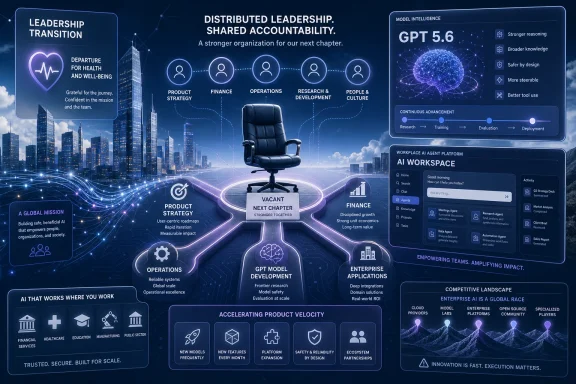 A Health Decision Exposes an Organizational Bet
Simo said the medical leave she began in April, after a severe flare of postural orthostatic tachycardia syndrome, had taken longer to resolve than expected. POTS is described in the source reporting as a neuroimmune condition, and Simo said she was diagnosed with it in 2019.Her explanation should be taken plainly. Simo did not announce a move to a competitor, signal disagreement with Sam Altman, or present her departure as a judgment on OpenAI’s strategy. She said her condition had worsened, recovery would require more time, and a full-time executive position was no longer compatible with what that recovery demanded.
“I failed to make this decision many times before,” she wrote. That sentence carries more weight than the conventional language of an executive transition because it describes not a sudden rupture but a repeatedly deferred acknowledgment that the job had become unsustainable.
Altman responded to Simo’s post on X by expressing gratitude for her contributions and wishing her a speedy recovery. Simo will retain a formal connection to OpenAI through a part-time advisory role focused on consumer products, advertising, and health—three areas that reflect both her professional background and the broad commercial brief she had been given inside the company.
The humane interpretation and the corporate interpretation are not in conflict. A senior leader can leave for an entirely genuine medical reason while the resulting vacancy still reveals weaknesses in organizational design. In OpenAI’s case, the problem is that Simo’s position was not merely one executive seat among many; it was the central junction through which much of the company’s product, financial, operational, and commercial authority had recently been rerouted.
OpenAI Built a Second Center of Gravity Around Simo
Simo joined OpenAI’s board in 2024 and took the newly created CEO of Applications role in May 2025. The appointment was an attempt to solve a challenge that confronts companies when an exceptional technical breakthrough becomes a sprawling commercial platform: the skills needed to lead research are not necessarily the same skills needed to package, distribute, monetize, support, and govern products used at scale.OpenAI’s official announcement of her appointment described a widening leadership structure rather than Altman surrendering the chief executive role. Altman remained responsible for the company as a whole, but he was expected to concentrate more heavily on research, compute, and safety while Simo ran the applications side.
That distinction was more consequential than the word applications might suggest. Chief Operating Officer Brad Lightcap, Chief Financial Officer Sarah Friar, and Chief Product Officer Kevin Weil began reporting to Simo when she took the role. Product, finance, and operations were therefore being gathered beneath one executive who reported directly to Altman.
It was, in effect, an attempt to create two tightly connected centers of gravity. Altman would oversee the frontier—models, infrastructure, research direction, and safety—while Simo would turn that frontier into products, businesses, and consumer experiences.
The arrangement made strategic sense. OpenAI was no longer simply a research laboratory that occasionally released a model or API. It was operating consumer software, enterprise services, developer platforms, and increasingly ambitious agent products, all of which required decisions about pricing, distribution, support, marketing, partnerships, and monetization.
But the structure was also unusually dependent on the executive occupying the applications role. Simo was not placed over one product line with narrow boundaries; she was positioned over a collection of functions that normally create their own competing constituencies inside a technology company. Finance wants predictability, product wants speed, operations wants repeatability, and commercial teams want features that can be sold now rather than after another research cycle.
Her job was to reconcile those pressures before they reached Altman. With Simo gone from full-time work, OpenAI has not simply lost an executive. It has lost the person around whom its effort to separate frontier development from commercial execution had been organized.
Timeline
2019 — Simo was diagnosed with postural orthostatic tachycardia syndrome, the neuroimmune condition she later cited in explaining her departure.2024 — Simo joined OpenAI’s board, establishing a relationship with the company before moving into an executive position.
May 2025 — She took the newly created Chief Executive Officer of Applications role, reporting to Altman and assuming authority over major product, financial, and operating functions.
April — Simo began medical leave after a severe flare of POTS, and President Greg Brockman absorbed product strategy during her absence.
Thursday — Simo stepped down from full-time executive work and moved into a part-time advisory role as OpenAI launched GPT 5.6 and ChatGPT Work.
The Medical Leave Became a Live Test of the Succession Plan
A temporary leave can be managed through delegation. A permanent departure tests whether that delegation represents a stable operating model or merely a bridge until the absent executive returns.When Simo began medical leave in April, Brockman absorbed product strategy. That gave OpenAI a familiar senior figure with deep institutional authority, but it did not recreate Simo’s role in full. Product strategy is only one part of a job that also connected business operations, financial priorities, and product commercialization.
Simo’s remaining duties are now being divided among Brockman, Friar, and Chief Strategy Officer Jason Kwon. The allocation means OpenAI is replacing one coordinating executive with a group of powerful leaders, each approaching decisions from a different institutional position.
| Operating phase | Product strategy | Finance and business duties | Central coordinator | Practical consequence |
|---|---|---|---|---|
| After Simo’s May 2025 appointment | Led within Simo’s applications organization | Consolidated beneath Simo, including Friar’s reporting line | Fidji Simo | One executive reconciled product, finance, and operations |
| During Simo’s medical leave | Absorbed by Greg Brockman | Distributed among continuing executives | Temporary shared coverage | OpenAI operated without the full applications structure |
| After Simo’s departure | Brockman retains a central product role | Split among Brockman, Sarah Friar, and Jason Kwon | No direct replacement identified in the source material | Accountability becomes more distributed |
The problem is that shared responsibility works only when decision rights are explicit. If product, finance, and strategy disagree about whether to launch, delay, reprice, restrict, or expand a service, someone still needs final authority. Otherwise, the organization either slows down or defaults upward, returning more decisions to Altman—the very outcome Simo’s appointment was designed to avoid.
This is the structural problem beneath the personnel news. OpenAI spent a year building an applications organization around a second senior executive, then began dismantling or redistributing that structure almost as soon as it was put under pressure.
Leadership Churn Is Becoming Part of the Operating Environment
Simo’s departure does not stand alone. OpenAI has also moved Lightcap into a newly created special-projects role, while Chief Marketing Officer Kate Rouch is departing. Earlier in the year, the company lost its product chief, its Sora lead, and an enterprise technology executive on a single day, according to the source reporting.Other departures reached into commercially sensitive areas. A head of private equity left for Google, while a sales leader departed for Thrive Capital. No single one of those moves proves organizational dysfunction, and large technology companies routinely lose executives to investors, competitors, and new ventures.
The pattern nevertheless matters because turnover is cumulative. An organization can replace one product leader, redistribute one operating portfolio, or absorb one sales departure without changing course. When those moves overlap, however, the institutional memory needed to coordinate launches and customer commitments becomes more difficult to preserve.
OpenAI’s challenge is intensified by the speed at which its products change. A conventional software vendor might manage executive turnover against a stable release calendar and a mature support structure. An AI company launching model families and agent products in rapid succession is asking its leadership team to define the market while simultaneously defining the organization that will serve it.
Personnel continuity matters most at the seams: where a research result becomes a product specification, where a product becomes a contract, and where a contract becomes a support obligation. Those transitions require more than technical competence. They require durable ownership and a shared understanding of promises already made to customers.
The departure of an executive with Simo’s background is especially consequential at those seams. She spent more than a decade at Facebook, including a period as head of the Facebook app, before becoming chief executive of Instacart and leading the grocery delivery company through its public listing. Her résumé was not that of a frontier-model researcher; it was that of an operator accustomed to large consumer platforms, advertising systems, and the pressures of a public-facing business.
That was the point of hiring her. OpenAI did not need another executive to explain why increasingly capable models were important. It needed someone to impose commercial and product discipline on a company whose technology was expanding faster than its organizational habits.
Simo’s departure therefore removes not only capacity but a particular kind of experience. OpenAI still has experienced operators, product leaders, strategists, and founders, but the burden now falls on them to preserve the integration her office was intended to provide.
Launch Day Turned an Executive Exit Into a Strategy Story
The announcement arrived on a day already crowded with product news. OpenAI introduced its GPT 5.6 model family and ChatGPT Work, an office-focused agent positioned against Anthropic.That coincidence does not mean the launches and Simo’s departure were causally related. It does, however, create a revealing contrast: OpenAI was presenting a more ambitious commercial platform to customers at the same moment it was confirming that the executive responsible for integrating its applications business would not return full time.
ChatGPT Work is strategically important because office agents cannot be treated like ordinary chat interfaces. A system that works across documents, spreadsheets, presentations, files, and business context sits closer to the operating core of an organization. Its success depends not only on model performance but on permissions, data handling, reliability, administrative controls, procurement, support, and user trust.
Those are applications questions in the fullest sense. They are also the questions that become harder to answer consistently when product ownership, strategic authority, and commercial responsibility are divided among multiple executives.
OpenAI’s own product presentation frames ChatGPT Work as a system that can gather context, plan an approach, act across tools, and produce finished work. The product promise is therefore not simply better text generation. It is delegated execution.
That shift raises the organizational stakes. When a chatbot produces an unsatisfactory answer, the user can discard it. When an office agent acts across corporate tools or produces material that enters a business process, customers need to know who owns deployment safety, policy enforcement, auditability, integration behavior, and service continuity.
The same applies to GPT 5.6. A model family marketed for professional work becomes part of enterprise architecture once applications, automations, and internal processes are built around it. Customers then care about predictable behavior, migration paths, availability, documentation, and the durability of product commitments.
A strong model release can briefly dominate headlines, but enterprise adoption is won through repetition and predictability. OpenAI’s competitors do not need the company’s technology to fail outright; they need procurement teams to perceive rival platforms as easier to plan around.
This is where leadership churn can become a competitive issue even if it never produces a visible outage or canceled product. Organizational uncertainty creates hesitation. Hesitation gives competitors time to improve, deepen relationships, or position themselves as the more stable choice.
Anthropic Is Competing on Institutional Confidence as Well as Models
OpenAI’s decision to pitch GPT 5.6 and ChatGPT Work against Anthropic reflects how the competitive contest has changed. The market is no longer organized solely around which laboratory can publish the most impressive model result. It is increasingly organized around which company can make advanced models dependable enough to become workplace infrastructure.Anthropic’s importance in this story is not that it somehow caused OpenAI’s leadership problems. It is that every internal transition at OpenAI now occurs against a credible alternative supplier seeking many of the same professional and enterprise workloads.
For individual ChatGPT users, switching costs may remain limited. A user can try another assistant, compare answers, and return later. For businesses, switching involves much more: security review, data classification, employee training, identity integration, workflow redesign, contract negotiation, and governance approval.
Those costs favor incumbency once a platform is embedded, but they also make buyers cautious before embedding one. An enterprise customer evaluating ChatGPT Work will therefore assess not only what it can do today but whether OpenAI appears capable of supporting its commitments through future reorganizations.
Leadership stability is an imperfect proxy for product stability, but it is a proxy buyers understand. Repeated changes in product, operations, marketing, sales, and enterprise leadership can cause customers to ask whether roadmap decisions will survive the executives who approved them.
OpenAI can counter that concern through clear product ownership and consistent communication. It does not necessarily need to appoint an immediate replica of Simo. It does need to show that the division of her responsibilities will not result in competing roadmaps, slower escalation, or ambiguous accountability.
The strongest signal would be operational rather than rhetorical: products continuing to ship, documentation remaining current, enterprise support working predictably, and administrators receiving clear notice before consequential changes. Continuity, not reassurance, is the real test.
Windows and Microsoft Shops Should Separate Product Risk From Leadership Noise
For Windows administrators and Microsoft-centered IT departments, the practical question is not whether Simo’s departure makes OpenAI “safe” or “unsafe.” That framing is too broad to be useful.The relevant issue is dependency. If an organization uses OpenAI services experimentally, an executive transition may require little more than monitoring. If OpenAI models or agents are becoming embedded in document production, software development, customer support, analysis, or automated workflows, leadership changes are another reason to examine whether the organization can tolerate a sudden change in product direction.
Administrators should also distinguish OpenAI’s direct products from AI services delivered through other vendors. A workplace may encounter related model capabilities through several commercial channels, each with different contracts, controls, support arrangements, and update policies. A change at OpenAI does not automatically produce the same operational effect across every service using its technology.
The launch of ChatGPT Work makes this distinction particularly important. An office-focused agent may interact with the same kinds of files and tasks that Windows users handle every day, but its governance depends on how it is deployed, which tools it can reach, and whose administrative boundary controls it.
IT teams should resist two opposite errors. The first is assuming a prominent departure means products are about to collapse. The second is assuming the departure is irrelevant because the service remains online.
The sensible position lies between them. Executive churn is not an incident, but it can foreshadow reorganized priorities, changed escalation paths, shifting commercial terms, or altered product ownership. Those possibilities belong in vendor-risk monitoring even when they do not justify emergency action.
Action checklist for admins
- Identify every workflow that depends directly on OpenAI models, APIs, or agent products, and assign an internal owner to each dependency.
- Keep pilots of ChatGPT Work separated from production processes until permissions, data access, output review, and rollback procedures are understood.
- Record which contractual commitments come from OpenAI directly and which come from another platform or service provider.
- Preserve exportable copies of critical prompts, configurations, workflow instructions, and evaluation data rather than leaving them only inside one vendor’s product.
- Monitor product notices for changes in model availability, administrative controls, integrations, and enterprise-support ownership.
- Require human approval for consequential agent actions until the organization has enough evidence to define narrower automation boundaries.
The Human Reality Should Not Be Flattened Into Corporate Drama
Technology coverage has a habit of treating every senior departure as a proxy war, especially at companies where executive relationships are already intensely scrutinized. That approach is inappropriate here unless evidence emerges that contradicts Simo’s own account.The disclosed facts describe a chronic illness, a severe flare, a medical leave beginning in April, and a recovery period that proved longer and more complicated than expected. Simo chose to leave full-time work while maintaining a limited advisory relationship with the company.
Her statement also points toward a broader issue in executive culture. “I failed to make this decision many times before” describes the pressure to treat endurance as leadership, even when the physical cost is mounting.
That pressure can be especially severe in an organization racing to define a new technology category. The work is framed as historic, competitors are moving quickly, and any absence can feel like surrendering strategic ground. Senior executives also know that authority can be redistributed while they are away and may not automatically return when they do.
Indeed, that is effectively what happened here. Brockman absorbed product strategy after Simo went on leave, and OpenAI’s next structure developed around her absence. By the time it became clear that her recovery would require a longer horizon, the company was already operating through an alternative arrangement.
None of that makes the medical explanation less credible. It demonstrates why people in high-pressure positions may delay stepping back even when doing so is medically necessary. The job does not pause cleanly; it reforms around whoever remains.
Simo’s future advisory focus includes health, an area where her personal experience and OpenAI’s product ambitions may intersect. But the move should not be misread as a disguised continuation of her old job. Advising on consumer products, advertising, and health is materially different from running daily product and business operations with major executives reporting into the role.
The distinction protects both Simo and OpenAI from pretending that a part-time appointment can reproduce full-time executive control. It also leaves the company with a straightforward obligation: formally account for the authority that no longer sits in her office.
OpenAI’s Next Risk Is Diffuse Accountability
The duties Simo leaves behind will be divided among Brockman, Friar, and Kwon. Each is a senior executive, and each brings a plausible claim to part of the portfolio.Brockman already absorbed product strategy and has the institutional authority of OpenAI’s president. Friar, as chief financial officer, is positioned to connect commercial priorities with spending and financial planning. Kwon, as chief strategy officer, can coordinate corporate direction and major strategic decisions.
The risk is not lack of talent. It is that several capable executives may each control part of a decision without any one of them owning the complete outcome.
Consider a hypothetical enterprise agent feature that is technically impressive but expensive to operate, difficult to govern, and urgently desired by sales prospects. Product leadership might favor shipping it, finance might demand narrower availability, and strategy might treat it as essential to competitive positioning.
Under Simo’s original mandate, those arguments could converge inside one applications organization. Under a divided model, the same decision may require negotiation across executive domains before reaching a conclusion—or escalation back to Altman.
That could push OpenAI toward one of two structures. The company may eventually appoint a new leader with authority comparable to Simo’s, restoring the original split between frontier development and applications. Alternatively, it may decide that the experiment with a single applications chief concentrated too much power and retain a distributed model.
Either structure can work. What cannot work indefinitely is ambiguity between them.
If Brockman is now the decisive product authority, customers and employees need to understand how that authority relates to Friar’s commercial responsibilities and Kwon’s strategic role. If the three operate collectively, the organization needs a reliable way to resolve disagreement without turning Altman into the default owner of every cross-functional dispute.
The question is especially important because Lightcap, who had been chief operating officer and reported to Simo, has moved into a newly created special-projects position. That removes another obvious candidate for serving as the day-to-day integrator across OpenAI’s commercial machinery.
OpenAI may be comfortable with a founder-led structure in which Brockman and Altman take more direct control. But doing so would mark a meaningful retreat from the premise of Simo’s appointment: that the company had become too operationally broad for its frontier leadership and applications business to be managed through the same narrow executive channel.
Product Momentum Cannot Permanently Substitute for Organizational Design
Launching GPT 5.6 and ChatGPT Work on the day of Simo’s announcement gave OpenAI a way to demonstrate momentum. The company could point to new models and a workplace agent as evidence that its execution engine continued functioning through leadership changes.That evidence matters, but only up to a point. Products announced on Thursday were developed over time, under structures and decisions that preceded the announcement. The more revealing test will be what happens to the roadmap after the current pipeline has moved through launch.
Does ChatGPT Work develop into a coherent, governable workplace platform, or accumulate disconnected capabilities? Does OpenAI maintain a consistent line between consumer experimentation and enterprise commitments? Do advertising, health, and office-product strategies reinforce one another, or become separate executive projects competing for resources?
Simo’s advisory role may help preserve continuity in some of those discussions, particularly around consumer products, advertising, and health. Yet an adviser can recommend; an operator must decide, allocate, and enforce.
That distinction becomes crucial when tradeoffs are unpopular. Product discipline is not merely generating new ideas. It is deciding which ideas not to pursue, which launches to delay, and which customer demands to reject because they conflict with the platform’s longer-term architecture.
The departure also leaves OpenAI facing a cultural question. If the company interprets repeated executive redistribution as proof that everyone is interchangeable, it risks losing the value of clearly owned mandates. If it responds by freezing decision-making until another dominant leader is found, it risks slowing at precisely the moment competitors are applying pressure.
A durable organization must be able to survive both the loss of a key executive and the arrival of a new one. That means documenting decisions, clarifying authority, retaining institutional knowledge, and designing reporting lines around work rather than personalities.
OpenAI’s Simo structure was bold because it acknowledged that commercialization had become a chief-executive-sized task. The company’s next move will reveal whether it still believes that diagnosis even after the executive chosen to address it can no longer continue.
The Signals That Matter After Simo’s Exit
The immediate facts are simple, but their consequences will emerge gradually. Users and IT leaders should focus on observable changes rather than speculation about private executive relationships.- Simo has left full-time operational leadership for health reasons and will remain a part-time adviser.
- Brockman, Friar, and Kwon will divide responsibilities that had been concentrated within the applications organization.
- Brockman already absorbed product strategy during Simo’s medical leave.
- OpenAI’s wider executive turnover raises the importance of explicit product and commercial ownership.
- GPT 5.6 and ChatGPT Work show that launches are continuing, but they do not by themselves prove long-term organizational continuity.
- Enterprise customers should monitor roadmap consistency, administrative controls, support ownership, and service commitments rather than reacting to leadership headlines alone.
References
- Primary source: NewsGhana
Published: 2026-07-10T16:50:08.892121
Loading…
www.newsghana.com.gh - Related coverage: techcrunch.com
Loading…
techcrunch.com - Related coverage: fortune.com
Loading…
fortune.com - Related coverage: wired.com
Loading…
www.wired.com - Related coverage: theinformation.com
Loading…
www.theinformation.com - Related coverage: the-decoder.com
Loading…
the-decoder.com
- Related coverage: easternherald.com
Loading…
easternherald.com - Related coverage: axios.com
Loading…
www.axios.com - Related coverage: mywrittenword.com
Loading…
mywrittenword.com - Official source: cdn.openai.com
Loading…
cdn.openai.com - Official source: openai.com
ChatGPT Work with GPT-5.6 | OpenAI
ChatGPT Work, powered by GPT-5.6, helps teams take on ambitious work and turn goals into finished outputs. Connect tools, automate tasks, and keep projects moving. openai.com
- Official source: help.openai.com
Loading…
help.openai.com - Official source: edunewsletter.openai.com
Introducing ChatGPT Work. A More Capable ChatGPT for Education
Introducing ChatGPT Work, a new way for faculty and staff to carry out longer, multi-step work across approved files, connected apps, and the web.edunewsletter.openai.com