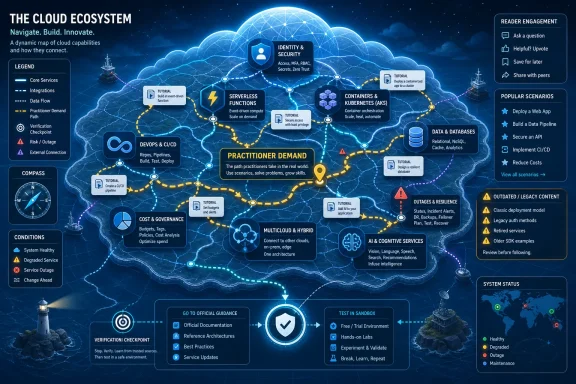
HackerNoon has assembled 140 free blog posts about Microsoft Azure, ranked by its reader-engagement data, into a sprawling learning index that ranges from identity and serverless code to Kubernetes, multicloud migration, cost control, outages, artificial intelligence, and certification preparation for developers and administrators. It is an unusually broad snapshot of what practitioners actually read when Azure becomes a working problem rather than an abstract platform. That makes the collection useful, but it also exposes its central weakness: popularity can identify friction, yet it cannot replace a curriculum. The list is best understood as a map of practitioner demand, not a validated Azure syllabus.
HackerNoon describes the collection plainly: 140 free posts, ordered using its reader-engagement data. Its Learn Repo project applies the same premise to other technologies—start with what readers have spent time on rather than what a vendor, instructor, or certification blueprint believes should come first.
There is real intelligence in that approach. Official learning programs tend to impose a clean progression from fundamentals to architecture, while engineers rarely encounter cloud platforms so politely. A developer may first meet Azure through a failed function deployment, an authentication error, a request to upload a 40GB virtual-machine image, or an urgent demand to connect an existing Java application to a managed database.
The HackerNoon list reflects that messiness. Its early entries include Application Insights logging, flexible SQL infrastructure, authentication through the MSAL Python library and Flask, Azure DevOps permissions, Datadog monitoring, local Azure Functions configuration, and Microsoft Dynamics 365 integration. These are not chapters in a textbook; they are the points at which teams discover that using the cloud means coordinating code, identity, operations, data, and organizational access.
That is precisely why the collection should not be read from top to bottom as if its ranking represented instructional sequence. Reader engagement measures attention, not accuracy, freshness, difficulty, completeness, or architectural importance. A highly read workaround may answer a narrow historical problem, while a less popular article on governance may matter more to an enterprise preparing a production environment.
Microsoft’s own Azure material frames the platform around building, deploying, and managing solutions. Microsoft Learn’s Cloud Adoption Framework goes further, separating the work into strategy, planning, environment readiness, migration, modernization, cloud-native development, governance, security, and management. HackerNoon’s list cuts horizontally across all those concerns, but it does not organize them into that operational lifecycle.
The difference is important. Microsoft provides the official model; HackerNoon provides evidence of where the model collides with reality.
That breadth makes generic promises to “learn Azure” almost meaningless. An application developer, cloud administrator, data engineer, security specialist, and enterprise architect may all use Azure without sharing much of the same daily work. Even the programming languages and tooling vary: C#, Java, Python, Node.js, PowerShell, Bicep, Terraform, YAML, and Ballerina all appear in the collection.
Some posts sit even farther from conventional infrastructure administration. Microsoft Dynamics 365 is presented as a business-applications platform combining customer relationship management, enterprise resource planning, productivity applications, and artificial intelligence tools. Other entries cover Azure OpenAI, IoT edge processing, Ethereum integration, conversational interfaces, unified data platforms, and 5G-related scenarios.
This diversity is not editorial noise alone. It demonstrates how Azure has become an integration layer spanning Microsoft’s developer, business, identity, data, and operations ecosystems. The practical challenge is no longer merely learning where to create a virtual machine. It is understanding which part of the platform should own a workload, how that service authenticates, how it is deployed, what it costs, what happens when it fails, and how the organization governs it afterward.
The collection succeeds when it makes that surface area visible. A beginner scanning it will quickly understand that Azure competence is not a single skill. It is a collection of related disciplines held together by identity, automation, monitoring, and policy.
The opening group is telling. Application Insights and Serilog appear before an introductory deployment tutorial. Authentication with MSAL Python and Flask appears alongside Azure DevOps permissions. Local function settings and application-performance monitoring also rank prominently.
That order would be strange in a beginner’s course, but it is entirely believable as a record of real-world demand. Developers often inherit an application before they understand its cloud platform. Their first job is not to learn every Azure concept; it is to discover why telemetry is incomplete, why a token is rejected, why a function works locally but not after deployment, or why a team cannot access a pipeline.
Engagement, however, also amplifies catchy claims, urgent fixes, and fashionable topics. One entry claims that 90% of applications have five times more resources than they need. That may be an effective prompt to investigate overprovisioning, but an administrator should not convert it into a capacity-planning assumption without examining the original article’s methodology and measuring the actual workload.
The same caution applies to competitive cloud comparisons. The collection includes an updated 2021 pricing comparison for AWS, Azure, and Google Cloud, alongside posts that call Amazon, Azure, and Google the “Big Three.” Such articles may help identify pricing dimensions and strategic questions, but cloud prices, service capabilities, discounts, and licensing conditions are moving targets. A historical comparison is evidence of how the market looked when it was written, not a procurement answer that can safely be reused.
Engagement is not validation. It tells an editor what attracted readers and tells a practitioner where others encountered friction. It does not tell an administrator whether commands still work, names remain current, security advice is complete, or a service behaves the same way today.
Those examples are more valuable than broad declarations about cloud agility because they introduce the awkward boundaries between services. Moving a large image is not merely a storage lesson; it involves tooling, transfer reliability, permissions, file formats, and the eventual creation of a virtual machine. Connecting an application running in AKS to PostgreSQL is not merely a Kubernetes lesson; it crosses container orchestration, identity, networking, database access, and application configuration.
A separate scenario begins with enterprise services developed for the previous two years in one of two cloud providers before a decision to use the other. That framing captures an uncomfortable truth about multicloud strategy: portability is usually discussed after code, data, deployment systems, and operational habits have already accumulated around one provider.
Other entries deal with automated replication from AWS storage to Azure Blob Storage, multicloud inventory, cloud-provider command-line interfaces, Terraform, Crossplane authentication, and CAST AI support for Amazon Web Services, Google Cloud Platform, and Azure. Taken together, these posts present multicloud not as a pristine architecture selected at project inception, but as a response to mandates, migration pressure, cost concerns, acquisitions, and existing technical debt.
This is where community writing can outperform product documentation. Official documentation explains supported behavior and recommended configuration. Practitioner posts can document the crooked route by which an organization arrived at the problem in the first place.
The tradeoff is consistency. A practitioner tutorial may contain exactly the workaround a reader needs, yet omit threat modeling, rollback planning, governance, or future maintenance. Its specificity is both its advantage and its boundary.
That repetition is meaningful. Serverless platforms are marketed as a way to avoid infrastructure management, but the HackerNoon entries show how quickly the abstraction acquires its own operational vocabulary. Developers still have to understand triggers, bindings, secrets, deployment pipelines, runtime compatibility, logging, storage, identity, and the differences between local and hosted execution.
One post explains that C# Azure Functions can run in an isolated process, decoupling the .NET version used by the function from the runtime version. Another explores how bindings differ between in-process and isolated functions. Together, they illustrate the sort of platform evolution that makes old tutorials dangerous even when their code remains superficially familiar.
Ballerina’s built-in Azure Functions support since version 1.2.5 is another example of the ecosystem extending beyond Microsoft’s most familiar development stack. The post describes mapping parameters and return types to function triggers and bindings, allowing access to services such as storage and databases through the function model.
The value of these articles is not that every Azure learner should adopt every language or framework represented. It is that they reveal the common architecture beneath them: event-driven execution, managed integrations, identity-mediated access, observability, and automated delivery.
A sensible learner should therefore read across implementations rather than collecting isolated recipes. The C# developer can learn something from the Node.js deployment post; the Node.js developer can learn something from the discussion of isolated processes; both can benefit from the articles on monitoring, secrets, and pipeline design. Azure services create the shared operational environment even when application languages differ.
Running Spring Boot on AKS is not inherently the difficult part. The difficult part is establishing a repeatable path from source code to a cluster, connecting the workload to data, assigning identity, constraining network access, monitoring behavior, and recovering when one of those dependencies changes.
The list’s inclusion of zone resiliency is particularly important because availability does not emerge automatically from selecting a managed service. A workload can run on a highly available platform while remaining vulnerable to a single deployment mistake, a narrow network dependency, insufficient replicas, an unavailable database, or an untested recovery process.
Microsoft’s Well-Architected guidance treats reliability, security, cost optimization, operational excellence, and performance efficiency as related concerns with unavoidable tradeoffs. The HackerNoon posts demonstrate those tradeoffs in fragments. A zone-resilient design may improve fault tolerance while adding operational complexity and cost. Aggressive rightsizing may save money while leaving too little capacity for failover. Extra logging may improve diagnosis while increasing data volume and expense.
Readers should resist the temptation to treat each tutorial as a self-contained architecture. A functioning cluster configuration is not necessarily a production design. It is one component in a system that still requires lifecycle management, access control, observability, capacity planning, and tested failure handling.
It also means the archive contains terminology, assumptions, comparisons, and implementation details from different periods. An older article can explain why a pattern became popular, but it may no longer describe the preferred identity mechanism, supported runtime, current product name, or most economical service configuration.
The source itself places old and new subjects side by side. A post references Viet Nam Web Summit 2019 and its VNWS2019 abbreviation. Another looks back from the 2020s to life in 2010, when 4G had become prominent and 5G was still on the horizon. A 2021 article compares pricing across AWS, Azure, and Google Cloud, while another entry addresses a major Azure outage on July 19, 2024.
That temporal mixture should change how the collection is used. Older posts belong in an archive track: useful for concepts, migration history, and understanding design decisions that may still exist in production. Newer posts belong in a verification track: potentially actionable, but still requiring confirmation against official documentation and a test environment.
2021 — A listed comparison revisits pricing across AWS, Azure, and Google Cloud, offering a historical market snapshot rather than a timeless purchasing guide.
10/9/2023 — The collection includes a dated HackerNoon homepage item identifying the day’s top five stories, showing that the index incorporates editorial and community material alongside tutorials.
July 19, 2024 — A listed article reports that Azure cloud services experienced a significant outage, bringing operational failure and dependency risk into an otherwise tutorial-heavy collection.
Chronology matters because cloud guidance decays unevenly. A general explanation of horizontal versus vertical scaling may remain useful for years. A tutorial tied to a particular identity component, runtime behavior, portal screen, or SDK can become misleading much faster.
It is also an area in which historical tutorials require especially careful handling. Product naming, preferred authentication flows, SDK behavior, managed identity patterns, and security recommendations evolve. An article can remain conceptually sound while its screenshots, names, packages, or setup sequence age out from under it.
The Java Spring Boot and AKS example is useful precisely because it combines application identity with database access. But any administrator reproducing the pattern should verify the current supported identity method rather than assuming that the component named in the original post remains the preferred choice.
The MSAL Python and Flask article offers a similar lesson. Its durable value lies in the authentication concepts: obtaining tokens, validating identity, constraining access, and integrating a third-party service with Microsoft’s identity platform. Its code and configuration should be treated as a starting hypothesis until checked against current library documentation.
This is not a reason to discard community tutorials. Official identity documentation can be comprehensive yet difficult to translate into a small application. A focused tutorial gives the reader a concrete path. The responsible workflow is to use community material for orientation and official documentation for confirmation.
Security-sensitive instructions deserve the strictest standard. If an article handles credentials, tokens, pipeline permissions, database access, secrets, or administrative roles, readers should identify every trust boundary before reproducing it. A tutorial that makes an application work is not automatically a tutorial that makes it safe.
Another post states that major cloud providers commonly guarantee availability service-level agreements of about 99.95%. That figure sounds reassuring until an administrator converts it into allowed downtime, examines which individual service the guarantee covers, and asks whether the complete application can remain available when one dependency fails.
An SLA is also not an architecture. It does not configure replication, make backups restorable, distribute application instances, protect an identity dependency, or create an incident-response plan. It describes a provider commitment under defined conditions; it does not guarantee that a customer’s workload has been designed to survive an incident.
The collection contains many of the pieces needed for a more mature discussion: zone resiliency, monitoring, traffic management, automation, backup, scaling, cloud outages, multicloud replication, and disaster recovery. Its weakness is that these pieces appear as separate destinations rather than a unified reliability practice.
Administrators can supply that missing structure. Every tutorial that deploys a service should trigger a second set of questions: how is it observed, how is data protected, what is its failure domain, what depends on it, how is it restored, and how is configuration reproduced? Without those answers, the exercise teaches creation but not operation.
Multicloud articles should receive the same scrutiny. Moving data between providers may reduce one form of dependency while creating more integration points, security policies, billing models, and recovery procedures. Redundancy only improves reliability when teams can operate it under pressure.
The provocative claim that 90% of applications have five times more resources than necessary captures the concern, even if it should not be accepted as a universal measurement. Overprovisioning is common because teams size for uncertain peaks, duplicate environments, retain abandoned resources, or avoid the perceived risk of reducing capacity.
Yet underprovisioning has costs too. Performance failures, emergency scaling, unavailable services, and engineering time can easily erase savings from an aggressively reduced configuration. Microsoft’s Well-Architected guidance treats cost as a tradeoff rather than a contest to produce the smallest bill.
The correct lesson is not “shrink everything.” It is to measure utilization, define service objectives, understand scaling behavior, identify ownership, and test changes. A resource that appears idle may provide failover capacity, absorb periodic demand, or support a recovery requirement. Another may truly be waste left behind by a completed experiment.
Posts comparing CAST AI and Spot.io, discussing automated optimization, or covering vertical and horizontal scaling can help teams build a vocabulary for the problem. They cannot determine the correct action for a workload without telemetry, business context, and a rollback plan.
The same limitation affects cross-provider pricing comparisons. Cost depends on architecture, data movement, support, licensing, commitments, operations, and staff capability—not merely a displayed compute rate. A company can select the nominally cheaper service and still create the more expensive system.
One post argues that organizations can use large language models while retaining data ownership. That concern places AI directly inside the enterprise architecture debate. The question is no longer simply whether a model can produce an acceptable response; it is where data travels, who can access it, how output is validated, and what evidence exists when an automated decision goes wrong.
The inclusion of Pydantic-based validation and a confidence gate is significant because it moves beyond demonstration. Generative systems produce probabilistic output, so a successful API call does not guarantee usable data. Applications need schema enforcement, confidence thresholds, fallback behavior, monitoring, and explicit handling of incomplete or malformed results.
This mirrors the broader lesson of the collection. Azure abstractions accelerate development, but every abstraction creates a new operational contract. A model endpoint still needs identity, networking, cost controls, telemetry, data governance, and failure handling.
AI also increases the risk of copying tutorials without understanding their boundaries. A compelling demo may omit evaluation, prompt-injection defenses, sensitive-data handling, or output review. Community posts can show what is possible; production teams must define what is permissible.
The collection is strongest when its AI entries are read alongside its security, governance, logging, data-platform, and cost material. Treating AI as a separate novelty track would repeat the same mistake early cloud projects made when they treated infrastructure availability as the whole architecture.
A useful process begins by assigning each article to an operational objective. A logging tutorial belongs under observability; a feature-flag article belongs under safe delivery; an Azure Key Vault component belongs under secrets management; a storage-upload workaround belongs under migration or data movement. This prevents the team from accumulating disconnected experiments with no relation to business needs.
Each item should then be classified by risk. A conceptual comparison can be read without consequence. Code that creates billable infrastructure, changes permissions, moves data, or modifies identity should be reproduced only in an isolated environment with spending and access controls.
Finally, the result should be documented internally. If a tutorial solves a real problem, the team should capture the verified commands, current prerequisites, security decisions, cleanup procedure, and owner. The community post then becomes the spark for an organizationally controlled procedure rather than a permanent external dependency.
A platform engineer working with AKS should connect cluster provisioning to networking, identity, zone resiliency, databases, observability, scaling, and cost. Reading only the deployment article would produce a functioning demonstration but leave the operating model unfinished.
An administrator focused on governance should start with Azure’s four levels of management scope, rights and permissions, Active Directory objects, policy-oriented tooling, PowerShell automation, Terraform state, asset inventory, and backup. The point is not to read every associated post immediately, but to construct a chain from organizational control to technical implementation.
A data professional might connect Azure SQL, Cosmos DB, PostgreSQL, Synapse, Azure Data Factory, storage, data platforms, and multicloud replication. An AI practitioner should add identity, data governance, validation, telemetry, and cost controls to the obvious model and application tutorials.
Certification candidates need an additional distinction. The list includes Azure fundamentals resources and a post asking whether to take the AZ-500 test, but community reading is not a substitute for an official exam outline. Such posts can provide context, motivation, and alternative explanations; the current official skills definition must govern preparation.
This role-based reordering turns the list’s disorder into an advantage. Readers can follow the contour of a real system rather than an editor’s popularity ranking. More importantly, they can see where a tutorial stops and where their professional responsibility begins.
That pattern should influence how organizations train cloud teams. Product familiarity matters, but the most transferable skills sit between products: diagnosing a distributed application, designing least-privilege access, automating a deployment, validating recovery, interpreting telemetry, and reasoning about tradeoffs.
Microsoft Learn’s own skills guidance emphasizes governance, security, identity, networking, management, workload design, monitoring, reliability, infrastructure as code, containers, microservices, and AI development. HackerNoon’s reader-driven archive independently points toward much the same competency set, albeit through anecdotes and tutorials rather than a formal framework.
The agreement is more important than the differences. Cloud learning works best when structured guidance and practitioner experience reinforce one another. Official material defines supported behavior and architectural intent; community material shows where implementations become confusing, expensive, brittle, or unexpectedly difficult.
The danger comes when either side is used alone. Vendor documentation may describe the ideal path without conveying the accumulated compromises of an existing environment. Community guidance may solve the immediate symptom without exposing the platform-level consequences.
A mature Azure learning program needs both, plus hands-on validation. Reading establishes vocabulary. Labs establish mechanical competence. Design review establishes judgment. Production experience establishes humility.
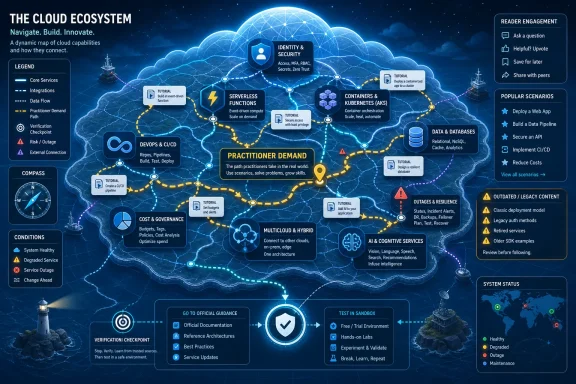 HackerNoon Has Built a Map, Not a Curriculum
HackerNoon describes the collection plainly: 140 free posts, ordered using its reader-engagement data. Its Learn Repo project applies the same premise to other technologies—start with what readers have spent time on rather than what a vendor, instructor, or certification blueprint believes should come first.There is real intelligence in that approach. Official learning programs tend to impose a clean progression from fundamentals to architecture, while engineers rarely encounter cloud platforms so politely. A developer may first meet Azure through a failed function deployment, an authentication error, a request to upload a 40GB virtual-machine image, or an urgent demand to connect an existing Java application to a managed database.
The HackerNoon list reflects that messiness. Its early entries include Application Insights logging, flexible SQL infrastructure, authentication through the MSAL Python library and Flask, Azure DevOps permissions, Datadog monitoring, local Azure Functions configuration, and Microsoft Dynamics 365 integration. These are not chapters in a textbook; they are the points at which teams discover that using the cloud means coordinating code, identity, operations, data, and organizational access.
That is precisely why the collection should not be read from top to bottom as if its ranking represented instructional sequence. Reader engagement measures attention, not accuracy, freshness, difficulty, completeness, or architectural importance. A highly read workaround may answer a narrow historical problem, while a less popular article on governance may matter more to an enterprise preparing a production environment.
Microsoft’s own Azure material frames the platform around building, deploying, and managing solutions. Microsoft Learn’s Cloud Adoption Framework goes further, separating the work into strategy, planning, environment readiness, migration, modernization, cloud-native development, governance, security, and management. HackerNoon’s list cuts horizontally across all those concerns, but it does not organize them into that operational lifecycle.
The difference is important. Microsoft provides the official model; HackerNoon provides evidence of where the model collides with reality.
Azure’s Size Turns Discovery Into a Skill of Its Own
Azure is Microsoft’s cloud-computing platform, but that short definition disguises the scale of what learners must absorb. Even within this collection, “learning Azure” can mean writing a serverless Node.js application, managing Active Directory objects with Terraform, comparing SQL purchasing models, designing an AKS network, automating a pipeline, controlling costs, or building around an outage.That breadth makes generic promises to “learn Azure” almost meaningless. An application developer, cloud administrator, data engineer, security specialist, and enterprise architect may all use Azure without sharing much of the same daily work. Even the programming languages and tooling vary: C#, Java, Python, Node.js, PowerShell, Bicep, Terraform, YAML, and Ballerina all appear in the collection.
Some posts sit even farther from conventional infrastructure administration. Microsoft Dynamics 365 is presented as a business-applications platform combining customer relationship management, enterprise resource planning, productivity applications, and artificial intelligence tools. Other entries cover Azure OpenAI, IoT edge processing, Ethereum integration, conversational interfaces, unified data platforms, and 5G-related scenarios.
This diversity is not editorial noise alone. It demonstrates how Azure has become an integration layer spanning Microsoft’s developer, business, identity, data, and operations ecosystems. The practical challenge is no longer merely learning where to create a virtual machine. It is understanding which part of the platform should own a workload, how that service authenticates, how it is deployed, what it costs, what happens when it fails, and how the organization governs it afterward.
The collection succeeds when it makes that surface area visible. A beginner scanning it will quickly understand that Azure competence is not a single skill. It is a collection of related disciplines held together by identity, automation, monitoring, and policy.
Engagement Ranking Rewards Pain More Reliably Than Fundamentals
The strongest argument for HackerNoon’s ranking method is that readers reveal their priorities through behavior. Logging, authentication, deployment, troubleshooting, and cost articles attract attention because those are recurring sources of engineering pain. A list ranked by engagement can therefore function as an informal survey of the Azure problems that send practitioners searching for help.The opening group is telling. Application Insights and Serilog appear before an introductory deployment tutorial. Authentication with MSAL Python and Flask appears alongside Azure DevOps permissions. Local function settings and application-performance monitoring also rank prominently.
That order would be strange in a beginner’s course, but it is entirely believable as a record of real-world demand. Developers often inherit an application before they understand its cloud platform. Their first job is not to learn every Azure concept; it is to discover why telemetry is incomplete, why a token is rejected, why a function works locally but not after deployment, or why a team cannot access a pipeline.
Engagement, however, also amplifies catchy claims, urgent fixes, and fashionable topics. One entry claims that 90% of applications have five times more resources than they need. That may be an effective prompt to investigate overprovisioning, but an administrator should not convert it into a capacity-planning assumption without examining the original article’s methodology and measuring the actual workload.
The same caution applies to competitive cloud comparisons. The collection includes an updated 2021 pricing comparison for AWS, Azure, and Google Cloud, alongside posts that call Amazon, Azure, and Google the “Big Three.” Such articles may help identify pricing dimensions and strategic questions, but cloud prices, service capabilities, discounts, and licensing conditions are moving targets. A historical comparison is evidence of how the market looked when it was written, not a procurement answer that can safely be reused.
Engagement is not validation. It tells an editor what attracted readers and tells a practitioner where others encountered friction. It does not tell an administrator whether commands still work, names remain current, security advice is complete, or a service behaves the same way today.
The Best Entries Begin Where Product Pages Stop
The collection is most persuasive when its posts describe a specific task with enough constraints to resemble actual work. One author needed to move a 40GB virtual-machine image into an Azure storage account. Another post explains how to run a Java Spring Boot application on Azure Kubernetes Service, connect it to Azure PostgreSQL, and use Azure AD Pod Identity.Those examples are more valuable than broad declarations about cloud agility because they introduce the awkward boundaries between services. Moving a large image is not merely a storage lesson; it involves tooling, transfer reliability, permissions, file formats, and the eventual creation of a virtual machine. Connecting an application running in AKS to PostgreSQL is not merely a Kubernetes lesson; it crosses container orchestration, identity, networking, database access, and application configuration.
A separate scenario begins with enterprise services developed for the previous two years in one of two cloud providers before a decision to use the other. That framing captures an uncomfortable truth about multicloud strategy: portability is usually discussed after code, data, deployment systems, and operational habits have already accumulated around one provider.
Other entries deal with automated replication from AWS storage to Azure Blob Storage, multicloud inventory, cloud-provider command-line interfaces, Terraform, Crossplane authentication, and CAST AI support for Amazon Web Services, Google Cloud Platform, and Azure. Taken together, these posts present multicloud not as a pristine architecture selected at project inception, but as a response to mandates, migration pressure, cost concerns, acquisitions, and existing technical debt.
This is where community writing can outperform product documentation. Official documentation explains supported behavior and recommended configuration. Practitioner posts can document the crooked route by which an organization arrived at the problem in the first place.
The tradeoff is consistency. A practitioner tutorial may contain exactly the workaround a reader needs, yet omit threat modeling, rollback planning, governance, or future maintenance. Its specificity is both its advantage and its boundary.
Serverless Becomes the Collection’s Native Language
Azure Functions and serverless development recur throughout the list in multiple languages and operational contexts. The collection covers local settings, service-bus triggers, isolated functions, bindings, deployment slots, Node.js applications, C# pipelines, tests, token-refresh jobs, Dockerized authorization failures, and Ballerina integration.That repetition is meaningful. Serverless platforms are marketed as a way to avoid infrastructure management, but the HackerNoon entries show how quickly the abstraction acquires its own operational vocabulary. Developers still have to understand triggers, bindings, secrets, deployment pipelines, runtime compatibility, logging, storage, identity, and the differences between local and hosted execution.
One post explains that C# Azure Functions can run in an isolated process, decoupling the .NET version used by the function from the runtime version. Another explores how bindings differ between in-process and isolated functions. Together, they illustrate the sort of platform evolution that makes old tutorials dangerous even when their code remains superficially familiar.
Ballerina’s built-in Azure Functions support since version 1.2.5 is another example of the ecosystem extending beyond Microsoft’s most familiar development stack. The post describes mapping parameters and return types to function triggers and bindings, allowing access to services such as storage and databases through the function model.
The value of these articles is not that every Azure learner should adopt every language or framework represented. It is that they reveal the common architecture beneath them: event-driven execution, managed integrations, identity-mediated access, observability, and automated delivery.
A sensible learner should therefore read across implementations rather than collecting isolated recipes. The C# developer can learn something from the Node.js deployment post; the Node.js developer can learn something from the discussion of isolated processes; both can benefit from the articles on monitoring, secrets, and pipeline design. Azure services create the shared operational environment even when application languages differ.
Kubernetes Turns Cloud Convenience Back Into Systems Engineering
The AKS material offers a useful counterweight to serverless optimism. Topics include zone resiliency, virtual networks, serverless virtual nodes, Terraform provisioning, PostgreSQL connectivity, identity, and application deployment. Each one exposes another layer that a managed Kubernetes service simplifies without eliminating.Running Spring Boot on AKS is not inherently the difficult part. The difficult part is establishing a repeatable path from source code to a cluster, connecting the workload to data, assigning identity, constraining network access, monitoring behavior, and recovering when one of those dependencies changes.
The list’s inclusion of zone resiliency is particularly important because availability does not emerge automatically from selecting a managed service. A workload can run on a highly available platform while remaining vulnerable to a single deployment mistake, a narrow network dependency, insufficient replicas, an unavailable database, or an untested recovery process.
Microsoft’s Well-Architected guidance treats reliability, security, cost optimization, operational excellence, and performance efficiency as related concerns with unavoidable tradeoffs. The HackerNoon posts demonstrate those tradeoffs in fragments. A zone-resilient design may improve fault tolerance while adding operational complexity and cost. Aggressive rightsizing may save money while leaving too little capacity for failover. Extra logging may improve diagnosis while increasing data volume and expense.
Readers should resist the temptation to treat each tutorial as a self-contained architecture. A functioning cluster configuration is not necessarily a production design. It is one component in a system that still requires lifecycle management, access control, observability, capacity planning, and tested failure handling.
The Collection’s Age Is Context and Liability at Once
The list stretches across several generations of cloud practice. That gives it historical value: readers can see serverless, containers, multicloud, IoT, infrastructure as code, and artificial intelligence moving from emerging ideas into routine engineering concerns.It also means the archive contains terminology, assumptions, comparisons, and implementation details from different periods. An older article can explain why a pattern became popular, but it may no longer describe the preferred identity mechanism, supported runtime, current product name, or most economical service configuration.
The source itself places old and new subjects side by side. A post references Viet Nam Web Summit 2019 and its VNWS2019 abbreviation. Another looks back from the 2020s to life in 2010, when 4G had become prominent and 5G was still on the horizon. A 2021 article compares pricing across AWS, Azure, and Google Cloud, while another entry addresses a major Azure outage on July 19, 2024.
That temporal mixture should change how the collection is used. Older posts belong in an archive track: useful for concepts, migration history, and understanding design decisions that may still exist in production. Newer posts belong in a verification track: potentially actionable, but still requiring confirmation against official documentation and a test environment.
Timeline
2019 — A serverless-migration tutorial draws on material presented at Viet Nam Web Summit 2019, or VNWS2019, capturing the period when serverless adoption still required extensive explanation.2021 — A listed comparison revisits pricing across AWS, Azure, and Google Cloud, offering a historical market snapshot rather than a timeless purchasing guide.
10/9/2023 — The collection includes a dated HackerNoon homepage item identifying the day’s top five stories, showing that the index incorporates editorial and community material alongside tutorials.
July 19, 2024 — A listed article reports that Azure cloud services experienced a significant outage, bringing operational failure and dependency risk into an otherwise tutorial-heavy collection.
Chronology matters because cloud guidance decays unevenly. A general explanation of horizontal versus vertical scaling may remain useful for years. A tutorial tied to a particular identity component, runtime behavior, portal screen, or SDK can become misleading much faster.
Identity Drift Is the Archive’s Clearest Warning Label
Identity appears repeatedly through Active Directory authentication, the MSAL Python library, Flask, application identities, Terraform providers, .NET applications, Kubernetes workloads, access automation, and organizational permissions. That is appropriate: identity is the connective tissue of Azure administration.It is also an area in which historical tutorials require especially careful handling. Product naming, preferred authentication flows, SDK behavior, managed identity patterns, and security recommendations evolve. An article can remain conceptually sound while its screenshots, names, packages, or setup sequence age out from under it.
The Java Spring Boot and AKS example is useful precisely because it combines application identity with database access. But any administrator reproducing the pattern should verify the current supported identity method rather than assuming that the component named in the original post remains the preferred choice.
The MSAL Python and Flask article offers a similar lesson. Its durable value lies in the authentication concepts: obtaining tokens, validating identity, constraining access, and integrating a third-party service with Microsoft’s identity platform. Its code and configuration should be treated as a starting hypothesis until checked against current library documentation.
This is not a reason to discard community tutorials. Official identity documentation can be comprehensive yet difficult to translate into a small application. A focused tutorial gives the reader a concrete path. The responsible workflow is to use community material for orientation and official documentation for confirmation.
Security-sensitive instructions deserve the strictest standard. If an article handles credentials, tokens, pipeline permissions, database access, secrets, or administrative roles, readers should identify every trust boundary before reproducing it. A tutorial that makes an application work is not automatically a tutorial that makes it safe.
Outages Break the Myth of Purchased Reliability
The collection’s outage material adds an essential corrective to the cloud-learning genre. Tutorials usually end when deployment succeeds; operations begin at exactly that point. The listed account of significant Azure disruption on July 19, 2024 reminds readers that a managed platform transfers responsibility but does not abolish dependency risk.Another post states that major cloud providers commonly guarantee availability service-level agreements of about 99.95%. That figure sounds reassuring until an administrator converts it into allowed downtime, examines which individual service the guarantee covers, and asks whether the complete application can remain available when one dependency fails.
An SLA is also not an architecture. It does not configure replication, make backups restorable, distribute application instances, protect an identity dependency, or create an incident-response plan. It describes a provider commitment under defined conditions; it does not guarantee that a customer’s workload has been designed to survive an incident.
The collection contains many of the pieces needed for a more mature discussion: zone resiliency, monitoring, traffic management, automation, backup, scaling, cloud outages, multicloud replication, and disaster recovery. Its weakness is that these pieces appear as separate destinations rather than a unified reliability practice.
Administrators can supply that missing structure. Every tutorial that deploys a service should trigger a second set of questions: how is it observed, how is data protected, what is its failure domain, what depends on it, how is it restored, and how is configuration reproduced? Without those answers, the exercise teaches creation but not operation.
Multicloud articles should receive the same scrutiny. Moving data between providers may reduce one form of dependency while creating more integration points, security policies, billing models, and recovery procedures. Redundancy only improves reliability when teams can operate it under pressure.
Cost Advice Becomes Useful Only After Measurement
Cost optimization is another recurring theme, from virtual-machine selection and scaling to automated optimization platforms and comparisons among providers. The popularity of these posts reflects a familiar cloud pattern: resources can be created quickly, while ownership, utilization, and cleanup processes arrive later.The provocative claim that 90% of applications have five times more resources than necessary captures the concern, even if it should not be accepted as a universal measurement. Overprovisioning is common because teams size for uncertain peaks, duplicate environments, retain abandoned resources, or avoid the perceived risk of reducing capacity.
Yet underprovisioning has costs too. Performance failures, emergency scaling, unavailable services, and engineering time can easily erase savings from an aggressively reduced configuration. Microsoft’s Well-Architected guidance treats cost as a tradeoff rather than a contest to produce the smallest bill.
The correct lesson is not “shrink everything.” It is to measure utilization, define service objectives, understand scaling behavior, identify ownership, and test changes. A resource that appears idle may provide failover capacity, absorb periodic demand, or support a recovery requirement. Another may truly be waste left behind by a completed experiment.
Posts comparing CAST AI and Spot.io, discussing automated optimization, or covering vertical and horizontal scaling can help teams build a vocabulary for the problem. They cannot determine the correct action for a workload without telemetry, business context, and a rollback plan.
The same limitation affects cross-provider pricing comparisons. Cost depends on architecture, data movement, support, licensing, commitments, operations, and staff capability—not merely a displayed compute rate. A company can select the nominally cheaper service and still create the more expensive system.
Artificial Intelligence Widens the Platform Before It Simplifies It
AI-related entries demonstrate how quickly Azure’s learning surface has expanded. The list includes Azure OpenAI introductions, text generation, function calling, validation of unpredictable outputs, conversational enterprise interfaces, agent pipelines, and Microsoft’s Open AI challenge for developers learning to build Azure AI solutions and applications.One post argues that organizations can use large language models while retaining data ownership. That concern places AI directly inside the enterprise architecture debate. The question is no longer simply whether a model can produce an acceptable response; it is where data travels, who can access it, how output is validated, and what evidence exists when an automated decision goes wrong.
The inclusion of Pydantic-based validation and a confidence gate is significant because it moves beyond demonstration. Generative systems produce probabilistic output, so a successful API call does not guarantee usable data. Applications need schema enforcement, confidence thresholds, fallback behavior, monitoring, and explicit handling of incomplete or malformed results.
This mirrors the broader lesson of the collection. Azure abstractions accelerate development, but every abstraction creates a new operational contract. A model endpoint still needs identity, networking, cost controls, telemetry, data governance, and failure handling.
AI also increases the risk of copying tutorials without understanding their boundaries. A compelling demo may omit evaluation, prompt-injection defenses, sensitive-data handling, or output review. Community posts can show what is possible; production teams must define what is permissible.
The collection is strongest when its AI entries are read alongside its security, governance, logging, data-platform, and cost material. Treating AI as a separate novelty track would repeat the same mistake early cloud projects made when they treated infrastructure availability as the whole architecture.
Administrators Should Turn the List Into a Controlled Experiment Queue
For Windows and Azure administrators, the practical value of the collection lies in triage. It can reveal unfamiliar services, provide implementation ideas, and supply compact examples for internal labs. It should not become a source of unreviewed production runbooks.A useful process begins by assigning each article to an operational objective. A logging tutorial belongs under observability; a feature-flag article belongs under safe delivery; an Azure Key Vault component belongs under secrets management; a storage-upload workaround belongs under migration or data movement. This prevents the team from accumulating disconnected experiments with no relation to business needs.
Each item should then be classified by risk. A conceptual comparison can be read without consequence. Code that creates billable infrastructure, changes permissions, moves data, or modifies identity should be reproduced only in an isolated environment with spending and access controls.
Finally, the result should be documented internally. If a tutorial solves a real problem, the team should capture the verified commands, current prerequisites, security decisions, cleanup procedure, and owner. The community post then becomes the spark for an organizationally controlled procedure rather than a permanent external dependency.
Action checklist for admins
- Select posts by an identified skills gap or workload requirement, not merely by their engagement ranking.
- Verify product names, SDKs, identity methods, runtime behavior, and service limitations against current Microsoft documentation.
- Reproduce technical steps in a sandbox using nonproduction data, restricted credentials, and explicit cost boundaries.
- Record every created resource and include a cleanup step before beginning an experiment.
- Review authentication, secrets, network exposure, permissions, telemetry, backup, and rollback before promoting any pattern.
- Convert successful experiments into version-controlled internal guidance with an owner and review schedule.
- Recheck historical pricing, SLA, availability, and competitive claims before using them in architecture or procurement decisions.
A Better Reading Order Starts With the Workload
The most effective way to use the 140-post collection is to ignore its numerical sequence and build a role-specific route through it. A developer beginning with Azure Functions should combine the introductory deployment posts with isolated-process guidance, bindings, logging, local configuration, secrets, testing, and pipeline automation.A platform engineer working with AKS should connect cluster provisioning to networking, identity, zone resiliency, databases, observability, scaling, and cost. Reading only the deployment article would produce a functioning demonstration but leave the operating model unfinished.
An administrator focused on governance should start with Azure’s four levels of management scope, rights and permissions, Active Directory objects, policy-oriented tooling, PowerShell automation, Terraform state, asset inventory, and backup. The point is not to read every associated post immediately, but to construct a chain from organizational control to technical implementation.
A data professional might connect Azure SQL, Cosmos DB, PostgreSQL, Synapse, Azure Data Factory, storage, data platforms, and multicloud replication. An AI practitioner should add identity, data governance, validation, telemetry, and cost controls to the obvious model and application tutorials.
Certification candidates need an additional distinction. The list includes Azure fundamentals resources and a post asking whether to take the AZ-500 test, but community reading is not a substitute for an official exam outline. Such posts can provide context, motivation, and alternative explanations; the current official skills definition must govern preparation.
This role-based reordering turns the list’s disorder into an advantage. Readers can follow the contour of a real system rather than an editor’s popularity ranking. More importantly, they can see where a tutorial stops and where their professional responsibility begins.
The Archive Reveals What Azure Users Actually Struggle With
Read as a whole, the collection offers a clearer picture of Azure practice than its individual entries suggest. The recurring subjects are not glamorous product announcements. They are logging, identity, deployment, data movement, scaling, permissions, cost, reliability, and integration.That pattern should influence how organizations train cloud teams. Product familiarity matters, but the most transferable skills sit between products: diagnosing a distributed application, designing least-privilege access, automating a deployment, validating recovery, interpreting telemetry, and reasoning about tradeoffs.
Microsoft Learn’s own skills guidance emphasizes governance, security, identity, networking, management, workload design, monitoring, reliability, infrastructure as code, containers, microservices, and AI development. HackerNoon’s reader-driven archive independently points toward much the same competency set, albeit through anecdotes and tutorials rather than a formal framework.
The agreement is more important than the differences. Cloud learning works best when structured guidance and practitioner experience reinforce one another. Official material defines supported behavior and architectural intent; community material shows where implementations become confusing, expensive, brittle, or unexpectedly difficult.
The danger comes when either side is used alone. Vendor documentation may describe the ideal path without conveying the accumulated compromises of an existing environment. Community guidance may solve the immediate symptom without exposing the platform-level consequences.
A mature Azure learning program needs both, plus hands-on validation. Reading establishes vocabulary. Labs establish mechanical competence. Design review establishes judgment. Production experience establishes humility.
What to Keep From the 140-Post Experiment
HackerNoon’s collection is most valuable as a discovery engine and historical record of practitioner attention. Its concrete lessons are less about completing all 140 articles than about learning how to interrogate each one.- The engagement ranking highlights common pain points, not a safe instructional sequence.
- Specific tutorials—such as the 40GB image transfer or Spring Boot deployment to AKS—are useful because they expose cross-service dependencies.
- Historical articles can preserve architectural context while containing outdated names, code, prices, or assumptions.
- Azure Functions, AKS, identity, DevOps, data, cost, and AI should be learned as connected operational systems.
- SLA figures and provider comparisons require workload-specific validation before they influence a production decision.
- The safest workflow is discovery through community writing, confirmation through official guidance, and proof through controlled testing.
References
- Primary source: HackerNoon
Published: 2026-07-11T23:30:09.306817
140 Blog Posts To Learn About Azure | HackerNoon
Learn everything you need to know about Azure via these 140 free HackerNoon blog posts.hackernoon.com - Official source: learn.microsoft.com
Architecture strategies for optimizing environment costs - Microsoft Azure Well-Architected Framework | Microsoft Learn
Learn how to optimize environment costs by tailoring each environment to its specific purpose and optimize it for cost effectiveness.learn.microsoft.com - Official source: azure.microsoft.com