

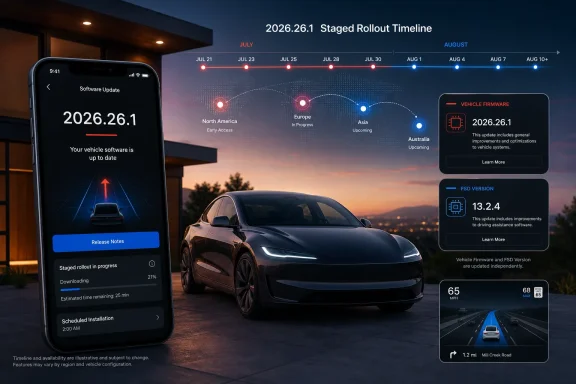
 Tesla 2026.26.1 Summer Update: What Owners Should Expect
Tesla software build 2026.26.1 is beginning to appear, with broader distribution reportedly possible during the week after July 10, 2026, and the rollout targeted for the end of July. No specific new features can responsibly be predicted yet: the supplied BASENOR reporting identifies the build and its expected timing, but not a confirmed feature package. Owners should therefore expect a staged rollout over roughly two to three weeks, potentially concluding before August, rather than assume that a particular interface, entertainment, charging, navigation, or Full Self-Driving change is included.Confirmed / Unknown / What to do
Confirmed in the supplied reporting
Unknown
- Build 2026.26.1 has begun appearing.
- Broader distribution may start during the week after July 10, 2026.
- The estimated rollout period is two to three weeks, with an end-of-July or “before August” target.
What owners should do
- The supplied BASENOR reporting does not identify a confirmed feature list for 2026.26.1.
- It does not identify the vehicle models, regions, hardware configurations, or purchased packages included in the reported rollout.
- It does not confirm an FSD package for 2026.26.1.
- Record the vehicle firmware version and FSD version separately.
- Read the release notes displayed by the vehicle for the package actually offered.
- Do not treat another owner’s screenshot as confirmation of what a different car will receive.
2026.26.1: What Is Verified
BASENOR’s July 10 reporting, attributed to The Tesla Newswire, says some owners were already seeing software build 2026.26.1. Broader availability could begin during the following week, with distribution expected to take approximately two to three weeks and conclude before August.Those descriptions point to the same general window. Beginning the week after July 10 and continuing for two to three weeks would place the reported target near the end of July. They should be treated as an estimate for the rollout, not as a delivery appointment for an individual car.
The version number establishes that a software branch is appearing. It does not reveal its complete contents. Although 2026.26.1 is being discussed as Tesla’s expected 2026 Summer Update, the supplied BASENOR material does not provide a confirmed list of user-facing changes.
That means the following features should not be attached to 2026.26.1 without vehicle release notes or another reliable description of the build:
- New or revised FSD behavior
- Navigation or routing changes
- Charging improvements
- Entertainment applications
- Interface redesigns
- New vehicle controls
- Dashcam or security changes
- Climate or energy-management additions
Firmware and FSD Version Matrix
The most important distinction for owners is that a Tesla vehicle’s firmware version and its FSD version are separate facts. Firmware identifies the broader vehicle-software package. The FSD label identifies the driver-assistance package reported within a particular firmware release.The supplied reporting describes three combinations that should not be merged into one presumed upgrade path:
| Software track | Reported vehicle group | Vehicle firmware | Reported FSD package | Reported timing | What the report establishes |
|---|---|---|---|---|---|
| Expected Summer Update | Vehicle, region, hardware, and package eligibility not identified | 2026.26.1 | Not identified | Appearing by July 10; broader rollout may begin the following week; two-to-three-week estimate with an end-of-July target | The build is appearing, but its feature list and FSD payload are not identified |
| Netherlands FSD rollout | Initial cohort in the Netherlands | 2026.21.100 | FSD (Supervised) v14.2.2.6 | Downloads reportedly began July 10 | A limited Netherlands deployment was reported on a different firmware branch |
| Hardware 3 FSD rollout | Reported Hardware 3 vehicles in the United States and South Korea | 2026.20.51 | FSD v14 Light | U.S. rollout reportedly began June 29 and reached South Korea July 10 | A Hardware 3-oriented FSD package was reported independently of 2026.26.1 |
A screenshot showing 2026.26.1 does not, by itself, show whether the car has v14.2.2.6, v14 Light, another FSD version, or no related FSD change. Conversely, a report mentioning “FSD v14” is incomplete unless it also identifies the underlying vehicle firmware and the relevant hardware or regional context.
There is no need to speculate about whether these branches will eventually align. That possibility does not change the decision an owner must make today: check both numbers on the individual vehicle and rely on the release notes associated with its actual update.
FSD v14.2.2.6 vs. v14 Light
The two FSD packages in the supplied reporting have different firmware pairings and rollout descriptions.BASENOR reports that FSD (Supervised) v14.2.2.6 began downloading to an initial cohort in the Netherlands on July 10 through firmware 2026.21.100. “Initial cohort” describes a limited starting group. The supplied material does not quantify that group or establish availability across the entire Dutch Tesla fleet.
Separately, BASENOR associates FSD v14 Light with firmware 2026.20.51 for Hardware 3 vehicles. That rollout reportedly began in the United States on June 29 and reached South Korea on July 10.
The shared “v14” branding does not make the packages interchangeable. The report associates them with different firmware builds and different hardware or regional groups. It also does not provide a verified feature-by-feature comparison explaining what “Light” changes, removes, retains, or limits.
Owners should therefore avoid claims that v14 Light necessarily alters specific behaviors such as lane selection, merges, pedestrian handling, navigation, traffic-light response, or route planning. Those descriptions require release notes, direct testing tied to a clearly identified build, or another dependable source.
Most importantly, neither reported FSD deployment establishes an FSD payload for 2026.26.1. Receiving the expected Summer Update should not be interpreted as automatic confirmation of either v14.2.2.6 or v14 Light.
Live Self-Driving Indicator in the Tesla App
A separate owner-facing detail in the supplied reporting concerns the Tesla mobile app’s live Self-Driving indicator. This should not be confused with the unknown feature contents of 2026.26.1.The report says owners need:
- Tesla app version 4.58.5 or later
- Vehicle software 2026.20.6.1 or newer
This is an app-and-vehicle compatibility detail, not evidence that the feature was introduced by 2026.26.1. A car may meet the reported requirement on an earlier qualifying firmware release, while a car receiving 2026.26.1 still needs a compatible Tesla app version for the indicator.
The indicator should also be understood as informational. It can help an owner see that FSD is active, but it does not turn the phone into a remote driving or safety-control interface.
For anyone specifically waiting for that indicator, the relevant checks are app 4.58.5 or later and vehicle software 2026.20.6.1 or newer. The correct question is not whether the car has the Summer Update, but whether both reported version requirements have been met.
What Tesla Owners Should Check
Owners do not need to predict the update’s feature list to prepare for the rollout. A short version audit will provide more useful information than comparing isolated screenshots online.Before an update appears
- Update the Tesla mobile app. Install version 4.58.5 or later if you want the reported live Self-Driving indicator and your vehicle otherwise supports it.
- Record the current vehicle firmware. Note the complete number, including the point release, rather than recording only “2026.20” or “2026.26.”
- Record the displayed FSD version separately. Do not assume it can be derived from the vehicle firmware number.
- Remember the indicator requirement. The supplied report says the vehicle must have software 2026.20.6.1 or newer for the live app indicator. This does not identify a 2026.26.1 feature.
- Treat July timing as a rollout estimate. The two-to-three-week window and “before August” framing describe the reported distribution target, not a date promised to a particular vehicle.
When the update is offered
- Confirm the complete offered build number. A later 2026.26 point release may not be identical to 2026.26.1.
- Read the vehicle’s release notes. They are the most relevant description of the package offered to that car.
- Check whether an FSD version is displayed. If so, record it separately from the vehicle firmware.
- Compare like with like. When reviewing an owner report, check its model, hardware generation, country, firmware, and FSD package before drawing conclusions.
- Avoid installing immediately before a required trip. The useful decision is whether the vehicle can remain unavailable during installation, not whether other owners have already received the same build.
After installation
- Verify the installed firmware rather than relying on the notification alone.
- Review the release notes again after installation.
- Check the app version if an expected app-side indicator is absent.
- Do not classify a missing rumored feature as an installation failure. The supplied reporting does not establish that feature as part of 2026.26.1.
- Report the full software combination when discussing the update. “2026.26.1 with no displayed FSD change,” for example, is more informative than “I received the Summer Update.”
Admin Checklist for Tracking 2026.26.1 Reports
Forum administrators and owners compiling rollout information can make reports substantially more useful by requesting the same small set of fields each time.| Field to record | Why it matters |
|---|---|
| Complete vehicle firmware | Distinguishes 2026.26.1 from later point releases or separate branches |
| Displayed FSD version | Prevents firmware and driver-assistance packages from being conflated |
| Vehicle model and model year | Adds context without implying that all similar vehicles will receive the build |
| Hardware generation, if known | Helps distinguish reports involving Hardware 3 and other configurations |
| Country or region | Separates regional rollouts such as the Netherlands, United States, and South Korea |
| Tesla app version | Relevant to app-side features such as the reported live Self-Driving indicator |
| Release-note text or summary | Identifies what the offered package says it includes |
| Date the update appeared | Helps test the reported two-to-three-week rollout estimate |
| Date installation completed | Separates update availability from successful installation |
A delayed offer does not, on its own, prove that a vehicle is incompatible, excluded, malfunctioning, or being held for a particular technical reason. It establishes only that the vehicle has not yet been offered the reported build.
Rollout Timeline
June 29, 2026 — BASENOR reports that the U.S. rollout of FSD v14 Light began for Hardware 3 vehicles through firmware 2026.20.51.July 10, 2026 — Some owners were reportedly seeing the early 2026.26.1 build.
July 10, 2026 — FSD (Supervised) v14.2.2.6 reportedly began downloading to an initial Netherlands cohort on firmware 2026.21.100.
July 10, 2026 — The Hardware 3 FSD v14 Light rollout reportedly reached South Korea.
Week after July 10, 2026 — Broader availability of 2026.26.1 may begin, according to the supplied BASENOR report.
Following two to three weeks — The reported rollout is expected to expand in stages.
Before August 2026 — Distribution is targeted for completion by the end of July.
The “two to three weeks,” “before August,” and “end of July” descriptions are broadly equivalent timing frames in this context. None identifies when a specific vehicle will receive an offer, and the supplied report does not define which portion of the fleet is covered by the completion target.
What to Expect Next
The next useful evidence will be release notes tied directly to 2026.26.1 and subsequent 2026.26 point releases. Those notes can show whether the branch includes visible owner features, maintenance changes, regional differences, or a particular FSD pairing.Additional rollout reports will also be valuable when they include complete software combinations. A report that identifies only the firmware or only the FSD version can easily create confusion, especially while 2026.26.1, 2026.21.100 with v14.2.2.6, and 2026.20.51 with v14 Light are all being discussed.
For now, “what to expect” has a narrow answer: expect a staged rollout that may broaden during the week after July 10 and continue for approximately two to three weeks, with completion targeted before August. Do not expect a verified feature package until the build’s actual release notes establish one.
Owners can prepare by updating the Tesla app to 4.58.5 or later, particularly if they want the separately reported live Self-Driving indicator, and by confirming whether their vehicle has 2026.20.6.1 or newer for that indicator. Those requirements are separate from the still-unverified feature contents of 2026.26.1.
The Summer Update may eventually bring visible changes, under-the-hood work, or different packages for different configurations. The supplied reporting does not yet say. What it does establish is that 2026.26.1 is appearing, broader rollout may start after July 10, and the expected two-to-three-week schedule points to an end-of-July finish. The vehicle’s own release notes—not the Summer Update label—will determine what an individual owner actually receives.
References
- Primary source: BASENOR - Tesla Accessories
Published: Fri, 10 Jul 2026 20:09:01 GMT
Tesla Summer Update 2026.26 Is Coming — What to Expect
Tesla's Summer Update is almost here. According to The Tesla Newswire, the release — likely designated 2026.26 — is expected to begin appearing for owners as early as next week, with a full fleet rollout targeted by the end of July. While Tesla hasn't published an official feature list... www.basenor.com
- Related coverage: tesla.com
- Related coverage: ir.tesla.com
- Related coverage: teslaoracle.com
Belgium approves Tesla FSD, automaker shares ~2 months of safety and usage stats from the Netherlands - Tesla Oracle
Tesla obtains approval to operate Full Self-Driving (Supervised) in Belgium. The automaker shares safety results from the Netherlands public roads of ~2 months usage. www.teslaoracle.com
- Related coverage: teslahub.dk
Tesla FSD v14.2.2.6 ruller ud i Nederlandene | Teslahub
Tesla FSD v14.2.2.6: Se nyheder om HW4, supervised kørsel, aktivering i appen, rulleudrulning i Europa og de vigtigste release notes.teslahub.dk - Related coverage: windowsforum.com
Tesla 2026.21.100 Brings FSD v14.2.2.6 to Dutch Initial Cohort | Windows Forum
Tesla’s firmware 2026.21.100, carrying FSD (Supervised) v14.2.2.6, reportedly began downloading to an initial group of owners in the Netherlands during the...windowsforum.com