

Bank of America has named South Korea the strongest country outside the United States and China to benefit from the next wave of artificial-intelligence investment. The assessment combines Korea’s position in memory semiconductors with indicators of domestic AI development, adoption, policy support, and productivity potential.Answer: BofA’s call is that South Korea is the leading AI-investment beneficiary outside the US and China because of its memory-chip position; enterprise IT teams should treat memory supply, cloud-region capacity, and power exposure as procurement risks.
The conclusion matters beyond national rankings. For enterprise IT teams, the practical takeaway is not to buy technology based on country of origin or assume that BofA has predicted specific hardware shortages. It is to recognize that AI deployment depends on concentrated suppliers and infrastructure. Memory availability, vendor allocation policies, cloud-region capacity, and electricity constraints should therefore appear explicitly in procurement and production-readiness plans.
South Korea’s strength is also its clearest vulnerability: much of the investment case depends on sustained demand for memory chips and on the country converting semiconductor momentum into broader, durable gains.
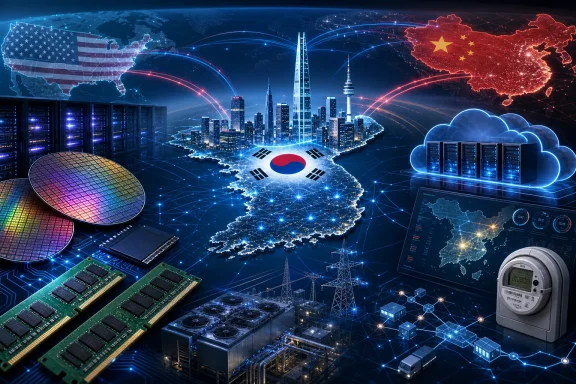 BofA Is Ranking AI-Investment Beneficiaries, Not Just Model Prestige
The AI race is often presented as a contest between the United States and China. BofA’s assessment accepts their position as the two dominant powers and asks a narrower question: Which other countries are best placed to benefit from expanding AI investment?That framing separates technical visibility from economic positioning. Producing a notable model is one indicator of capability, but countries can also benefit by supplying components, attracting infrastructure investment, deploying AI domestically, or developing specialized services.
According to the reporting on BofA’s assessment, South Korea ranks first among the contenders outside the United States and China over both the short and long term. The bank is not claiming that Seoul has displaced either leader. It is identifying Korea as the strongest beneficiary in the next group.
Memory semiconductors are central to that conclusion. Samsung Electronics and SK Hynix give South Korea substantial exposure to a component category required by AI servers and data centers. The available material supports treating Korea’s memory position as a major advantage, but it does not establish every detail of how particular products, customers, or supply agreements contribute to the ranking.
BofA’s wider case, as described in the reporting, also includes AI adoption, government support, model development, patents, and productivity potential. Those factors make the assessment broader than a simple bet on two chipmakers, even though semiconductor demand remains the most visible part of the thesis.
Korea’s Market Repricing Shows the Scale of the Bet
According to the account of BofA’s assessment published by News Ghana, South Korea’s stock market reached a valuation of approximately US$5.2 trillion after roughly tripling over eighteen months. The same account placed Korea fifth globally by market value, ahead of France, Germany, and the United Kingdom.Market rankings can vary with prices, exchange rates, dates, and classification methods. The figures should therefore be read as a snapshot attributed to the underlying report, not as a permanent ordering or an independently verified live market total.
Nor does the supplied evidence establish a single cause for the increase. It would be too strong to say that investors repriced the entire Korean market solely because of AI or that semiconductor capacity alone explains the move. The figures nevertheless show the financial scale surrounding Korea’s technology and industrial outlook.
BofA also raised its 2026 South Korean economic-growth forecast to 3.1% from 1.9%, according to the provided reporting. That is a substantial revision, but the source as supplied should not be stretched into a precise account of how AI spending will flow through exports, income, corporate investment, or other economic channels. The defensible point is narrower: BofA became markedly more optimistic about Korean growth while also ranking the country as the leading AI-investment beneficiary outside the two dominant powers.
South Korea’s memory industry helps explain why the country is prominent in the discussion. AI infrastructure requires large quantities of memory alongside processors, storage, networking, cooling, and power. A country with a strong position in an essential component can benefit even when major AI models and platforms are developed elsewhere.
That advantage does not guarantee uninterrupted growth. Demand can change, customers can renegotiate spending, competitors can improve, and manufacturers can add capacity. BofA’s ranking is an investment assessment, not a promise that semiconductor revenue, market valuations, or national growth will rise in a straight line.
A US$5.2 Trillion Market Is Also a Concentration Warning
A market strongly influenced by a small number of major technology manufacturers can magnify both optimism and disappointment. South Korea’s exposure to memory demand may support investment when AI infrastructure spending rises, but it also leaves the national story sensitive to decisions made by large global customers.The available material does not support a detailed reconstruction of previous memory cycles or a claim that the current cycle must follow a particular historical pattern. General manufacturing risks are enough to make the point: capacity takes time and money to build, forecasts can be wrong, and changes in supply or customer demand can alter pricing and margins.
There is also a difference between strong component exports and broad productivity improvement. Semiconductor success may raise corporate earnings and national output without automatically improving every smaller business, public institution, or service industry.
For BofA’s long-term ranking to look convincing in retrospect, Korea would need to preserve its semiconductor relevance while spreading AI use and technical capability more widely. That is WindowsForum’s interpretation of what durable success would require, not a separately verified BofA condition.
The most useful test is therefore not whether Korea maintains a particular market-cap ranking every month. It is whether investment produces lasting capacity: competitive companies, valuable intellectual property, effective domestic deployment, skilled workers, and measurable operational improvements beyond a narrow group of manufacturers.
Market valuation measures expectations. It does not demonstrate that those expectations have already been fulfilled.
Innovation Indicators Broaden the Case Beyond Memory
The reporting also cites Stanford University’s AI Index as evidence that South Korea has a significant domestic innovation base. According to the cited index results, South Korea ranked third globally in notable AI models, behind the United States and China, and first in AI patents per capita.Both data points require restraint. A model count does not guarantee commercial success, and patents differ in quality, scope, enforceability, and economic importance. A per-capita ranking also answers a different question from a ranking based on total patent volume.
Even with those qualifications, the indicators support a broader interpretation of Korea’s position. The country is not represented in the assessment only as a manufacturing location. It also records technical activity in model development and patenting.
The combination could be valuable because component producers, software developers, researchers, and customers can learn from one another. Workload requirements can inform hardware decisions, while deployment experience can reveal cost and performance limitations. The supplied evidence does not quantify that feedback effect, so it should be treated as WindowsForum analysis rather than as a direct BofA finding.
Government support is another part of the reported ranking. Public policy can help fund research, adoption, infrastructure, and training, but the presence of support does not prove that every program will succeed. The stronger point is that Korea combines policy attention with measurable industrial and technical activity.
That combination helps distinguish it from strategies built mostly around future ambition. South Korea already has major technology companies and recorded AI outputs. The open question is how effectively those assets will be translated into durable gains across the wider economy.
BofA’s Country Groups Point to More Than One Route to Benefit
BofA’s country groupings suggest that countries do not need identical AI strategies. Some enter the investment cycle with major technology companies; others may benefit through infrastructure, policy, capital, adoption, or specialized industries.The following table preserves the reported BofA groupings. The description column is explicitly WindowsForum analysis, included only to explain how enterprise readers might interpret the groups. It should not be read as a quotation of BofA’s rationale or as a complete inventory of each country’s capabilities.
| Reported BofA grouping | Countries | WindowsForum analysis—not a direct BofA finding |
|---|---|---|
| Dominant AI powers | United States and China | The baseline leaders against which the remaining countries are being compared |
| Leading beneficiary outside the two dominant powers | South Korea | The ranking centers on Korea’s memory-chip position, supplemented by the adoption, policy, model, patent, and productivity indicators identified in the reporting |
| Next strongest contender | United Arab Emirates | A country identified by BofA as a significant contender, without assigning unsupported claims about adoption rates or geopolitical outcomes |
| Strong second tier | Canada, Germany, Israel, the Netherlands, Singapore, Switzerland, and the United Kingdom | Economies BofA placed in a favorable secondary group; the supplied material does not establish one uniform advantage or challenge for all of them |
| Developing-economy challenger | India | A long-term contender whose placement should not be expanded into unsupported claims about workforce size, chip capacity, or employment disruption |
| Immediate infrastructure beneficiaries | Taiwan, Australia, and Japan | Countries BofA associated with near-term infrastructure investment benefits; the available material does not justify a detailed country-by-country supply-chain breakdown |
| Countries highlighted for stable power | Canada, France, and the United Arab Emirates | BofA’s grouping makes electricity availability relevant, but it does not by itself prove a specific level of grid capacity, project readiness, or permitting speed |
It also does not mean that one resource will remain decisive indefinitely. Memory matters during the current infrastructure expansion, but enterprise deployment also depends on processors, networking, storage, cloud facilities, connectivity, cooling, electricity, software, and skilled operations.
South Korea has an immediate advantage because its memory industry already participates in global technology markets. Other national strategies may depend more heavily on projects or programs that are still developing. That distinction helps explain Korea’s leading placement without requiring unsupported claims about every competing country.
The UAE and India Illustrate Different Paths
BofA placed the United Arab Emirates as the next strongest contender after South Korea, according to the supplied reporting. That ranking is noteworthy, but the available evidence does not support a claim that the UAE has one of the world’s highest AI-adoption rates or that BofA formally identified a specific geopolitical risk.The restrained interpretation is that BofA sees the UAE as well positioned relative to other contenders. Any further explanation involving capital deployment, energy, government coordination, international partnerships, or geopolitical exposure should be labeled as analysis unless the underlying BofA material directly documents it.
India represents another route. The reporting identifies it as the clearest long-term challenger among developing economies. That placement points to potential rather than a guaranteed outcome.
The supplied evidence does not establish detailed claims about India’s technical workforce, semiconductor capacity, job creation, or labor-market disruption. Those subjects may be relevant to a fuller national assessment, but they should not be attributed to BofA without direct support.
The Korea-India comparison is still useful at a high level. Korea enters the ranking with a prominent position in memory semiconductors, while India appears in a different BofA category focused on long-term developing-economy potential. The two countries therefore should not be evaluated as though they are following identical strategies.
More broadly, “benefiting from AI” can mean several things: attracting investment, increasing exports, building valuable companies, improving productivity, creating services, or expanding access to technology. BofA’s ranking is most safely read as an assessment of investment positioning. It is not a guarantee that gains will reach every company, worker, or region equally.
Electricity Is Now an Enterprise Planning Variable
BofA’s grouping of Canada, France, and the UAE around stable power adds an important constraint to the investment story. Large-scale AI services depend not only on chips but also on facilities that can operate consistently and expand when demand rises.The grouping should not be exaggerated into a claim that any national electricity system can accommodate unlimited data-center construction. The supplied material does not provide figures for available generation, transmission capacity, connection queues, project schedules, prices, or permitting.
For enterprise buyers, however, the planning implication is concrete. Cloud capacity is regional. A provider can have ample resources in one location and tighter availability in another. Electricity, cooling, connectivity, hardware allocation, regulation, and customer demand can all shape when a region expands and which services are offered there.
That does not prove that BofA’s Korean ranking will cause cloud restrictions or higher prices. It means the ranking highlights dependencies that procurement teams should already be tracking as general risk-management practice.
The same caution applies to on-premises deployments. A company may budget for servers and accelerators without confirming whether its facilities can support additional power, cooling, rack density, and network demand. Hardware availability alone is not production readiness.
National AI rankings are therefore useful when translated into operational questions rather than investment slogans: Which suppliers are concentrated? Which configurations require unusually large amounts of memory? Which cloud regions host the workload? What happens if capacity is allocated or delayed? What contractual protections exist?
For Windows and Enterprise IT, Geography Returns to the Architecture Diagram
For Windows administrators and enterprise technology buyers, South Korea’s position may initially sound remote from endpoint management. In reality, PCs, workstations, servers, and cloud platforms all rely on globally distributed hardware production and regional infrastructure.AI-capable endpoints and production AI workloads can require configurations different from ordinary office systems. Some projects need more system memory, accelerator memory, storage throughput, or network capacity. Others depend primarily on cloud services. The correct requirements vary by workload and should be tested rather than inferred from marketing labels.
BofA’s ranking does not prove that Korea’s position will change enterprise availability, pricing, lead times, contract terms, or regional cloud availability. Those outcomes are plausible procurement concerns, but they remain contingent on demand, supply, vendor policies, and customer configuration choices.
The appropriate response is not stockpiling or country-based purchasing. It is better documentation and more disciplined supplier management.
Procurement mini-playbook for admins
Treat the following as general planning guidance, not as direct consequences established by BofA’s ranking:- Add a high-memory dependency field to the hardware-refresh spreadsheet.
For every endpoint, workstation, server, and appliance category, record whether the approved configuration depends on above-standard system memory, specialized accelerator memory, or unusually high storage throughput. Include the business owner, planned purchase quarter, acceptable substitute configuration, and maximum tolerable delay. - Create a supplier-allocation record.
Require strategic hardware vendors and resellers to state allocation policies, estimated lead times, substitution rights, cancellation terms, and escalation contacts in writing. Store those responses with the request for proposal, quote, or master procurement file rather than relying on verbal assurances. - Maintain an approved-substitution matrix.
Document which memory capacities, server models, endpoint configurations, and cloud instance families can substitute for one another. Record any effects on application certification, Windows deployment images, driver support, warranty coverage, security baselines, and total cost. - Set a quarterly cloud-region capacity review.
Review the primary and recovery regions for production AI services at least once per quarter. Track service availability, quota limits, reservation options, data-residency requirements, network latency, announced retirements, and evidence of regional expansion or constraint. - Define pilot-to-production acceptance criteria.
Before an AI pilot is approved for production, specify minimum and maximum memory use, latency targets, throughput, availability, data-residency boundaries, recovery objectives, logging requirements, and expected monthly cost. Do not treat a successful demonstration as proof that the workload is ready to scale. - Add power and cooling checks to on-premises approvals.
Require facilities or data-center operations teams to confirm rack power, cooling headroom, redundancy, cabling, and expansion limits before approving high-density equipment. Attach that confirmation to the architecture decision record. - Model at least two capacity scenarios.
Build a base case and a constrained case for each major deployment. The constrained case should assume that the preferred configuration or cloud region is delayed, quota-limited, or more expensive than expected. Identify the fallback design and the point at which the project must be reapproved. - Measure operational value before expanding commitments.
Connect infrastructure spending to specific outcomes such as reduced handling time, improved service levels, lower error rates, higher developer throughput, or faster incident resolution. Review those results before renewing reservations or expanding hardware orders.
The Korean Thesis Has Four Ways to Break
The first risk is cyclical. If infrastructure buyers reduce spending or supply expands faster than demand, Korean semiconductor companies could face weaker conditions. The supplied material does not establish when or whether that will happen, but concentration in memory makes demand changes an unavoidable part of the risk assessment.The second risk is structural. South Korea could remain a successful component supplier without generating equally strong gains in software, services, domestic deployment, or productivity. That is a WindowsForum analytical risk, not a condition directly attributed to BofA.
The third risk is geopolitical. Semiconductor production depends on cross-border access to equipment, materials, customers, logistics, and technology. The article’s sources do not document a particular disruption scenario, so this risk should be understood generally rather than as a forecast of a specific policy or conflict.
The fourth risk is domestic concentration. A rising market and stronger major manufacturers do not automatically mean that smaller businesses, workers, consumers, and public institutions receive proportional benefits. If financial and industrial gains remain narrow, headline success may overstate the depth of the national transformation.
There is also a valuation risk. According to the cited account, Korea’s market value tripled over eighteen months to approximately US$5.2 trillion. Rapid appreciation can reflect confidence, but it can also raise expectations. If earnings, investment, or growth fail to meet those expectations, prices can adjust even if the underlying industry remains strategically important.
None of these risks invalidates BofA’s ranking. They define what must go right for the call to remain persuasive over the long term.
What Readers Should Take Away
BofA’s answer is clear: outside the United States and China, South Korea is the leading national beneficiary of the next phase of AI investment. The bank’s call rests prominently on Korea’s memory-chip position and is reinforced in the reporting by adoption, policy, productivity, model, and patent indicators.The key attributed figures give the thesis scale. News Ghana’s account of the BofA assessment put the Korean stock market at approximately US$5.2 trillion after a threefold increase over eighteen months and ranked it fifth globally. The provided reporting says BofA raised its 2026 growth forecast for South Korea to 3.1% from 1.9%. The Stanford AI Index results cited in that reporting placed South Korea third in notable AI models and first in AI patents per capita.
Those figures do not prove that Korea’s lead is permanent, that every Korean company will benefit, or that enterprise buyers will necessarily face shortages or higher prices. They show why the country has become central to the AI-investment discussion.
For investors, the question is whether semiconductor strength can support durable, broader growth without leaving the market excessively dependent on a narrow group of companies.
For policymakers, the question is whether industrial success can be connected to domestic adoption, skills, infrastructure, and productivity.
For Windows administrators and enterprise buyers, the immediate task is more practical: identify high-memory dependencies, obtain written supplier terms, review cloud-region capacity quarterly, and require clear memory, latency, residency, availability, and cost criteria before pilots move into production.
South Korea may be BofA’s leading beneficiary beyond the two dominant AI powers, but the enterprise lesson is not to bet on a country ranking. It is to plan for the concentrated hardware, regional capacity, and power dependencies that the ranking brings into view.
References
- Primary source: NewsGhana
Published: 2026-07-12T10:50:07.969803
- Related coverage: tomshardware.com
SK hynix raises a record $26.5 billion in historic U.S. IPO — South Korean memory giant to fund massive HBM manufacturing expansions | Tom's Hardware
The offering was more than seven times oversubscribedwww.tomshardware.com - Related coverage: korea.net
- Related coverage: bloomberg.com
- Related coverage: koreatimes.co.kr
Korea ranks 3rd globally in key AI models, securing top spot for patents - The Korea Times
Korea is strengthening its position among the world’s leading players in artificial intelligence (AI), ranking third in notable AI models released...www.koreatimes.co.kr
- Related coverage: investing.com
BofA names South Korea, UAE among top AI contenders beyond U.S. and China By Investing.com
BofA names South Korea, UAE among top AI contenders beyond U.S. and Chinawww.investing.com
- Related coverage: business.bofa.com