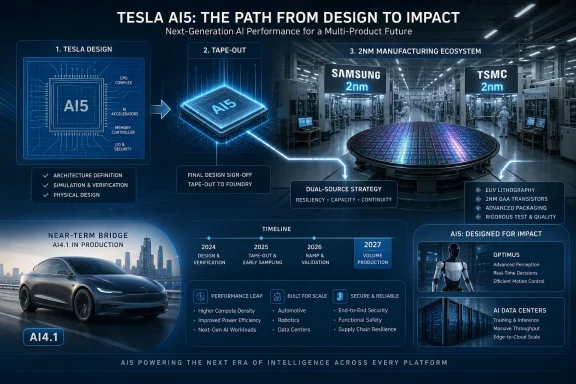
Samsung-side confirmation supports Tesla AI5, also known as Hardware 5, reaching tape-out for planned 2nm manufacturing at Samsung’s Taylor, Texas facility. It is an important manufacturing milestone, but its immediate implications are limited:
BASENOR senior writer Sarah Chen reported the Samsung disclosure after Tesla observer Sawyer Merritt surfaced it on July 11, 2026. According to BASENOR’s account, a Samsung Foundry Principal Engineer confirmed the tape-out milestone and identified Samsung’s Taylor facility and a 2nm process as the intended manufacturing destination.
The disclosure provides manufacturing-side corroboration for Elon Musk’s April 15, 2026 announcement that Tesla’s AI5 design had taped out. That does not necessarily mean every manufacturing step was completed on April 15 or that production-ready chips already exist. It means the program has reached the point at which the completed design can move into fabrication and physical validation.
The Samsung engineer was also quoted as saying AI5 “will soon be integrated into Tesla’s newest products.” That wording does not identify a product, define “soon,” or establish a retail launch schedule. It could encompass engineering systems, internal Tesla hardware, Optimus development platforms, computing clusters, preproduction vehicles, or eventual customer vehicles.
Merritt reportedly cautioned that volume production would not begin immediately. That distinction is especially important because the tape-out announcement has already generated speculation about refreshed vehicles and the timing of a transition away from HW4.
No first HW5 vehicle has been announced. No order-page configuration has been identified. No retrofit has been promised. Samsung’s confirmation strengthens the evidence that AI5 is becoming a physical manufacturing program, but it does not resolve when ordinary buyers will encounter it.
The important steps still ahead include fabrication of initial silicon, testing of engineering samples, correction of any design or manufacturing problems, system-level validation, and the ramp to repeatable production. A chip can reach tape-out and still require revisions before it is suitable for high-volume use.
For AI5, the next meaningful evidence is expected to be engineering samples in late 2026. Those samples should provide the first opportunity to determine whether physical silicon meets Tesla’s intended performance, power, reliability, and software requirements. Even then, working samples would not by themselves establish a vehicle launch date.
The available production windows must also be kept separate. BASENOR’s compilation describes late 2026 or early 2027 as a target associated with the broader AI5 program. Vehicle-specific high-volume production is reported for mid-to-late 2027.
That gap matters. It leaves room for early silicon to be used in engineering systems or other Tesla programs before vehicle production reaches meaningful scale. It also means a limited appearance in prototypes or preproduction hardware should not be confused with a broad transition across Tesla’s consumer lineup.
April 15, 2026 — Elon Musk announced that Tesla’s AI5 design had reached tape-out.
July 11, 2026 — Sawyer Merritt surfaced the Samsung Foundry Principal Engineer’s confirmation, as reported by BASENOR, supporting the Samsung-side tape-out milestone and planned 2nm production at Taylor.
Late 2026 — Engineering samples are expected. These would provide the first significant evidence from physical silicon, although they would not constitute a retail launch.
Late 2026 or early 2027 — BASENOR’s compiled reporting describes this as a target for broader AI5 high-volume production, subject to successful validation and manufacturing execution.
Mid-to-late 2027 — Reporting compiled by BASENOR places vehicle-specific high-volume AI5 production in this later window.
None of these dates identifies the first retail vehicle, confirms a model-year transition, or promises an upgrade for existing owners.
Those figures are not verified product specifications. Tesla has not provided a complete public specification sheet, independent benchmark package, shipping configuration, or final production-power profile. The numbers should be understood as reported targets and executive claims attached to a chip that has not yet been demonstrated in a shipping product.
The same caution applies to memory. BASENOR’s compilation describes support for as much as 192GB of SK Hynix LPDDR5X per system-on-chip and presents that figure as approximately nine times the memory associated with the AI4 reference. Until Tesla identifies a production configuration, it is unclear whether that maximum would apply to every deployment, only particular systems, or an option intended for non-vehicle use.
Every AI5 number in that table remains provisional unless and until Tesla publishes final specifications or shipping systems can be measured independently.
Musk has claimed that one AI5 system-on-chip could offer performance comparable to NVIDIA’s Hopper generation and that a dual-chip arrangement could approach Blackwell-class performance. He has also claimed approximately three times the efficiency at less than 10 percent of the cost.
Those are Musk’s comparisons, as compiled by BASENOR, rather than independently verified results. They lack the public workload definitions, configurations, precision settings, utilization data, pricing methodology, and repeatable benchmark results required for a direct technical comparison. “Hopper-class” or “Blackwell-class” should therefore be read as an expression of Tesla’s performance ambition, not an established equivalence.
The reported 2,000–2,500 TOPS and eight-times-compute figures need similar restraint. TOPS is a theoretical throughput measure under defined conditions. It does not by itself establish application performance, autonomy capability, model quality, latency, safety, or efficiency in a completed system.
AI5 may ultimately deliver a substantial increase over HW4, but the available evidence does not support treating every reported maximum as a guaranteed vehicle specification. Tesla could use different configurations for different products, and the final numbers could change between engineering silicon and production hardware.
What can reasonably be concluded is narrower: Tesla appears to be targeting a much larger computing platform than HW4, with reported ambitions spanning vehicles, Optimus, and computing clusters. Whether one common production configuration will serve all three remains unconfirmed.
Peak power also does not reveal average consumption. A computer may reach its maximum only under particular workloads, and different products could operate it under different limits. Tesla has not published a duty cycle, final vehicle power profile, thermal design, or production configuration for AI5.
Even with those uncertainties, the reported figure highlights a general engineering consideration. Higher-power computing hardware can require more attention to electrical capacity, heat removal, physical integration, cost, and long-term validation. Those are broad issues for any automotive manufacturer considering a major increase in onboard computing power; they are not evidence that Tesla has encountered a specific AI5 vehicle problem.
The same distinction applies to non-vehicle systems. Computing clusters and robots have different design requirements from passenger vehicles, but no verified material establishes exactly how Tesla will configure AI5 for each environment. It would be premature to infer a specific cooling system, package layout, power-delivery architecture, or deployment plan.
Musk has described AI5 as “overengineered for cars.” That statement supports the idea that its intended capabilities may exceed what Tesla views as necessary for current vehicle workloads. It does not prove that the chip will be delayed in cars, excluded from particular models, or configured identically across the company’s products.
Musk has also argued that AI4 is sufficient to achieve Tesla’s stated FSD safety objective. That remains a Tesla executive claim rather than proof that the objective has been reached. For buyers, however, the product implication is relevant: Tesla’s own stated position does not frame AI5 as a prerequisite for continued development of the current vehicle software stack.
That weakens the case for treating HW5 as an essential buying requirement before Tesla has announced an HW5 vehicle or shown an AI5-exclusive customer feature.
That priority should be preserved as an attribution, not converted into a definitive allocation plan. Tesla has not publicly provided a detailed schedule showing how many chips will go to robots, clusters, engineering systems, or vehicles. Nor has it established that every early AI5 chip will be withheld from automotive development.
The available information supports a cautious interpretation: AI5 may appear first or most visibly in non-retail systems, while meaningful vehicle volume follows later. That interpretation is consistent with BASENOR’s stated priority and the separate vehicle-production window, but it remains subject to Tesla’s execution and product decisions.
BASENOR also reports planned AI5 manufacturing involving both Samsung’s Taylor facility and TSMC’s Arizona operations. The existence of more than one reported manufacturing partner should not be used to infer how production will be divided, when each source will begin shipping, or whether every resulting chip will have identical characteristics.
No verified allocation percentages, qualification sequence, production volumes, or product assignments are supplied. The responsible conclusion is simply that BASENOR describes a multi-supplier manufacturing plan. Any more detailed scenario would be speculation.
The Samsung confirmation is valuable precisely because it adds one concrete point: the Taylor-bound 2nm implementation has reached the tape-out milestone. It does not validate the entire supply plan, establish output levels, or show how quickly the program can advance from first silicon to high-volume production.
Nothing in the Samsung-side confirmation makes an HW4 vehicle obsolete. It does not remove existing features, establish that current software development will stop, or prove that future customer functions will require AI5.
It also does not establish hardware parity between generations. AI5 is being presented as a substantially more capable platform, and future Tesla products could eventually use that capacity in ways HW4 cannot match. The unresolved question is not whether AI5 targets more computing power; it is when that additional capacity will become necessary for a defined customer feature.
Tesla has not answered that question with a product announcement.
Current Tesla vehicles use HW4. Buyers should evaluate those vehicles according to the driver-assistance functions, software, charging behavior, range, comfort, service, price, and other capabilities available at the time of purchase. Features described as future possibilities should not be valued as though they are delivered.
The Samsung confirmation provides no basis for assuming that an HW4 vehicle can be converted to HW5. A retrofit would depend on more than the existence of a new processor, and Tesla has not announced an upgrade program, eligible vehicles, pricing, timing, or technical scope.
The confirmation also provides no basis for naming a first HW5 model. Speculation about a Model Y variant or other future vehicle remains speculation unless Tesla announces the configuration or production vehicles can be verified.
A limited early appearance would not necessarily mean a lineup-wide change. Engineering vehicles, internal systems, preproduction fleets, and low-volume customer products can precede broad availability. Conversely, a mid-to-late 2027 vehicle-volume window does not guarantee that every Tesla built during that period will receive HW5.
Buyers who need a vehicle now should not delay solely because AI5 has taped out. Buyers who specifically want HW5 should wait for a clear Tesla product announcement rather than trying to predict hardware from factory location, build date, trim, or internet rumor.
The next evidence must come from hardware.
Engineering samples expected in late 2026 would move the discussion from design targets toward measurable silicon. Observers should look for confirmation that samples exist, that they run Tesla’s intended software, and that the design can meet its functional goals.
After that, the question becomes whether the silicon has been validated for the products in which Tesla plans to use it. Validation for an internal computing system is not automatically evidence of readiness for a production vehicle. A named product and production schedule would provide a much stronger signal than another generalized performance claim.
Volume matters as well. A small number of working chips can support development without establishing a commercially significant ramp. The reported mid-to-late 2027 vehicle window will become meaningful only when Tesla or its manufacturing partners provide evidence of qualified production intended for customer vehicles.
Until those milestones appear, claims about exact performance, cost, efficiency, power, model assignment, or adoption rate should remain clearly labeled as reported targets or executive statements.
Each program has different operating requirements. That is a general engineering observation, not evidence of Tesla’s final AI5 design choices. The company may use different numbers of chips, memory capacities, power limits, boards, or software configurations, but no such production variants have been confirmed.
BASENOR’s report that Optimus and clusters are the near-term priority is therefore more useful than speculation based on the headline specifications. It provides an attributed indication of program emphasis while preserving the uncertainty around exact deployment.
The vehicle story remains important because Hardware 5 will naturally be viewed as the successor to HW4. But the available timeline does not support portraying an HW5 consumer transition as imminent. Engineering samples expected in late 2026 come first, and vehicle-specific high-volume production is reported for mid-to-late 2027.
That schedule could change. Validation may proceed faster or slower than expected, Tesla may alter its priorities, and the company may announce a limited vehicle application before broad volume begins. None of those possibilities is confirmed by tape-out alone.
For existing owners, the practical course is to judge software updates and vehicle functionality as they arrive. The reported AI5 targets do not remove value from HW4, nor do they guarantee that HW4 will receive every capability associated with future hardware.
For prospective buyers, the decision depends on timing and priorities:
BASENOR reports engineering samples for late 2026 and identifies Optimus and supercomputer clusters as the near-term priority, while its compiled reporting places vehicle-specific high-volume production in mid-to-late 2027. The reported performance, memory, power, efficiency, cost, Hopper, and Blackwell comparisons remain unverified targets or Musk claims—not final product specifications.
For buyers, HW5 is still a roadmap item. Buy an HW4 vehicle only if its current features justify the purchase, and wait for a named, shipping configuration if Hardware 5 is essential.
- Samsung-side confirmation supports tape-out at Taylor on a 2nm process.
- It does not confirm a shipping HW5 vehicle or identify the first vehicle model.
- It does not establish that Tesla will offer an HW5 retrofit for existing vehicles.
- Engineering samples are expected in late 2026, while reporting compiled by BASENOR points to mid-to-late 2027 for vehicle-specific high-volume production.
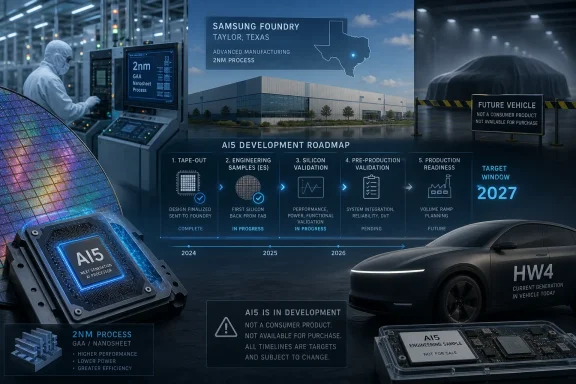 Samsung’s Confirmation Turns a Tesla Claim Into a Manufacturing Milestone
BASENOR senior writer Sarah Chen reported the Samsung disclosure after Tesla observer Sawyer Merritt surfaced it on July 11, 2026. According to BASENOR’s account, a Samsung Foundry Principal Engineer confirmed the tape-out milestone and identified Samsung’s Taylor facility and a 2nm process as the intended manufacturing destination.The disclosure provides manufacturing-side corroboration for Elon Musk’s April 15, 2026 announcement that Tesla’s AI5 design had taped out. That does not necessarily mean every manufacturing step was completed on April 15 or that production-ready chips already exist. It means the program has reached the point at which the completed design can move into fabrication and physical validation.
The Samsung engineer was also quoted as saying AI5 “will soon be integrated into Tesla’s newest products.” That wording does not identify a product, define “soon,” or establish a retail launch schedule. It could encompass engineering systems, internal Tesla hardware, Optimus development platforms, computing clusters, preproduction vehicles, or eventual customer vehicles.
Merritt reportedly cautioned that volume production would not begin immediately. That distinction is especially important because the tape-out announcement has already generated speculation about refreshed vehicles and the timing of a transition away from HW4.
No first HW5 vehicle has been announced. No order-page configuration has been identified. No retrofit has been promised. Samsung’s confirmation strengthens the evidence that AI5 is becoming a physical manufacturing program, but it does not resolve when ordinary buyers will encounter it.
One Concise Explanation: Tape-Out Is Not Production
Tape-out means a chip design has been completed for submission to manufacturing. It is a major engineering milestone, but it is not the same as validated silicon, volume production, or installation in a customer product.The important steps still ahead include fabrication of initial silicon, testing of engineering samples, correction of any design or manufacturing problems, system-level validation, and the ramp to repeatable production. A chip can reach tape-out and still require revisions before it is suitable for high-volume use.
For AI5, the next meaningful evidence is expected to be engineering samples in late 2026. Those samples should provide the first opportunity to determine whether physical silicon meets Tesla’s intended performance, power, reliability, and software requirements. Even then, working samples would not by themselves establish a vehicle launch date.
The available production windows must also be kept separate. BASENOR’s compilation describes late 2026 or early 2027 as a target associated with the broader AI5 program. Vehicle-specific high-volume production is reported for mid-to-late 2027.
That gap matters. It leaves room for early silicon to be used in engineering systems or other Tesla programs before vehicle production reaches meaningful scale. It also means a limited appearance in prototypes or preproduction hardware should not be confused with a broad transition across Tesla’s consumer lineup.
Timeline
July 2025 — BASENOR reports that Samsung secured an AI5 and AI6 manufacturing contract, establishing the relationship behind the Taylor program.April 15, 2026 — Elon Musk announced that Tesla’s AI5 design had reached tape-out.
July 11, 2026 — Sawyer Merritt surfaced the Samsung Foundry Principal Engineer’s confirmation, as reported by BASENOR, supporting the Samsung-side tape-out milestone and planned 2nm production at Taylor.
Late 2026 — Engineering samples are expected. These would provide the first significant evidence from physical silicon, although they would not constitute a retail launch.
Late 2026 or early 2027 — BASENOR’s compiled reporting describes this as a target for broader AI5 high-volume production, subject to successful validation and manufacturing execution.
Mid-to-late 2027 — Reporting compiled by BASENOR places vehicle-specific high-volume AI5 production in this later window.
None of these dates identifies the first retail vehicle, confirms a model-year transition, or promises an upgrade for existing owners.
Reported AI5 Targets Point Beyond an Incremental Vehicle Upgrade
The reported scale of AI5 helps explain why the chip is attracting attention far beyond the normal progression from one vehicle computer to the next. BASENOR’s compilation of reporting and Musk’s statements describes a full AI5 computer targeting approximately 2,000 to 2,500 trillion operations per second, or TOPS, and characterizes that target as roughly eight times the AI4 reference baseline.Those figures are not verified product specifications. Tesla has not provided a complete public specification sheet, independent benchmark package, shipping configuration, or final production-power profile. The numbers should be understood as reported targets and executive claims attached to a chip that has not yet been demonstrated in a shipping product.
The same caution applies to memory. BASENOR’s compilation describes support for as much as 192GB of SK Hynix LPDDR5X per system-on-chip and presents that figure as approximately nine times the memory associated with the AI4 reference. Until Tesla identifies a production configuration, it is unclear whether that maximum would apply to every deployment, only particular systems, or an option intended for non-vehicle use.
| Category | Reported AI5 / HW5 target | AI4 / HW4 comparison |
|---|---|---|
| Manufacturing process | Planned 2nm production at Samsung Taylor; BASENOR also reports TSMC involvement | Described in BASENOR’s compilation as 7nm class |
| Full-computer compute | Approximately 2,000–2,500 TOPS, according to BASENOR-compiled reporting | Reported as roughly an 8x comparison |
| Memory | Up to 192GB LPDDR5X, according to BASENOR-compiled reporting | Reported as approximately nine times the AI4 reference |
| Peak power | Approximately 700–800W, according to BASENOR-compiled reporting | Approximately 300W reference figure |
| Product status | Taped out; engineering samples expected in late 2026 | Currently used in shipping Tesla vehicles |
| Vehicle-volume timing | Reported for mid-to-late 2027 | Currently in vehicle production |
Musk has claimed that one AI5 system-on-chip could offer performance comparable to NVIDIA’s Hopper generation and that a dual-chip arrangement could approach Blackwell-class performance. He has also claimed approximately three times the efficiency at less than 10 percent of the cost.
Those are Musk’s comparisons, as compiled by BASENOR, rather than independently verified results. They lack the public workload definitions, configurations, precision settings, utilization data, pricing methodology, and repeatable benchmark results required for a direct technical comparison. “Hopper-class” or “Blackwell-class” should therefore be read as an expression of Tesla’s performance ambition, not an established equivalence.
The reported 2,000–2,500 TOPS and eight-times-compute figures need similar restraint. TOPS is a theoretical throughput measure under defined conditions. It does not by itself establish application performance, autonomy capability, model quality, latency, safety, or efficiency in a completed system.
AI5 may ultimately deliver a substantial increase over HW4, but the available evidence does not support treating every reported maximum as a guaranteed vehicle specification. Tesla could use different configurations for different products, and the final numbers could change between engineering silicon and production hardware.
What can reasonably be concluded is narrower: Tesla appears to be targeting a much larger computing platform than HW4, with reported ambitions spanning vehicles, Optimus, and computing clusters. Whether one common production configuration will serve all three remains unconfirmed.
The Reported Power Target Complicates the Vehicle Question
BASENOR’s compilation places the reported peak power of a full AI5 computer at approximately 700 to 800 watts, compared with an approximately 300-watt reference figure for HW4. As with the compute and memory figures, those values have not been verified in a final shipping system.Peak power also does not reveal average consumption. A computer may reach its maximum only under particular workloads, and different products could operate it under different limits. Tesla has not published a duty cycle, final vehicle power profile, thermal design, or production configuration for AI5.
Even with those uncertainties, the reported figure highlights a general engineering consideration. Higher-power computing hardware can require more attention to electrical capacity, heat removal, physical integration, cost, and long-term validation. Those are broad issues for any automotive manufacturer considering a major increase in onboard computing power; they are not evidence that Tesla has encountered a specific AI5 vehicle problem.
The same distinction applies to non-vehicle systems. Computing clusters and robots have different design requirements from passenger vehicles, but no verified material establishes exactly how Tesla will configure AI5 for each environment. It would be premature to infer a specific cooling system, package layout, power-delivery architecture, or deployment plan.
Musk has described AI5 as “overengineered for cars.” That statement supports the idea that its intended capabilities may exceed what Tesla views as necessary for current vehicle workloads. It does not prove that the chip will be delayed in cars, excluded from particular models, or configured identically across the company’s products.
Musk has also argued that AI4 is sufficient to achieve Tesla’s stated FSD safety objective. That remains a Tesla executive claim rather than proof that the objective has been reached. For buyers, however, the product implication is relevant: Tesla’s own stated position does not frame AI5 as a prerequisite for continued development of the current vehicle software stack.
That weakens the case for treating HW5 as an essential buying requirement before Tesla has announced an HW5 vehicle or shown an AI5-exclusive customer feature.
BASENOR Reports Optimus and Clusters as the Near-Term Priority
BASENOR reports that Optimus and Tesla’s supercomputer clusters are the near-term priority for AI5, while vehicle-specific high-volume production is reported for mid-to-late 2027.That priority should be preserved as an attribution, not converted into a definitive allocation plan. Tesla has not publicly provided a detailed schedule showing how many chips will go to robots, clusters, engineering systems, or vehicles. Nor has it established that every early AI5 chip will be withheld from automotive development.
The available information supports a cautious interpretation: AI5 may appear first or most visibly in non-retail systems, while meaningful vehicle volume follows later. That interpretation is consistent with BASENOR’s stated priority and the separate vehicle-production window, but it remains subject to Tesla’s execution and product decisions.
BASENOR also reports planned AI5 manufacturing involving both Samsung’s Taylor facility and TSMC’s Arizona operations. The existence of more than one reported manufacturing partner should not be used to infer how production will be divided, when each source will begin shipping, or whether every resulting chip will have identical characteristics.
No verified allocation percentages, qualification sequence, production volumes, or product assignments are supplied. The responsible conclusion is simply that BASENOR describes a multi-supplier manufacturing plan. Any more detailed scenario would be speculation.
The Samsung confirmation is valuable precisely because it adds one concrete point: the Taylor-bound 2nm implementation has reached the tape-out milestone. It does not validate the entire supply plan, establish output levels, or show how quickly the program can advance from first silicon to high-volume production.
HW4 Owners Should Ignore the Hardware-Fear Cycle
Every new Tesla computer creates understandable concern among existing owners. AI5’s reported targets are large enough to intensify that anxiety, particularly when they are presented without the qualifications attached to engineering-stage hardware.Nothing in the Samsung-side confirmation makes an HW4 vehicle obsolete. It does not remove existing features, establish that current software development will stop, or prove that future customer functions will require AI5.
It also does not establish hardware parity between generations. AI5 is being presented as a substantially more capable platform, and future Tesla products could eventually use that capacity in ways HW4 cannot match. The unresolved question is not whether AI5 targets more computing power; it is when that additional capacity will become necessary for a defined customer feature.
Tesla has not answered that question with a product announcement.
Current Tesla vehicles use HW4. Buyers should evaluate those vehicles according to the driver-assistance functions, software, charging behavior, range, comfort, service, price, and other capabilities available at the time of purchase. Features described as future possibilities should not be valued as though they are delivered.
The Samsung confirmation provides no basis for assuming that an HW4 vehicle can be converted to HW5. A retrofit would depend on more than the existence of a new processor, and Tesla has not announced an upgrade program, eligible vehicles, pricing, timing, or technical scope.
The confirmation also provides no basis for naming a first HW5 model. Speculation about a Model Y variant or other future vehicle remains speculation unless Tesla announces the configuration or production vehicles can be verified.
A limited early appearance would not necessarily mean a lineup-wide change. Engineering vehicles, internal systems, preproduction fleets, and low-volume customer products can precede broad availability. Conversely, a mid-to-late 2027 vehicle-volume window does not guarantee that every Tesla built during that period will receive HW5.
Buyers who need a vehicle now should not delay solely because AI5 has taped out. Buyers who specifically want HW5 should wait for a clear Tesla product announcement rather than trying to predict hardware from factory location, build date, trim, or internet rumor.
What this means now
- No HW5 vehicle has been announced.
- No first vehicle model has been confirmed.
- No HW5 retrofit policy has been announced for current Tesla owners.
- Engineering samples are expected in late 2026, but samples are not retail products.
- BASENOR-compiled reporting points to mid-to-late 2027 for vehicle-specific high-volume production.
- Buy current HW4 vehicles based on the features and performance available today, not on promised future capability.
- If HW5 is a must-have requirement, wait for Tesla to identify a shipping vehicle and configuration.
Taylor’s Next Test Is Working, Validated Silicon
The significance of the Taylor milestone should not be understated, but it should be described accurately. A Samsung-side source has corroborated a concrete step in Tesla’s AI5 program and connected that step to planned 2nm manufacturing in Texas.The next evidence must come from hardware.
Engineering samples expected in late 2026 would move the discussion from design targets toward measurable silicon. Observers should look for confirmation that samples exist, that they run Tesla’s intended software, and that the design can meet its functional goals.
After that, the question becomes whether the silicon has been validated for the products in which Tesla plans to use it. Validation for an internal computing system is not automatically evidence of readiness for a production vehicle. A named product and production schedule would provide a much stronger signal than another generalized performance claim.
Volume matters as well. A small number of working chips can support development without establishing a commercially significant ramp. The reported mid-to-late 2027 vehicle window will become meaningful only when Tesla or its manufacturing partners provide evidence of qualified production intended for customer vehicles.
Until those milestones appear, claims about exact performance, cost, efficiency, power, model assignment, or adoption rate should remain clearly labeled as reported targets or executive statements.
One Chip, Three Possible Tesla Programs
Tesla has discussed AI5 in connection with vehicles, Optimus, and supercomputer systems. A common computing architecture could theoretically allow parts of its software work to be shared across those programs, but the verified information does not establish the implementation details or prove that one identical configuration will be used everywhere.Each program has different operating requirements. That is a general engineering observation, not evidence of Tesla’s final AI5 design choices. The company may use different numbers of chips, memory capacities, power limits, boards, or software configurations, but no such production variants have been confirmed.
BASENOR’s report that Optimus and clusters are the near-term priority is therefore more useful than speculation based on the headline specifications. It provides an attributed indication of program emphasis while preserving the uncertainty around exact deployment.
The vehicle story remains important because Hardware 5 will naturally be viewed as the successor to HW4. But the available timeline does not support portraying an HW5 consumer transition as imminent. Engineering samples expected in late 2026 come first, and vehicle-specific high-volume production is reported for mid-to-late 2027.
That schedule could change. Validation may proceed faster or slower than expected, Tesla may alter its priorities, and the company may announce a limited vehicle application before broad volume begins. None of those possibilities is confirmed by tape-out alone.
Buyer Guidance: Separate the Chip Roadmap From the Product You Can Purchase
AI5 may become one of Tesla’s most important computing platforms. That strategic potential does not make it a current consumer product.For existing owners, the practical course is to judge software updates and vehicle functionality as they arrive. The reported AI5 targets do not remove value from HW4, nor do they guarantee that HW4 will receive every capability associated with future hardware.
For prospective buyers, the decision depends on timing and priorities:
- Buy now if a current HW4 Tesla meets your needs at an acceptable price. Evaluate delivered features rather than assuming future software or hardware upgrades.
- Wait if owning HW5 is itself a requirement. There is currently no announced model, configuration, price, delivery date, or retrofit.
- Do not treat a rumored build window as confirmation. A factory transition, first model, or hardware revision must be demonstrated through an official announcement or verifiable production vehicles.
- Do not treat maximum reported specifications as guaranteed in-car specifications. The compute, memory, power, efficiency, and cost figures remain reported targets or Musk claims.
- Do not assume that engineering samples mean customer availability. Samples are evidence that validation can begin, not that a retail rollout has begun.
Verdict
Samsung-side confirmation gives Tesla’s AI5 program a credible manufacturing milestone: the Taylor-bound 2nm design has reached tape-out. It does not confirm a shipping HW5 car, a first vehicle model, a retrofit, or vehicle-volume production.BASENOR reports engineering samples for late 2026 and identifies Optimus and supercomputer clusters as the near-term priority, while its compiled reporting places vehicle-specific high-volume production in mid-to-late 2027. The reported performance, memory, power, efficiency, cost, Hopper, and Blackwell comparisons remain unverified targets or Musk claims—not final product specifications.
For buyers, HW5 is still a roadmap item. Buy an HW4 vehicle only if its current features justify the purchase, and wait for a named, shipping configuration if Hardware 5 is essential.
Watch list
- Engineering samples: Evidence that physical AI5 silicon exists and is operating, expected in late 2026.
- Validated silicon: Confirmation that the chip meets the requirements of its intended Tesla deployments.
- Named vehicle: An official Tesla announcement identifying the first customer vehicle equipped with HW5.
- Production volumes: Evidence that AI5 has moved beyond samples and limited systems into meaningful vehicle production.
- Retrofit policy: A clear Tesla statement on whether any existing vehicles will be eligible for an HW5 upgrade.
References
- Primary source: BASENOR - Tesla Accessories
Published: Sat, 11 Jul 2026 19:04:03 GMT
Tesla-Samsung AI5 Chip Hits Tape-Out at Taylor Fab on 2nm Process
Samsung Foundry has publicly confirmed that the Tesla-Samsung AI5 chip has reached tape-out, marking the completion of its design phase and clearing the runway for manufacturing at Samsung's Taylor, Texas plant on a 2nm process. The announcement came from a Samsung Foundry Principal Engineer... www.basenor.com
- Related coverage: semiconductor.samsung.com
Manufacturing sites | Manufacturing | Samsung Semiconductor Global
Samsung Foundry has world-class facilities and is expanding worldwide to provide better service. Discover their manufacturing sites in Korea and the U.S.semiconductor.samsung.com - Related coverage: news.samsung.com
Samsung Electronics anuncia un nuevo sitio de fabricación de semiconductores avanzados en Taylor, Texas – Samsung Newsroom México
La inversión de $17 mil millones de Samsung en una nueva instalación impulsará la producción de semiconductores avanzados. La mayor inversión realizada por Samsung en Estados Unidos mejorará la resiliencia de la cadena de suministro de cruciales chips lógicosnews.samsung.com
- Related coverage: sammobile.com
Elon Musk thanks Samsung for making first Tesla AI5 chip for cars and robots - SamMobile
Elon Musk revealed on X that the tape-out of the AI5 chip is complete and thanked Samsung Foundry for completing the process ahead of time. - SamMobilewww.sammobile.com - Related coverage: tomshardware.com
Musk says Samsung's Texas fab outclasses TSMC's US-based fabs — with AI5 still in development, questions remain over whether Tesla will need advanced tools | Tom's Hardware
AI5 is set to be deployed in cars, robots, and data centerswww.tomshardware.com - Related coverage: tparts.com
Tesla's HW5/AI5 Chip: 2000-2500 TOPS Performance & Robotaxi-Ready Upgr | Tparts
South Korean outlet MK reports Tesla is preparing production for its next-gen FSD Hardware 5.0 (AI 5). The chip targets 2000-2500 TOPS – 4-5x faster than current HW4's 500 TOPS. Samsung and TSMC may jointly manufacture it to mitigate supply risks. 1. Performance Leap: HW5 vs. HW4... www.tparts.com
- Related coverage: download.semiconductor.samsung.com
- Related coverage: images.samsung.com
- Related coverage: image.semiconductor.samsung.com
- Related coverage: techradar.com
Tesla confirms Samsung will build its AI6 AI chip to support robotics, autonomy, and data center workloads | TechRadar
Deal for the AI6 chip will run until 2033www.techradar.com - Related coverage: pcgamer.com
Samsung's US chip fab gets a much-needed lifeline in the form of a $16.5 billion deal to supply Tesla's next generation of car processors | PC Gamer
Meanwhile, Intel Foundry continues to shout into the void for customers, getting only echoes as a reply.www.pcgamer.com - Related coverage: trendforce.com
[News] Musk Confirms AI5 Tape-Out, but Wrong TSMC Tag Triggers Social Media Mix-Up
While Tesla is collaborating with Intel on its ambitious Terafab project, the company has also reached a key milestone in its next-generation AI chip ...www.trendforce.com - Related coverage: digitimes.com
Tesla AI5 dual sourcing may not mean equal weight for Samsung
Tesla CEO Elon Musk has confirmed that the company's in-house AI5 chip has completed design tape-out and entered a critical pre-production validation stage. The move has drawn renewed attention from supply chains in Taiwan and South Korea as Tesla builds a scalable computing infrastructure for...www.digitimes.com - Related coverage: driveteslacanada.ca
Tesla nears final design of AI5 chip - Drive Tesla
Tesla is moving closer to the next version of its artificial intelligence (AI) hardware, with CEO Elon Musk confirming the company is nearing the tape-out stage for its AI5 chip while at the same time […]driveteslacanada.ca - Related coverage: globalautoinsight.com
Tesla AI5 Self-Driving Chip Tape-Out Marks Key Milestone in Autonomous Driving Roadmap
Tesla AI5 chip reaches tape-out stage, marking progress in autonomous driving hardware. Production expected post-2027 as AI5 development timeline continues to evolve. www.globalautoinsight.com
- Related coverage: aitoolsrecap.com
Tesla Tapes Out Next-Gen AI5 Chip for Optimus Robots and Supercomputers — Produced in the U.S. by TSMC and Samsung | AIToolsRecap
Tesla taped out its AI5 chip on April 15, 2026, targeting Optimus robots and supercomputer clusters. Dual-sourced from TSMC Arizona and Samsung Texas, with ~... aitoolsrecap.com
- Related coverage: electrek.co
Musk says Tesla FSD v15 will 'far exceed' human safety — he said the same about v12 and v14 | Electrek
Elon Musk claims Tesla FSD v15 will far exceed human safety levels. He made the same promise about Version 12 in 2023 and V14 in 2025 — neither delivered.electrek.co