

A critical authentication-bypass vulnerability in miniOrange’s enterprise OAuth Single Sign-On plugin for WordPress can reportedly let an unauthenticated attacker obtain administrator-level access. Patchstack disclosed the flaw on July 9, 2026, and says every enterprise release through version 38.5.8 is vulnerable, with no official vendor patch available as of July 13.
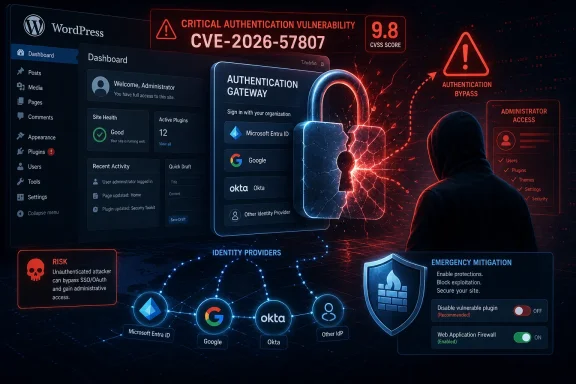
Tracked as CVE-2026-57807, the vulnerability carries a CVSS 3.1 score of 9.8 out of 10. Patchstack describes it as broken authentication that can be exploited remotely without credentials or user interaction, making affected WordPress installations candidates for automated scanning and takeover attempts.
Administrators should not wait for signs of active exploitation. If the affected plugin is installed, the safest immediate response is to disable it or place an effective web application firewall rule in front of the vulnerable authentication path, then investigate the site for unauthorized administrative activity.
The version number requires careful attention because miniOrange distributes free and paid editions of its OAuth client on different release tracks. CVE-2026-57807 identifies versions through 38.5.8, which miniOrange has previously confirmed is part of the enterprise, paid branch.
That is separate from the free OAuth Single Sign On – SSO (OAuth Client) plugin listed in the WordPress.org repository. The repository edition currently uses 6.26.x version numbers, while miniOrange’s enterprise packages use 38.5.x numbers. Administrators should therefore inspect the version reported by the plugin installed on the site rather than assuming the WordPress.org listing establishes whether their deployment is affected.
Patchstack’s vulnerability entry uses the product name OAuth Single Sign On – SSO (OAuth Client) and lists miniOrange Security Software as the developer. The National Vulnerability Database repeats the affected range as all applicable releases through 38.5.8 and classifies the weakness as authentication bypass through an alternate path or channel.
That distinction matters for incident response. The public WordPress.org page reports more than 6,000 active installations for the free plugin, but that figure does not provide a reliable count of vulnerable enterprise deployments. Paid copies may be delivered and updated outside the WordPress.org repository, leaving no authoritative public installation total.
Those capabilities make a failure in the authentication flow particularly consequential. Patchstack says an unauthenticated attacker can perform actions that should be restricted to more privileged users and may ultimately gain administrator access to the website.
The public advisory does not provide exploit instructions, which is appropriate for an unpatched vulnerability. NVD describes the issue as allowing “password recovery exploitation,” but neither NVD nor Patchstack has published enough technical detail to determine from public information exactly which configurations, role-mapping options, or identity providers are required.
The CVSS vector nevertheless describes a worst-case network attack with low complexity, no privileges and no user interaction. A successful compromise would affect confidentiality, integrity and availability—the combination behind the 9.8 severity score.
Administrator access to WordPress is usually enough to convert an authentication failure into persistent server-side compromise. An intruder could install a malicious plugin, edit theme or plugin code, create additional accounts, change site content, steal stored information, redirect visitors, or implant a backdoor that survives removal of the original vulnerable component.
Depending on hosting permissions, the damage may extend beyond the WordPress dashboard. Writable application files, exposed secrets in configuration data, shared hosting accounts and reused credentials can give an attacker opportunities to move deeper into the environment.
In practical terms, that means the mitigation may disable or disrupt normal SSO activity. It is closer to closing the affected entrance entirely than transparently distinguishing every attack from a valid login.
That disruption is preferable to an exposed administrator takeover route, but organizations need a fallback authentication plan before activating broad blocking. Sites that normally force all employees through SSO may need to restore a tightly controlled local administrator login, restrict access by IP address or VPN, and enforce multifactor authentication while the plugin remains disabled.
Patchstack says vulnerabilities of this type are attractive for mass-exploitation campaigns and expects the flaw to become exploited. That is a risk forecast, not confirmation that widespread attacks are already underway. No public advisory reviewed for this report establishes that exploitation has been observed in the wild as of July 13.
The absence of confirmed exploitation should not be treated as evidence that a site is safe. WordPress attackers routinely automate discovery of vulnerable plugins, and authentication bypasses are especially valuable because they avoid password guessing and social engineering.
Until miniOrange publishes a corrected build, affected operators should take the following steps:
Simply deleting an unfamiliar administrator is insufficient if the attacker has already installed code or obtained secrets. Restoration from a known-good backup may be necessary, followed by updates, credential rotation and verification that the vulnerable component is no longer reachable.
After installing a corrected build, organizations should test SSO, account linking, automatic provisioning and role mapping before returning the site to normal service. Temporary firewall rules should remain in place until the update has been validated, though rules that block all SSO traffic will eventually need to be adjusted or removed to restore legitimate logins.
For now, the operational choice is stark: tolerate an SSO outage or leave a maximum-severity authentication flaw exposed. With no official patch available and Patchstack warning that exploitation is expected, disabling the affected enterprise plugin is the more defensible default.
Tracked as CVE-2026-57807, the vulnerability carries a CVSS 3.1 score of 9.8 out of 10. Patchstack describes it as broken authentication that can be exploited remotely without credentials or user interaction, making affected WordPress installations candidates for automated scanning and takeover attempts.
Administrators should not wait for signs of active exploitation. If the affected plugin is installed, the safest immediate response is to disable it or place an effective web application firewall rule in front of the vulnerable authentication path, then investigate the site for unauthorized administrative activity.
 The Enterprise Version Is the One Named in the Advisory
The version number requires careful attention because miniOrange distributes free and paid editions of its OAuth client on different release tracks. CVE-2026-57807 identifies versions through 38.5.8, which miniOrange has previously confirmed is part of the enterprise, paid branch.That is separate from the free OAuth Single Sign On – SSO (OAuth Client) plugin listed in the WordPress.org repository. The repository edition currently uses 6.26.x version numbers, while miniOrange’s enterprise packages use 38.5.x numbers. Administrators should therefore inspect the version reported by the plugin installed on the site rather than assuming the WordPress.org listing establishes whether their deployment is affected.
Patchstack’s vulnerability entry uses the product name OAuth Single Sign On – SSO (OAuth Client) and lists miniOrange Security Software as the developer. The National Vulnerability Database repeats the affected range as all applicable releases through 38.5.8 and classifies the weakness as authentication bypass through an alternate path or channel.
That distinction matters for incident response. The public WordPress.org page reports more than 6,000 active installations for the free plugin, but that figure does not provide a reliable count of vulnerable enterprise deployments. Paid copies may be delivered and updated outside the WordPress.org repository, leaving no authoritative public installation total.
Authentication Bypass Turns SSO Into the Entry Point
The plugin connects WordPress to OAuth and OpenID Connect identity providers, including Microsoft Entra ID and Azure AD environments, Office 365, Google Workspace, Okta, Keycloak, AWS Cognito, Auth0, and other identity services. It can also create WordPress accounts automatically, link identities to existing accounts, and map identity-provider attributes or groups to WordPress roles.Those capabilities make a failure in the authentication flow particularly consequential. Patchstack says an unauthenticated attacker can perform actions that should be restricted to more privileged users and may ultimately gain administrator access to the website.
The public advisory does not provide exploit instructions, which is appropriate for an unpatched vulnerability. NVD describes the issue as allowing “password recovery exploitation,” but neither NVD nor Patchstack has published enough technical detail to determine from public information exactly which configurations, role-mapping options, or identity providers are required.
The CVSS vector nevertheless describes a worst-case network attack with low complexity, no privileges and no user interaction. A successful compromise would affect confidentiality, integrity and availability—the combination behind the 9.8 severity score.
Administrator access to WordPress is usually enough to convert an authentication failure into persistent server-side compromise. An intruder could install a malicious plugin, edit theme or plugin code, create additional accounts, change site content, steal stored information, redirect visitors, or implant a backdoor that survives removal of the original vulnerable component.
Depending on hosting permissions, the damage may extend beyond the WordPress dashboard. Writable application files, exposed secrets in configuration data, shared hosting accounts and reused credentials can give an attacker opportunities to move deeper into the environment.
Patchstack’s Virtual Patch Comes With a Tradeoff
Patchstack has issued a virtual mitigation rule for customers of its security service while an official update is unavailable. Unusually, the company warns that the rule blocks both legitimate and illegitimate requests in order to cover every known scenario.In practical terms, that means the mitigation may disable or disrupt normal SSO activity. It is closer to closing the affected entrance entirely than transparently distinguishing every attack from a valid login.
That disruption is preferable to an exposed administrator takeover route, but organizations need a fallback authentication plan before activating broad blocking. Sites that normally force all employees through SSO may need to restore a tightly controlled local administrator login, restrict access by IP address or VPN, and enforce multifactor authentication while the plugin remains disabled.
Patchstack says vulnerabilities of this type are attractive for mass-exploitation campaigns and expects the flaw to become exploited. That is a risk forecast, not confirmation that widespread attacks are already underway. No public advisory reviewed for this report establishes that exploitation has been observed in the wild as of July 13.
The absence of confirmed exploitation should not be treated as evidence that a site is safe. WordPress attackers routinely automate discovery of vulnerable plugins, and authentication bypasses are especially valuable because they avoid password guessing and social engineering.
Administrators Need to Treat This as a Possible Incident
The first task is to establish whether the enterprise plugin is present and whether its version is 38.5.8 or older. Asset inventories may list only the generic product name, so administrators should verify the installed package directly through WordPress, filesystem records, deployment manifests or miniOrange licensing information.Until miniOrange publishes a corrected build, affected operators should take the following steps:
- Disable the vulnerable plugin if OAuth or OIDC login can be suspended without locking administrators out of the site.
- Apply Patchstack’s virtual mitigation or an equivalent hosting-provider rule, accepting that SSO requests may be blocked.
- Restrict access to WordPress administration through a VPN, private network, identity-aware proxy or narrowly defined IP allowlist.
- Review administrator and editor accounts for unfamiliar users, unexpected email changes, recent password resets and unexplained role promotions.
- Examine web, authentication, WordPress and WAF logs for unusual requests to the SSO flow, particularly requests followed by privileged dashboard activity.
- Inspect recently installed or modified plugins, themes, scheduled tasks, PHP files and upload directories for persistence.
- Rotate WordPress administrative credentials and relevant application secrets if compromise is suspected, while recognizing that password changes alone will not correct an authentication bypass.
- Preserve logs and a forensic copy before cleaning a potentially compromised system.
Simply deleting an unfamiliar administrator is insufficient if the attacker has already installed code or obtained secrets. Restoration from a known-good backup may be necessary, followed by updates, credential rotation and verification that the vulnerable component is no longer reachable.
The Next Safe Milestone Is a Vendor-Fixed Build
An official miniOrange update remains the key remediation milestone. Administrators should obtain it through their normal licensed distribution channel and verify that the vendor explicitly identifies CVE-2026-57807 or the authentication-bypass issue as fixed; a higher version number without corresponding release documentation is not enough.After installing a corrected build, organizations should test SSO, account linking, automatic provisioning and role mapping before returning the site to normal service. Temporary firewall rules should remain in place until the update has been validated, though rules that block all SSO traffic will eventually need to be adjusted or removed to restore legitimate logins.
For now, the operational choice is stark: tolerate an SSO outage or leave a maximum-severity authentication flaw exposed. With no official patch available and Patchstack warning that exploitation is expected, disabling the affected enterprise plugin is the more defensible default.
References
- Primary source: cyberpress.org
Published: 2026-07-13T06:48:17+00:00
- Related coverage: wordpress.org
- Related coverage: wordfence.com