

The New York Times, the New York Daily News and 15 other media organizations have asked a federal judge to sanction OpenAI, alleging that the ChatGPT maker withheld, destroyed or distorted evidence in their copyright litigation. The motion, filed July 9 in Manhattan federal court, turns a dispute over AI training into a potentially consequential fight over how OpenAI preserved and disclosed its internal datasets and ChatGPT logs.
As reported by The Associated Press and Reuters, the publishers accuse OpenAI of misrepresenting its ability to search those systems for copyrighted journalism. OpenAI rejects the allegations and says the newspapers are attempting to gain access to private conversations belonging to users who have no connection to the case.
The accusations have not been proved, and the court has not imposed the requested penalties. But the filing raises the stakes for OpenAI and Microsoft, its technology and commercial partner in a case that could influence the legal foundations beneath ChatGPT, Copilot and the broader generative-AI market.
The underlying litigation began in December 2023, when The New York Times sued OpenAI and Microsoft. The newspaper alleged that millions of its articles had been used without permission to train AI models capable of competing with its reporting and, under some circumstances, reproducing portions of that reporting.
Other publishers subsequently filed similar cases. The consolidated litigation now includes the New York Daily News, the Chicago Tribune and additional organizations associated with Tribune Publishing and MediaNews Group.
OpenAI maintains that training AI systems on publicly available material is protected by the long-established doctrine of fair use. It has also argued that ChatGPT is not a substitute for a newspaper subscription and that its products generate new responses rather than operating as searchable archives of copyrighted articles.
The new sanctions motion does not ask the judge to resolve that central copyright question. Instead, it attacks OpenAI’s conduct during discovery, the pretrial process in which parties must preserve and exchange evidence relevant to the dispute.
According to the publishers, OpenAI spent roughly two years claiming that it could not conduct the searches needed to locate their content in training datasets or output logs. They contend that testimony from OpenAI employee John Vincent “Vinnie” Monaco contradicted those representations and revealed that relevant searches had already been possible or performed.
Important portions of the deposition and sanctions motion remain redacted. The public record therefore does not disclose the full technical details of what OpenAI could search, which systems were involved or precisely what Monaco testified.
That distinction matters. The filing contains serious allegations, but it remains the publishers’ account of disputed events rather than a judicial finding that OpenAI lied or destroyed evidence unlawfully.
According to reporting by TechCrunch, the requested remedies include preventing OpenAI from relying on a sample of 20 million chat logs that the publishers consider unreliable. They also want the court to restrict OpenAI from arguing that the produced logs show little substantial reproduction of their work.
Most consequentially, the publishers are seeking an adverse inference: a finding allowing the court to assume that missing or compromised evidence would have supported their claims. That would not automatically decide the entire case, but it could remove important factual ground from OpenAI’s defense.
The publishers allege that billions of ChatGPT outputs were deleted after litigation began and that millions of records in the requested sample were replaced or otherwise made unsuitable for analysis. They further contend that OpenAI concealed searches that could identify instances in which models reproduced or relied upon their journalism.
Steven Lieberman, an attorney representing the Daily News and seven related newspapers, accused OpenAI of hiding and destroying evidence showing how ChatGPT was trained. Ian Crosby, lead counsel for The New York Times, similarly characterized the company’s conduct as a sustained deception of the plaintiffs and the court.
OpenAI spokesperson Drew Pusateri called those allegations false. In a statement carried by The Associated Press, he said the publishers were persisting with attempts to invade the privacy of unrelated ChatGPT users as their case weakened.
The opposing positions expose two issues that the court must keep separate: whether OpenAI complied with its evidence-preservation obligations and whether disclosure of customer conversations can occur without compromising user privacy. Privacy concerns can justify strict controls on evidence, but they do not automatically excuse the loss or withholding of material covered by a court order.
The copyright litigation disrupted that normal lifecycle. Court orders required OpenAI to preserve output logs while the parties argued over which records could be reviewed and under what safeguards.
That created a collision between two legitimate expectations. Litigants expect potentially relevant evidence to survive, while users expect the service to honor its deletion controls and protect conversations that may contain personal, commercial or confidential information.
The publishers are not simply requesting a conventional bundle of corporate emails. ChatGPT logs can contain source code, medical questions, unpublished documents, workplace information and highly personal discussions. Even de-identified records can create risk if their content contains enough contextual detail to expose a person or organization.
For administrators, this is another reason not to treat a public consumer chatbot as an approved destination for sensitive company data. Legal holds, regulatory investigations and civil litigation can change how long information is retained, regardless of the deletion experience presented in an application.
Enterprise customers should distinguish ChatGPT’s consumer services from Microsoft 365 Copilot, Azure-hosted services and business versions of OpenAI products, which operate under different contractual, retention and data-protection terms. The present dispute does not establish that Microsoft 365 Copilot customer prompts were included in the contested ChatGPT-log production.
Nevertheless, the case illustrates a broader governance problem: data entered into an AI service may become discoverable evidence. Organizations need enforceable policies covering approved tools, prompt content, retention, auditing and the use of confidential material with third-party models.
The sanctions motion is directed at OpenAI’s alleged discovery conduct, not at a new Copilot feature or Windows change. Windows users should not expect an immediate product shutdown, licensing change or removal of Copilot because of the filing.
The longer-term implications could still be substantial. A ruling that weakens OpenAI’s ability to defend its training practices could increase pressure for publisher licensing, better dataset documentation and more restrictive treatment of protected material. Microsoft and other AI vendors could then face higher costs and tighter requirements for the models deployed through cloud and productivity services.
A court finding of discovery misconduct would create a separate trust problem. Enterprise buyers are being asked to accept vendor assurances about training boundaries, retention and data isolation. Allegations that a supplier could not accurately describe or search its own systems strike directly at the auditability those customers expect.
That does not prove that Copilot’s enterprise safeguards are ineffective. It does mean procurement and security teams should demand precise, contract-backed answers rather than relying on broad statements about responsible AI.
The outcome will not by itself settle whether training on copyrighted reporting constitutes fair use. It could, however, determine what evidence remains available when that issue is eventually tried—and which arguments OpenAI is permitted to make.
For Microsoft customers and Windows-focused IT teams, no emergency action is required. The practical response is to review which AI services employees use, keep sensitive information out of unapproved consumer tools and verify the retention commitments attached to enterprise deployments.
The copyright battle was already testing whether AI companies may build commercial models from journalism without negotiating licenses. The sanctions fight adds a sharper question: whether the evidence needed to answer that issue was properly preserved in the first place.
As reported by The Associated Press and Reuters, the publishers accuse OpenAI of misrepresenting its ability to search those systems for copyrighted journalism. OpenAI rejects the allegations and says the newspapers are attempting to gain access to private conversations belonging to users who have no connection to the case.
The accusations have not been proved, and the court has not imposed the requested penalties. But the filing raises the stakes for OpenAI and Microsoft, its technology and commercial partner in a case that could influence the legal foundations beneath ChatGPT, Copilot and the broader generative-AI market.
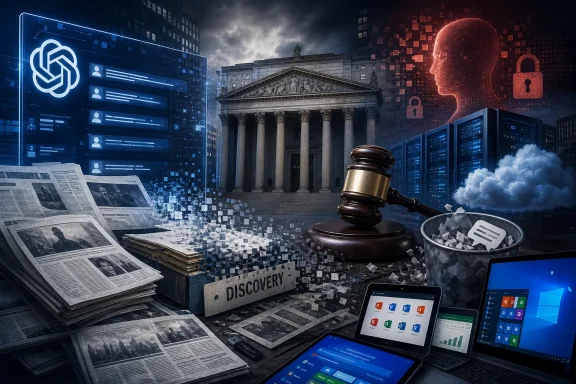 A Copyright Case Becomes a Fight Over Discovery
The underlying litigation began in December 2023, when The New York Times sued OpenAI and Microsoft. The newspaper alleged that millions of its articles had been used without permission to train AI models capable of competing with its reporting and, under some circumstances, reproducing portions of that reporting.Other publishers subsequently filed similar cases. The consolidated litigation now includes the New York Daily News, the Chicago Tribune and additional organizations associated with Tribune Publishing and MediaNews Group.
OpenAI maintains that training AI systems on publicly available material is protected by the long-established doctrine of fair use. It has also argued that ChatGPT is not a substitute for a newspaper subscription and that its products generate new responses rather than operating as searchable archives of copyrighted articles.
The new sanctions motion does not ask the judge to resolve that central copyright question. Instead, it attacks OpenAI’s conduct during discovery, the pretrial process in which parties must preserve and exchange evidence relevant to the dispute.
According to the publishers, OpenAI spent roughly two years claiming that it could not conduct the searches needed to locate their content in training datasets or output logs. They contend that testimony from OpenAI employee John Vincent “Vinnie” Monaco contradicted those representations and revealed that relevant searches had already been possible or performed.
Important portions of the deposition and sanctions motion remain redacted. The public record therefore does not disclose the full technical details of what OpenAI could search, which systems were involved or precisely what Monaco testified.
That distinction matters. The filing contains serious allegations, but it remains the publishers’ account of disputed events rather than a judicial finding that OpenAI lied or destroyed evidence unlawfully.
Publishers Want More Than Their Legal Bills Paid
Reuters reported that the media organizations are asking for attorneys’ fees covering work required to pursue evidence they say was improperly withheld. Their demands also include findings that could influence how the copyright claims are presented at trial.According to reporting by TechCrunch, the requested remedies include preventing OpenAI from relying on a sample of 20 million chat logs that the publishers consider unreliable. They also want the court to restrict OpenAI from arguing that the produced logs show little substantial reproduction of their work.
Most consequentially, the publishers are seeking an adverse inference: a finding allowing the court to assume that missing or compromised evidence would have supported their claims. That would not automatically decide the entire case, but it could remove important factual ground from OpenAI’s defense.
The publishers allege that billions of ChatGPT outputs were deleted after litigation began and that millions of records in the requested sample were replaced or otherwise made unsuitable for analysis. They further contend that OpenAI concealed searches that could identify instances in which models reproduced or relied upon their journalism.
Steven Lieberman, an attorney representing the Daily News and seven related newspapers, accused OpenAI of hiding and destroying evidence showing how ChatGPT was trained. Ian Crosby, lead counsel for The New York Times, similarly characterized the company’s conduct as a sustained deception of the plaintiffs and the court.
OpenAI spokesperson Drew Pusateri called those allegations false. In a statement carried by The Associated Press, he said the publishers were persisting with attempts to invade the privacy of unrelated ChatGPT users as their case weakened.
The opposing positions expose two issues that the court must keep separate: whether OpenAI complied with its evidence-preservation obligations and whether disclosure of customer conversations can occur without compromising user privacy. Privacy concerns can justify strict controls on evidence, but they do not automatically excuse the loss or withholding of material covered by a court order.
ChatGPT Privacy Is Now Part of the Litigation
OpenAI has previously objected to demands that it indefinitely retain user conversations, including chats that customers attempted to delete. Its published consumer policy ordinarily schedules deleted ChatGPT conversations for permanent removal within 30 days, unless legal or security obligations require longer retention.The copyright litigation disrupted that normal lifecycle. Court orders required OpenAI to preserve output logs while the parties argued over which records could be reviewed and under what safeguards.
That created a collision between two legitimate expectations. Litigants expect potentially relevant evidence to survive, while users expect the service to honor its deletion controls and protect conversations that may contain personal, commercial or confidential information.
The publishers are not simply requesting a conventional bundle of corporate emails. ChatGPT logs can contain source code, medical questions, unpublished documents, workplace information and highly personal discussions. Even de-identified records can create risk if their content contains enough contextual detail to expose a person or organization.
For administrators, this is another reason not to treat a public consumer chatbot as an approved destination for sensitive company data. Legal holds, regulatory investigations and civil litigation can change how long information is retained, regardless of the deletion experience presented in an application.
Enterprise customers should distinguish ChatGPT’s consumer services from Microsoft 365 Copilot, Azure-hosted services and business versions of OpenAI products, which operate under different contractual, retention and data-protection terms. The present dispute does not establish that Microsoft 365 Copilot customer prompts were included in the contested ChatGPT-log production.
Nevertheless, the case illustrates a broader governance problem: data entered into an AI service may become discoverable evidence. Organizations need enforceable policies covering approved tools, prompt content, retention, auditing and the use of confidential material with third-party models.
Microsoft’s Exposure Runs Beyond the Courtroom
Microsoft remains a defendant in the original copyright litigation because of its close technical and commercial relationship with OpenAI. Its products have embedded OpenAI-derived models throughout Windows, Microsoft 365, Azure and developer tooling, making the legal status of model training more than a remote concern for the Windows ecosystem.The sanctions motion is directed at OpenAI’s alleged discovery conduct, not at a new Copilot feature or Windows change. Windows users should not expect an immediate product shutdown, licensing change or removal of Copilot because of the filing.
The longer-term implications could still be substantial. A ruling that weakens OpenAI’s ability to defend its training practices could increase pressure for publisher licensing, better dataset documentation and more restrictive treatment of protected material. Microsoft and other AI vendors could then face higher costs and tighter requirements for the models deployed through cloud and productivity services.
A court finding of discovery misconduct would create a separate trust problem. Enterprise buyers are being asked to accept vendor assurances about training boundaries, retention and data isolation. Allegations that a supplier could not accurately describe or search its own systems strike directly at the auditability those customers expect.
That does not prove that Copilot’s enterprise safeguards are ineffective. It does mean procurement and security teams should demand precise, contract-backed answers rather than relying on broad statements about responsible AI.
The Judge’s Response Will Shape the Trial
The immediate milestone is the court’s decision on whether OpenAI’s conduct warrants sanctions and, if so, how severe they should be. The judge could award fees, limit evidence, adopt factual inferences, order additional discovery or reject the publishers’ motion after reviewing OpenAI’s response.The outcome will not by itself settle whether training on copyrighted reporting constitutes fair use. It could, however, determine what evidence remains available when that issue is eventually tried—and which arguments OpenAI is permitted to make.
For Microsoft customers and Windows-focused IT teams, no emergency action is required. The practical response is to review which AI services employees use, keep sensitive information out of unapproved consumer tools and verify the retention commitments attached to enterprise deployments.
The copyright battle was already testing whether AI companies may build commercial models from journalism without negotiating licenses. The sanctions fight adds a sharper question: whether the evidence needed to answer that issue was properly preserved in the first place.
References
- Primary source: The Daily Jagran
Published: 2026-07-13T08:12:00+00:00
Loading…
www.thedailyjagran.com - Related coverage: washingtonpost.com
Loading…
www.washingtonpost.com - Related coverage: wtop.com
Loading…
wtop.com - Related coverage: ksat.com
Loading…
www.ksat.com - Related coverage: euronews.com
Loading…
www.euronews.com - Related coverage: thewrap.com
Loading…
www.thewrap.com