

Intel’s latest education push with ASUS is a useful demonstration of where on-device AI fits in schools, but it is not evidence that classroom privacy has become a decisive competitive advantage for Intel hardware.
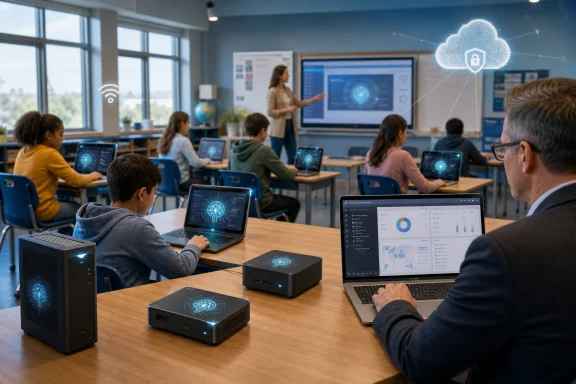
At ISTE+ASCD 2026 in Orlando, ASUS and Intel jointly showed an education lineup spanning rugged student systems, ExpertBook laptops, ASUS NUC mini PCs, Chromebooks and the newly announced Chromebox 6a. ASUS said its Intel-powered NUC 15 Pro and NUC 16 Pro systems offer Copilot+ capabilities and enough platform AI performance for local workloads, framing that as a way to keep sensitive student data on-device.
That matters in K–12 procurement. Student data is a regulatory and reputational liability, and local processing can reduce the amount of audio, images, documents and usage data sent to a cloud service. It can also improve responsiveness when schools have weak connectivity or restrictive network policies.
The important qualification is that an NPU does not automatically make a classroom deployment private. A school still needs software that can run its model locally, policies that limit telemetry and data retention, identity controls, endpoint management, and a clear understanding of what the application sends off-device.
For Windows administrators, the relevant distinction is between a device capable of local AI and an application configured to use it. Copilot+ PCs and Intel’s AI-capable platforms can accelerate supported local features, but many education applications remain cloud-backed by design. Districts should verify data flows with each vendor rather than treating “on-device AI” as a compliance guarantee.
ASUS is also selling the practical parts of an education fleet: reinforced laptops, stable multi-year hardware availability, tool-free serviceability, centralized deployment, and small PCs suited to labs and classrooms. Those attributes are at least as important as AI acceleration in a district refresh cycle.
But the announcement is primarily an OEM and channel win, not a new Intel-exclusive technology. AMD, Qualcomm and Apple all make similar arguments around efficient local inference, while Google’s Chromebook ecosystem has its own management and security model. Intel’s advantage here will depend on price, availability, battery life, Windows and ChromeOS support, and whether independent software vendors actually target its hardware well.
ASUS’s Chromebox 6a also illustrates the mixed-platform reality. It uses a 14th Gen Intel Core 7 processor, Wi‑Fi 7, Google Zero-Touch Enrollment and Google Admin console management, with the Titan C security chip for hardware-backed protection. The privacy story is therefore split among Intel silicon, ASUS hardware, Google’s operating environment, and the school’s own configuration.
For schools planning Windows AI deployments, local AI capability should be one line item in a broader evaluation of management, repairability, application data handling and total fleet cost.
At ISTE+ASCD 2026 in Orlando, ASUS and Intel jointly showed an education lineup spanning rugged student systems, ExpertBook laptops, ASUS NUC mini PCs, Chromebooks and the newly announced Chromebox 6a. ASUS said its Intel-powered NUC 15 Pro and NUC 16 Pro systems offer Copilot+ capabilities and enough platform AI performance for local workloads, framing that as a way to keep sensitive student data on-device.
That matters in K–12 procurement. Student data is a regulatory and reputational liability, and local processing can reduce the amount of audio, images, documents and usage data sent to a cloud service. It can also improve responsiveness when schools have weak connectivity or restrictive network policies.
 Privacy is a deployment choice, not a processor feature
The important qualification is that an NPU does not automatically make a classroom deployment private. A school still needs software that can run its model locally, policies that limit telemetry and data retention, identity controls, endpoint management, and a clear understanding of what the application sends off-device.For Windows administrators, the relevant distinction is between a device capable of local AI and an application configured to use it. Copilot+ PCs and Intel’s AI-capable platforms can accelerate supported local features, but many education applications remain cloud-backed by design. Districts should verify data flows with each vendor rather than treating “on-device AI” as a compliance guarantee.
ASUS is also selling the practical parts of an education fleet: reinforced laptops, stable multi-year hardware availability, tool-free serviceability, centralized deployment, and small PCs suited to labs and classrooms. Those attributes are at least as important as AI acceleration in a district refresh cycle.
Intel gets a credible reference deployment
The partnership gives Intel a visible vertical-market showcase for its client platform strategy. It places Intel processors across several device categories instead of isolating AI to premium Windows notebooks. For Intel, that is a credible message: AI workloads do not have to begin in a data center, and education is an environment where local processing has an understandable privacy and connectivity rationale.But the announcement is primarily an OEM and channel win, not a new Intel-exclusive technology. AMD, Qualcomm and Apple all make similar arguments around efficient local inference, while Google’s Chromebook ecosystem has its own management and security model. Intel’s advantage here will depend on price, availability, battery life, Windows and ChromeOS support, and whether independent software vendors actually target its hardware well.
ASUS’s Chromebox 6a also illustrates the mixed-platform reality. It uses a 14th Gen Intel Core 7 processor, Wi‑Fi 7, Google Zero-Touch Enrollment and Google Admin console management, with the Titan C security chip for hardware-backed protection. The privacy story is therefore split among Intel silicon, ASUS hardware, Google’s operating environment, and the school’s own configuration.
For schools planning Windows AI deployments, local AI capability should be one line item in a broader evaluation of management, repairability, application data handling and total fleet cost.
References
- Primary source: simplywall.st
Published: 2026-07-13T03:32:36.331000+00:00
Is Intel (INTC) Quietly Turning Classroom Privacy Into a Competitive Edge in AI Hardware? - Simply Wall St News
In June 2026, ASUS Education and Intel appeared at ISTE+ASCD 2026 in Orlando, showcasing a full portfolio of Intel-powered, AI-ready classroom devices spanning rugged K-12 laptops, ExpertBook systems, Chromebooks, NUCs, and edge AI accelerators. This collaboration highlights how Intel’s platform...simplywall.st - Related coverage: techtimes.com
Intel Core Ultra Price Hike Reaches 17 Percent as Arrow Lake Refresh Loses Its Edge
Intel Core Ultra price increase hits Arrow Lake Refresh owners as Intel quietly raised the recommended customer price on its Core Ultra 7 270K Plus and Core Ultra 5 250K Plus by up to 17 percent onwww.techtimes.com - Related coverage: windowscentral.com
Intel plans to raise 13th Gen CPU prices — here's why | Windows Central
Get your Raptor Lake chips now before prices go up!www.windowscentral.com