

Google Maps’ new Immersive Navigation interface is now appearing on Android Auto for some U.S. drivers, bringing the 3D route view Google announced in March to in-car displays. ZDNET reports that the feature has begun showing up in real-world Android Auto use, while Android Authority says the rollout appears to be server-side and therefore may not correspond to a particular Google Maps or Android Auto app update.
The change is primarily visual, but it targets common navigation pain points: confusing freeway splits, stacked roads, dense city blocks, and last-minute lane changes. Instead of the conventional flat or lightly angled map, Immersive Navigation renders translucent building outlines, terrain, overpasses, ramps, greenery, and more detailed lane markings where data is available.
Google has described the feature as its largest navigation redesign in more than a decade. Per Google’s March announcement, Gemini models help analyze Street View and aerial imagery to create a more spatially accurate representation of the route, including landmarks and road medians.
In ZDNET’s testing around Charlotte, North Carolina, the most useful additions were not the decorative 3D buildings but the extra context around route decisions. Buildings are shown in their actual footprints rather than as anonymous blocks, while their translucent treatment avoids obscuring roads behind them.
The interface can also make flyovers and underpasses easier to distinguish, an area where conventional map views can be misleading when several roads overlap. Google Maps may zoom closer on difficult junctions, and lane markings can show where drivers need to position themselves before a merge or exit.
Arrival guidance is also part of the package. Google says Maps can identify a destination’s entrance, nearby parking and the correct side of the street, rather than stopping at a street address that may be adjacent to the actual driveway or access point.
The added detail will not be consistent everywhere. ZDNET noted that lane information was more visible in urban areas than rural locations, and the visual richness depends on Google having sufficiently detailed map and imagery data for a given route.
There does not appear to be a dedicated Android Auto download or universal settings toggle that guarantees access. Keeping Google Maps and Android Auto current is sensible, but the activation itself reportedly happens from Google’s side.
For drivers who routinely navigate unfamiliar city centers or complex interchanges, the upgrade should make route guidance easier to interpret once it reaches their Android Auto setup.
The change is primarily visual, but it targets common navigation pain points: confusing freeway splits, stacked roads, dense city blocks, and last-minute lane changes. Instead of the conventional flat or lightly angled map, Immersive Navigation renders translucent building outlines, terrain, overpasses, ramps, greenery, and more detailed lane markings where data is available.
Google has described the feature as its largest navigation redesign in more than a decade. Per Google’s March announcement, Gemini models help analyze Street View and aerial imagery to create a more spatially accurate representation of the route, including landmarks and road medians.
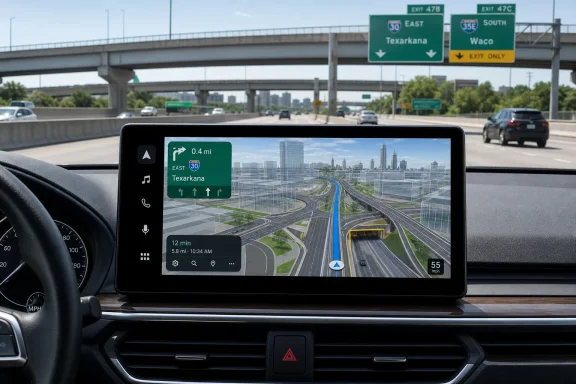 What changes on the dashboard
In ZDNET’s testing around Charlotte, North Carolina, the most useful additions were not the decorative 3D buildings but the extra context around route decisions. Buildings are shown in their actual footprints rather than as anonymous blocks, while their translucent treatment avoids obscuring roads behind them.The interface can also make flyovers and underpasses easier to distinguish, an area where conventional map views can be misleading when several roads overlap. Google Maps may zoom closer on difficult junctions, and lane markings can show where drivers need to position themselves before a merge or exit.
Arrival guidance is also part of the package. Google says Maps can identify a destination’s entrance, nearby parking and the correct side of the street, rather than stopping at a street address that may be adjacent to the actual driveway or access point.
The added detail will not be consistent everywhere. ZDNET noted that lane information was more visible in urban areas than rural locations, and the visual richness depends on Google having sufficiently detailed map and imagery data for a given route.
No manual switch guaranteed
Google originally said Immersive Navigation would roll out gradually across the United States to eligible Android and iOS devices, CarPlay, Android Auto, and vehicles with Google built-in. Android Auto availability has been uneven since then, with reports of the new view appearing for some users while others retain the older interface.There does not appear to be a dedicated Android Auto download or universal settings toggle that guarantees access. Keeping Google Maps and Android Auto current is sensible, but the activation itself reportedly happens from Google’s side.
For drivers who routinely navigate unfamiliar city centers or complex interchanges, the upgrade should make route guidance easier to interpret once it reaches their Android Auto setup.
References
- Primary source: ZDNET
Published: 2026-07-14T06:40:33+00:00
I tried Google Maps' new 3D Immersive View for Android Auto, and it fixed my biggest navigation problems
The update is the biggest visual change in a decade, and it makes navigating much easier.www.zdnet.com - Related coverage: tomsguide.com
I tested Google's new Gemini update for Android Auto and it finally fixes everything that made the old Google Assistant so frustrating to use while driving | Tom's Guide
Google Assistant was the bane of my driving experience, but Gemini is already making up for all those past wrongs.www.tomsguide.com - Related coverage: blog.google
Ask Maps and Immersive Navigation: New AI features in Google Maps
Google Maps has two new AI features: Ask Maps and Immersive Navigation.blog.google - Related coverage: androidauthority.com
Google Maps Immersive Navigation seems to be rolling out for Android Auto
Google has started rolling out the new Immersive Navigation UI in Google Maps for Android Auto but it could be a server-side update.www.androidauthority.com - Related coverage: androidcentral.com
Android Auto gets a fresh take on Google Maps navigation, teases more Gemini at the Android Show | Android Central
The Show revealed everything you can expect from Android Auto.www.androidcentral.com - Related coverage: macrumors.com
Google Maps Adds Gemini AI-Powered 'Ask Maps' Feature and 3D Immersive Navigation
Google today added Gemini AI to Google Maps, enabling a new Ask Maps feature. Gemini in maps can answer complex, real-world questions that Google says "a map could never answer before".www.macrumors.com
