

CVE-2026-54116 can expose internal memory pointers from Microsoft SQL Server 2025, giving an authenticated attacker addresses that may weaken memory-layout protections and help prepare a more damaging follow-on exploit. It does not, based on Microsoft’s published description, directly disclose database rows, passwords, query contents, or customer files.
Microsoft disclosed the flaw on July 14, 2026, through the Microsoft Security Response Center as part of its monthly security release. The CVE record describes a remotely reachable type confusion bug in SQL Server that allows an authorized attacker to disclose information over a network.
The vulnerability carries a CVSS 3.1 score of 6.5, placing it in the Medium severity range. Its practical importance comes less from the immediate data leak than from what a reliable memory address can enable when combined with another vulnerability.
An internal memory pointer is an address identifying where an object, function, or data structure resides within a running process. Applications normally have little reason to reveal those raw addresses to remote clients, because they expose details about the process’s memory layout.
Microsoft says successful exploitation of CVE-2026-54116 could disclose such pointers. The leaked values could help an attacker determine where selected SQL Server components have been loaded or where relevant objects are located in memory.
That distinction matters. This is not described as a flaw that permits an attacker to issue an unauthorized
Microsoft has not publicly documented which pointer types, SQL Server objects, or request sequences are involved. Administrators therefore should not assume that ordinary database permissions or a particular feature configuration eliminates exposure unless Microsoft explicitly documents that limitation.
A pointer disclosure can undermine that uncertainty. If the leaked address belongs to a known module or object, an attacker may be able to calculate the location of other structures relative to it. This is commonly referred to as defeating or weakening ASLR.
The pointer itself does not automatically grant code execution. An attacker would generally need another weakness—such as a buffer overflow, use-after-free bug, or other memory-corruption condition—to turn that knowledge into control over the SQL Server process.
That makes CVE-2026-54116 a potential exploit-chain component. A second vulnerability that would otherwise crash unpredictably or fail because of ASLR may become more dependable once the attacker knows a valid runtime address.
Microsoft’s CVSS vector reinforces this interpretation: network access is possible, attack complexity is rated low, low-level privileges are required, and no user interaction is needed. The confidentiality impact is rated High, while integrity and availability impacts are rated None for this CVE by itself.
That requirement lowers the immediate risk compared with a pre-authentication SQL Server flaw, but it should not be treated as a strong boundary in every environment. Application service accounts, developer credentials, reporting users, vendor integrations, and compromised workloads may all provide an attacker with a path to low-privilege database access.
The network attack vector is particularly relevant to shared database infrastructure. A compromised application account might have tightly restricted access to business tables while still being able to reach the vulnerable SQL Server code path. If that path returns a process address, the attacker gains information outside the intended scope of the account.
Administrators should also consider lateral movement. An attacker who has already breached a web server or application tier may recover a SQL login from configuration files, environment variables, connection strings, or process memory. CVE-2026-54116 could then become one step in an attack against the database server.
This is why least privilege remains important but is not a substitute for the update. Restricting logins and network access reduces the number of potential attackers; it does not correct the underlying type confusion.
SQL Server administrators should verify the installed engine build rather than assuming that Windows Update alone has completed the work. The active SQL Server instance version can be checked with:
Deployment planning also needs to account for the servicing branch. Organizations following the GDR track generally should install the corresponding GDR security release, while systems already maintained through cumulative updates should use the applicable CU-based package.
Microsoft lists a known issue for KB5101346 involving linked-server queries that use the
The operational risk lies in composition. Security controls such as ASLR are designed to force attackers to guess, and a leaked address removes part of that guesswork. On systems affected by other SQL Server flaws, third-party extensions, unsafe components, or undiscovered memory-corruption bugs, that information may materially improve exploit reliability.
SQL Server 2025 operators should move CU6 installations to 17.0.4060.2 and GDR installations to 17.0.1125.2, while specifically testing
Microsoft disclosed the flaw on July 14, 2026, through the Microsoft Security Response Center as part of its monthly security release. The CVE record describes a remotely reachable type confusion bug in SQL Server that allows an authorized attacker to disclose information over a network.
The vulnerability carries a CVSS 3.1 score of 6.5, placing it in the Medium severity range. Its practical importance comes less from the immediate data leak than from what a reliable memory address can enable when combined with another vulnerability.
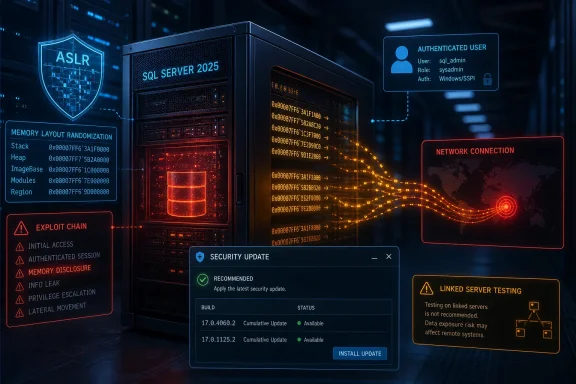 The Leak Exposes Process Layout, Not Database Records
An internal memory pointer is an address identifying where an object, function, or data structure resides within a running process. Applications normally have little reason to reveal those raw addresses to remote clients, because they expose details about the process’s memory layout.Microsoft says successful exploitation of CVE-2026-54116 could disclose such pointers. The leaked values could help an attacker determine where selected SQL Server components have been loaded or where relevant objects are located in memory.
That distinction matters. This is not described as a flaw that permits an attacker to issue an unauthorized
SELECT statement or dump a table containing personal, financial, or authentication data. The disclosed information is primarily useful at the exploitation layer: it provides knowledge about the SQL Server process itself.Microsoft has not publicly documented which pointer types, SQL Server objects, or request sequences are involved. Administrators therefore should not assume that ordinary database permissions or a particular feature configuration eliminates exposure unless Microsoft explicitly documents that limitation.
Why a Memory Address Has Security Value
Modern Windows and Linux systems use Address Space Layout Randomization, or ASLR, to make memory-corruption attacks less reliable. ASLR changes the locations of executables, libraries, stacks, heaps, and other regions so an attacker cannot safely predict the address of useful code or data.A pointer disclosure can undermine that uncertainty. If the leaked address belongs to a known module or object, an attacker may be able to calculate the location of other structures relative to it. This is commonly referred to as defeating or weakening ASLR.
The pointer itself does not automatically grant code execution. An attacker would generally need another weakness—such as a buffer overflow, use-after-free bug, or other memory-corruption condition—to turn that knowledge into control over the SQL Server process.
That makes CVE-2026-54116 a potential exploit-chain component. A second vulnerability that would otherwise crash unpredictably or fail because of ASLR may become more dependable once the attacker knows a valid runtime address.
Microsoft’s CVSS vector reinforces this interpretation: network access is possible, attack complexity is rated low, low-level privileges are required, and no user interaction is needed. The confidentiality impact is rated High, while integrity and availability impacts are rated None for this CVE by itself.
Authentication Narrows the Door but Does Not Close It
The CVE description says exploitation requires an authorized attacker. In practical terms, the attacker needs some level of authenticated access rather than being able to target an arbitrary internet-facing SQL Server anonymously.That requirement lowers the immediate risk compared with a pre-authentication SQL Server flaw, but it should not be treated as a strong boundary in every environment. Application service accounts, developer credentials, reporting users, vendor integrations, and compromised workloads may all provide an attacker with a path to low-privilege database access.
The network attack vector is particularly relevant to shared database infrastructure. A compromised application account might have tightly restricted access to business tables while still being able to reach the vulnerable SQL Server code path. If that path returns a process address, the attacker gains information outside the intended scope of the account.
Administrators should also consider lateral movement. An attacker who has already breached a web server or application tier may recover a SQL login from configuration files, environment variables, connection strings, or process memory. CVE-2026-54116 could then become one step in an attack against the database server.
This is why least privilege remains important but is not a substitute for the update. Restricting logins and network access reduces the number of potential attackers; it does not correct the underlying type confusion.
SQL Server 2025 Is the Published Target
The initial Microsoft-supplied CVE data identifies Microsoft SQL Server 2025 on the CU6 and GDR servicing branches. The published fixed build levels are:- SQL Server 2025 CU6 systems should reach build 17.0.4060.2 through KB5101346.
- SQL Server 2025 GDR systems should reach build 17.0.1125.2 through KB5102333.
SQL Server administrators should verify the installed engine build rather than assuming that Windows Update alone has completed the work. The active SQL Server instance version can be checked with:
SELECT @@VERSION;Deployment planning also needs to account for the servicing branch. Organizations following the GDR track generally should install the corresponding GDR security release, while systems already maintained through cumulative updates should use the applicable CU-based package.
Microsoft lists a known issue for KB5101346 involving linked-server queries that use the
MSDASQL OLE DB Provider for ODBC Drivers and specify a provider string. Those queries may fail with error 7416 after the update, giving administrators a concrete regression to test before broad production deployment.Patching Removes a Useful Building Block
CVE-2026-54116 is not presented as a standalone route to taking control of SQL Server. Its disclosed effect is narrower: an authenticated attacker can obtain internal memory pointers through a remotely accessible type-confusion condition.The operational risk lies in composition. Security controls such as ASLR are designed to force attackers to guess, and a leaked address removes part of that guesswork. On systems affected by other SQL Server flaws, third-party extensions, unsafe components, or undiscovered memory-corruption bugs, that information may materially improve exploit reliability.
SQL Server 2025 operators should move CU6 installations to 17.0.4060.2 and GDR installations to 17.0.1125.2, while specifically testing
MSDASQL linked servers. The information at stake is not a customer table; it is the memory map an attacker may need to reach one through a second flaw.References
- Primary source: MSRC
Published: 2026-07-14T07:00:00-07:00
Security Update Guide - Microsoft Security Response Center
 msrc.microsoft.com
- Official source: support.microsoft.com
KB5058716 - Description of the security update for SQL Server 2017 GDR: July 8, 2025 | Microsoft Support
KB5058716 - Description of the security update for SQL Server 2017 GDR: July 8, 2025support.microsoft.com
