

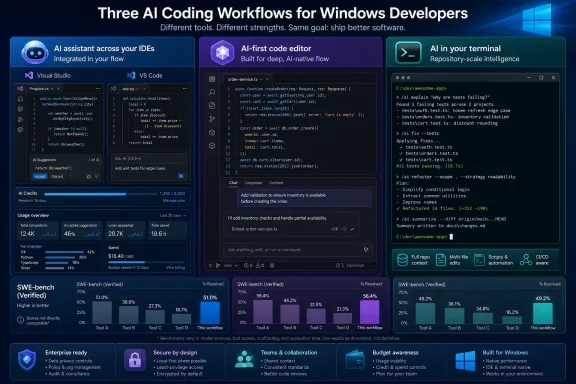
A July 14 comparison on Tech-Insider usefully captures the growing overlap between Claude Code, Cursor and GitHub Copilot, but its headline metric needs a large asterisk: the cited 80.8% SWE-bench Verified result belongs to an Anthropic model-and-agent setup, not to “Claude Code” as a directly comparable retail product score.
Anthropic’s own system-card material ties the 80.8% figure to Claude Opus 4.6 on SWE-bench Verified. Cursor and GitHub Copilot do not have equivalent official public submissions in the comparison, so estimated scores for those products should not be presented as a clean three-way league table. SWE-bench measures issue resolution in selected open-source repositories; it does not measure editor integration, latency, policy controls, price predictability, or the quality of daily inline completions.
The consequential news for Windows developers and IT admins is GitHub Copilot’s billing change. GitHub says usage-based billing went live on June 1, 2026. Paid plans retain unlimited code completions and next-edit suggestions, but chat, agents, CLI work and certain other AI features consume GitHub AI Credits. One credit equals $0.01.
GitHub’s documentation says Copilot code review also consumes GitHub Actions minutes as of June 1. That matters for organizations that have treated Copilot as a predictable per-seat purchase: heavy agent and review use now needs budgets, usage monitoring and policy limits alongside license assignments.
GitHub still positions Copilot as the broadest Windows-friendly option. It works in Visual Studio, Visual Studio Code, JetBrains IDEs and other environments, making it the low-friction standardization choice for teams with mixed toolchains.
Cursor’s SOC 2 certification is a meaningful procurement checkbox, but an enterprise should verify the exact data-retention, identity and contractual controls in its own agreement rather than treating a certification badge as a full security assessment.
Claude Code, meanwhile, is best understood as a terminal-based agent workflow that can sit alongside an existing Windows editor. Anthropic’s current pricing lists Claude Pro at $20 per month, including terminal access to Claude Code, with higher-use Max tiers starting at $100 monthly. Anthropic also raised Claude Code rate limits in May, confirming that rate limits—not just subscription price—remain part of capacity planning for frequent agent users.
Anthropic’s own system-card material ties the 80.8% figure to Claude Opus 4.6 on SWE-bench Verified. Cursor and GitHub Copilot do not have equivalent official public submissions in the comparison, so estimated scores for those products should not be presented as a clean three-way league table. SWE-bench measures issue resolution in selected open-source repositories; it does not measure editor integration, latency, policy controls, price predictability, or the quality of daily inline completions.
 The real 2026 change: Copilot is metered
The consequential news for Windows developers and IT admins is GitHub Copilot’s billing change. GitHub says usage-based billing went live on June 1, 2026. Paid plans retain unlimited code completions and next-edit suggestions, but chat, agents, CLI work and certain other AI features consume GitHub AI Credits. One credit equals $0.01.GitHub’s documentation says Copilot code review also consumes GitHub Actions minutes as of June 1. That matters for organizations that have treated Copilot as a predictable per-seat purchase: heavy agent and review use now needs budgets, usage monitoring and policy limits alongside license assignments.
GitHub still positions Copilot as the broadest Windows-friendly option. It works in Visual Studio, Visual Studio Code, JetBrains IDEs and other environments, making it the low-friction standardization choice for teams with mixed toolchains.
Cursor and Claude Code are less interchangeable than the headline suggests
Cursor remains a VS Code-derived, AI-first editor rather than a general extension. That distinction matters for Windows shops built around Visual Studio or JetBrains. However, the claim that Cursor has no JetBrains support is no longer accurate: Cursor announced Cursor ACP support for JetBrains IDEs in March 2026, bringing agent-driven workflows into that environment.Cursor’s SOC 2 certification is a meaningful procurement checkbox, but an enterprise should verify the exact data-retention, identity and contractual controls in its own agreement rather than treating a certification badge as a full security assessment.
Claude Code, meanwhile, is best understood as a terminal-based agent workflow that can sit alongside an existing Windows editor. Anthropic’s current pricing lists Claude Pro at $20 per month, including terminal access to Claude Code, with higher-use Max tiers starting at $100 monthly. Anthropic also raised Claude Code rate limits in May, confirming that rate limits—not just subscription price—remain part of capacity planning for frequent agent users.
What Windows teams should do
The practical split is clearer than benchmark charts suggest:- Use Copilot where editor portability, GitHub integration and centrally managed Windows development environments matter most.
- Evaluate Cursor where a team wants an AI-native VS Code-style workflow and can support its editor and agent model choices.
- Add Claude Code for engineers handling repository-wide changes, migrations and investigations from the terminal.
References
- Primary source: tech-insider.org
Published: 2026-07-14T22:22:38+00:00
Loading…
tech-insider.org - Official source: docs.github.com
Loading…
docs.github.com - Official source: github.com
GitHub Copilot · Your AI pair programmer · GitHub
GitHub is where people build software. More than 150 million people use GitHub to discover, fork, and contribute to over 420 million projects. github.com