

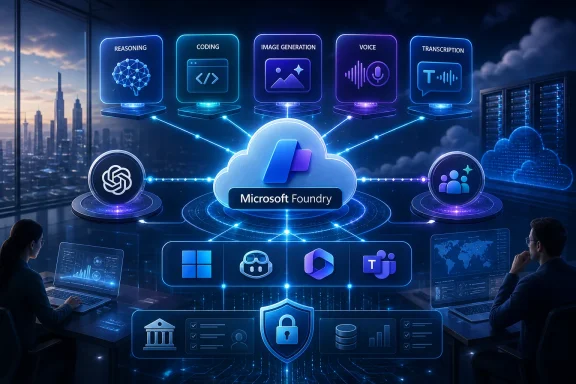
Microsoft’s MAI model program has moved beyond a hedge against OpenAI and into a tangible second AI stack: seven in-house models now span reasoning, code, image generation, speech, and transcription, with Microsoft Foundry serving as the distribution point. The practical consequence for Windows developers and enterprise IT is not that OpenAI has been pushed aside. It is that Microsoft can increasingly choose the model, price point, hosting arrangement, and data lineage appropriate to a workload rather than relying on one supplier.
The earlier release of MAI-Transcribe-1, MAI-Voice-1, and MAI-Image-2 established the first part of that strategy. But reporting from GeekWire on Microsoft Build 2026 makes clear that the initiative has accelerated. Microsoft AI CEO Mustafa Suleyman presented a broader family led by MAI-Thinking-1, alongside MAI-Code-1-Flash and updated image models. This is no longer a collection of narrowly useful media models; it is an effort to ensure that Microsoft can operate credible alternatives across the core capabilities now driving Copilot, Azure AI, GitHub, and Windows-adjacent services.
That is an AI empire in the narrow infrastructure sense: Microsoft wants to own enough of the model layer to avoid being strategically captive to any one lab. It is not, however, evidence of a clean break with OpenAI.
Microsoft’s first public MAI releases were deliberately practical. MAI-Transcribe-1 targets speech-to-text at enterprise scale, where per-hour cost, language support, noise tolerance, and predictable latency can matter more than having the industry’s most celebrated general-purpose model. Microsoft said the transcription model delivered competitive quality at roughly half the GPU cost of leading alternatives.
MAI-Voice-1 focuses on speech generation, including fast expressive output for agent scenarios. MAI-Image-2, meanwhile, was positioned for text-to-image generation and rolled into Microsoft’s consumer creative experiences. These are not trivial capabilities, particularly inside a company that operates Teams meetings, Copilot interactions, Bing image features, PowerPoint workflows, and cloud services for thousands of organizations.
The newer models raise the stakes. According to GeekWire, MAI-Thinking-1 is Microsoft’s flagship homegrown reasoning model and is available in private preview through Microsoft Foundry. Microsoft says it was trained from scratch rather than distilled from another model provider’s output—a claim aimed squarely at customers that care about provenance, compliance, and an auditable training story.
MAI-Code-1-Flash is also significant because Microsoft is reportedly rolling it into Visual Studio Code and GitHub Copilot. That places an in-house model directly in a developer workflow where Microsoft has enormous distribution, deep telemetry, and a strong incentive to lower inference costs. A five-billion-parameter code model will not displace every frontier reasoning model, but it does not need to. For autocomplete, boilerplate, lightweight transformations, and routine coding tasks, speed and cost can be more important than maximum benchmark performance.
The key shift is model routing. Microsoft can reserve a larger external model for a difficult reasoning prompt while using its own code, speech, transcription, or image model for high-volume work. That creates a much more defensible business than paying a premium model rate for every Copilot interaction.
Microsoft’s January 2025 announcement said the companies’ foundational agreement ran through 2030, preserving Microsoft’s access to OpenAI intellectual property, API exclusivity through Azure, and revenue-sharing arrangements. At the time, Microsoft also described a right of first refusal arrangement for new OpenAI compute capacity.
Then, in October 2025, OpenAI and Microsoft announced a revised structure after OpenAI’s recapitalization. Microsoft retained an approximately 27 percent stake in OpenAI Group PBC, valued at about $135 billion at that point, according to the companies’ announcement and Microsoft’s regulatory filings. OpenAI could pursue certain paths more independently, while Microsoft preserved access to key OpenAI technology.
The more important revision came on April 27, 2026. OpenAI stated that Microsoft remains its primary cloud partner and that OpenAI products will ship first on Azure unless Microsoft cannot or declines to support required capabilities. Yet OpenAI can now serve products across other cloud providers, and Microsoft’s license to OpenAI IP is non-exclusive through 2032.
The revenue arrangement also became more explicit. Microsoft no longer pays a revenue share to OpenAI, while OpenAI will continue revenue-share payments to Microsoft through 2030, subject to a cap. That is coopetition in its clearest form: the companies still share financial incentives and infrastructure commitments, but neither is treating the other as its sole path to the market.
For Microsoft, MAI is leverage as much as it is research. A company that can deploy its own models has more bargaining power in licensing, capacity, product scheduling, and pricing discussions. It also has a fallback if an external supplier changes direction, limits capacity, alters commercial terms, or prioritizes competing platforms.
Foundry is where Microsoft can present OpenAI, Anthropic, and Microsoft-developed models as selectable building blocks rather than as mutually exclusive platforms. For enterprise customers, that lets procurement, security, and platform teams standardize around one Azure-based governance and deployment surface while application teams choose a model by task.
That model catalog approach is familiar to IT professionals. Organizations already expect to choose between CPU families, database engines, VM sizes, and storage tiers. AI is moving in the same direction. A legal document summarization workflow may require a higher-capability reasoning model. Contact-center transcription may prioritize cost and language accuracy. An internal coding assistant may need private code handling, low latency, and a clear policy on data retention. There is no technical reason those workloads must run through the same foundation model.
Microsoft’s advantage is not simply that it can build models. Google, Amazon, Meta, Anthropic, OpenAI, and others can make similar claims. Microsoft’s advantage is the chance to connect model choice to Azure identity, Microsoft Purview compliance controls, Teams, Microsoft 365, Power Platform, GitHub, Visual Studio Code, and device-level Copilot experiences.
That integration also creates a responsibility for administrators. More model options mean more opportunities for shadow configuration, uneven safety settings, and accidental use of a lower-cost model for a high-risk task. IT teams should expect to define approved model tiers, data classifications, logging requirements, and human-review rules rather than treating “Copilot” as a single controlled service.
That could include faster Copilot responses for common tasks, cheaper audio and image generation, more resilient service availability, and more targeted AI experiences in Windows, Edge, Microsoft 365, and developer tools. Microsoft can also tune smaller or specialized models for predictable jobs without exposing users to the cost and latency of a giant general-purpose model.
The risk is fragmentation. If Copilot behavior varies by model, geography, subscription tier, or workload, users may see inconsistent quality and administrators may struggle to explain why one AI feature behaves differently from another. Microsoft must make model selection useful without turning its product line into a confusing menu of opaque AI brands.
The MAI models matter because they make that partnership portfolio credible. Microsoft no longer has to frame every AI feature as an OpenAI feature, and it does not have to wait for an outside roadmap to improve transcription, voice, images, coding, or selected reasoning tasks.
For customers, the next milestone is not a declaration of independence. It is whether Microsoft can prove that MAI models deliver dependable quality, transparent governance, and material cost benefits inside Foundry, GitHub Copilot, Microsoft 365, and Windows-connected services. If it can, Microsoft will have built something more durable than an empire: a multi-model platform that can keep operating even when the alliances behind AI change again.
The earlier release of MAI-Transcribe-1, MAI-Voice-1, and MAI-Image-2 established the first part of that strategy. But reporting from GeekWire on Microsoft Build 2026 makes clear that the initiative has accelerated. Microsoft AI CEO Mustafa Suleyman presented a broader family led by MAI-Thinking-1, alongside MAI-Code-1-Flash and updated image models. This is no longer a collection of narrowly useful media models; it is an effort to ensure that Microsoft can operate credible alternatives across the core capabilities now driving Copilot, Azure AI, GitHub, and Windows-adjacent services.
That is an AI empire in the narrow infrastructure sense: Microsoft wants to own enough of the model layer to avoid being strategically captive to any one lab. It is not, however, evidence of a clean break with OpenAI.
 The MAI portfolio is becoming a production option
Microsoft’s first public MAI releases were deliberately practical. MAI-Transcribe-1 targets speech-to-text at enterprise scale, where per-hour cost, language support, noise tolerance, and predictable latency can matter more than having the industry’s most celebrated general-purpose model. Microsoft said the transcription model delivered competitive quality at roughly half the GPU cost of leading alternatives.MAI-Voice-1 focuses on speech generation, including fast expressive output for agent scenarios. MAI-Image-2, meanwhile, was positioned for text-to-image generation and rolled into Microsoft’s consumer creative experiences. These are not trivial capabilities, particularly inside a company that operates Teams meetings, Copilot interactions, Bing image features, PowerPoint workflows, and cloud services for thousands of organizations.
The newer models raise the stakes. According to GeekWire, MAI-Thinking-1 is Microsoft’s flagship homegrown reasoning model and is available in private preview through Microsoft Foundry. Microsoft says it was trained from scratch rather than distilled from another model provider’s output—a claim aimed squarely at customers that care about provenance, compliance, and an auditable training story.
MAI-Code-1-Flash is also significant because Microsoft is reportedly rolling it into Visual Studio Code and GitHub Copilot. That places an in-house model directly in a developer workflow where Microsoft has enormous distribution, deep telemetry, and a strong incentive to lower inference costs. A five-billion-parameter code model will not displace every frontier reasoning model, but it does not need to. For autocomplete, boilerplate, lightweight transformations, and routine coding tasks, speed and cost can be more important than maximum benchmark performance.
The key shift is model routing. Microsoft can reserve a larger external model for a difficult reasoning prompt while using its own code, speech, transcription, or image model for high-volume work. That creates a much more defensible business than paying a premium model rate for every Copilot interaction.
OpenAI remains central, but the contract has changed
Calling this a divorce from OpenAI would be inaccurate. Microsoft remains a major OpenAI shareholder, and OpenAI models still have a privileged role in Microsoft’s commercial stack. But the relationship has become more flexible—and less exclusive—than the arrangement that initially made Azure and OpenAI appear inseparable.Microsoft’s January 2025 announcement said the companies’ foundational agreement ran through 2030, preserving Microsoft’s access to OpenAI intellectual property, API exclusivity through Azure, and revenue-sharing arrangements. At the time, Microsoft also described a right of first refusal arrangement for new OpenAI compute capacity.
Then, in October 2025, OpenAI and Microsoft announced a revised structure after OpenAI’s recapitalization. Microsoft retained an approximately 27 percent stake in OpenAI Group PBC, valued at about $135 billion at that point, according to the companies’ announcement and Microsoft’s regulatory filings. OpenAI could pursue certain paths more independently, while Microsoft preserved access to key OpenAI technology.
The more important revision came on April 27, 2026. OpenAI stated that Microsoft remains its primary cloud partner and that OpenAI products will ship first on Azure unless Microsoft cannot or declines to support required capabilities. Yet OpenAI can now serve products across other cloud providers, and Microsoft’s license to OpenAI IP is non-exclusive through 2032.
The revenue arrangement also became more explicit. Microsoft no longer pays a revenue share to OpenAI, while OpenAI will continue revenue-share payments to Microsoft through 2030, subject to a cap. That is coopetition in its clearest form: the companies still share financial incentives and infrastructure commitments, but neither is treating the other as its sole path to the market.
For Microsoft, MAI is leverage as much as it is research. A company that can deploy its own models has more bargaining power in licensing, capacity, product scheduling, and pricing discussions. It also has a fallback if an external supplier changes direction, limits capacity, alters commercial terms, or prioritizes competing platforms.
Foundry is the strategic control point
The most consequential Microsoft product in this story may not be a MAI model at all. It is Microsoft Foundry.Foundry is where Microsoft can present OpenAI, Anthropic, and Microsoft-developed models as selectable building blocks rather than as mutually exclusive platforms. For enterprise customers, that lets procurement, security, and platform teams standardize around one Azure-based governance and deployment surface while application teams choose a model by task.
That model catalog approach is familiar to IT professionals. Organizations already expect to choose between CPU families, database engines, VM sizes, and storage tiers. AI is moving in the same direction. A legal document summarization workflow may require a higher-capability reasoning model. Contact-center transcription may prioritize cost and language accuracy. An internal coding assistant may need private code handling, low latency, and a clear policy on data retention. There is no technical reason those workloads must run through the same foundation model.
Microsoft’s advantage is not simply that it can build models. Google, Amazon, Meta, Anthropic, OpenAI, and others can make similar claims. Microsoft’s advantage is the chance to connect model choice to Azure identity, Microsoft Purview compliance controls, Teams, Microsoft 365, Power Platform, GitHub, Visual Studio Code, and device-level Copilot experiences.
That integration also creates a responsibility for administrators. More model options mean more opportunities for shadow configuration, uneven safety settings, and accidental use of a lower-cost model for a high-risk task. IT teams should expect to define approved model tiers, data classifications, logging requirements, and human-review rules rather than treating “Copilot” as a single controlled service.
Windows users will see the effects indirectly
The MAI strategy does not mean Windows 11 suddenly receives a local frontier model capable of replacing cloud Copilot. Most of the announced models are cloud-oriented and are being delivered through Foundry or existing Microsoft services. The near-term impact on Windows will be less about a new app and more about what powers familiar features behind the scenes.That could include faster Copilot responses for common tasks, cheaper audio and image generation, more resilient service availability, and more targeted AI experiences in Windows, Edge, Microsoft 365, and developer tools. Microsoft can also tune smaller or specialized models for predictable jobs without exposing users to the cost and latency of a giant general-purpose model.
The risk is fragmentation. If Copilot behavior varies by model, geography, subscription tier, or workload, users may see inconsistent quality and administrators may struggle to explain why one AI feature behaves differently from another. Microsoft must make model selection useful without turning its product line into a confusing menu of opaque AI brands.
Self-sufficiency is the goal, not isolation
Suleyman’s phrase “long-term self-sufficiency” is telling. Microsoft is building the ability to stand on its own in AI, not necessarily the desire to work alone. OpenAI remains a valuable partner, Azure remains deeply tied to OpenAI’s capacity needs, and Microsoft is also incorporating other model providers into its ecosystem.The MAI models matter because they make that partnership portfolio credible. Microsoft no longer has to frame every AI feature as an OpenAI feature, and it does not have to wait for an outside roadmap to improve transcription, voice, images, coding, or selected reasoning tasks.
For customers, the next milestone is not a declaration of independence. It is whether Microsoft can prove that MAI models deliver dependable quality, transparent governance, and material cost benefits inside Foundry, GitHub Copilot, Microsoft 365, and Windows-connected services. If it can, Microsoft will have built something more durable than an empire: a multi-model platform that can keep operating even when the alliances behind AI change again.
References
- Primary source: Kavout | AI
Published: 2026-07-16T00:50:08.652288
Is Microsoft Building Its Own AI Empire Beyond OpenAI
Microsoft is developing its own AI models to reduce reliance on OpenAI. New MAI models offer cost efficiency and are integrated into Microsoft products. This signals a strategic shift towards AI self-sufficiency and greater control.www.kavout.com
- Official source: openai.com
The next chapter of the Microsoft–OpenAI partnership | OpenAI
Microsoft and OpenAI sign a new agreement that strengthens its long-term partnership, expands innovation, and ensures responsible AI progress.openai.com - Official source: blogs.microsoft.com
Microsoft and OpenAI evolve partnership to drive the next phase of AI - The Official Microsoft Blog
We are thrilled to continue our strategic partnership with OpenAI and to partner on Stargate. Today’s announcement is complementary to what our two companies have been working on together since 2019. The key elements of our partnership remain in place for the duration of our contract through...blogs.microsoft.com
