

Android Headlines’ July 15 comparison of Google’s Pixel 10 Pro XL and Pixel 10a lands on the obvious dividing line: the 10a is the smaller, cheaper Pixel with much of Google’s software experience intact, while the Pro XL is the hardware-heavy option for buyers who need a larger display, more storage, and a real zoom camera.
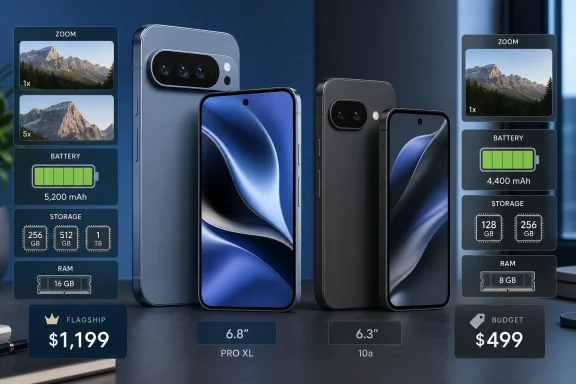
The basic specification gap is substantial. Google lists the Pixel 10 Pro XL with a 6.8-inch 1–120Hz LTPO OLED panel, Tensor G5, 16GB of RAM, up to 1TB of storage, and a 50MP/48MP/48MP rear camera system with a 5x telephoto lens. The Pixel 10a uses a 6.3-inch 60–120Hz pOLED display, last-generation Tensor G4, 8GB of RAM, up to 256GB of storage, and a dual-camera setup without optical telephoto hardware.
The Pro XL is not merely a bigger Pixel 10a. Its 3,300-nit Super Actua display supports variable refresh rates down to 1Hz, carries Gorilla Glass Victus 2 protection, and is paired with faster UFS 4.0 storage. It also adds the camera hardware that matters most for distant subjects: a stabilized 48MP 5x telephoto camera, with Google advertising up to 100x Pro Zoom.
The 10a’s advantages are its more manageable 183g weight and likely lower cost of ownership. Its 5,100mAh battery sits just 100mAh below the Pro XL’s 5,200mAh unit, despite serving a smaller screen and lower-powered silicon. Google rates the 10a for more than 30 hours of battery life, versus more than 24 hours for the Pro XL under its testing methodology. Both phones have IP68 dust and water resistance, stereo speakers, USB-C audio, and long-term Pixel software support.
For Windows users, neither device creates a special ecosystem advantage over the other. Both are Android phones, and both rely on the same Windows-facing basics: Phone Link, Quick Share compatibility, USB file transfer, and cloud services. The decision is instead about local hardware capability.
Google’s official specifications also describe the Pixel 10a as reaching up to 50% in around 30 minutes with a 45W USB-C PPS charger or higher. That does not necessarily mean the phone draws 45W continuously, but it makes a simple “30W wired” label incomplete.
Google announced the Pixel 10a at $499 in March, positioning it as the budget entry in the current lineup. Buyers who mainly want Google’s clean Android software, Gemini features, and competent main camera can reasonably choose it; those who need telephoto photography, sustained multitasking headroom, premium display hardware, or 1TB storage should start with the Pro XL.
The basic specification gap is substantial. Google lists the Pixel 10 Pro XL with a 6.8-inch 1–120Hz LTPO OLED panel, Tensor G5, 16GB of RAM, up to 1TB of storage, and a 50MP/48MP/48MP rear camera system with a 5x telephoto lens. The Pixel 10a uses a 6.3-inch 60–120Hz pOLED display, last-generation Tensor G4, 8GB of RAM, up to 256GB of storage, and a dual-camera setup without optical telephoto hardware.
 The practical differences
The Pro XL is not merely a bigger Pixel 10a. Its 3,300-nit Super Actua display supports variable refresh rates down to 1Hz, carries Gorilla Glass Victus 2 protection, and is paired with faster UFS 4.0 storage. It also adds the camera hardware that matters most for distant subjects: a stabilized 48MP 5x telephoto camera, with Google advertising up to 100x Pro Zoom.The 10a’s advantages are its more manageable 183g weight and likely lower cost of ownership. Its 5,100mAh battery sits just 100mAh below the Pro XL’s 5,200mAh unit, despite serving a smaller screen and lower-powered silicon. Google rates the 10a for more than 30 hours of battery life, versus more than 24 hours for the Pro XL under its testing methodology. Both phones have IP68 dust and water resistance, stereo speakers, USB-C audio, and long-term Pixel software support.
For Windows users, neither device creates a special ecosystem advantage over the other. Both are Android phones, and both rely on the same Windows-facing basics: Phone Link, Quick Share compatibility, USB file transfer, and cloud services. The decision is instead about local hardware capability.
Charging and camera caveats
Android Headlines’ comparison contains a charging inconsistency worth correcting. Its specification table lists 30W wired charging for the Pixel 10 Pro XL, while the text later says 45W. Google’s own technical specifications say the Pro XL can reach up to 70% in roughly 30 minutes with a 45W USB-C PPS charger or higher, and supports Qi2-certified Pixelsnap wireless charging up to 25W. The charger is sold separately.Google’s official specifications also describe the Pixel 10a as reaching up to 50% in around 30 minutes with a 45W USB-C PPS charger or higher. That does not necessarily mean the phone draws 45W continuously, but it makes a simple “30W wired” label incomplete.
Google announced the Pixel 10a at $499 in March, positioning it as the budget entry in the current lineup. Buyers who mainly want Google’s clean Android software, Gemini features, and competent main camera can reasonably choose it; those who need telephoto photography, sustained multitasking headroom, premium display hardware, or 1TB storage should start with the Pro XL.
References
- Primary source: Android Headlines
Published: 2026-07-15T16:26:42+00:00
Loading…
www.androidheadlines.com - Related coverage: androidcentral.com
Loading…
www.androidcentral.com - Related coverage: blog.google
Google announces the new Pixel 10a for $499
Learn more about Google’s new Pixel 10a, its latest A-series Pixel phone.blog.google - Official source: store.google.com
Loading…
store.google.com - Related coverage: androidauthority.com
Loading…
www.androidauthority.com - Related coverage: wired.com
Loading…
www.wired.com