

Microsoft says it is formalizing a product-feedback program that puts neurodivergent employees into the design and testing loop for products across the company, including work connected to Microsoft 365 Copilot.
In a July 16 Inside Track post, Microsoft said its first feedback round involved 150 neurodivergent employees assessing 10 products across several divisions through real-world scenarios. The initiative grew out of Neurodiversity Celebration Week and is intended to replace ad hoc requests to employee inclusion networks with a repeatable co-design process.
The testing focused on issues that conventional accessibility reviews can miss: cognitive load, clarity of instructions, navigation, information overload, pacing, memory, organization, and recovery when a workflow goes wrong.
Microsoft’s stated aim is not merely regulatory compliance but reducing friction for people with differing ways of processing information. Employees recorded their screens, described pain points while completing scenarios, and submitted usability surveys. Product teams then received the results and rated experiences to identify areas for improvement.
That can mean simpler instructions, clearer next steps and better recovery paths rather than a feature explicitly branded as an accessibility tool. Microsoft said such changes are particularly relevant where users encounter dead-end workflows or must repeatedly decode similar-looking guidance.
Microsoft says product teams are exploring custom instruction menus, smarter defaults and adaptive personalization to better match individual preferences. Those are exploratory efforts, not announced features or delivery commitments, so admins and users should not expect an immediate Copilot setting rollout from this program alone.
The company is also leaning on its Inclusive Tech Lab, which connects design teams with disabled advisors early in a product cycle. The lab covers experiences including low vision, photosensitivity, mobility limitations and neurodivergence.
Microsoft is setting up a unified feedback route for product groups, a tester pool, and guidelines intended to make testing scenarios reflect real user needs. It says the expectation is to involve participants early and continuously, rather than treating accessibility as a final-stage validation exercise.
No Windows, Microsoft 365, or Copilot feature changes were announced alongside the program, but the feedback model is now positioned to influence future product design.
In a July 16 Inside Track post, Microsoft said its first feedback round involved 150 neurodivergent employees assessing 10 products across several divisions through real-world scenarios. The initiative grew out of Neurodiversity Celebration Week and is intended to replace ad hoc requests to employee inclusion networks with a repeatable co-design process.
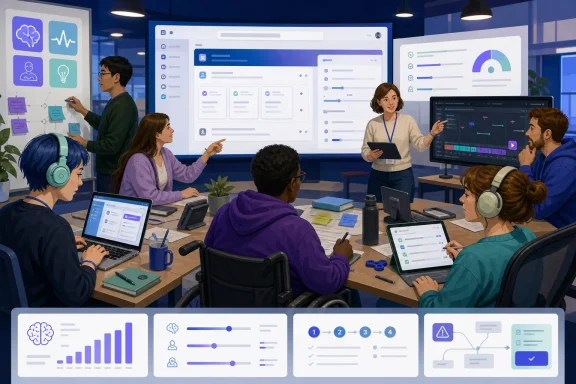 Feedback Beyond Conventional Accessibility Checks
The testing focused on issues that conventional accessibility reviews can miss: cognitive load, clarity of instructions, navigation, information overload, pacing, memory, organization, and recovery when a workflow goes wrong.Microsoft’s stated aim is not merely regulatory compliance but reducing friction for people with differing ways of processing information. Employees recorded their screens, described pain points while completing scenarios, and submitted usability surveys. Product teams then received the results and rated experiences to identify areas for improvement.
That can mean simpler instructions, clearer next steps and better recovery paths rather than a feature explicitly branded as an accessibility tool. Microsoft said such changes are particularly relevant where users encounter dead-end workflows or must repeatedly decode similar-looking guidance.
Copilot Detail Controls Are Under Consideration
The most concrete product example in Microsoft’s account involves Copilot. Testers reportedly found that Copilot responses can become overwhelming when too much information arrives at once. The concern was not a lack of capability, Microsoft said, but insufficient control over the level of detail.Microsoft says product teams are exploring custom instruction menus, smarter defaults and adaptive personalization to better match individual preferences. Those are exploratory efforts, not announced features or delivery commitments, so admins and users should not expect an immediate Copilot setting rollout from this program alone.
The company is also leaning on its Inclusive Tech Lab, which connects design teams with disabled advisors early in a product cycle. The lab covers experiences including low vision, photosensitivity, mobility limitations and neurodivergence.
Why It Matters to Windows and Microsoft 365 Users
For IT teams, the interesting part is the process rather than a specific release. Enterprise software often creates usability problems through dense settings pages, ambiguous error messages, lengthy AI output and workflows that assume users will infer the next action. Those problems do not exclusively affect neurodivergent users, but they can hit them earlier and harder.Microsoft is setting up a unified feedback route for product groups, a tester pool, and guidelines intended to make testing scenarios reflect real user needs. It says the expectation is to involve participants early and continuously, rather than treating accessibility as a final-stage validation exercise.
No Windows, Microsoft 365, or Copilot feature changes were announced alongside the program, but the feedback model is now positioned to influence future product design.
References
- Primary source: Microsoft
Published: 2026-07-16T15:45:00+00:00
Loading…
www.microsoft.com