

CVE-2026-15714 is a newly disclosed out-of-bounds read in libsoup’s multipart HTTP-response handling that can let an unauthenticated remote server crash a vulnerable client application or potentially expose fragments of process memory metadata. For Windows users, the immediate concern is not Windows itself or Microsoft’s built-in HTTP stack; it is Linux software running in WSL, containers, virtual machines, CI runners, or cross-platform desktop applications that include the GNOME HTTP library.
The CVE record, published July 14, identifies the vulnerable code as
The important operational distinction is that this is principally a client-side parsing issue. The exposed application must make a request to an attacker-controlled, compromised, or otherwise malicious HTTP endpoint and then process a multipart response through the affected libsoup functionality. That places software that downloads or consumes multipart feeds, streaming content, or API responses higher on the review list than a conventional web service that only accepts multipart file uploads.
GNOME’s libsoup documentation describes
That matters because a package inventory alone cannot establish exploitability. A system may have
The published description says the consequence can be denial of service through application failure and potentially the reading of unauthorized memory metadata. That wording should not be expanded into a claim of remote code execution: no such impact has been established in the currently available public CVE details. The confidentiality component in Red Hat’s CVSS vector reflects the possibility of memory disclosure, while the availability component reflects the more straightforward risk of a crash.
Administrators should read that carefully. “Affected” is a product-status statement, not a universal declaration that every installed workload is exposed. “Unknown” also is not a clean bill of health, especially for retired or extended-life environments where package lineage, support entitlements, and backported fixes can complicate analysis.
As of July 17, neither the NVD record nor the material referenced by Red Hat publicly supplies a fixed package version in the CVE entry itself. NVD has also marked the record as not scheduled for enrichment, meaning it currently provides no NIST-assessed vector or expanded remediation analysis beyond the CNA-provided data. That makes vendor errata and package metadata—not a generic CVE scanner verdict—the authoritative sources for confirming when a particular RHEL repository carries a fix.
Red Hat’s established practice is to backport security fixes to supported package versions where appropriate, so administrators should not assume that only a major upstream libsoup upgrade resolves the flaw. Check the advisory associated with the installed product channel and compare the package release, not merely the visible upstream version number.
For Debian- and Ubuntu-based WSL or container images, the package names commonly include
That distinction is particularly relevant for vulnerability-management teams. A Medium CVSS score can still produce real operational pain if a widely deployed application repeatedly contacts untrusted services and crashes on a crafted response. At the same time, this does not justify emergency changes across every Windows endpoint merely because a package scanner found a libsoup dependency inside an unused development image.
The sensible priority order is to patch supported affected packages as vendor updates become available, identify applications using multipart response handling, and restrict unnecessary outbound access from sensitive workloads. Egress controls, allowlists for update and content endpoints, and proxy inspection will not replace the patch, but they can reduce the number of servers capable of delivering a malicious response to exposed clients.
For Windows administrators, the near-term task is straightforward: look beyond the Windows host and inventory the WSL distributions, container base images, Linux VMs, and bundled components that make up the actual application estate.
The CVE record, published July 14, identifies the vulnerable code as
soup_multipart_input_stream_read_headers() in soup-multipart-input-stream.c. According to Red Hat’s advisory data, a malicious HTTP response with a malformed or oversized multipart boundary can cause the multipart stream reader to access memory beyond its allocated buffer. Red Hat assigned a CVSS 3.1 score of 6.5, rated Medium, with a network-reachable, low-complexity attack path requiring no privileges or user interaction.The important operational distinction is that this is principally a client-side parsing issue. The exposed application must make a request to an attacker-controlled, compromised, or otherwise malicious HTTP endpoint and then process a multipart response through the affected libsoup functionality. That places software that downloads or consumes multipart feeds, streaming content, or API responses higher on the review list than a conventional web service that only accepts multipart file uploads.
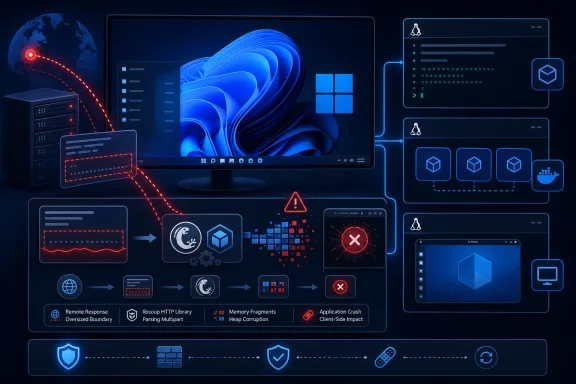 The Vulnerable Path Is More Specific Than “Any App Using Libsoup”
GNOME’s libsoup documentation describes MultipartInputStream as a facility for processing multipart messages returned over HTTP. Applications wrap a response stream and advance through the individual message parts, rather than treating the response as an ordinary single-body download. CVE-2026-15714 concerns the header-reading logic in exactly that path.That matters because a package inventory alone cannot establish exploitability. A system may have
libsoup or libsoup3 installed because of desktop dependencies, GNOME components, or another application, but the vulnerable code path requires software that actually uses multipart response streaming. Conversely, a relatively small custom application that uses SoupMultipartInputStream to retrieve content from external endpoints may deserve urgent attention even if it is not an obvious internet-facing service.The published description says the consequence can be denial of service through application failure and potentially the reading of unauthorized memory metadata. That wording should not be expanded into a claim of remote code execution: no such impact has been established in the currently available public CVE details. The confidentiality component in Red Hat’s CVSS vector reflects the possibility of memory disclosure, while the availability component reflects the more straightforward risk of a crash.
Red Hat Lists RHEL 8, 9, and 10 as Affected
Red Hat, the CVE Numbering Authority named in the record, currently listslibsoup as affected in Red Hat Enterprise Linux 8 and Red Hat Enterprise Linux 9, and libsoup3 as affected in Red Hat Enterprise Linux 10. The entry leaves the status of RHEL 6 and RHEL 7 as unknown rather than declaring them safe.Administrators should read that carefully. “Affected” is a product-status statement, not a universal declaration that every installed workload is exposed. “Unknown” also is not a clean bill of health, especially for retired or extended-life environments where package lineage, support entitlements, and backported fixes can complicate analysis.
As of July 17, neither the NVD record nor the material referenced by Red Hat publicly supplies a fixed package version in the CVE entry itself. NVD has also marked the record as not scheduled for enrichment, meaning it currently provides no NIST-assessed vector or expanded remediation analysis beyond the CNA-provided data. That makes vendor errata and package metadata—not a generic CVE scanner verdict—the authoritative sources for confirming when a particular RHEL repository carries a fix.
Red Hat’s established practice is to backport security fixes to supported package versions where appropriate, so administrators should not assume that only a major upstream libsoup upgrade resolves the flaw. Check the advisory associated with the installed product channel and compare the package release, not merely the visible upstream version number.
Windows Environments Should Start With Their Linux Footprint
A typical Windows 11 endpoint does not ship with libsoup as part of the operating system, and Windows Server’s IIS and HTTP.sys are unrelated to this vulnerability. The exposure enters Windows-centered estates through the increasingly common places where Linux user space runs alongside Windows:- Windows Subsystem for Linux distributions may contain
libsouporlibsoup3as direct or transitive packages. - Docker Desktop, Podman Desktop, Kubernetes development clusters, and CI build images may carry affected RHEL, Fedora, Ubuntu, or other Linux packages.
- Linux virtual machines hosted in Hyper-V, Azure, VMware, or other platforms need to be evaluated as Linux systems, regardless of the administrator’s Windows management plane.
- Cross-platform products may bundle their own libraries, so an operating-system package query can miss statically linked or privately shipped copies.
rpm -q libsoup libsoup3. That is only the first pass. Teams should then map the packages to running applications and identify whether those applications use multipart HTTP responses from endpoints outside their trust boundary.For Debian- and Ubuntu-based WSL or container images, the package names commonly include
libsoup2.4-1 or libsoup-3.0-0, but the installed package name and security status should be verified through the distribution’s own tracker and security repositories. The CVE record supplied by Red Hat should not be used to infer that every distribution has identical affected versions or release timing.A Public PoC Signal Raises the Priority, Not the Proven Impact
CISA added SSVC data to the CVE record on July 15 and recorded exploitation as “poc,” automation as “yes,” and technical impact as “partial.” In practical terms, that indicates public proof-of-concept availability has been reported to the SSVC process and that probing or exploit delivery could be automated; it does not mean CISA has confirmed active exploitation in the wild.That distinction is particularly relevant for vulnerability-management teams. A Medium CVSS score can still produce real operational pain if a widely deployed application repeatedly contacts untrusted services and crashes on a crafted response. At the same time, this does not justify emergency changes across every Windows endpoint merely because a package scanner found a libsoup dependency inside an unused development image.
The sensible priority order is to patch supported affected packages as vendor updates become available, identify applications using multipart response handling, and restrict unnecessary outbound access from sensitive workloads. Egress controls, allowlists for update and content endpoints, and proxy inspection will not replace the patch, but they can reduce the number of servers capable of delivering a malicious response to exposed clients.
The Next Useful Data Point Is a Fixed Build
The GNOME libsoup work item referenced by the CVE may eventually provide upstream remediation detail, while Red Hat errata should establish the fixed builds for supported RHEL releases. Until those package-level fixes are published and deployed, teams should treat CVE-2026-15714 as a targeted client-library issue: serious for software that parses multipart responses from untrusted servers, but not a vulnerability in Windows networking itself.For Windows administrators, the near-term task is straightforward: look beyond the Windows host and inventory the WSL distributions, container base images, Linux VMs, and bundled components that make up the actual application estate.
References
- Primary source: NVD
Published: 2026-07-17T01:01:45-07:00
NVD - CVE-2026-15714
 nvd.nist.gov
- Security advisory: MSRC
Published: 2026-07-17T01:01:45-07:00
Original feed URL
Security Update Guide - Microsoft Security Response Center
 msrc.microsoft.com
- Related coverage: docs.gtk.org

Gtk.MediaFile.set_input_stream
docs.gtk.org
- Related coverage: valadoc.org
Soup.MultipartInputStream – libsoup-3.0
The canonical source for Vala API references.valadoc.org