

CVE-2026-15711 is a newly published remote denial-of-service vulnerability in libsoup’s WebSocket parser that lets an unauthenticated peer crash an application by sending an oversized WebSocket control frame. Red Hat assigned the flaw a CVSS 3.1 score of 7.5 High, and the National Vulnerability Database record, published July 14 and updated July 15, identifies Red Hat Enterprise Linux 8, 9, and 10 packages as affected.
The immediate concern is not Windows itself but software estates that include Linux workloads: WSL distributions, Linux containers hosted through Docker Desktop or Kubernetes, CI runners, appliance images, and servers running GNOME- or GLib-based applications. Any exposed service that accepts WebSocket connections through libsoup deserves a rapid inventory check, especially where a single process crash interrupts a user-facing session, automation endpoint, or service gateway.
According to Red Hat’s CVE record and the NVD entry, the bug lies in handling invalid WebSocket control frames—the protocol messages used for Ping, Pong, and Close operations rather than ordinary application data. A malicious remote client can send a control frame exceeding the protocol’s 125-byte payload limit. Instead of rejecting the malformed frame and terminating the connection cleanly, vulnerable libsoup processing can crash internally.
The underlying WebSocket rule is unusually clear. RFC 6455, the IETF standard for WebSocket, requires all control frames to carry payloads of 125 bytes or less and forbids their fragmentation. These limits exist precisely because control messages are intended to remain small, immediate protocol-management signals that can be handled in the middle of large fragmented application messages.
CVE-2026-15711 concerns the point where libsoup should enforce that boundary. Red Hat says the parser fails to validate the control-frame length rule, allowing a non-compliant frame to proceed into processing that should never occur. The result is a crash, not data exposure, privilege escalation, or remote code execution.
That distinction matters for triage. The published CVSS vector is network-reachable, low-complexity, requires no authentication or user interaction, and has an availability-only impact. An attacker needs access to a reachable WebSocket endpoint using the affected library; they do not need a valid account or a cooperative browser user. But the disclosed impact is confined to availability: disruption of the vulnerable application or service.
The NVD also records CISA’s Stakeholder-Specific Vulnerability Categorization data as indicating a proof of concept, automation potential, and partial technical impact. That is a reason to move promptly on internet-facing services, while resisting the temptation to describe this as a broad compromise of the operating system.
For Windows administrators, this makes the assessment more dependent on deployment architecture than on desktop patch management. A regular Windows 11 workstation with no Linux subsystem, containers, or relevant application stack is not the natural target. A Windows server or developer machine running Linux containers, a WSL-hosted service, or a desktop application gateway can be relevant if it exposes a libsoup-backed WebSocket listener.
The first task is therefore to distinguish package presence from actual reachability:
As of July 17, the public NVD record is marked “Not Scheduled” for NVD enrichment. That label does not downgrade the vulnerability; it means NVD has not committed the record to further enrichment work such as an independent CVSS assessment. The score currently displayed is Red Hat’s 7.5 High assessment.
Equally important, the public materials do not establish a universal fixed version that every distribution has already shipped. The linked GNOME issue and Red Hat Bugzilla record are relevant tracking points, but package remediation will be distribution-specific. Enterprises should rely on their vendor’s signed security errata and repositories rather than substituting a generic upstream build in production.
For Red Hat environments, use normal package-update workflows to identify the advisory and updated package build associated with the CVE, then restart any application process that has loaded the vulnerable library. Updating a package on disk without restarting the WebSocket-serving process leaves the old code resident in memory.
Rate limits and automated restarts can help preserve service continuity, but neither is a full mitigation. A low-complexity crash condition can be repeated, and process supervision turns a one-time failure into a cycle of crash-and-restart if the attacker retains access. Health checks should distinguish between a healthy service and a process that is merely alive again after repeated failures.
Monitoring teams should also look for clustered service restarts, abnormal WebSocket disconnects, and application crash signatures around control-frame parsing. Because the triggering input is malformed protocol traffic rather than an ordinary oversized upload, logging configurations that record WebSocket close reasons or parser errors may offer more value than generic bandwidth alerts.
The near-term milestone is vendor remediation: organizations need to match their deployed libsoup package builds to the security advisories issued for their supported Linux distributions, rebuild affected container images, and restart exposed services. Until then, CVE-2026-15711 is best treated as a targeted availability risk at every externally reachable libsoup-backed WebSocket endpoint—not as a Windows platform flaw, but as a potentially disruptive dependency issue inside mixed Windows and Linux environments.
The immediate concern is not Windows itself but software estates that include Linux workloads: WSL distributions, Linux containers hosted through Docker Desktop or Kubernetes, CI runners, appliance images, and servers running GNOME- or GLib-based applications. Any exposed service that accepts WebSocket connections through libsoup deserves a rapid inventory check, especially where a single process crash interrupts a user-facing session, automation endpoint, or service gateway.
According to Red Hat’s CVE record and the NVD entry, the bug lies in handling invalid WebSocket control frames—the protocol messages used for Ping, Pong, and Close operations rather than ordinary application data. A malicious remote client can send a control frame exceeding the protocol’s 125-byte payload limit. Instead of rejecting the malformed frame and terminating the connection cleanly, vulnerable libsoup processing can crash internally.
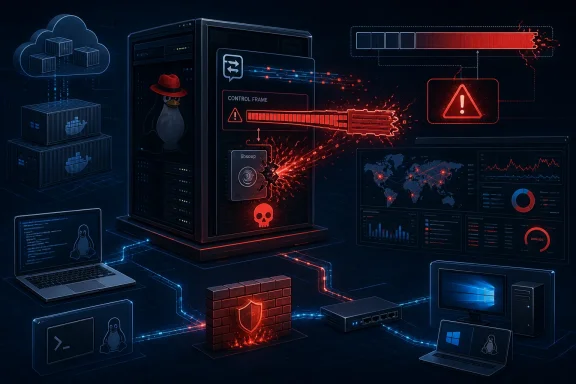 A Protocol Violation Becomes a Process Crash
The underlying WebSocket rule is unusually clear. RFC 6455, the IETF standard for WebSocket, requires all control frames to carry payloads of 125 bytes or less and forbids their fragmentation. These limits exist precisely because control messages are intended to remain small, immediate protocol-management signals that can be handled in the middle of large fragmented application messages.CVE-2026-15711 concerns the point where libsoup should enforce that boundary. Red Hat says the parser fails to validate the control-frame length rule, allowing a non-compliant frame to proceed into processing that should never occur. The result is a crash, not data exposure, privilege escalation, or remote code execution.
That distinction matters for triage. The published CVSS vector is network-reachable, low-complexity, requires no authentication or user interaction, and has an availability-only impact. An attacker needs access to a reachable WebSocket endpoint using the affected library; they do not need a valid account or a cooperative browser user. But the disclosed impact is confined to availability: disruption of the vulnerable application or service.
The NVD also records CISA’s Stakeholder-Specific Vulnerability Categorization data as indicating a proof of concept, automation potential, and partial technical impact. That is a reason to move promptly on internet-facing services, while resisting the temptation to describe this as a broad compromise of the operating system.
The Exposure Is in Applications, Not Every Linux Host
libsoup is a GNOME project library that provides HTTP client and server capabilities, including WebSocket support. Its presence on a system does not automatically mean the system is exposed. The operative question is whether an installed application uses libsoup to accept or process WebSocket traffic from an untrusted network peer.For Windows administrators, this makes the assessment more dependent on deployment architecture than on desktop patch management. A regular Windows 11 workstation with no Linux subsystem, containers, or relevant application stack is not the natural target. A Windows server or developer machine running Linux containers, a WSL-hosted service, or a desktop application gateway can be relevant if it exposes a libsoup-backed WebSocket listener.
The first task is therefore to distinguish package presence from actual reachability:
- Identify deployed services that use libsoup or libsoup3 and determine whether they establish WebSocket server connections or consume WebSocket connections from untrusted systems.
- Prioritize endpoints exposed through reverse proxies, load balancers, VPN gateways, public IP addresses, development tunnels, or internal networks shared with untrusted clients.
- Treat container base images as separate assets, since a patched host does not repair an outdated libsoup package embedded in an already-built image.
- Review restart behavior and service supervision, because a crash that is automatically restarted may still create a repeatable outage under continued malformed traffic.
Red Hat Lists RHEL 8, 9, and 10 as Affected
Red Hat’s initial CVE submission listslibsoup on Red Hat Enterprise Linux 8 and 9 as affected, along with libsoup3 on Red Hat Enterprise Linux 10. RHEL 6 and RHEL 7 appear in the record with an unknown status rather than a clean affected or unaffected designation, so teams with extended-lifecycle systems should not interpret the entry as clearance.As of July 17, the public NVD record is marked “Not Scheduled” for NVD enrichment. That label does not downgrade the vulnerability; it means NVD has not committed the record to further enrichment work such as an independent CVSS assessment. The score currently displayed is Red Hat’s 7.5 High assessment.
Equally important, the public materials do not establish a universal fixed version that every distribution has already shipped. The linked GNOME issue and Red Hat Bugzilla record are relevant tracking points, but package remediation will be distribution-specific. Enterprises should rely on their vendor’s signed security errata and repositories rather than substituting a generic upstream build in production.
For Red Hat environments, use normal package-update workflows to identify the advisory and updated package build associated with the CVE, then restart any application process that has loaded the vulnerable library. Updating a package on disk without restarting the WebSocket-serving process leaves the old code resident in memory.
Compensating Controls Are Narrow but Useful
Where an update is not yet available or requires a change window, the strongest short-term control is to limit who can open WebSocket connections to the affected service. Restrict public exposure, require authenticated access at the edge where practical, and narrow ingress rules to known client networks. These measures do not correct the parser, but they reduce the number of systems capable of sending the triggering frame.Rate limits and automated restarts can help preserve service continuity, but neither is a full mitigation. A low-complexity crash condition can be repeated, and process supervision turns a one-time failure into a cycle of crash-and-restart if the attacker retains access. Health checks should distinguish between a healthy service and a process that is merely alive again after repeated failures.
Monitoring teams should also look for clustered service restarts, abnormal WebSocket disconnects, and application crash signatures around control-frame parsing. Because the triggering input is malformed protocol traffic rather than an ordinary oversized upload, logging configurations that record WebSocket close reasons or parser errors may offer more value than generic bandwidth alerts.
The near-term milestone is vendor remediation: organizations need to match their deployed libsoup package builds to the security advisories issued for their supported Linux distributions, rebuild affected container images, and restart exposed services. Until then, CVE-2026-15711 is best treated as a targeted availability risk at every externally reachable libsoup-backed WebSocket endpoint—not as a Windows platform flaw, but as a potentially disruptive dependency issue inside mixed Windows and Linux environments.