

NVIDIA has expanded its physical-AI push in Japan, pairing a new edge-focused model with a growing roster of industrial partners. The company announced Cosmos 3 Edge and a Japan-based expansion of its Cosmos Coalition on July 16 in Tokyo, according to NVIDIA’s regional announcement.
Cosmos 3 Edge is a 4-billion-parameter model based on NVIDIA Nemotron, designed to let robots and vision-AI systems interpret their surroundings, reason in real time and predict actions locally rather than relying entirely on a remote data center. NVIDIA says it is intended for deployment across RTX GPUs, DGX systems, GeForce RTX GPUs, Jetson hardware and its new Jetson T2000 and T3000 modules.
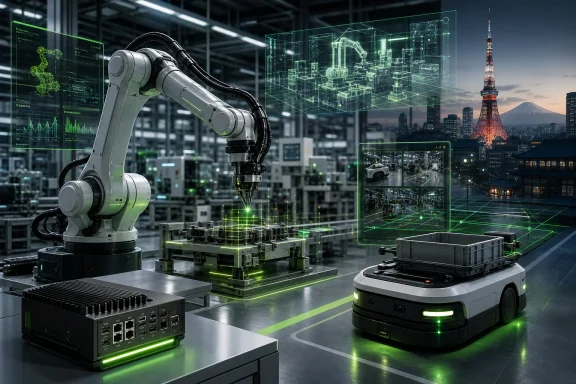
This is not another chatbot model or a Windows Copilot component. Cosmos 3 Edge targets “physical AI”: robots, autonomous vehicles, industrial cameras and other systems that need to turn sensor input into decisions in the real world.
The edge angle matters. Sending every camera feed or control decision to a cloud service adds latency, bandwidth costs and reliability concerns that are difficult to accept on a factory floor or in mobile equipment. NVIDIA is pitching Cosmos 3 Edge as a smaller, adaptable model that can be tuned for a particular robot, vehicle, sensor set or workplace environment. The company says developers can adapt it in about a day, though that claim will depend heavily on the complexity and quality of the available training data.
For Windows users, the immediate relevance is mainly on the development side. Organizations building vision, simulation, robotics or industrial automation workloads on RTX-equipped Windows workstations now have another NVIDIA model family aimed at local inference and testing. Production deployments are more likely to land on Jetson systems or dedicated edge infrastructure than on conventional PCs.
Fujitsu has separately begun exploring a collaborative-control platform for physical AI with FANUC, Yaskawa and Kawasaki Heavy Industries. NVIDIA says that work will use elements of its Cosmos, Omniverse, Isaac and Newton technology stack for digital twins, robot training, simulation-to-real-world workflows and predeployment validation.
The announcements also include an updated NVIDIA Metropolis library set for building agentic vision-AI applications. Metropolis is aimed at video and sensor workloads such as inspection, tracking, safety monitoring and operational analytics—areas where Windows-based development tools and NVIDIA GPUs already have a substantial enterprise footprint.
NVIDIA’s broader Japan messaging is about tying its accelerated-computing platform to the country’s manufacturing and robotics base, rather than announcing a new consumer GPU product or Windows software release.
For IT teams, there is no client-side action to take; the practical next step is to watch for Cosmos 3 Edge tooling and supported deployment packages if their organization builds RTX- or Jetson-based vision and robotics systems.
Cosmos 3 Edge is a 4-billion-parameter model based on NVIDIA Nemotron, designed to let robots and vision-AI systems interpret their surroundings, reason in real time and predict actions locally rather than relying entirely on a remote data center. NVIDIA says it is intended for deployment across RTX GPUs, DGX systems, GeForce RTX GPUs, Jetson hardware and its new Jetson T2000 and T3000 modules.
 A model for machines, not desktop AI
This is not another chatbot model or a Windows Copilot component. Cosmos 3 Edge targets “physical AI”: robots, autonomous vehicles, industrial cameras and other systems that need to turn sensor input into decisions in the real world.The edge angle matters. Sending every camera feed or control decision to a cloud service adds latency, bandwidth costs and reliability concerns that are difficult to accept on a factory floor or in mobile equipment. NVIDIA is pitching Cosmos 3 Edge as a smaller, adaptable model that can be tuned for a particular robot, vehicle, sensor set or workplace environment. The company says developers can adapt it in about a day, though that claim will depend heavily on the complexity and quality of the available training data.
For Windows users, the immediate relevance is mainly on the development side. Organizations building vision, simulation, robotics or industrial automation workloads on RTX-equipped Windows workstations now have another NVIDIA model family aimed at local inference and testing. Production deployments are more likely to land on Jetson systems or dedicated edge infrastructure than on conventional PCs.
Japan coalition brings manufacturers into the stack
NVIDIA said a broad group of Japanese companies intends to join the Cosmos Coalition, which is meant to support open physical-AI models, datasets and development frameworks. The list includes FANUC, Fujitsu, Hitachi, Kawasaki Heavy Industries, Kubota, NEC, SoftBank, Sony Group and Yaskawa, alongside a range of robotics and AI specialists.Fujitsu has separately begun exploring a collaborative-control platform for physical AI with FANUC, Yaskawa and Kawasaki Heavy Industries. NVIDIA says that work will use elements of its Cosmos, Omniverse, Isaac and Newton technology stack for digital twins, robot training, simulation-to-real-world workflows and predeployment validation.
The announcements also include an updated NVIDIA Metropolis library set for building agentic vision-AI applications. Metropolis is aimed at video and sensor workloads such as inspection, tracking, safety monitoring and operational analytics—areas where Windows-based development tools and NVIDIA GPUs already have a substantial enterprise footprint.
NVIDIA’s broader Japan messaging is about tying its accelerated-computing platform to the country’s manufacturing and robotics base, rather than announcing a new consumer GPU product or Windows software release.
For IT teams, there is no client-side action to take; the practical next step is to watch for Cosmos 3 Edge tooling and supported deployment packages if their organization builds RTX- or Jetson-based vision and robotics systems.
References
- Primary source: Shacknews
Published: 2026-07-16T19:10:00+00:00
NVIDIA (NVDA) announces expansion into Japan and new AI model | Shacknews
NVIDIA has partnered with multiple Japanese companies as part of its mission.www.shacknews.com - Related coverage: blogs.nvidia.co.kr
일본의 로보틱스·제조 리더들, NVIDIA Cosmos를 기반으로 피지컬 AI의 새 지평을 열다 - NVIDIA Blog Korea
일본의 피지컬 AI 리더들이 NVIDIA Cosmos, NVIDIA Isaac, NVIDIA Metropolis, NVIDIA Jetson 플랫폼을 기반으로 제조, 모빌리티, 인프라, 로보틱스 전반에 걸쳐 지능형 기계의 배포를 가속화하고 있습니다.blogs.nvidia.co.kr - Related coverage: siliconangle.com
Nvidia launches Cosmos 3 Edge model and expands its physical AI push in Japan - SiliconANGLE
Nvidia launches Cosmos 3 Edge model and expands its physical AI push in Japan - SiliconANGLE siliconangle.com
- Related coverage: blogs.nvidia.com
NVIDIA and Japan Bring Full-Stack AI and Robotics to Every Industry | NVIDIA Blog
NVIDIA and its partners in Japan are this week showcasing the AI ecosystem's latest advancements. Check back here for updates.blogs.nvidia.com - Related coverage: pluang.com
Nvidia launches Cosmos 3 Edge AI model and expa... | Pluang
Nvidia introduced Cosmos 3 Edge, a new AI model designed for robots and vision AI agents to navigate physical environments in real time. The company is expanding its AI ecosystem in Japan by partnering with major local firms like Fujitsu, Hitachi, and Kawasaki Heavy Industries, focusing on...pluang.com - Related coverage: gate.com