

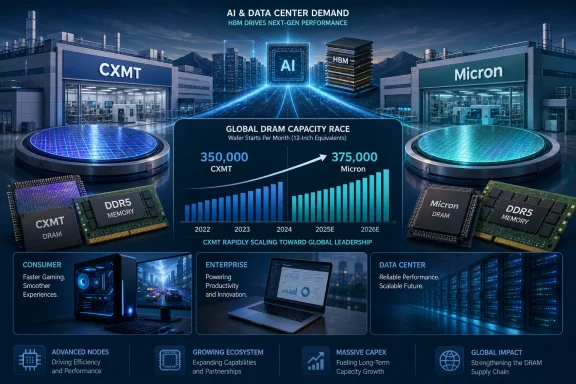
ChangXin Memory Technologies could end 2026 within 25,000 wafer starts per month of Micron’s estimated DRAM capacity, a shift that matters to anyone pricing a Windows gaming PC, a business laptop fleet, or a server refresh in a memory-constrained market. The forecast places CXMT at roughly 350,000 DRAM wafer starts per month, versus 375,000 for Micron, according to a Citrini Research model reported this week by Tom’s Hardware and recapped by NoobFeed.
That is a startling comparison for a Chinese manufacturer that only recently became a meaningful presence outside its domestic supply chain. It does not mean CXMT will match Micron in usable chip output, leading-edge process technology, reliability validation, or revenue. But it does mean the global DRAM market may be moving toward a fourth producer with enough scale to affect availability in the commodity memory segments that feed PCs, notebooks, phones, and standard servers.
The immediate practical implication is more restrained: CXMT’s expansion may ease some of the pressure that has pushed DDR5 and LPDDR pricing higher in 2026. It is not a promise of cheap RAM on U.S. retail shelves, and it is certainly not a quick cure for the HBM-driven supply crunch now shaping the industry.
The 350,000-wafer figure is a capacity forecast, not a shipment guarantee. Wafer starts measure how much silicon a fab begins processing; the eventual number of functional DRAM dies depends on process maturity, yields, product mix, package availability, and qualification by module makers and OEMs.
That distinction is essential when comparing CXMT with Micron, Samsung, and SK hynix. Reuters reported on June 29 that CXMT had about 300,000 wafers per month of combined DRAM capacity across two Hefei fabs and one Beijing fab, with further projects intended to lift output substantially. The same Reuters report said the company had faced low DDR5 yields during the first quarter, illustrating the distance between aggressive fab construction and consistent high-volume production.
Earlier reporting from ChosunBiz, citing industry and market-research estimates, also described a material yield gap between CXMT’s 1x-class DRAM process and the more mature advanced nodes used by the established leaders. That does not invalidate the new capacity outlook. It does mean a wafer-for-wafer comparison should not be read as a chip-for-chip equivalence.
For Windows system builders, the question is simpler than the manufacturing math: can a CXMT-based DDR5 kit deliver stable JEDEC operation or stable XMP/EXPO settings at a price worth considering? On that front, the initial signals are mixed. Tom’s Hardware reported this week on early enthusiast testing that suggested significant variation between batches of CXMT DDR5, weaker voltage scaling, and less headroom for manual overclocking than comparable SK hynix-based modules. Those are early tests rather than a broad reliability verdict, but they are a reminder that capacity growth alone does not establish premium-memory credibility.
That allocation has consequences far beyond AI data centers. The same industry equipment, packaging capacity, engineering effort, and wafer supply cannot be committed indefinitely to every memory product at once. As suppliers optimize for HBM and high-end server DRAM, consumer-oriented memory becomes relatively tighter, even if PC demand itself has not suddenly exploded.
Reuters reported that DRAM contract prices rose roughly 95% quarter over quarter during the first quarter of 2026, citing UBS. Long-term supply contracts and prepaid allocations have also become more common among hyperscalers seeking to secure memory for cloud and AI infrastructure. In that environment, a supplier willing and able to add volume for China’s domestic PC, phone, and conventional-server markets has strategic value even if it cannot yet compete at the HBM frontier.
CXMT itself is not standing completely apart from the AI race. The company has been pursuing HBM-related work, and Reuters reported that it operates a Shanghai site focused on HBM packaging. If more of its capacity is ultimately steered toward AI hardware, the direct benefit for consumer DRAM supply will be smaller. If it expands mainstream DDR5, LPDDR, and server DIMM output in parallel, the effect could be more noticeable—especially in China, where domestic OEMs have the strongest incentive to qualify local parts.
The details remain uncertain. The reported fab capacity does not reveal how much of the eventual output will be DDR4, DDR5, LPDDR, server memory, or HBM-related products. It also does not establish when each operation will produce competitive yields at commercially meaningful volume.
Still, the direction is clear. China is attempting to build a domestic DRAM ecosystem rather than depend on a single national champion. Tom’s Hardware reported projected capacity for a 140,000-wafer-per-month Swaysure fab in Shenzhen, a JHICC ramp expected to begin receiving equipment by the end of 2026, and approximately 50,000 wafers per month of projected DRAM production at YMTC/XMC’s Wuhan Fab 3.
That is strategically consequential even before all those lines are fully operational. More domestic sourcing gives Chinese PC makers, phone vendors, cloud providers, and module assemblers leverage during shortages. Reuters reported that CXMT has signed a multiyear DRAM supply agreement with Tencent worth more than 20 billion yuan, according to people familiar with the deal, while listing Tencent, Alibaba Cloud, ByteDance, Lenovo, and Xiaomi among major customers identified in its IPO prospectus.
The more Chinese demand CXMT can satisfy at home, the less domestic customers need to compete for allocation from Micron, Samsung, and SK hynix. That could indirectly loosen global demand for conventional DRAM. But the effect will depend on whether CXMT’s products meet customers’ performance, power, validation, and supply-consistency requirements.
That last point matters to enthusiasts. Memory compatibility is not merely a question of whether a DDR5 module physically fits a motherboard slot. SPD programming, training behavior, density support, BIOS tuning, XMP or EXPO profiles, sleep-resume stability, and error rates under load determine whether a module belongs in a dependable Windows workstation or a gaming system.
Enterprise IT should apply an even stricter standard. A lower-cost DIMM is not a bargain if its sourcing changes unexpectedly, vendor support is unclear, or its performance characteristics complicate validation across a standardized fleet. Server buyers will care less about an impressive wafer-start forecast than about qualified ECC RDIMMs, stable supply contracts, platform certification, and predictable replacement inventory.
CXMT’s expansion is therefore best viewed as a potential pressure valve, not an instant reset for memory pricing. The company’s projected scale could make it increasingly difficult for the incumbent DRAM suppliers to ignore China’s conventional-memory demand. Yet the AI sector’s appetite for HBM and high-capacity server memory remains large enough that any new supply can be absorbed quickly.
The milestone to watch is not December’s projected 350,000-wafer figure by itself. It is whether CXMT converts that capacity into high-yield DDR5 and LPDDR volume, earns broad OEM qualification, and begins appearing in stable, competitively priced modules beyond its home market.
That is a startling comparison for a Chinese manufacturer that only recently became a meaningful presence outside its domestic supply chain. It does not mean CXMT will match Micron in usable chip output, leading-edge process technology, reliability validation, or revenue. But it does mean the global DRAM market may be moving toward a fourth producer with enough scale to affect availability in the commodity memory segments that feed PCs, notebooks, phones, and standard servers.
The immediate practical implication is more restrained: CXMT’s expansion may ease some of the pressure that has pushed DDR5 and LPDDR pricing higher in 2026. It is not a promise of cheap RAM on U.S. retail shelves, and it is certainly not a quick cure for the HBM-driven supply crunch now shaping the industry.
 Capacity Is Not the Same as Finished, Saleable DRAM
The 350,000-wafer figure is a capacity forecast, not a shipment guarantee. Wafer starts measure how much silicon a fab begins processing; the eventual number of functional DRAM dies depends on process maturity, yields, product mix, package availability, and qualification by module makers and OEMs.That distinction is essential when comparing CXMT with Micron, Samsung, and SK hynix. Reuters reported on June 29 that CXMT had about 300,000 wafers per month of combined DRAM capacity across two Hefei fabs and one Beijing fab, with further projects intended to lift output substantially. The same Reuters report said the company had faced low DDR5 yields during the first quarter, illustrating the distance between aggressive fab construction and consistent high-volume production.
Earlier reporting from ChosunBiz, citing industry and market-research estimates, also described a material yield gap between CXMT’s 1x-class DRAM process and the more mature advanced nodes used by the established leaders. That does not invalidate the new capacity outlook. It does mean a wafer-for-wafer comparison should not be read as a chip-for-chip equivalence.
For Windows system builders, the question is simpler than the manufacturing math: can a CXMT-based DDR5 kit deliver stable JEDEC operation or stable XMP/EXPO settings at a price worth considering? On that front, the initial signals are mixed. Tom’s Hardware reported this week on early enthusiast testing that suggested significant variation between batches of CXMT DDR5, weaker voltage scaling, and less headroom for manual overclocking than comparable SK hynix-based modules. Those are early tests rather than a broad reliability verdict, but they are a reminder that capacity growth alone does not establish premium-memory credibility.
AI Has Redirected the Industry’s Best Capacity
The reason CXMT’s rise is attracting attention is the market it is entering. Samsung, SK hynix, and Micron have devoted increasing attention, capital, and advanced production resources to high-bandwidth memory, or HBM, the stacked DRAM used alongside AI accelerators. HBM commands substantially higher prices than ordinary DDR5 DIMMs, LPDDR mobile memory, and legacy DDR4.That allocation has consequences far beyond AI data centers. The same industry equipment, packaging capacity, engineering effort, and wafer supply cannot be committed indefinitely to every memory product at once. As suppliers optimize for HBM and high-end server DRAM, consumer-oriented memory becomes relatively tighter, even if PC demand itself has not suddenly exploded.
Reuters reported that DRAM contract prices rose roughly 95% quarter over quarter during the first quarter of 2026, citing UBS. Long-term supply contracts and prepaid allocations have also become more common among hyperscalers seeking to secure memory for cloud and AI infrastructure. In that environment, a supplier willing and able to add volume for China’s domestic PC, phone, and conventional-server markets has strategic value even if it cannot yet compete at the HBM frontier.
CXMT itself is not standing completely apart from the AI race. The company has been pursuing HBM-related work, and Reuters reported that it operates a Shanghai site focused on HBM packaging. If more of its capacity is ultimately steered toward AI hardware, the direct benefit for consumer DRAM supply will be smaller. If it expands mainstream DDR5, LPDDR, and server DIMM output in parallel, the effect could be more noticeable—especially in China, where domestic OEMs have the strongest incentive to qualify local parts.
Beijing’s Broader DRAM Plan Changes the Stakes
Citrini Research’s model, as described by Tom’s Hardware, goes beyond CXMT’s own fabs. It contends that Chinese authorities are pressing CXMT to share DRAM technology with three other domestic efforts: Fujian Jinhua Integrated Circuit, Swaysure, and XMC, a YMTC subsidiary.The details remain uncertain. The reported fab capacity does not reveal how much of the eventual output will be DDR4, DDR5, LPDDR, server memory, or HBM-related products. It also does not establish when each operation will produce competitive yields at commercially meaningful volume.
Still, the direction is clear. China is attempting to build a domestic DRAM ecosystem rather than depend on a single national champion. Tom’s Hardware reported projected capacity for a 140,000-wafer-per-month Swaysure fab in Shenzhen, a JHICC ramp expected to begin receiving equipment by the end of 2026, and approximately 50,000 wafers per month of projected DRAM production at YMTC/XMC’s Wuhan Fab 3.
That is strategically consequential even before all those lines are fully operational. More domestic sourcing gives Chinese PC makers, phone vendors, cloud providers, and module assemblers leverage during shortages. Reuters reported that CXMT has signed a multiyear DRAM supply agreement with Tencent worth more than 20 billion yuan, according to people familiar with the deal, while listing Tencent, Alibaba Cloud, ByteDance, Lenovo, and Xiaomi among major customers identified in its IPO prospectus.
The more Chinese demand CXMT can satisfy at home, the less domestic customers need to compete for allocation from Micron, Samsung, and SK hynix. That could indirectly loosen global demand for conventional DRAM. But the effect will depend on whether CXMT’s products meet customers’ performance, power, validation, and supply-consistency requirements.
Windows Buyers Should Watch Modules, Not Just Wafer Forecasts
For buyers in the United States, the near-term retail impact is likely limited. CXMT DRAM is increasingly visible in China-bound systems and memory kits, but its wider availability in Western channels remains constrained by qualification, commercial relationships, and geopolitical risk. PC Gamer reported that some vendors, including Corsair in China-market Vengeance kits, have used CXMT dies, while motherboard makers have begun adding or refining BIOS support for selected Chinese-memory configurations.That last point matters to enthusiasts. Memory compatibility is not merely a question of whether a DDR5 module physically fits a motherboard slot. SPD programming, training behavior, density support, BIOS tuning, XMP or EXPO profiles, sleep-resume stability, and error rates under load determine whether a module belongs in a dependable Windows workstation or a gaming system.
Enterprise IT should apply an even stricter standard. A lower-cost DIMM is not a bargain if its sourcing changes unexpectedly, vendor support is unclear, or its performance characteristics complicate validation across a standardized fleet. Server buyers will care less about an impressive wafer-start forecast than about qualified ECC RDIMMs, stable supply contracts, platform certification, and predictable replacement inventory.
CXMT’s expansion is therefore best viewed as a potential pressure valve, not an instant reset for memory pricing. The company’s projected scale could make it increasingly difficult for the incumbent DRAM suppliers to ignore China’s conventional-memory demand. Yet the AI sector’s appetite for HBM and high-capacity server memory remains large enough that any new supply can be absorbed quickly.
The milestone to watch is not December’s projected 350,000-wafer figure by itself. It is whether CXMT converts that capacity into high-yield DDR5 and LPDDR volume, earns broad OEM qualification, and begins appearing in stable, competitively priced modules beyond its home market.
References
- Primary source: NoobFeed
Published: 2026-07-17T00:00:00+00:00
NoobFeed
NoobFeed is your most up-to-date source for video game news, reviews, rumors, and the latest game guides.www.noobfeed.com