

Mezha’s July 2026 “PC of the Month” guide argues that memory pricing—not CPUs or graphics cards—is now the main constraint on sensible gaming-PC builds. Its recommendations keep older DDR4-capable platforms in play for budget systems while reserving DDR5 builds for buyers willing to accept a sharply higher entry cost.
The Ukraine-focused component roundup, published July 17, lists a basic gaming build at roughly $1,000 using either Intel’s Core i5-12400F on B760 or AMD’s Ryzen 5 5600 on B550, paired with 16GB of dual-channel DDR4 and a GeForce RTX 5060 8GB, Radeon RX 9060 8GB, or Intel Arc B580 12GB. Mezha’s central argument is straightforward: DDR4 lets builders preserve a usable two-stick configuration at a lower total system cost, even if AM4 and LGA1700 are older sockets.
For a platform with a clearer upgrade path—AMD AM5 or Intel LGA1851—the guide suggests that buyers may have to begin with a single 16GB DDR5 DIMM. That is an awkward proposition for gaming because single-channel memory can materially affect frame rates and, particularly, minimum FPS in bandwidth-sensitive titles.
Mezha puts a 16GB DDR5-5200/5600 stick at about $220 in its market, versus roughly $150 for a 16GB DDR4 dual-channel kit. Those figures are regional estimates, not US street prices, but the buying logic travels: do not sacrifice dual-channel operation solely to claim a newer platform unless a second matching DIMM is a realistic near-term purchase.
The publication’s higher-tier build similarly budgets 32GB of DDR5, but says the memory allocation alone can reach $420 or more. That makes 32GB the expense to plan around rather than an automatic checkbox.
At the upper end, the recommendation remains the GeForce RTX 5070 Ti 16GB or Radeon RX 9070 XT 16GB, with a Ryzen 7 9800X3D or comparable Intel Core Ultra processor. Mezha also notes that rumors of RTX 50 Super cards and AMD’s next RDNA generation are not grounds to delay a purchase; neither product family is confirmed for an imminent retail launch.
For US builders, treat the guide as a component-tier sanity check and price the full memory configuration first before committing to a motherboard or CPU platform.
The Ukraine-focused component roundup, published July 17, lists a basic gaming build at roughly $1,000 using either Intel’s Core i5-12400F on B760 or AMD’s Ryzen 5 5600 on B550, paired with 16GB of dual-channel DDR4 and a GeForce RTX 5060 8GB, Radeon RX 9060 8GB, or Intel Arc B580 12GB. Mezha’s central argument is straightforward: DDR4 lets builders preserve a usable two-stick configuration at a lower total system cost, even if AM4 and LGA1700 are older sockets.
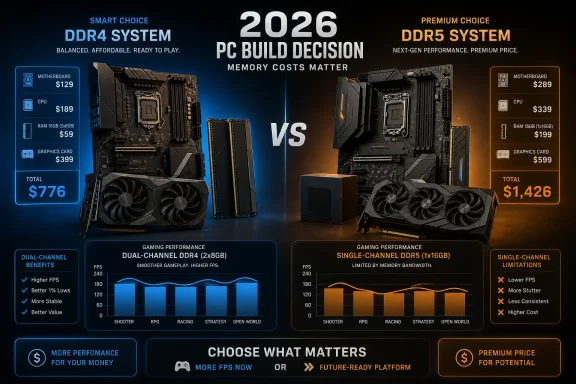 DDR5 is the expensive compromise
For a platform with a clearer upgrade path—AMD AM5 or Intel LGA1851—the guide suggests that buyers may have to begin with a single 16GB DDR5 DIMM. That is an awkward proposition for gaming because single-channel memory can materially affect frame rates and, particularly, minimum FPS in bandwidth-sensitive titles.Mezha puts a 16GB DDR5-5200/5600 stick at about $220 in its market, versus roughly $150 for a 16GB DDR4 dual-channel kit. Those figures are regional estimates, not US street prices, but the buying logic travels: do not sacrifice dual-channel operation solely to claim a newer platform unless a second matching DIMM is a realistic near-term purchase.
The publication’s higher-tier build similarly budgets 32GB of DDR5, but says the memory allocation alone can reach $420 or more. That makes 32GB the expense to plan around rather than an automatic checkbox.
GPUs remain familiar, with one pricing warning
For the 1440p class, Mezha continues to favor the GeForce RTX 5070 12GB and Radeon RX 9070 16GB. It is less enthusiastic about the Radeon RX 9070 GRE 12GB, saying the card trails the standard RX 9070 by around 15% while initially landing too close to the full model on price. The GRE only becomes compelling after a substantial discount, according to the guide.At the upper end, the recommendation remains the GeForce RTX 5070 Ti 16GB or Radeon RX 9070 XT 16GB, with a Ryzen 7 9800X3D or comparable Intel Core Ultra processor. Mezha also notes that rumors of RTX 50 Super cards and AMD’s next RDNA generation are not grounds to delay a purchase; neither product family is confirmed for an imminent retail launch.
For US builders, treat the guide as a component-tier sanity check and price the full memory configuration first before committing to a motherboard or CPU platform.
References
- Primary source: Mezha
Published: 2026-07-17T08:10:00+00:00
PC of the Month (July 2026) • Межа
What gaming PC should you build in July 2026? Optimal configurations for Intel and AMD, the latest processors and graphics cards, prices for DDR4/DDR5 memory, and practical advice on choosing components in the latest edition of 'PC of the Month'.mezha.ua