

A July 17 roundup from PropelRC names the ASUS ROG Astral GeForce RTX 5090 its top 4K gaming card, but its recommendations need a substantial reality check before anyone treats the list as a 2026 buying guide.
The core hardware facts are sound: Nvidia’s RTX 5090 is the fastest consumer GeForce card, with Blackwell architecture and 32GB of GDDR7 memory. The RTX 5080 carries 16GB of GDDR7, while AMD’s older Radeon RX 7900 XTX has 24GB of GDDR6. But the article mixes those specifications with unsubstantiated temperature, noise, reliability, and performance claims for individual board models.
The guide says its preferred RTX 5080 delivers roughly 75% of RTX 5090 performance for 35% of the price. It supplies no consistent benchmark suite, test platform, driver version, settings, or actual street-price snapshots to support that calculation.
That is a problem in a market where retail prices move faster than the underlying GPU hierarchy. Nvidia launched the RTX 5090 at $1,999 and the RTX 5080 at $999, but current board-partner pricing can differ sharply from those figures. AIB premiums also vary widely: an oversized, factory-overclocked ASUS or Gigabyte card should not be compared as if it were priced like a Founders Edition.
Claims that a particular card “rarely exceeds 75°C,” runs at “45–55°C under load,” or has no coil whine should likewise be treated cautiously. Cooling results depend on the case, fan curve, ambient temperature, workload, power target, silicon variance, and whether the numbers refer to GPU core, hotspot, or memory temperatures.
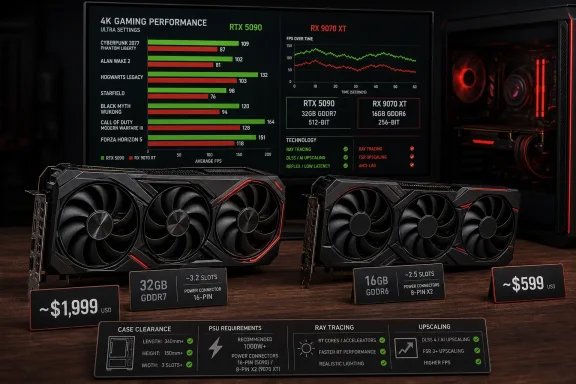
AMD introduced the RDNA 4-based RX 9070 XT in March 2025 with 16GB of memory, newer ray-tracing hardware, and FSR 4 support. AMD explicitly positioned the RX 9070 series for high-refresh 4K gaming. Leaving it out of a guide published in July 2026 makes the AMD section look dated before the shopping links begin.
The RX 7900 XTX remains a capable card, particularly in rasterized games and memory-heavy workloads, but it is not the only meaningful Radeon choice for a current 4K build.
The core hardware facts are sound: Nvidia’s RTX 5090 is the fastest consumer GeForce card, with Blackwell architecture and 32GB of GDDR7 memory. The RTX 5080 carries 16GB of GDDR7, while AMD’s older Radeon RX 7900 XTX has 24GB of GDDR6. But the article mixes those specifications with unsubstantiated temperature, noise, reliability, and performance claims for individual board models.
 Rankings without comparable testing
The guide says its preferred RTX 5080 delivers roughly 75% of RTX 5090 performance for 35% of the price. It supplies no consistent benchmark suite, test platform, driver version, settings, or actual street-price snapshots to support that calculation.That is a problem in a market where retail prices move faster than the underlying GPU hierarchy. Nvidia launched the RTX 5090 at $1,999 and the RTX 5080 at $999, but current board-partner pricing can differ sharply from those figures. AIB premiums also vary widely: an oversized, factory-overclocked ASUS or Gigabyte card should not be compared as if it were priced like a Founders Edition.
Claims that a particular card “rarely exceeds 75°C,” runs at “45–55°C under load,” or has no coil whine should likewise be treated cautiously. Cooling results depend on the case, fan curve, ambient temperature, workload, power target, silicon variance, and whether the numbers refer to GPU core, hotspot, or memory temperatures.
The AMD omission
Most conspicuously, the list recommends the Radeon RX 7900 XTX as AMD’s flagship 4K option while omitting AMD’s Radeon RX 9070 XT entirely.AMD introduced the RDNA 4-based RX 9070 XT in March 2025 with 16GB of memory, newer ray-tracing hardware, and FSR 4 support. AMD explicitly positioned the RX 9070 series for high-refresh 4K gaming. Leaving it out of a guide published in July 2026 makes the AMD section look dated before the shopping links begin.
The RX 7900 XTX remains a capable card, particularly in rasterized games and memory-heavy workloads, but it is not the only meaningful Radeon choice for a current 4K build.
What buyers should actually check
For a 4K upgrade, start with independent game benchmarks for the titles you play, at the settings you will use. Then verify:- Actual local price, not MSRP or an affiliate-page “check price” button.
- Card length, slot thickness, connector clearance, and whether your case can support it.
- PSU capacity and the GPU maker’s connector requirements.
- VRAM needs for your intended texture settings and ray tracing.
- Whether DLSS, FSR, XeSS, frame generation, or native rendering is acceptable for your target frame rate.
References
- Primary source: Propel RC
Published: 2026-07-17T18:18:16+00:00
Best 4K Gaming Graphics Cards 2026: Top GPUs for Ultra HD Gaming
Discover the best 4K gaming graphics cards in 2026. Our expert reviews cover RTX 5090, RTX 5080, RX 7900 XTX and more for ultimate ultra HD gaming performance.www.propelrc.com - Related coverage: pcgamer.com
Graphics card price watch: We're tracking the lowest prices and the best GPU deals for Nvidia, AMD, and Intel cards | PC Gamer
We've done the hard yards sourcing the best graphics card deals for the GPUs worth putting in your gaming PC.www.pcgamer.com - Related coverage: nvidia.com
NVIDIA GeForce RTX 5090 Graphics Cards
The most powerful GeForce GPU ever made, bringing game-changing capabilities to gamers and creators, powered by the NVIDIA Blackwell architecture.www.nvidia.com - Related coverage: ir.amd.com
AMD Unveils World’s Most Advanced Gaming Graphics Cards, Built on Groundbreaking AMD RDNA 3 Architecture with Chiplet Design :: Advanced Micro Devices, Inc. (AMD)
– Highly efficient AMD RDNA 3 architecture delivers world-class performance, and features new unified compute units, world’s fastest…...ir.amd.com - Related coverage: marketplace.nvidia.com
- Related coverage: tomshardware.com
Best Graphics Cards for Gaming in 2026 | Tom's Hardware
Here are the best graphics cards for gaming, for every monitor resolution and budget.www.tomshardware.com