

Windows Package Manager 1.29.280 should not be configured to favor a private repository across the board. The safer enterprise policy is to give a curated private source higher priority only for packages the organization owns, validates, and can maintain reliably, while leaving the
Released June 24, 2026, WinGet 1.29.280 introduces Source Priority as an experimental feature controlled by the disabled-by-default
WinGet has long supported multiple package sources, including private REST-based repositories alongside the default
Source Priority gives administrators a numerical way to influence that choice. Higher-priority sources can appear earlier in results, but only after WinGet considers match quality and the field that matched the query. Microsoft describes source order as the lowest-ranking factor, so a weak private-source match should not automatically outrank a better public-source match merely because an administrator assigned it a larger priority value.
The more consequential behavior appears in install-oriented commands. If multiple sources return matches, but exactly one highest-priority source returns exactly one result, WinGet can select that package rather than stopping with a multiple-packages disambiguation error.
That turns priority into installation policy encoded in client behavior. An interactive user may simply notice fewer prompts or errors, but an unattended script can proceed with a package selected from the favored source.
The behavior applies to both WinGet CLI and PowerShell module command paths. It therefore matters on administrator workstations, provisioning scripts, development environments, and CI/CD systems—not just in an occasional
In that situation, source priority can express a legitimate organizational decision: when the internal and public repositories both offer a plausible match, use the organization-approved package. The private source becomes an authoritative distribution point rather than merely another catalog.
A private source can also represent a curated version of externally produced software, but the operational standard should remain high. If the enterprise republishes or wraps a third-party application, it assumes responsibility for keeping that package current, correctly identified, and suitable for automated deployment.
Administrators should establish the boundary before enabling the experimental flag:
That is a substantial commitment. Once automation depends on the private source winning ambiguous matches, delays and catalog errors become deployment behavior rather than administrative inconvenience.
A package can remain downloadable while still being operationally unsuitable. It may lag behind the version expected by a deployment workflow, point to an installer that no longer reflects enterprise policy, or cease to be the package administrators intended when they wrote a broad search-based command.
Source Priority does not replace package validation, repository governance, or precise automation. It only settles a narrow class of selection conflicts after stronger matching criteria have already been considered.
The feature also should not be treated as a security boundary. A higher priority value says which source WinGet should prefer in an eligible ambiguity; it does not, by itself, establish that the source’s contents are trusted, current, approved, or correctly maintained.
This distinction is critical in CI/CD. A desktop user can inspect a result and recognize that the wrong application is about to be installed. An unattended pipeline may accept the selected package and continue into later stages before the mistake becomes visible.
Priority should therefore be a fallback policy, not the primary identity mechanism. If a deployment absolutely requires the organization’s build, its automation should state that requirement as explicitly as the available command supports.
Search testing matters as well. Because match quality and matched field outrank source order, assigning a private source the highest priority does not guarantee that every similarly named private package will appear first. Teams should test the actual IDs and queries used in production rather than inferring behavior from the priority values alone.
That explicit opt-in should shape the rollout plan. Experimental features are suitable for labs, controlled pilots, and carefully observed automation, but they should not silently become a fleet-wide dependency without testing and a reversal path.
Organizations evaluating Source Priority should capture current behavior before enabling it. Run representative searches and install requests against all configured sources, record where WinGet currently reports ambiguity, and then repeat those operations with priorities assigned.
The important result is not whether the private source appears nearer the top of a search listing. It is whether an install command that previously stopped for disambiguation now proceeds—and which repository supplies the selected package.
Teams should separately test CLI and PowerShell workflows even though Microsoft says the behavior has been implemented in both paths. The surrounding scripts, error handling, logging, and assumptions about user interaction may differ enough to produce different operational consequences.
Removing or broadly subordinating those sources can turn the private repository into a bottleneck. Every newly requested utility, developer tool, or Store-distributed application then becomes an internal packaging task before users or automation can consume it through the standard workflow.
A layered approach is more sustainable. Let the private repository be authoritative for a deliberately maintained package set, while Microsoft’s sources continue to cover the broader Windows software ecosystem.
This also preserves clearer failure signals. If the private catalog does not contain an internally governed package, that absence should prompt investigation rather than allow an ambiguous or loosely matched entry to win simply because the entire repository was assigned top priority.
The immediate recommendation for WinGet 1.29.280 is therefore a controlled pilot, not a universal source-order mandate. Use Source Priority where repository ownership and package maintenance justify an automatic decision, keep public sources available, and watch whether Microsoft changes the feature’s experimental status or selection behavior in a future Windows Package Manager release.
winget community repository and msstore Microsoft Store source available for everything else.Released June 24, 2026, WinGet 1.29.280 introduces Source Priority as an experimental feature controlled by the disabled-by-default
sourcePriority flag. Microsoft’s release notes and WinGet settings documentation make clear that this is more than a cosmetic adjustment: under specific conditions, source priority can determine which package WinGet installs.
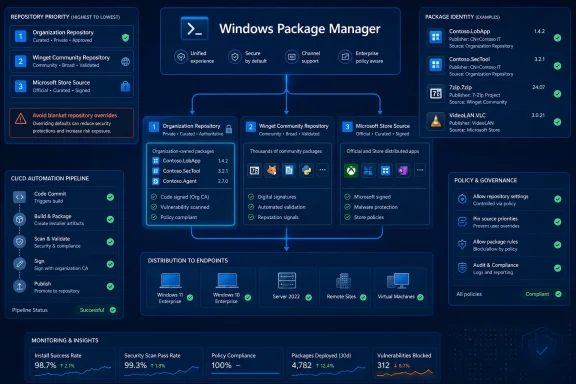 Source Order Can Now Resolve an Installation
WinGet has long supported multiple package sources, including private REST-based repositories alongside the default winget and msstore sources. That arrangement creates an unavoidable identity problem when more than one source contains a package matching the same request.Source Priority gives administrators a numerical way to influence that choice. Higher-priority sources can appear earlier in results, but only after WinGet considers match quality and the field that matched the query. Microsoft describes source order as the lowest-ranking factor, so a weak private-source match should not automatically outrank a better public-source match merely because an administrator assigned it a larger priority value.
The more consequential behavior appears in install-oriented commands. If multiple sources return matches, but exactly one highest-priority source returns exactly one result, WinGet can select that package rather than stopping with a multiple-packages disambiguation error.
That turns priority into installation policy encoded in client behavior. An interactive user may simply notice fewer prompts or errors, but an unattended script can proceed with a package selected from the favored source.
The behavior applies to both WinGet CLI and PowerShell module command paths. It therefore matters on administrator workstations, provisioning scripts, development environments, and CI/CD systems—not just in an occasional
winget search session.Private Sources Should Win Only Inside a Defined Ownership Boundary
The strongest case for a higher-priority private repository is a package that the organization explicitly controls. That might mean internally developed software or a package whose installer, manifest, release cadence, and validation process are managed as an enterprise service.In that situation, source priority can express a legitimate organizational decision: when the internal and public repositories both offer a plausible match, use the organization-approved package. The private source becomes an authoritative distribution point rather than merely another catalog.
A private source can also represent a curated version of externally produced software, but the operational standard should remain high. If the enterprise republishes or wraps a third-party application, it assumes responsibility for keeping that package current, correctly identified, and suitable for automated deployment.
Administrators should establish the boundary before enabling the experimental flag:
- Identify packages for which the private repository is genuinely authoritative.
- Confirm that each private package has a stable and unambiguous identity.
- Define who updates its manifest and installer when a new release becomes available.
- Validate the package through the same path used by production CLI and PowerShell automation.
- Test searches and installations while the public
wingetandmsstoresources remain enabled. - Roll out the priority configuration gradually and monitor which source satisfies each installation request.
A Blanket Override Creates a Maintenance Promise
Making a private repository outrank Microsoft’s sources for every overlapping result may look like a quick way to standardize software delivery. In practice, it makes the private catalog responsible for being consistently better maintained than the public alternatives.That is a substantial commitment. Once automation depends on the private source winning ambiguous matches, delays and catalog errors become deployment behavior rather than administrative inconvenience.
A package can remain downloadable while still being operationally unsuitable. It may lag behind the version expected by a deployment workflow, point to an installer that no longer reflects enterprise policy, or cease to be the package administrators intended when they wrote a broad search-based command.
Source Priority does not replace package validation, repository governance, or precise automation. It only settles a narrow class of selection conflicts after stronger matching criteria have already been considered.
The feature also should not be treated as a security boundary. A higher priority value says which source WinGet should prefer in an eligible ambiguity; it does not, by itself, establish that the source’s contents are trusted, current, approved, or correctly maintained.
Exact Package Identity Still Beats Priority
Source Priority is most useful when administrators cannot avoid overlapping catalogs, but robust automation should minimize ambiguity before asking WinGet to resolve it. Scripts should use the most precise package identity and source constraints available to their command path instead of relying on a broad name query and hoping repository order produces the intended result.This distinction is critical in CI/CD. A desktop user can inspect a result and recognize that the wrong application is about to be installed. An unattended pipeline may accept the selected package and continue into later stages before the mistake becomes visible.
Priority should therefore be a fallback policy, not the primary identity mechanism. If a deployment absolutely requires the organization’s build, its automation should state that requirement as explicitly as the available command supports.
Search testing matters as well. Because match quality and matched field outrank source order, assigning a private source the highest priority does not guarantee that every similarly named private package will appear first. Teams should test the actual IDs and queries used in production rather than inferring behavior from the priority values alone.
Experimental Means Change Control Is Still Required
ThesourcePriority feature is disabled by default in WinGet 1.29.280. Administrators must enable it under the experimentalFeatures section of WinGet settings:
Code:
{
  "experimentalFeatures": {
    "sourcePriority": true
  }
}Organizations evaluating Source Priority should capture current behavior before enabling it. Run representative searches and install requests against all configured sources, record where WinGet currently reports ambiguity, and then repeat those operations with priorities assigned.
The important result is not whether the private source appears nearer the top of a search listing. It is whether an install command that previously stopped for disambiguation now proceeds—and which repository supplies the selected package.
Teams should separately test CLI and PowerShell workflows even though Microsoft says the behavior has been implemented in both paths. The surrounding scripts, error handling, logging, and assumptions about user interaction may differ enough to produce different operational consequences.
Keep Microsoft’s Sources in the Design
The defaultwinget repository and msstore source remain valuable even when an organization operates a mature internal service. They provide catalog coverage beyond the set of applications most enterprises can reasonably package and maintain themselves.Removing or broadly subordinating those sources can turn the private repository into a bottleneck. Every newly requested utility, developer tool, or Store-distributed application then becomes an internal packaging task before users or automation can consume it through the standard workflow.
A layered approach is more sustainable. Let the private repository be authoritative for a deliberately maintained package set, while Microsoft’s sources continue to cover the broader Windows software ecosystem.
This also preserves clearer failure signals. If the private catalog does not contain an internally governed package, that absence should prompt investigation rather than allow an ambiguous or loosely matched entry to win simply because the entire repository was assigned top priority.
The immediate recommendation for WinGet 1.29.280 is therefore a controlled pilot, not a universal source-order mandate. Use Source Priority where repository ownership and package maintenance justify an automatic decision, keep public sources available, and watch whether Microsoft changes the feature’s experimental status or selection behavior in a future Windows Package Manager release.
References
- Primary source: learn.microsoft.com
settings command | Microsoft Learn
Provides customizations for the Windows Package Manager.learn.microsoft.com - Independent coverage: github.com
Releases · microsoft/winget-cli · GitHub
WinGet is the Windows Package Manager. This project includes a CLI (Command Line Interface), PowerShell modules, and a COM (Component Object Model) API (Application Programming Interface). - Releases · microsoft/winget-cli github.com
- Primary source: WindowsForum
Why WinGet Is the Future of Windows Package Management | Windows Forum
Managing software installations on Windows has traditionally been a manual and time-consuming process. However, the advent of package managers like...windowsforum.com