

SpaceX is pressing the Federal Communications Commission to let winners of the planned 3.98–4.14 GHz upper C-band auction count satellite-delivered coverage toward their buildout obligations, a late intervention that could reshape who can realistically use one of the next major blocks of U.S. mid-band spectrum. As first reported by Fierce Network, SpaceX made the case in meetings with FCC staff ahead of the agency’s July 22, 2026 vote on auction procedures.
The practical issue is larger than a narrow licensing dispute. The FCC’s draft order is structured around terrestrial wireless deployment: licensees would need to provide reliable service to 45% of the population in each license area one year after the applicable transition deadline, rising to 80% after five years. SpaceX wants a technology-neutral alternative that would recognize high-power, wide-area satellite service in places where conventional tower construction is difficult or uneconomic.
That proposal puts Starlink’s direct-to-device ambitions directly into the rules of an auction designed primarily to extend the C-band spectrum used by 5G networks. For enterprise IT teams, remote workers and organizations operating Windows devices outside dense metro footprints, the eventual answer could influence whether new coverage is built from cellular sites, satellite links—or a combination of both.
The FCC is scheduled to vote on an order that would auction 160 MHz of upper C-band spectrum in 2027, covering 3.98 GHz to 4.14 GHz. Combined with the lower C-band already assigned to wireless carriers, the plan would create a contiguous 440 MHz “super band” from 3.7 GHz to 4.14 GHz for terrestrial mobile service.
The agency’s draft, released July 1, makes the direction clear. It would add a primary mobile allocation across 4.0 GHz to 4.16 GHz in the contiguous United States, remove fixed-satellite-service status below 4.16 GHz, and establish a migration process for incumbent satellite users. The FCC says this structure could allow most Americans to receive service in the upper C-band before the end of 2030, subject to satellite clearing and aviation-safety work.
That terrestrial framing matters because SpaceX is not merely asking for an opportunity to bid. It is asking the FCC to recognize satellite infrastructure as a valid way for an auction winner to keep a license from being cancelled for failing coverage milestones.
In its filing, SpaceX argued that satellite coverage could bring broadband service to sparsely populated areas years sooner than a terrestrial rollout. The company also urged the FCC to reject a different relaxation supported by CTIA: counting low-power or localized deployments, including some IoT, point-to-point, or private internal systems, toward buildout compliance.
The irony is that the FCC’s circulating draft already rejects CTIA’s requested alternatives. It says IoT, fixed point-to-point and private internal operations may be allowed under flexible-use rules, but cannot satisfy the auction’s performance requirements. The draft does not extend the same recognition to satellite coverage, leaving SpaceX’s request as a direct challenge to the Commission’s central design.
This next sale is expected to draw the same national carriers, regional operators and potentially new entrants. FCC Chairman Brendan Carr has said the auction could raise tens of billions of dollars for the Treasury. TD Cowen analysts have estimated a broad range of possible outcomes, with SpaceX participation among the variables that could determine the final price.
SpaceX’s position is more consequential than a standard request for flexible regulation. If satellite service could fulfill population-coverage milestones, a bidder with Starlink’s infrastructure might place value on licenses that a traditional mobile network operator would assess very differently. It could also allow a spectrum holder to meet obligations without building the dense terrestrial radio network normally associated with C-band licenses.
For the incumbent carriers, that is the central concern. Their business models assume that C-band licenses are won by companies prepared to build mobile networks, deploy radios across thousands of sites and compete for smartphone and fixed-wireless subscribers. A rule that treats satellite coverage as equivalent could lower the infrastructure threshold for a new competitor—though it would also raise hard technical and policy questions about capacity, device compatibility, indoor service, reliability and whether satellite coverage truly matches the consumer experience expected from a high-power terrestrial license.
SpaceX is effectively asking the FCC to judge performance by the availability of service rather than the architecture used to provide it. That argument has obvious appeal in rural markets, where fiber backhaul, zoning, power availability and tower economics can slow conventional expansion. It also matches the broader industry push toward non-terrestrial networks, where satellites supplement cellular coverage rather than replace it.
But the Commission faces a more difficult definition problem than the phrase “technology neutral” suggests. A satellite connection that reaches an ordinary handset outdoors may be enormously useful for messaging, emergency alerts and modest data use. That does not automatically make it interchangeable with a terrestrial C-band network built for dense 5G traffic, enterprise mobility, fixed wireless access and heavily loaded urban corridors.
The FCC’s own draft repeatedly describes the auctioned spectrum as being repurposed for terrestrial flexible use. Any decision to credit satellite coverage would therefore need guardrails: minimum service levels, handset support, measurable coverage standards, capacity requirements and rules against simply declaring a broad satellite footprint as proof of usable service.
Without those details, a satellite-credit rule could create the appearance of aggressive buildout while weakening the auction’s promise of new terrestrial capacity. With them, it could become a useful tool for accelerating service in areas where the economics of a conventional network remain poor.
The current FCC plan includes a 20 MHz guard band from 4.14 GHz to 4.16 GHz and provides for aircraft radio-altimeter retrofit support. The agency says it developed the proposal with the Federal Aviation Administration, aiming for a predictable rollout rather than a repeat of the lower-band disruptions.
That timetable means the auction is not simply a 2027 bidding event. Spectrum winners will be purchasing licenses tied to satellite relocation, aviation-equipment transitions and buildout deadlines that may begin only after a specific market’s transition date. The financial and operational commitments will extend well into the next decade.
For businesses that rely on cellular-connected Windows laptops, rugged tablets, fleet systems and remote-site connectivity, the difference is tangible. More mid-band spectrum can eventually mean better capacity and fixed-wireless options. But the route to those gains will depend on whether the FCC keeps the auction focused on terrestrial 5G and future 6G networks, or formally makes room for satellite-first deployment models.
For now, the FCC’s draft favors a conventional answer: auction the spectrum, clear incumbent satellite operations, protect aviation systems and require wide-area terrestrial service. SpaceX is trying to change the meaning of “wide-area” before those rules harden.
Whether the FCC accommodates that request could determine not just how the upper C-band is deployed, but whether the 2027 auction becomes another carrier-spectrum contest or the first major test of satellite networks as full participants in America’s mobile buildout regime.
The practical issue is larger than a narrow licensing dispute. The FCC’s draft order is structured around terrestrial wireless deployment: licensees would need to provide reliable service to 45% of the population in each license area one year after the applicable transition deadline, rising to 80% after five years. SpaceX wants a technology-neutral alternative that would recognize high-power, wide-area satellite service in places where conventional tower construction is difficult or uneconomic.
That proposal puts Starlink’s direct-to-device ambitions directly into the rules of an auction designed primarily to extend the C-band spectrum used by 5G networks. For enterprise IT teams, remote workers and organizations operating Windows devices outside dense metro footprints, the eventual answer could influence whether new coverage is built from cellular sites, satellite links—or a combination of both.
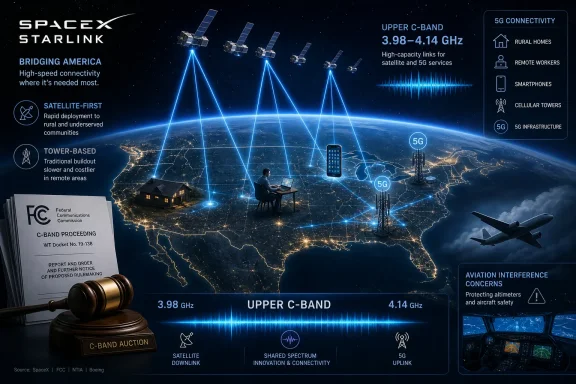 The FCC Draft Still Defines the Band as Terrestrial
The FCC is scheduled to vote on an order that would auction 160 MHz of upper C-band spectrum in 2027, covering 3.98 GHz to 4.14 GHz. Combined with the lower C-band already assigned to wireless carriers, the plan would create a contiguous 440 MHz “super band” from 3.7 GHz to 4.14 GHz for terrestrial mobile service.The agency’s draft, released July 1, makes the direction clear. It would add a primary mobile allocation across 4.0 GHz to 4.16 GHz in the contiguous United States, remove fixed-satellite-service status below 4.16 GHz, and establish a migration process for incumbent satellite users. The FCC says this structure could allow most Americans to receive service in the upper C-band before the end of 2030, subject to satellite clearing and aviation-safety work.
That terrestrial framing matters because SpaceX is not merely asking for an opportunity to bid. It is asking the FCC to recognize satellite infrastructure as a valid way for an auction winner to keep a license from being cancelled for failing coverage milestones.
In its filing, SpaceX argued that satellite coverage could bring broadband service to sparsely populated areas years sooner than a terrestrial rollout. The company also urged the FCC to reject a different relaxation supported by CTIA: counting low-power or localized deployments, including some IoT, point-to-point, or private internal systems, toward buildout compliance.
The irony is that the FCC’s circulating draft already rejects CTIA’s requested alternatives. It says IoT, fixed point-to-point and private internal operations may be allowed under flexible-use rules, but cannot satisfy the auction’s performance requirements. The draft does not extend the same recognition to satellite coverage, leaving SpaceX’s request as a direct challenge to the Commission’s central design.
SpaceX Wants More Than a Seat at the Auction
The upper C-band is especially valuable because of where it sits in the spectrum map. Mid-band frequencies can carry substantially more capacity than low-band cellular spectrum while covering much wider areas than millimeter-wave deployments. Verizon and AT&T spent heavily in the earlier lower C-band auction, which generated more than $80 billion in gross bids and became central to their 5G expansion plans.This next sale is expected to draw the same national carriers, regional operators and potentially new entrants. FCC Chairman Brendan Carr has said the auction could raise tens of billions of dollars for the Treasury. TD Cowen analysts have estimated a broad range of possible outcomes, with SpaceX participation among the variables that could determine the final price.
SpaceX’s position is more consequential than a standard request for flexible regulation. If satellite service could fulfill population-coverage milestones, a bidder with Starlink’s infrastructure might place value on licenses that a traditional mobile network operator would assess very differently. It could also allow a spectrum holder to meet obligations without building the dense terrestrial radio network normally associated with C-band licenses.
For the incumbent carriers, that is the central concern. Their business models assume that C-band licenses are won by companies prepared to build mobile networks, deploy radios across thousands of sites and compete for smartphone and fixed-wireless subscribers. A rule that treats satellite coverage as equivalent could lower the infrastructure threshold for a new competitor—though it would also raise hard technical and policy questions about capacity, device compatibility, indoor service, reliability and whether satellite coverage truly matches the consumer experience expected from a high-power terrestrial license.
A Buildout Rule Is Also a Market-Structure Rule
Construction requirements are often described as anti-hoarding provisions, but they also decide which business plans qualify for scarce spectrum. The FCC’s proposed 45% and 80% population thresholds are intended to ensure that licenses do not sit unused after auction. Failure to meet either benchmark would result in automatic termination of the authorization for that license area.SpaceX is effectively asking the FCC to judge performance by the availability of service rather than the architecture used to provide it. That argument has obvious appeal in rural markets, where fiber backhaul, zoning, power availability and tower economics can slow conventional expansion. It also matches the broader industry push toward non-terrestrial networks, where satellites supplement cellular coverage rather than replace it.
But the Commission faces a more difficult definition problem than the phrase “technology neutral” suggests. A satellite connection that reaches an ordinary handset outdoors may be enormously useful for messaging, emergency alerts and modest data use. That does not automatically make it interchangeable with a terrestrial C-band network built for dense 5G traffic, enterprise mobility, fixed wireless access and heavily loaded urban corridors.
The FCC’s own draft repeatedly describes the auctioned spectrum as being repurposed for terrestrial flexible use. Any decision to credit satellite coverage would therefore need guardrails: minimum service levels, handset support, measurable coverage standards, capacity requirements and rules against simply declaring a broad satellite footprint as proof of usable service.
Without those details, a satellite-credit rule could create the appearance of aggressive buildout while weakening the auction’s promise of new terrestrial capacity. With them, it could become a useful tool for accelerating service in areas where the economics of a conventional network remain poor.
The Aviation Timeline Keeps the Stakes High
The upper C-band proceeding is also shaped by the lessons of the lower C-band transition. Concerns about potential interference with aircraft radio altimeters delayed some early 5G deployments near airports and forced extensive coordination among carriers, aviation authorities and equipment manufacturers.The current FCC plan includes a 20 MHz guard band from 4.14 GHz to 4.16 GHz and provides for aircraft radio-altimeter retrofit support. The agency says it developed the proposal with the Federal Aviation Administration, aiming for a predictable rollout rather than a repeat of the lower-band disruptions.
That timetable means the auction is not simply a 2027 bidding event. Spectrum winners will be purchasing licenses tied to satellite relocation, aviation-equipment transitions and buildout deadlines that may begin only after a specific market’s transition date. The financial and operational commitments will extend well into the next decade.
For businesses that rely on cellular-connected Windows laptops, rugged tablets, fleet systems and remote-site connectivity, the difference is tangible. More mid-band spectrum can eventually mean better capacity and fixed-wireless options. But the route to those gains will depend on whether the FCC keeps the auction focused on terrestrial 5G and future 6G networks, or formally makes room for satellite-first deployment models.
July 22 Will Set the Default, Not End the Fight
The Commission’s July 22 vote is expected to establish the auction framework, but SpaceX’s filing shows that the broader fight over C-band use is far from settled. The company has already made clear that it sees Starlink as a potential competitor across rural, suburban and urban connectivity, not solely as a last-resort broadband provider.For now, the FCC’s draft favors a conventional answer: auction the spectrum, clear incumbent satellite operations, protect aviation systems and require wide-area terrestrial service. SpaceX is trying to change the meaning of “wide-area” before those rules harden.
Whether the FCC accommodates that request could determine not just how the upper C-band is deployed, but whether the 2027 auction becomes another carrier-spectrum contest or the first major test of satellite networks as full participants in America’s mobile buildout regime.
References
- Primary source: Fierce Network
Published: 2026-07-17T17:29:36+00:00
SpaceX seeks tweaks in upper C-band auction rules
SpaceX is pushing for more flexibility as the FCC tees up the next big spectrum auction.www.fierce-network.com - Related coverage: digital-strategy.ec.europa.eu
United States: Federal Communications Commission sets vote on rules for an Upper C-band 5G spectrum auction
The Federal Communications Commission (FCC) will vote in July on rules to auction 160 megahertz of Upper C-band spectrum for 5G, creating a contiguous 440 megahertz (MHz) mid-band block.digital-strategy.ec.europa.eu
- Related coverage: tvtechnology.com
FCC Proposes Upper C-Band Rules for 2027 Auction | TV Tech
In a 3-0 vote, the commissioners adopted the NPRM seeking comment on its plan to free up a minimum of 100 MHz of Upper C-band spectrumwww.tvtechnology.com