

OpenAI has added a new safety notification to ChatGPT parental controls: a linked parent or guardian can now be alerted when a teen’s account is banned for conversations involving violent threats or acts of violence. The important limitation is that the alert follows an account-enforcement decision; it is not a live monitoring feed, and it does not expose the teen’s prompts or chat history.
The change was outlined in OpenAI’s July 13 update to its parental-controls announcement, then discussed again in the company’s July 16 teen-safety post. TECHi’s report correctly identifies the practical distinction: this is an after-enforcement signal intended to bring a serious account action to an adult’s attention, rather than a promise that ChatGPT will identify danger before it develops.
For families using ChatGPT on Windows PCs, browsers, phones, or the desktop app, that distinction is the entire story. The new notification can create an opportunity for a conversation or urgent real-world intervention. It cannot serve as evidence that a parent has comprehensive visibility into a teenager’s AI use.
OpenAI says the new alert applies when a linked teen account is deactivated under rules covering violent threats or acts of violence. The company has described the trigger as deliberately narrow, saying it is not meant to apply to fictional writing, gaming, news and political discussion, general anger, or abstract questions about violence.
That matters because AI moderation can be prone to ambiguity. A teenager researching a historical attack, writing fiction, discussing a multiplayer game, or venting in anger may use similar language to someone expressing a genuine threat. OpenAI’s stated policy is that the alert is tied to an enforcement outcome, not simply the presence of sensitive words in a chat.
In practical terms, the sequence is likely to be: ChatGPT detects activity that may violate policy, OpenAI applies moderation or review processes, the teen account is deactivated, and the linked adult is notified. The parent is learning that the service has taken a serious action—not receiving an early warning based on every concerning exchange.
That makes the alert potentially valuable, especially when a disabled ChatGPT account might otherwise appear to be a password problem or technical outage. But it also puts a hard limit on the feature’s safety claims. A notification delivered after an account ban is closer to an escalation notice than a prediction system.
This preserves a meaningful privacy boundary for teens. It also creates an unavoidable operational problem: a parent who receives a violence-related ban notification cannot independently review the alleged conversation through the parental-controls panel.
If a teen insists that an account action was mistaken, the parent has no transcript to evaluate. The next steps would need to involve the teen, ChatGPT’s support or appeal channels, and—where there is an immediate or credible danger—appropriate emergency or mental-health services. The notification alone should not be treated as proof of intent.
OpenAI is attempting to occupy a difficult middle ground. It wants parental controls to offer intervention pathways without turning ChatGPT into a surveillance product. The result is a system in which adults can manage selected settings and receive narrow high-risk signals, but cannot inspect the underlying conversations that led to those signals.
The linked-account controls already extend far beyond a simple content filter. Depending on account availability and configuration, a parent or guardian can manage settings for:
OpenAI is positioning this as a way to help teens use AI for education and productivity with guardrails rather than excluding them from the platform outright. That is a product strategy as much as a safety strategy.
Either side can also end the relationship. If a teen unlinks the account, OpenAI says the parent is notified, but the company does not prevent the unlinking. The controls also end automatically once ChatGPT identifies the account holder as 18 or older and moves them out of the teen experience.
That means the new violence-ban notification has a fundamental coverage gap: it works only for accounts that are both identified as teen accounts and linked to a parent or guardian. An unlinked account will not send this particular parent notification.
OpenAI has separately invested in age prediction to decide when an account should receive teen protections. The company has said that its systems may use account and usage signals to estimate whether someone is under 18, with an age-verification path available for adults who believe they were classified incorrectly.
Those are separate mechanisms that should not be conflated. Age estimation determines which experience and safeguards may apply. Account linking enables parent-managed controls. Enforcement triggers account actions. The new notification bridges the last two only in a narrow set of circumstances.
There is no published figure for how many linked teen accounts will generate these alerts, how often the underlying enforcement is reviewed by humans, how often decisions are successfully appealed, or how quickly notifications reach parents. There is also no public false-negative rate showing how often genuinely dangerous conversations may evade detection or enforcement.
Those omissions do not make the feature useless. They do mean that parents, schools, and IT administrators should resist treating it as a reliable early-warning system.
A better next step from OpenAI would be aggregated transparency reporting: alert volumes, delivery rates, appeal outcomes, reviewer involvement, and broad error trends. That could be done without disclosing teen conversations or weakening privacy protections.
The immediate change is real but limited. ChatGPT parental controls now let a linked adult know when OpenAI has already deactivated a teen account for a narrowly defined category of violent activity. What remains unproven is whether that post-enforcement alert will consistently reach families early enough to change an outcome.
The change was outlined in OpenAI’s July 13 update to its parental-controls announcement, then discussed again in the company’s July 16 teen-safety post. TECHi’s report correctly identifies the practical distinction: this is an after-enforcement signal intended to bring a serious account action to an adult’s attention, rather than a promise that ChatGPT will identify danger before it develops.
For families using ChatGPT on Windows PCs, browsers, phones, or the desktop app, that distinction is the entire story. The new notification can create an opportunity for a conversation or urgent real-world intervention. It cannot serve as evidence that a parent has comprehensive visibility into a teenager’s AI use.
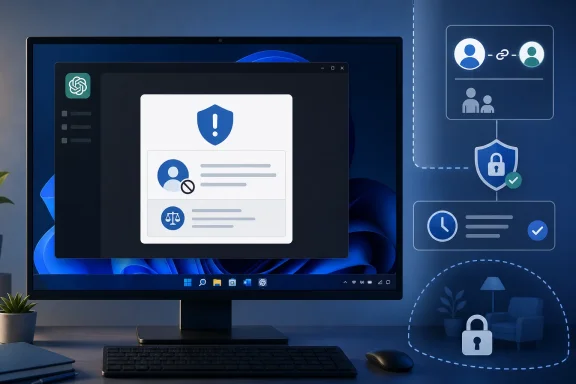 An Account Ban, Not a Conversation Transcript
OpenAI says the new alert applies when a linked teen account is deactivated under rules covering violent threats or acts of violence. The company has described the trigger as deliberately narrow, saying it is not meant to apply to fictional writing, gaming, news and political discussion, general anger, or abstract questions about violence.That matters because AI moderation can be prone to ambiguity. A teenager researching a historical attack, writing fiction, discussing a multiplayer game, or venting in anger may use similar language to someone expressing a genuine threat. OpenAI’s stated policy is that the alert is tied to an enforcement outcome, not simply the presence of sensitive words in a chat.
In practical terms, the sequence is likely to be: ChatGPT detects activity that may violate policy, OpenAI applies moderation or review processes, the teen account is deactivated, and the linked adult is notified. The parent is learning that the service has taken a serious action—not receiving an early warning based on every concerning exchange.
That makes the alert potentially valuable, especially when a disabled ChatGPT account might otherwise appear to be a password problem or technical outage. But it also puts a hard limit on the feature’s safety claims. A notification delivered after an account ban is closer to an escalation notice than a prediction system.
Privacy Remains the Boundary
OpenAI’s current parental-controls documentation is unusually explicit about what parents cannot do. Linking an adult and teen account does not give the adult access to prompts, responses, chat history, or real-time activity. The company says limited safety notifications include only information needed to help support the teen’s safety.This preserves a meaningful privacy boundary for teens. It also creates an unavoidable operational problem: a parent who receives a violence-related ban notification cannot independently review the alleged conversation through the parental-controls panel.
If a teen insists that an account action was mistaken, the parent has no transcript to evaluate. The next steps would need to involve the teen, ChatGPT’s support or appeal channels, and—where there is an immediate or credible danger—appropriate emergency or mental-health services. The notification alone should not be treated as proof of intent.
OpenAI is attempting to occupy a difficult middle ground. It wants parental controls to offer intervention pathways without turning ChatGPT into a surveillance product. The result is a system in which adults can manage selected settings and receive narrow high-risk signals, but cannot inspect the underlying conversations that led to those signals.
The Controls Are Becoming an Administrative Layer
The violence-ban alert arrived alongside a broader expansion of the parental-controls experience. Parents with linked teen accounts can now turn on Study Mode as the default for new main conversations, while OpenAI says it is also increasing break reminders for teen users.The linked-account controls already extend far beyond a simple content filter. Depending on account availability and configuration, a parent or guardian can manage settings for:
- Sensitive-content reduction, which adds extra safeguards around graphic material and certain types of roleplay.
- Quiet hours, which can block ChatGPT access during a chosen time window.
- Saved memory, voice mode, and image generation.
- Whether conversations may be used for model improvement.
- Study Mode for newly started conversations.
- Some ChatGPT Work capabilities, including controls related to Codex network access and cloud-browser use.
OpenAI is positioning this as a way to help teens use AI for education and productivity with guardrails rather than excluding them from the platform outright. That is a product strategy as much as a safety strategy.
Linking Is Voluntary—and It Can End
The parental-control relationship is consent-based. A parent or guardian can invite a teen to link accounts, or a teen can invite an adult. OpenAI says each teen can be linked to one parent or guardian at a time, although an adult can link to multiple teens.Either side can also end the relationship. If a teen unlinks the account, OpenAI says the parent is notified, but the company does not prevent the unlinking. The controls also end automatically once ChatGPT identifies the account holder as 18 or older and moves them out of the teen experience.
That means the new violence-ban notification has a fundamental coverage gap: it works only for accounts that are both identified as teen accounts and linked to a parent or guardian. An unlinked account will not send this particular parent notification.
OpenAI has separately invested in age prediction to decide when an account should receive teen protections. The company has said that its systems may use account and usage signals to estimate whether someone is under 18, with an age-verification path available for adults who believe they were classified incorrectly.
Those are separate mechanisms that should not be conflated. Age estimation determines which experience and safeguards may apply. Account linking enables parent-managed controls. Enforcement triggers account actions. The new notification bridges the last two only in a narrow set of circumstances.
OpenAI Has Not Published the Numbers That Matter
The most significant unanswered question is performance. OpenAI acknowledges that no safety system is perfect and that its notifications are not a replacement for professional care or emergency services. But it has not publicly provided operational data on the new violence-ban alert.There is no published figure for how many linked teen accounts will generate these alerts, how often the underlying enforcement is reviewed by humans, how often decisions are successfully appealed, or how quickly notifications reach parents. There is also no public false-negative rate showing how often genuinely dangerous conversations may evade detection or enforcement.
Those omissions do not make the feature useless. They do mean that parents, schools, and IT administrators should resist treating it as a reliable early-warning system.
A better next step from OpenAI would be aggregated transparency reporting: alert volumes, delivery rates, appeal outcomes, reviewer involvement, and broad error trends. That could be done without disclosing teen conversations or weakening privacy protections.
The immediate change is real but limited. ChatGPT parental controls now let a linked adult know when OpenAI has already deactivated a teen account for a narrowly defined category of violent activity. What remains unproven is whether that post-enforcement alert will consistently reach families early enough to change an outcome.
References
- Primary source: techi.com
Published: 2026-07-16T23:30:23.689000+00:00
OpenAI’s New Teen Alert Comes After a ChatGPT Account Ban | TECHi
OpenAI now alerts parents when linked teen accounts are banned for violent activity. Here is what ChatGPT parental controls do—and what they cannot see.www.techi.com - Official source: help.openai.com
Parental controls in ChatGPT | OpenAI Help Center
Learn how parents, guardians, and teens can link accounts, manage settings, understand safety notifications, and update or remove parental controls. help.openai.com
- Official source: openai.com
Introducing Trusted Contact in ChatGPT | OpenAI
Introducing Trusted Contact in ChatGPT, an optional safety feature that notifies someone you trust if serious self-harm concerns are detected.openai.com - Official source: cdn.openai.com
Protecting Teen ChatGPT Users: OpenAI’s Teen Safety Blueprint in Japan - Google Docs
PDF documentcdn.openai.com