Microsoft is reportedly preparing Project Perception, an enterprise AI security product designed to locate software vulnerabilities, explain their impact, and recommend fixes by routing work across models from Microsoft, OpenAI, and Anthropic. If the product reaches customers in the form described by The Information and summarized by TechRepublic on July 17, it would put Microsoft directly into a new and unusually consequential market: AI systems that do more than assist analysts, but actively investigate an organization’s code and IT environment for exploitable weaknesses.
The immediate appeal is not simply better vulnerability discovery. Microsoft’s expected pitch is that a multi-model system can make advanced AI-assisted security work affordable enough to use continuously, rather than reserve it for a small number of high-risk incidents. For Windows-heavy enterprises already operating Microsoft Defender, Sentinel, Azure, GitHub, and Microsoft 365, that integration story could matter as much as the underlying model quality.
Microsoft has not publicly announced Project Perception, released technical documentation, or confirmed availability, pricing, supported environments, or data-handling terms. That makes the current report a signal of product direction rather than a deployment plan. Still, the reported design is significant because it challenges the idea that a single frontier model must be the center of an AI security platform.
According to The Information, Project Perception would choose a model for each task rather than sending every prompt through the same expensive system. A lower-cost model could handle inventory, log parsing, codebase navigation, or vulnerability triage; a more capable model could be called when the system needs to reason through an exploit path, interpret a complex authentication flow, or produce a remediation plan.
That is a practical architecture for enterprise security. Vulnerability management creates enormous volumes of repetitive work: correlating CVEs with asset inventories, checking whether a vulnerable library is reachable, reviewing compensating controls, and turning scanner results into tickets that developers and operations teams can act on. Those jobs do not all require the most expensive model available.
The economics could become the actual differentiator. Anthropic lists Claude Mythos 5 at $10 per million input tokens and $50 per million output tokens, with access restricted to a limited set of vetted cybersecurity partners. TechRepublic reported that Mythos’s API pricing is materially above Anthropic’s Opus-tier model and OpenAI’s GPT offerings. A service that reserves high-cost reasoning for the few steps where it creates real value could undercut a one-model approach without abandoning frontier capabilities altogether.
That does not automatically mean Project Perception will be cheaper in real deployments. Token prices are only one component of the bill. Enterprise customers would also pay for ingestion, connectors, sandbox execution, storage, retention, analyst review, support, and the security controls required to let an AI system inspect sensitive code and infrastructure. But model routing gives Microsoft a credible lever to control cost at scale.
The important distinction is that Mythos is primarily presented as a highly capable model and a restricted access program. Project Perception, as reported, would be a Microsoft-built product layer that combines multiple underlying models, task routing, enterprise context, and presumably Microsoft’s own security tooling. In other words, Microsoft may be betting that the product system is more valuable than exclusive ownership of the smartest model.
That approach fits Microsoft’s established enterprise position. A Windows and Azure customer may already have endpoint telemetry in Defender XDR, cloud-security data in Defender for Cloud, identity signals in Entra ID, software repositories in GitHub, and incident workflows in ServiceNow or Microsoft’s own tools. An AI vulnerability platform that can safely combine those inputs could identify whether a theoretical flaw is genuinely exposed in a specific environment.
The harder part is earning permission to access that information. Source code, secrets, endpoint telemetry, network diagrams, unpatched assets, and incident evidence are precisely the data an attacker would want. Any Microsoft offering in this area will need exact answers on isolation, customer-data retention, model-training boundaries, access controls, auditing, regional processing, and how external models are invoked. “Multi-model” is a cost-saving concept; to a chief information security officer, it is also a data-governance question.
Project Ire is not the same thing as Project Perception. Ire focuses on malware classification and binary analysis, while Perception is reportedly intended to discover vulnerabilities across a customer’s IT environment and suggest fixes. Yet the connection is clear: Microsoft has been developing security agents that call specialist tools, gather evidence, validate conclusions, and stop at the boundary of what the evidence supports.
That evidence-boundary principle matters. Security teams should not accept an AI-generated vulnerability narrative merely because it reads like a polished penetration-test report. A useful system must show the affected package or host, the relevant code or configuration, the access path, the assumptions it made, the remediation it recommends, and the operational risk of that change. For Windows administrators, “apply this fix” is not enough if the fix affects Group Policy, authentication, driver compatibility, a line-of-business application, or a production domain controller.
Microsoft’s best opportunity may therefore be to turn AI findings into governed workflows rather than autonomous changes. A Perception finding that maps a vulnerable dependency to a running workload, produces a patch test plan, opens a tracked remediation item, and attaches a reproducible evidence package would save teams time without pretending that patch approval can be fully automated.
For customers, that can be attractive. It reduces dependence on one provider’s latency, availability, access rules, and pricing. It could also give Microsoft flexibility if a sensitive cybersecurity task needs a model with different safety restrictions or a different hosting path.
But it creates new operational questions. Administrators will need to know which model processed a case, why it was selected, what context it received, whether prompts or outputs were retained, and whether results can be reproduced after models change. A multi-model security tool that cannot provide a defensible audit trail may be difficult to use in regulated sectors, regardless of how impressive its findings are.
The first measure of Project Perception will not be whether it can produce dramatic proof-of-concept exploits. It will be whether it reduces the backlog of real, verified, actionable vulnerabilities without flooding security and IT teams with confident but low-value findings. If Microsoft can connect that workflow to the systems enterprises already trust to manage Windows endpoints, identities, cloud workloads, and developer pipelines, Anthropic’s Mythos may face a challenger built around deployment discipline rather than model mystique.
The immediate appeal is not simply better vulnerability discovery. Microsoft’s expected pitch is that a multi-model system can make advanced AI-assisted security work affordable enough to use continuously, rather than reserve it for a small number of high-risk incidents. For Windows-heavy enterprises already operating Microsoft Defender, Sentinel, Azure, GitHub, and Microsoft 365, that integration story could matter as much as the underlying model quality.
Microsoft has not publicly announced Project Perception, released technical documentation, or confirmed availability, pricing, supported environments, or data-handling terms. That makes the current report a signal of product direction rather than a deployment plan. Still, the reported design is significant because it challenges the idea that a single frontier model must be the center of an AI security platform.
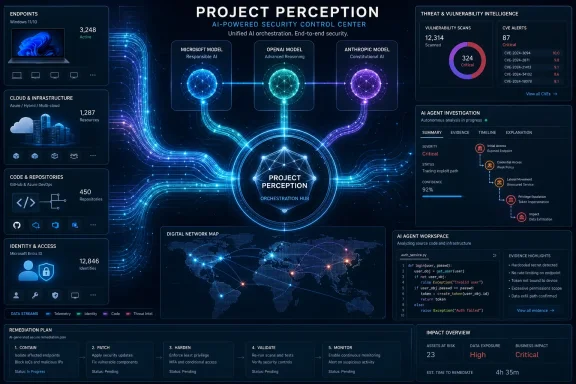 Microsoft’s reported advantage is orchestration, not one model
According to The Information, Project Perception would choose a model for each task rather than sending every prompt through the same expensive system. A lower-cost model could handle inventory, log parsing, codebase navigation, or vulnerability triage; a more capable model could be called when the system needs to reason through an exploit path, interpret a complex authentication flow, or produce a remediation plan.That is a practical architecture for enterprise security. Vulnerability management creates enormous volumes of repetitive work: correlating CVEs with asset inventories, checking whether a vulnerable library is reachable, reviewing compensating controls, and turning scanner results into tickets that developers and operations teams can act on. Those jobs do not all require the most expensive model available.
The economics could become the actual differentiator. Anthropic lists Claude Mythos 5 at $10 per million input tokens and $50 per million output tokens, with access restricted to a limited set of vetted cybersecurity partners. TechRepublic reported that Mythos’s API pricing is materially above Anthropic’s Opus-tier model and OpenAI’s GPT offerings. A service that reserves high-cost reasoning for the few steps where it creates real value could undercut a one-model approach without abandoning frontier capabilities altogether.
That does not automatically mean Project Perception will be cheaper in real deployments. Token prices are only one component of the bill. Enterprise customers would also pay for ingestion, connectors, sandbox execution, storage, retention, analyst review, support, and the security controls required to let an AI system inspect sensitive code and infrastructure. But model routing gives Microsoft a credible lever to control cost at scale.
Anthropic’s Mythos created the category Microsoft wants to enter
Anthropic’s Project Glasswing has made Claude Mythos the most visible example of an AI system being positioned for high-end defensive cybersecurity work. Anthropic says Mythos 5 is its most capable model for cybersecurity and biology research, with tightly controlled access intended to reduce misuse risk. The company has described the model as especially strong in exploit reasoning and has tied its limited availability to the dual-use implications of that capability.The important distinction is that Mythos is primarily presented as a highly capable model and a restricted access program. Project Perception, as reported, would be a Microsoft-built product layer that combines multiple underlying models, task routing, enterprise context, and presumably Microsoft’s own security tooling. In other words, Microsoft may be betting that the product system is more valuable than exclusive ownership of the smartest model.
That approach fits Microsoft’s established enterprise position. A Windows and Azure customer may already have endpoint telemetry in Defender XDR, cloud-security data in Defender for Cloud, identity signals in Entra ID, software repositories in GitHub, and incident workflows in ServiceNow or Microsoft’s own tools. An AI vulnerability platform that can safely combine those inputs could identify whether a theoretical flaw is genuinely exposed in a specific environment.
The harder part is earning permission to access that information. Source code, secrets, endpoint telemetry, network diagrams, unpatched assets, and incident evidence are precisely the data an attacker would want. Any Microsoft offering in this area will need exact answers on isolation, customer-data retention, model-training boundaries, access controls, auditing, regional processing, and how external models are invoked. “Multi-model” is a cost-saving concept; to a chief information security officer, it is also a data-governance question.
Project Ire shows Microsoft already has a security-AI blueprint
Microsoft does have a relevant precedent in Project Ire, its autonomous malware-classification research effort. Microsoft Research says Ire can analyze unfamiliar binaries without prior metadata or labels, use reverse-engineering and sandboxing tools, construct an evidence chain, and reach a malicious-or-benign conclusion that analysts can audit. Microsoft has said the work is being brought into Defender as Binary Analyzer for threat detection and software classification.Project Ire is not the same thing as Project Perception. Ire focuses on malware classification and binary analysis, while Perception is reportedly intended to discover vulnerabilities across a customer’s IT environment and suggest fixes. Yet the connection is clear: Microsoft has been developing security agents that call specialist tools, gather evidence, validate conclusions, and stop at the boundary of what the evidence supports.
That evidence-boundary principle matters. Security teams should not accept an AI-generated vulnerability narrative merely because it reads like a polished penetration-test report. A useful system must show the affected package or host, the relevant code or configuration, the access path, the assumptions it made, the remediation it recommends, and the operational risk of that change. For Windows administrators, “apply this fix” is not enough if the fix affects Group Policy, authentication, driver compatibility, a line-of-business application, or a production domain controller.
Microsoft’s best opportunity may therefore be to turn AI findings into governed workflows rather than autonomous changes. A Perception finding that maps a vulnerable dependency to a running workload, produces a patch test plan, opens a tracked remediation item, and attaches a reproducible evidence package would save teams time without pretending that patch approval can be fully automated.
The model competition will become a control-plane competition
Project Perception would arrive as Microsoft works to sharpen its AI story for enterprise customers while its relationships with OpenAI and Anthropic become more competitive. The reported use of models from all three companies is notable: Microsoft would be treating frontier models as interchangeable components within a service it owns, governs, and sells.For customers, that can be attractive. It reduces dependence on one provider’s latency, availability, access rules, and pricing. It could also give Microsoft flexibility if a sensitive cybersecurity task needs a model with different safety restrictions or a different hosting path.
But it creates new operational questions. Administrators will need to know which model processed a case, why it was selected, what context it received, whether prompts or outputs were retained, and whether results can be reproduced after models change. A multi-model security tool that cannot provide a defensible audit trail may be difficult to use in regulated sectors, regardless of how impressive its findings are.
The first measure of Project Perception will not be whether it can produce dramatic proof-of-concept exploits. It will be whether it reduces the backlog of real, verified, actionable vulnerabilities without flooding security and IT teams with confident but low-value findings. If Microsoft can connect that workflow to the systems enterprises already trust to manage Windows endpoints, identities, cloud workloads, and developer pipelines, Anthropic’s Mythos may face a challenger built around deployment discipline rather than model mystique.
References
- Primary source: TechRepublic
Published: 2026-07-17T20:23:36+00:00
Microsoft’s ‘Project Perception’ Could Challenge Anthropic’s Mythos in AI Security
Microsoft is reportedly developing Project Perception, a lower-cost AI security tool that would use multiple models to identify enterprise vulnerabilities.www.techrepublic.com
- Official source: microsoft.com
Project Ire - Microsoft Research
Autonomous malware classification Malware classification is one of cybersecurity’s hardest unsolved problems. Suspicious files arrive faster than analysts can clear them, and the gold standard for a verdict is full behavioral reverse engineering: slow, expensive, expert work. Project Ire...www.microsoft.com - Official source: anthropic.com
Claude Mythos \ Anthropic
Our most capable model for cybersecurity and biology research.www.anthropic.com - Related coverage: techcrunch.com
Anthropic debuts preview of powerful new AI model Mythos in new cybersecurity initiative | TechCrunch
The new model will be used by a small number of high-profile companies to engage in defensive cybersecurity work.techcrunch.com - Related coverage: theguardian.com
What is Mythos AI and why could it be a threat to global cybersecurity? | AI (artificial intelligence) | The Guardian
Anthropic’s decision to restrict access to its powerful new model increases fears about the advanced technologywww.theguardian.com - Official source: news.microsoft.com