

VR.org’s updated July 17 headset roundup puts Valve’s Steam Frame at the center of the remaining 2026 VR hardware calendar, but the device still has no announced retail price or precise launch date. Valve has publicly committed to a 2026 release window, while VR.org reports that the company is now targeting summer.
For Windows gamers, Steam Frame matters less as another standalone headset than as a potential new wireless PC VR endpoint. The headset is designed to stream games from a local PC through Steam Link, which could make it a more direct successor to Valve Index for existing SteamVR libraries than the Android XR and visionOS devices now competing at the premium end.
VR.org reports that Steam Frame uses dual 2160×2160 displays, Qualcomm’s Snapdragon 8 Gen 3 platform and 16GB of memory, alongside a 6GHz wireless dongle intended to reduce latency when streaming from a PC. The site also points to Valve’s “Great on Frame” compatibility material as a sign that software preparation is advancing.
None of that answers the two purchasing questions that matter most: availability and price. Estimates cited by VR.org range from $899 to $1,199, but Valve has not confirmed either figure. Buyers should treat the summer timing as a release window, not an appointment.
That distinction is important for Windows PC VR users weighing an upgrade from a Valve Index, Rift-era headset or first-generation Windows Mixed Reality hardware. Steam Frame’s streaming-first approach means real-world results will depend heavily on the gaming PC, network conditions and the maturity of its compatibility program, not simply panel resolution or onboard specifications.
Apple’s M5-equipped Vision Pro remains available from $3,699 in the United States, per Apple. Its refreshed processor and existing micro-OLED displays keep it positioned around media, work and spatial-computing applications rather than conventional SteamVR gaming.
Bigscreen Beyond 2 is the enthusiast PC VR alternative in the current market. VR.org lists it at $1,019 and emphasizes its ultralight, custom-fit design. That makes it a more immediate option for users who value a compact tethered headset and already have the graphics hardware to drive it.
For Windows users who need a headset now, the practical choice is between buying established PC VR hardware or waiting specifically for Valve to publish Steam Frame’s final price and date.
For Windows gamers, Steam Frame matters less as another standalone headset than as a potential new wireless PC VR endpoint. The headset is designed to stream games from a local PC through Steam Link, which could make it a more direct successor to Valve Index for existing SteamVR libraries than the Android XR and visionOS devices now competing at the premium end.
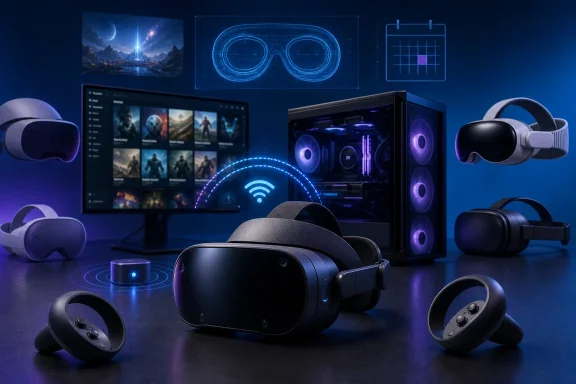 Steam Frame is close, but key details remain unresolved
VR.org reports that Steam Frame uses dual 2160×2160 displays, Qualcomm’s Snapdragon 8 Gen 3 platform and 16GB of memory, alongside a 6GHz wireless dongle intended to reduce latency when streaming from a PC. The site also points to Valve’s “Great on Frame” compatibility material as a sign that software preparation is advancing.None of that answers the two purchasing questions that matter most: availability and price. Estimates cited by VR.org range from $899 to $1,199, but Valve has not confirmed either figure. Buyers should treat the summer timing as a release window, not an appointment.
That distinction is important for Windows PC VR users weighing an upgrade from a Valve Index, Rift-era headset or first-generation Windows Mixed Reality hardware. Steam Frame’s streaming-first approach means real-world results will depend heavily on the gaming PC, network conditions and the maturity of its compatibility program, not simply panel resolution or onboard specifications.
The 2026 hardware that is already real
The guide also separates products currently available from the usual long-range XR rumor cycle. Samsung’s Galaxy XR is on sale from $1,799, according to Google and Samsung, as the first commercial Android XR headset. It offers eye and hand tracking and leans into Google’s Gemini features, but it is not a Windows-native PC VR replacement.Apple’s M5-equipped Vision Pro remains available from $3,699 in the United States, per Apple. Its refreshed processor and existing micro-OLED displays keep it positioned around media, work and spatial-computing applications rather than conventional SteamVR gaming.
Bigscreen Beyond 2 is the enthusiast PC VR alternative in the current market. VR.org lists it at $1,019 and emphasizes its ultralight, custom-fit design. That makes it a more immediate option for users who value a compact tethered headset and already have the graphics hardware to drive it.
Do not buy around unconfirmed road maps
Pico’s Project Swan and Meta Quest 4 should not hold up a purchase decision. VR.org characterizes the former’s specifications and timing as reported rather than confirmed, while its Quest 4 outlook points to the second half of 2027 or later. Meta’s current choices remain Quest 3 and Quest 3S.For Windows users who need a headset now, the practical choice is between buying established PC VR hardware or waiting specifically for Valve to publish Steam Frame’s final price and date.
References
- Primary source: vr.org
Published: 2026-06-04T00:00:00+00:00
Loading…
vr.org