

Nvidia’s next Vera Rubin AI platform is expected to make it one of the first major deployments of HBM4, the new high-bandwidth stacked memory technology. SK hynix has reportedly secured about 70% of Nvidia’s HBM4 allocation for Rubin, according to Yonhap News Agency, a larger share than earlier industry estimates of roughly 50%.
The reported split matters to the AI supply chain, but crypto miners should not mistake it for a new source of mining hardware. Rubin is a datacenter AI platform built around expensive, tightly integrated accelerators and HBM4 memory—not a successor to consumer GeForce cards.
SK hynix said in September 2025 that it had completed HBM4 development and was preparing mass production. Nvidia and SK hynix then announced a multiyear technology partnership on June 8, 2026, covering next-generation memory co-development and supply planning for Nvidia’s AI roadmap, including Vera Rubin systems.
Nvidia is not relying on only one vendor. Samsung and Micron are also qualified HBM4 suppliers for Vera Rubin, with Micron separately announcing volume shipments of its 36GB 12-high HBM4 product for the platform earlier this year. But a 70% allocation would leave SK hynix as Nvidia’s dominant supplier during the initial Rubin ramp.
HBM4 is not ordinary graphics memory. It uses vertically stacked DRAM connected through wide interfaces, trading ease of manufacture for immense bandwidth and compact packaging. Nvidia’s technical materials describe a Rubin GPU with 288GB of HBM4, aimed at training and inference workloads that need to keep enormous models and data sets moving.
The indirect effect is the more relevant one: AI infrastructure is locking up advanced memory capacity, packaging capacity, and engineering attention for years rather than quarters. Nvidia’s agreement with SK hynix is a sign that leading vendors increasingly treat memory supply as a strategic constraint, not a component purchased late in a product cycle.
That can influence the broader GPU market in two ways. First, strong AI demand may keep component and manufacturing capacity focused on high-margin datacenter products, reducing the incentive to flood the market with cheaper compute hardware. Second, a disruption at SK hynix would have outsized consequences for Nvidia’s Rubin volumes because one supplier reportedly holds most of the allocation.
For Windows users and IT teams, the immediate relevance is limited to organizations budgeting for AI infrastructure: Rubin availability and pricing will depend as much on HBM4 supply as on Nvidia’s GPU production.
The reported split matters to the AI supply chain, but crypto miners should not mistake it for a new source of mining hardware. Rubin is a datacenter AI platform built around expensive, tightly integrated accelerators and HBM4 memory—not a successor to consumer GeForce cards.
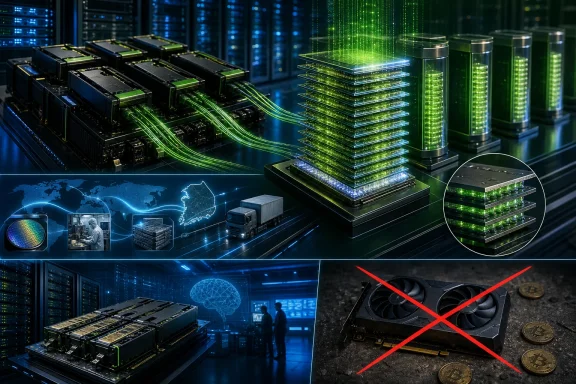 SK hynix tightens its lead
SK hynix said in September 2025 that it had completed HBM4 development and was preparing mass production. Nvidia and SK hynix then announced a multiyear technology partnership on June 8, 2026, covering next-generation memory co-development and supply planning for Nvidia’s AI roadmap, including Vera Rubin systems.Nvidia is not relying on only one vendor. Samsung and Micron are also qualified HBM4 suppliers for Vera Rubin, with Micron separately announcing volume shipments of its 36GB 12-high HBM4 product for the platform earlier this year. But a 70% allocation would leave SK hynix as Nvidia’s dominant supplier during the initial Rubin ramp.
HBM4 is not ordinary graphics memory. It uses vertically stacked DRAM connected through wide interfaces, trading ease of manufacture for immense bandwidth and compact packaging. Nvidia’s technical materials describe a Rubin GPU with 288GB of HBM4, aimed at training and inference workloads that need to keep enormous models and data sets moving.
Why miners should care—indirectly
For most miners, the direct effect is close to zero. Consumer GPUs use GDDR memory, and the economics of proof-of-work mining are governed far more by power prices, network difficulty, hardware efficiency, and coin prices than by HBM4 availability. No miner should expect a Rubin accelerator to become a practical mining product, let alone a retail purchase.The indirect effect is the more relevant one: AI infrastructure is locking up advanced memory capacity, packaging capacity, and engineering attention for years rather than quarters. Nvidia’s agreement with SK hynix is a sign that leading vendors increasingly treat memory supply as a strategic constraint, not a component purchased late in a product cycle.
That can influence the broader GPU market in two ways. First, strong AI demand may keep component and manufacturing capacity focused on high-margin datacenter products, reducing the incentive to flood the market with cheaper compute hardware. Second, a disruption at SK hynix would have outsized consequences for Nvidia’s Rubin volumes because one supplier reportedly holds most of the allocation.
For Windows users and IT teams, the immediate relevance is limited to organizations budgeting for AI infrastructure: Rubin availability and pricing will depend as much on HBM4 supply as on Nvidia’s GPU production.
References
- Primary source: Crypto Briefing
Published: 2026-07-18T10:19:57+00:00
Nvidia locks in as first customer for HBM4 memory, and here's why crypto miners should care
Nvidia will be the first customer for HBM4 memory, with SK Hynix capturing 70% of orders. Here's what it means for crypto GPU infrastructure.cryptobriefing.com - Related coverage: techtimes.com
Nvidia Vera Rubin Enters Full Production: Samsung, SK Hynix, Micron Named HBM4 Suppliers
Nvidia Vera Rubin is now in full production, with Samsung, SK hynix, and Micron confirmed as HBM4 memory suppliers at the GTC Taipei 2026 keynote. Korean AI stocks surged as Jensen Huang plans towww.techtimes.com - Related coverage: trendforce.com
[News] SK hynix Reportedly to Supply About Two-Thirds of NVIDIA HBM4; Samsung Targets Early Delivery
Competition over next-generation HBM4 is intensifying, with SK hynix and Samsung Electronics positioning for future supply to NVIDIA’s upcoming AI pla...www.trendforce.com - Related coverage: tomshardware.com
Nvidia and SK hynix ink multi-year memory co-development and supply agreement — seeks to address extended development cycles | Tom's Hardware
Nvidia and SK hynix tighten their relationship.www.tomshardware.com - Related coverage: souldriver.com.au
- Related coverage: investors.micron.com