

Estonia is not giving AI agents citizenship. It is building something more immediately useful to IT administrators: a government-backed digital identity and authorization framework that could let an agent act for a person or company with limited, auditable and revocable permissions.
That distinction matters. In the June 30 episode of The Hedgineer Podcast, “Gone Looping,” hosts Michael Watson and Jhanvi Virani pointed to Estonia’s policy as part of a wider shift toward agent-native infrastructure. Estonia’s government had already announced the plan on June 17, 2026, saying it would develop “AI ID codes” for agents that need to prepare documents, interact with information systems or make narrowly bounded transactions.
For Windows administrators and security teams, this is less a far-off public-policy curiosity than a preview of a problem already arriving in Microsoft 365, Power Platform, Azure and enterprise endpoint environments: an agent cannot safely inherit the full identity of the employee who launched it.
Estonia’s proposal is built around delegated authority. An AI agent could be authorized to view data, draft a declaration, prepare a payment or work within a specific financial ceiling, according to Prime Minister Kristen Michal’s office. The intended design is explicitly not “give Copilot-style assistant everything the user can access and hope the logs explain what happened later.”
That is a familiar failure mode in enterprise AI deployments. A user-facing agent may need to read SharePoint content, search Exchange mailboxes, query a line-of-business application and create a ticket in ServiceNow. If it operates under the employee’s own session and permissions, the agent has a dangerously broad effective identity. A prompt-injection attack, a compromised connector or an overly eager workflow can turn that convenience into data exposure or unauthorized action.
Estonia’s Information System Authority, known as RIA, is framing its Reason Reserve—or Aruait—project as an “Identity 2.0” framework for machines. The program calls for a central trust registry for public- and private-sector agents, technical interoperability standards and at least one end-to-end pilot in which a public-sector agent deals with an agent representing a citizen or private organization without a human manually completing every step.
The project has a 24-month duration and a €1 million budget. That makes it important to keep the announcement in proportion: Estonia has not rolled out a universal production ID system for AI agents, and it has not created a new legal personhood category for models. It has committed to designing the technical and legal foundation for tightly scoped digital delegation.
An agent identity should therefore answer several operational questions before it touches a Windows domain, Microsoft Graph tenant, cloud subscription or internal application:
That requirement becomes sharper in Windows-heavy organizations using Copilot Studio agents, Azure AI services, Power Automate flows and custom tools exposed through Model Context Protocol servers. The convenience layer increasingly connects an LLM to email, files, collaboration data, scripts and administrative APIs. The identity layer cannot remain an afterthought.
That sounds mundane, but it addresses a major visibility problem. If a Microsoft 365 agent reads a confidential document, summarizes it in Teams and then creates a task in an external SaaS platform, a useful audit record must distinguish among several actors:
This is where agent identity intersects with prompt injection. The most dangerous agent deployments combine three conditions: access to untrusted content, access to sensitive resources and the ability to send data or trigger actions externally. An identity system does not make prompt injection disappear. What it can do is ensure the injected workflow runs into hard permission boundaries before it reaches a mailbox, credential store, payment system or production tenant.
That distinction will be central to Estonia’s pilot work. An agent can be correctly identified and still be tricked by malicious web content, manipulated through a poisoned knowledge base, granted excessive access or routed through a vulnerable connector. Its underlying model may change behavior after an update even while its assigned identity remains the same.
The hard technical questions are also unresolved. What precisely defines an agent for registration purposes: the model, the prompt, its tool list, the organization deploying it, or a single runtime session? How are software updates handled? Can an agent delegate to a sub-agent, and if so, how is the delegation chain bounded and recorded? What happens when an agent performs an action across national or cloud-service boundaries?
RIA’s project recognizes that the answer is not merely a database of names. Its planned trust registry, interoperable standards and legal proposals amount to an effort to create an agent control plane. Whether that becomes a European model or remains an Estonian digital-government experiment will depend on whether it can work with existing enterprise identity platforms rather than replace them.
The immediate architectural move is to stop treating an AI agent as a transparent extension of the person using it. Give it a separate workload identity. Scope its Microsoft Graph and business-application permissions to the smallest viable set. Require explicit approval or step-up authentication for high-impact actions such as changing permissions, exporting sensitive content, initiating payments or modifying production infrastructure.
Security teams should also inventory the non-obvious agents already present in the environment. That includes Power Automate flows with AI actions, Copilot Studio agents, browser automation, GitHub or Azure DevOps bots, Teams-connected assistants and third-party SaaS agents holding OAuth grants. The agent that has no owner, no policy record and no clear revocation path is the one most likely to turn an ordinary automation failure into a security incident.
Estonia’s plan will not solve that problem for the rest of the world. But it puts the right question on the table: as agents become capable of acting rather than merely advising, enterprise identity must evolve from proving who logged in to governing what autonomous software may do on someone else’s behalf.
That distinction matters. In the June 30 episode of The Hedgineer Podcast, “Gone Looping,” hosts Michael Watson and Jhanvi Virani pointed to Estonia’s policy as part of a wider shift toward agent-native infrastructure. Estonia’s government had already announced the plan on June 17, 2026, saying it would develop “AI ID codes” for agents that need to prepare documents, interact with information systems or make narrowly bounded transactions.
For Windows administrators and security teams, this is less a far-off public-policy curiosity than a preview of a problem already arriving in Microsoft 365, Power Platform, Azure and enterprise endpoint environments: an agent cannot safely inherit the full identity of the employee who launched it.
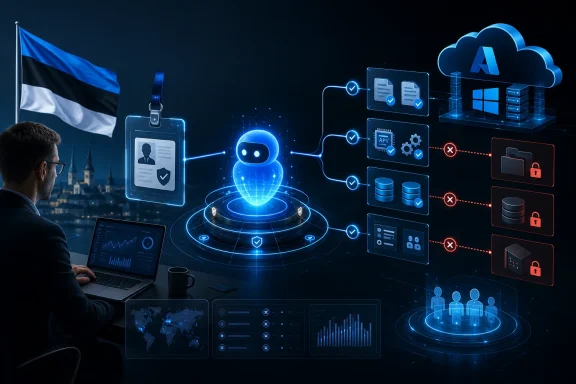 Estonia Is Trying to Separate Delegation From Full Account Access
Estonia’s proposal is built around delegated authority. An AI agent could be authorized to view data, draft a declaration, prepare a payment or work within a specific financial ceiling, according to Prime Minister Kristen Michal’s office. The intended design is explicitly not “give Copilot-style assistant everything the user can access and hope the logs explain what happened later.”That is a familiar failure mode in enterprise AI deployments. A user-facing agent may need to read SharePoint content, search Exchange mailboxes, query a line-of-business application and create a ticket in ServiceNow. If it operates under the employee’s own session and permissions, the agent has a dangerously broad effective identity. A prompt-injection attack, a compromised connector or an overly eager workflow can turn that convenience into data exposure or unauthorized action.
Estonia’s Information System Authority, known as RIA, is framing its Reason Reserve—or Aruait—project as an “Identity 2.0” framework for machines. The program calls for a central trust registry for public- and private-sector agents, technical interoperability standards and at least one end-to-end pilot in which a public-sector agent deals with an agent representing a citizen or private organization without a human manually completing every step.
The project has a 24-month duration and a €1 million budget. That makes it important to keep the announcement in proportion: Estonia has not rolled out a universal production ID system for AI agents, and it has not created a new legal personhood category for models. It has committed to designing the technical and legal foundation for tightly scoped digital delegation.
The Real Security Benefit Is a Smaller Blast Radius
The key idea is not mysterious. Enterprises have used service accounts, managed identities, OAuth scopes, role-based access control and just-in-time privilege for years. AI agents make those controls more urgent because they are built to interpret untrusted natural-language content and then take actions.An agent identity should therefore answer several operational questions before it touches a Windows domain, Microsoft Graph tenant, cloud subscription or internal application:
- The organization should be able to identify the human, team or business process that authorized the agent.
- The agent should receive only the permissions required for a defined task, rather than a cloned version of its owner’s access.
- Every material action should be attributable to the agent, its delegation chain and its active policy.
- The organization should be able to revoke the agent’s authority immediately without disabling the employee’s own account.
That requirement becomes sharper in Windows-heavy organizations using Copilot Studio agents, Azure AI services, Power Automate flows and custom tools exposed through Model Context Protocol servers. The convenience layer increasingly connects an LLM to email, files, collaboration data, scripts and administrative APIs. The identity layer cannot remain an afterthought.
Audit Trails Need More Than “The User Did It”
Estonia’s digital-government experience gives it an advantage here. The country already has national digital identity, electronic signatures and data-exchange infrastructure in the form of X-Road. Its proposal extends the same basic administrative question into agent systems: who acted, on whose behalf, with which rights, and who remains accountable?That sounds mundane, but it addresses a major visibility problem. If a Microsoft 365 agent reads a confidential document, summarizes it in Teams and then creates a task in an external SaaS platform, a useful audit record must distinguish among several actors:
- The employee who requested or approved the task.
- The specific agent instance that planned and executed it.
- The model and tools used during the run.
- The policy that allowed each access and outbound action.
- The destination identity that received the result.
This is where agent identity intersects with prompt injection. The most dangerous agent deployments combine three conditions: access to untrusted content, access to sensitive resources and the ability to send data or trigger actions externally. An identity system does not make prompt injection disappear. What it can do is ensure the injected workflow runs into hard permission boundaries before it reaches a mailbox, credential store, payment system or production tenant.
The Registry Must Not Become a False Sense of Safety
A registered identity is not evidence that an agent is trustworthy, secure or well configured. It is evidence that the organization has a way to recognize it and attach policy to it.That distinction will be central to Estonia’s pilot work. An agent can be correctly identified and still be tricked by malicious web content, manipulated through a poisoned knowledge base, granted excessive access or routed through a vulnerable connector. Its underlying model may change behavior after an update even while its assigned identity remains the same.
The hard technical questions are also unresolved. What precisely defines an agent for registration purposes: the model, the prompt, its tool list, the organization deploying it, or a single runtime session? How are software updates handled? Can an agent delegate to a sub-agent, and if so, how is the delegation chain bounded and recorded? What happens when an agent performs an action across national or cloud-service boundaries?
RIA’s project recognizes that the answer is not merely a database of names. Its planned trust registry, interoperable standards and legal proposals amount to an effort to create an agent control plane. Whether that becomes a European model or remains an Estonian digital-government experiment will depend on whether it can work with existing enterprise identity platforms rather than replace them.
Microsoft Environments Already Have the Building Blocks
Windows and Azure shops do not need to wait for a national registry to adopt the underlying discipline. Entra ID workload identities, managed identities, Conditional Access, Privileged Identity Management, Microsoft Purview auditing and Defender telemetry already provide pieces of the model.The immediate architectural move is to stop treating an AI agent as a transparent extension of the person using it. Give it a separate workload identity. Scope its Microsoft Graph and business-application permissions to the smallest viable set. Require explicit approval or step-up authentication for high-impact actions such as changing permissions, exporting sensitive content, initiating payments or modifying production infrastructure.
Security teams should also inventory the non-obvious agents already present in the environment. That includes Power Automate flows with AI actions, Copilot Studio agents, browser automation, GitHub or Azure DevOps bots, Teams-connected assistants and third-party SaaS agents holding OAuth grants. The agent that has no owner, no policy record and no clear revocation path is the one most likely to turn an ordinary automation failure into a security incident.
Estonia’s plan will not solve that problem for the rest of the world. But it puts the right question on the table: as agents become capable of acting rather than merely advising, enterprise identity must evolve from proving who logged in to governing what autonomous software may do on someone else’s behalf.
References
- Primary source: finance.biggo.com
Published: 2026-07-18T09:10:19.897509
Loading…
finance.biggo.com