

Anthropic has published a practical taxonomy for “loop engineering” in Claude Code, framing autonomous AI work not as a single prompt but as repeated agent actions governed by explicit stopping conditions. The company’s June 30 post identifies four loop types: turn-based, goal-based, time-based, and proactive.
The announcement is more a workflow guide than a major product launch. But it formalizes features and patterns that matter to developers and IT teams experimenting with coding agents that can run tests, monitor pull requests, process feedback, and make routine repository changes with reduced supervision.
Turn-based loops are the familiar interactive model: a user sends a prompt, Claude acts, checks its work where possible, and stops for the next instruction. Anthropic recommends encoding repeatable checks in
Goal-based loops use the
Time-based loops cover recurring checks. Anthropic says
Proactive loops combine schedules, goal checks, skills, agent workflows, and automatic permissions for longer-running, unattended work. Anthropic positions these for well-defined streams such as bug triage, dependency upgrades, migrations, and incoming feedback—not broad, open-ended development work.
Those controls address the two obvious failure modes: an agent that spends excessively while chasing an ambiguous task, and an agent that makes changes beyond its intended scope. Anthropic advises users to set measurable completion criteria, pilot a workflow on a small sample, use scripts for deterministic work, and avoid polling external systems more often than necessary.
For Windows developers, the approach maps neatly to existing operational habits: scheduled tasks, CI gates, test suites, PowerShell scripts, and least-privilege access. Claude Code’s Windows installation instructions use PowerShell, but the new loop model does not introduce a Windows-specific automation subsystem.
Teams considering these workflows should start with a bounded job—such as checking a test suite, summarizing a queue, or triaging a narrowly scoped issue type—and require machine-verifiable completion before granting broader access.
The announcement is more a workflow guide than a major product launch. But it formalizes features and patterns that matter to developers and IT teams experimenting with coding agents that can run tests, monitor pull requests, process feedback, and make routine repository changes with reduced supervision.
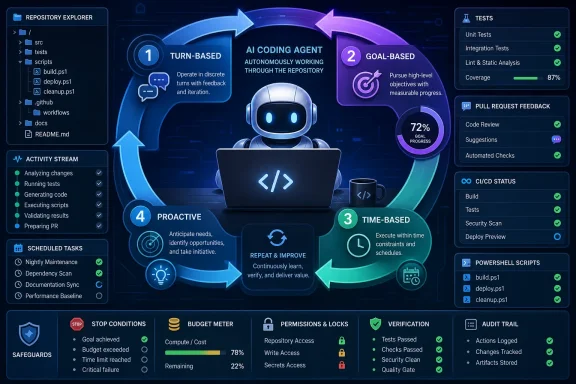 Four ways Claude Code can keep working
Turn-based loops are the familiar interactive model: a user sends a prompt, Claude acts, checks its work where possible, and stops for the next instruction. Anthropic recommends encoding repeatable checks in SKILL.md files so the agent can perform more verification itself rather than relying on a human reviewer after every turn.Goal-based loops use the
/goal command to make completion measurable. A prompt can set a concrete standard and a maximum number of attempts, such as reaching a specified Lighthouse score within five tries. When Claude attempts to stop, an evaluator checks whether the requirement was met and sends the task back for another pass if it was not.Time-based loops cover recurring checks. Anthropic says
/loop reruns a prompt on a local interval, while /schedule moves recurring jobs to the cloud so they can continue after the local machine is shut down. The intended use cases include monitoring pull-request feedback, checking CI failures, and generating regular summaries.Proactive loops combine schedules, goal checks, skills, agent workflows, and automatic permissions for longer-running, unattended work. Anthropic positions these for well-defined streams such as bug triage, dependency upgrades, migrations, and incoming feedback—not broad, open-ended development work.
Controls matter more than autonomy
The important detail for admins is that Anthropic’s own guidance repeatedly emphasizes verification, cost limits, and permissions. Per the Claude Code Agent SDK documentation, the underlying agent loop evaluates a prompt, calls tools, consumes the results, and repeats until it produces a response without tool calls. The SDK can also enforce maximum tool-use turns and a maximum dollar budget.Those controls address the two obvious failure modes: an agent that spends excessively while chasing an ambiguous task, and an agent that makes changes beyond its intended scope. Anthropic advises users to set measurable completion criteria, pilot a workflow on a small sample, use scripts for deterministic work, and avoid polling external systems more often than necessary.
For Windows developers, the approach maps neatly to existing operational habits: scheduled tasks, CI gates, test suites, PowerShell scripts, and least-privilege access. Claude Code’s Windows installation instructions use PowerShell, but the new loop model does not introduce a Windows-specific automation subsystem.
Teams considering these workflows should start with a bounded job—such as checking a test suite, summarizing a queue, or triaging a narrowly scoped issue type—and require machine-verifiable completion before granting broader access.
References
- Primary source: KuCoin
Published: 2026-07-17T01:15:08+00:00
Claude Code Officially Introduces Four Types of Loops for Autonomous AI Workflows | KuCoin
The real threshold of cycling isn't about keeping the AI running continuously, but whether it can stop itself."No more writing prompts"—recently, this phrase hawww.kucoin.com - Official source: support.claude.com
Claude Code power user tips | Claude Help Center
support.claude.com
- Official source: claude.com
Loop engineering: Getting started with loops | Claude by Anthropic
Loop engineering with Anthropic's Claude Code: design turn-based, goal, time, and proactive agent loops that run to a stop condition. claude.com
- Official source: code.claude.com
How the agent loop works - Claude Code Docs
Understand the message lifecycle, tool execution, context window, and architecture that power your SDK agents.code.claude.com