

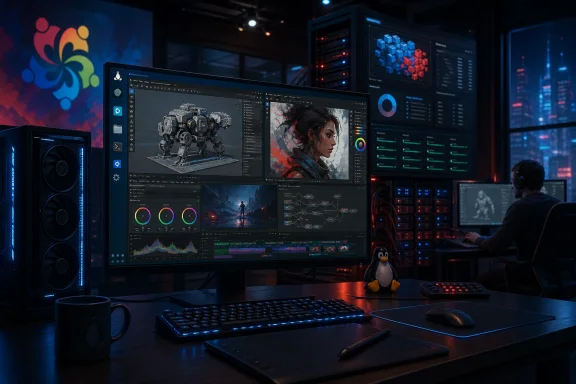
AlmaLinux used its July 18 AlmaLinux Day: Los Angeles event to introduce a Media & Entertainment edition aimed at animation, VFX, and render-farm deployments that once relied on CentOS Linux. The edition combines AlmaLinux 10, KDE Plasma, and a curated set of open-source media tools, with the project pitching it as a deployable base for artist workstations as well as studio infrastructure.
According to the AlmaLinux event agenda, the new build is paired with the AlmaLinux Creative Installer, an open-source utility from the project’s Media & Entertainment SIG. It installs more than 30 creative applications and desktop tweaks without requiring terminal use. The listed software includes Blender, DaVinci Resolve, Krita, GIMP, Inkscape, FreeCAD, Kdenlive, OBS Studio, Ardour, and Audacity.
That is a notable attempt to package enterprise Linux for smaller studios, freelancers, and students rather than expecting them to assemble a production desktop from repositories and third-party instructions. AlmaLinux says the installer is community-built and is moving toward a Qt-based GUI, which should make it easier to support additional desktop environments and package sets.
AlmaLinux is a community-run, RHEL-compatible distribution created after Red Hat ended the conventional CentOS Linux release model in late 2020. VFX facilities were among the users most affected: pipeline software, GPU drivers, render managers, and proprietary creative applications tend to be validated against specific operating-system releases, making surprise platform shifts expensive.
The new M&E edition does not change the basic AlmaLinux proposition for server administrators. Its value is in the opinionated desktop layer: KDE Plasma, creative applications, and a starting point intended for studios that want to derive their own images for mass deployment. AlmaLinux’s workshop material specifically describes tailoring the official deliverable to a facility’s hardware and software requirements.
The Academy Software Foundation’s newly launched Wayland for Artists Working Group was presented at the event precisely because the impact on professional content-creation software and remote workflows is not fully mapped. AlmaLinux also previewed Amazon DCV on the newer Linux desktop stack, but that should not be read as general availability: AWS’s current DCV documentation still says Linux DCV does not support Wayland and instructs administrators to disable it.
For Windows admins supporting mixed environments, the practical distinction is familiar: the installer may simplify a Linux creative workstation, but it does not remove the need to validate GPU drivers, color workflows, proprietary applications, and remote-desktop tooling before standardizing on AlmaLinux 10.
Studios considering the edition should test it as a workstation image first and keep existing remote-access platforms in scope before migrating production artists to Wayland.
According to the AlmaLinux event agenda, the new build is paired with the AlmaLinux Creative Installer, an open-source utility from the project’s Media & Entertainment SIG. It installs more than 30 creative applications and desktop tweaks without requiring terminal use. The listed software includes Blender, DaVinci Resolve, Krita, GIMP, Inkscape, FreeCAD, Kdenlive, OBS Studio, Ardour, and Audacity.
That is a notable attempt to package enterprise Linux for smaller studios, freelancers, and students rather than expecting them to assemble a production desktop from repositories and third-party instructions. AlmaLinux says the installer is community-built and is moving toward a Qt-based GUI, which should make it easier to support additional desktop environments and package sets.
 A CentOS replacement, with a workstation focus
AlmaLinux is a community-run, RHEL-compatible distribution created after Red Hat ended the conventional CentOS Linux release model in late 2020. VFX facilities were among the users most affected: pipeline software, GPU drivers, render managers, and proprietary creative applications tend to be validated against specific operating-system releases, making surprise platform shifts expensive.The new M&E edition does not change the basic AlmaLinux proposition for server administrators. Its value is in the opinionated desktop layer: KDE Plasma, creative applications, and a starting point intended for studios that want to derive their own images for mass deployment. AlmaLinux’s workshop material specifically describes tailoring the official deliverable to a facility’s hardware and software requirements.
Wayland remains the hard part
The more consequential technical issue is the move to AlmaLinux 10. As AlmaLinux noted in its event material, Enterprise Linux 10 removes the traditional Xorg server, leaving Xwayland as the compatibility component for older X11 applications. That matters less for a local Blender or Krita install than for remote artist workstations, where X11-era display and remote-access assumptions are still common.The Academy Software Foundation’s newly launched Wayland for Artists Working Group was presented at the event precisely because the impact on professional content-creation software and remote workflows is not fully mapped. AlmaLinux also previewed Amazon DCV on the newer Linux desktop stack, but that should not be read as general availability: AWS’s current DCV documentation still says Linux DCV does not support Wayland and instructs administrators to disable it.
For Windows admins supporting mixed environments, the practical distinction is familiar: the installer may simplify a Linux creative workstation, but it does not remove the need to validate GPU drivers, color workflows, proprietary applications, and remote-desktop tooling before standardizing on AlmaLinux 10.
Studios considering the edition should test it as a workstation image first and keep existing remote-access platforms in scope before migrating production artists to Wayland.
References
- Primary source: Tech Times
Published: 2026-07-18T23:10:58+00:00
AlmaLinux Launches VFX Edition Today, Filling CentOS Gap With No-Terminal Creative Installer
AlmaLinux Media Entertainment Edition debuts today at AlmaLinux Day: Los Angeles, giving VFX studios and animation pipelines a free enterprise Linux platform on AlmaLinux 10 with a one-click Creativewww.techtimes.com