

NVIDIA’s GeForce GTX 1060 reached its 10th anniversary on July 19, marking a rare run for a midrange graphics card that became the defining GPU of the late-2010s Steam PC. Launched in 2016 at $249 for partner cards and $299 for NVIDIA’s Founders Edition, the Pascal-based card paired near-flagship performance with a price that made it a default choice for mainstream gaming builds.
NVIDIA marketed the original 6GB GTX 1060 as delivering GeForce GTX 980-class performance for less than half of the older card’s $549 launch price. Its reference specifications—1,280 CUDA cores, 6GB of 8Gbps GDDR5 on a 192-bit bus, a 1,708MHz boost clock, and a 120W power rating—made it an unusually straightforward upgrade for Windows gaming PCs with a single six-pin PCIe power lead.
As reported by VideoCardz, the GTX 1060 became the most common GPU recorded by Valve’s Steam Hardware Survey in December 2017 and held that position through October 2022: 59 consecutive monthly surveys, or four years and 11 months.
That run ended in the November 2022 survey, when the GeForce GTX 1650 moved to first place with a 6.27% share, ahead of the GTX 1060’s 5.77%. The figure reflects the broad “GTX 1060” category used by Steam rather than one precise board configuration, which matters because NVIDIA and its partners produced a wide range of desktop and mobile variants.
The card’s longevity was not solely about the original 6GB model. NVIDIA released a $199 3GB GTX 1060 a month later, but it was more than a memory reduction: it used 1,152 CUDA cores rather than 1,280. Later variants included a 9Gbps 6GB model, a China-focused 5GB version with a narrower memory bus, a 6GB GDDR5X version, and the display-less P106-100 mining card. That breadth helped keep the 1060 name in systems—and in Steam’s survey—long after launch.
More importantly for Windows users, NVIDIA ended regular Game Ready driver support for Pascal-generation GeForce cards in October 2025. Per NVIDIA’s support plan, Pascal products including the GTX 1060 will receive only critical security-driver updates through October 2028, not new game optimizations, feature additions, or routine bug fixes.
GTX 1060 owners should install NVIDIA’s available security updates and treat the card as a legacy gaming component when planning future Windows game upgrades.
NVIDIA marketed the original 6GB GTX 1060 as delivering GeForce GTX 980-class performance for less than half of the older card’s $549 launch price. Its reference specifications—1,280 CUDA cores, 6GB of 8Gbps GDDR5 on a 192-bit bus, a 1,708MHz boost clock, and a 120W power rating—made it an unusually straightforward upgrade for Windows gaming PCs with a single six-pin PCIe power lead.
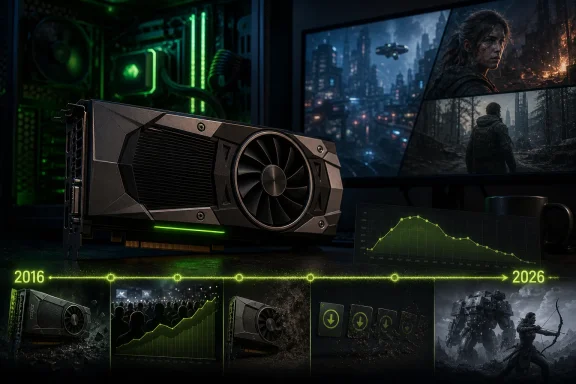 Five years at the top of Steam
As reported by VideoCardz, the GTX 1060 became the most common GPU recorded by Valve’s Steam Hardware Survey in December 2017 and held that position through October 2022: 59 consecutive monthly surveys, or four years and 11 months.That run ended in the November 2022 survey, when the GeForce GTX 1650 moved to first place with a 6.27% share, ahead of the GTX 1060’s 5.77%. The figure reflects the broad “GTX 1060” category used by Steam rather than one precise board configuration, which matters because NVIDIA and its partners produced a wide range of desktop and mobile variants.
The card’s longevity was not solely about the original 6GB model. NVIDIA released a $199 3GB GTX 1060 a month later, but it was more than a memory reduction: it used 1,152 CUDA cores rather than 1,280. Later variants included a 9Gbps 6GB model, a China-focused 5GB version with a narrower memory bus, a 6GB GDDR5X version, and the display-less P106-100 mining card. That breadth helped keep the 1060 name in systems—and in Steam’s survey—long after launch.
A milestone, not a return to relevance
The GTX 1060 remains capable of running older and less demanding PC games, but its status in 2026 is materially different. The 6GB version is constrained by modern texture and memory demands, while the 3GB version is far more limited. Neither supports hardware ray tracing or NVIDIA’s DLSS upscaling features introduced with RTX hardware.More importantly for Windows users, NVIDIA ended regular Game Ready driver support for Pascal-generation GeForce cards in October 2025. Per NVIDIA’s support plan, Pascal products including the GTX 1060 will receive only critical security-driver updates through October 2028, not new game optimizations, feature additions, or routine bug fixes.
GTX 1060 owners should install NVIDIA’s available security updates and treat the card as a legacy gaming component when planning future Windows game upgrades.
References
- Primary source: videocardz.com
Published: 2026-07-19T18:35:13+00:00
- Related coverage: notebookcheck.net
NVIDIA GeForce GTX 1650 overtakes GeForce GTX 1060 as most popular GPU in Steam November 2022 hardware survey - Notebookcheck News
A new graphics card has risen to the top of Steam's latest hardware survey. Surprisingly, the GeForce GTX 1650 now ranks as the most used graphics card on Steam, despite the plethora of graphics cards that NVIDIA has released since. NVIDIA still dominates though, with its mid-range cards... www.notebookcheck.net