

Perplexity’s brief life inside WhatsApp demonstrated how powerful an AI assistant can become when it meets users in an app they already open dozens of times a day. Launched in April 2025 as a phone-number-based service requiring no separate account, the assistant delivered web-backed answers, checked forwarded claims, interpreted voice notes, generated images, and eventually scheduled reminders. Its disappearance on January 15, 2026, following Meta’s restrictions on general-purpose AI providers, turned a convenient product experiment into a much larger dispute about platform control, competition, and who gets to define the future of messaging-based AI.
Perplexity on WhatsApp was essentially a compact version of the company’s answer engine placed inside an ordinary one-to-one conversation. Users saved the US number +1 (833) 436-3285, opened WhatsApp, and submitted questions as if they were texting another person.
There was no separate Perplexity installation, conventional onboarding process, or mandatory account creation. That simplicity was the product’s most important feature because it removed nearly every obstacle between having a question and consulting an AI system.
The WhatsApp integration compressed that workflow into a familiar chat interface. It did not offer the full research environment of Perplexity’s website, but it brought the service to people who might never install a dedicated AI application.
Its original availability ended on January 15, 2026, when revised WhatsApp Business Solution terms took effect for existing providers. Those rules prevented AI companies from using WhatsApp’s business infrastructure when a general-purpose AI assistant was the primary service being delivered.
That distinction matters. Meta did not prohibit all uses of artificial intelligence on WhatsApp. Businesses could still use AI for customer support, bookings, order tracking, sales assistance, and other defined commercial processes; what Meta restricted was the use of its infrastructure as a distribution channel for open-ended rival assistants.
Embedding AI in that environment could expose web search and generative tools to people who would not independently seek out Perplexity. It also reduced the storage, device-performance, and digital-literacy barriers associated with installing another application.
That continuity made the assistant useful for quick, iterative research. However, it should not be confused with durable account-based memory: the conversation existed in the WhatsApp chat, but it did not become a synchronized Perplexity research history available across the company’s other products.
The process offered several advantages:
It was less suitable for complex investigations requiring dozens of sources, long tables, extensive calculations, or carefully structured reports. Perplexity’s dedicated Research mode and desktop interface provided more space, controls, and visibility for those tasks.
This limitation weakened one of Perplexity’s biggest differentiators. A source is useful only if the user can identify it, open it, and understand which part of the answer it supports.
That turned fact-checking into a simple behavioral loop:
Language support was not the same as equal source coverage, however. The quality of results depended on how much reliable, indexed material existed for the claim and language concerned. Local rumors could be difficult to verify when authoritative coverage was scarce.
Perplexity was therefore best used as a research accelerator rather than a final authority. Medical advice, election information, legal claims, financial warnings, and emergency notices still required confirmation from primary or expert sources.
Basic iterative changes were also possible. A user could request another style, alter colors, add an object, or simplify the composition without beginning an entirely new workflow.
The attraction was obvious: image generation was accessible from an interface millions of people already understood. It avoided model selectors, generation settings, and specialist creative software, making the feature approachable for casual experimentation.
That arrangement raised questions about sustainability. Generous features can help a service spread rapidly, but unrestricted usage through a messaging platform can create unpredictable infrastructure demand, abuse, and content-moderation work.
This was useful for accessibility and hands-busy situations, but it was not equivalent to a fully interactive voice assistant. There was no continuous spoken dialogue comparable to dedicated real-time voice modes, and transcription quality could decline with background noise, accents, specialist vocabulary, or poor microphones.
Voice notes nevertheless exposed an important principle: the easiest AI interface is often whichever input method the user already prefers. On WhatsApp, that might be typing, forwarding a screenshot, sharing a photograph, or holding down the microphone button.
This mattered because an answer engine normally waits for the user to return. Scheduling allowed the assistant to initiate a useful interaction later, transforming WhatsApp into a delivery channel for generated briefings.
Ambiguous phrases such as “tomorrow morning” could also create timezone or interpretation problems. For anything important, users needed to state the date, time, and timezone explicitly and verify that the assistant understood them.
This was a substantial weakness for fact-checking. Group conversations are exactly where a shared verification tool could have interrupted the rapid circulation of questionable claims.
Allowing an AI bot into groups would have created additional privacy and moderation concerns, however. Participants might not consent to having their messages processed by an external AI provider, while automated replies could become intrusive or be manipulated by adversarial prompts.
Screenshots could provide limited visual context, but a screenshot is not a substitute for a complete file. It may omit metadata, footnotes, formulas, hidden sheets, page order, or surrounding paragraphs necessary for accurate interpretation.
That made WhatsApp ideal for immediate questions but unsuitable as Perplexity’s definitive interface. The integration was a convenient doorway, not a full replacement for the web application.
Users could manually copy information, export a WhatsApp chat, or repeat the question elsewhere, but those workarounds defeated part of the convenience. Modern AI services increasingly depend on continuity across phone, browser, and PC, particularly for research that begins casually and becomes more involved.
This created an unusual inversion. The most frictionless interface could be the least connected to the customer relationship that funded the product.
The trade-off illustrates a recurring tension in consumer AI. Users want assistants to understand their preferences and continue tasks across devices, but those capabilities require persistent identity and broader data retention.
A retailer using AI to answer questions about returns could remain. An airline using a chatbot to help passengers find bookings could remain. A provider offering an assistant that could discuss almost any subject, generate content, perform research, and answer general questions could not use the platform in the same way.
The economics were also different. WhatsApp’s business pricing and operational model had not necessarily been designed to host a rival consumer AI product whose users might exchange long sequences of messages without conducting a business transaction.
Those are legitimate operational considerations, but they do not settle the competition question. A platform can face real infrastructure costs while also adopting rules that advantage its own adjacent product.
The result was difficult to ignore: Meta restricted rival general-purpose assistants while retaining its own. Even if infrastructure and pricing were genuine motivations, the policy also reduced consumer choice and strengthened Meta AI’s distribution advantage.
That order complicates any simple claim that the WhatsApp AI ban is final everywhere. The original shutdown occurred on January 15, but the regulatory position had materially changed by July 2026.
A legal obligation to reopen the platform does not automatically mean Perplexity’s old number has resumed service. Perplexity would still need to decide whether to relaunch, rebuild the integration, satisfy regional requirements, and support a product that Meta could eventually place under a new commercial structure.
The Brazilian proceedings highlighted another possibility: access might technically remain available but under pricing conditions that make large-scale assistants uneconomical. Competition authorities therefore had to consider both outright exclusion and discriminatory costs.
For Perplexity, WhatsApp offered distribution. For Meta, WhatsApp offered a strategic surface on which its own AI could become habitual. The collision was therefore almost inevitable.
For Windows users, this can be both positive and negative. Dedicated desktop apps offer richer features, better formatting, account synchronization, file handling, and operating-system integration. They also require users to maintain separate AI destinations instead of consulting multiple assistants from a common messaging client.
Perplexity faced a similar incentive. Losing WhatsApp reduced reach, but it also encouraged users to enter Perplexity’s own ecosystem, where the company could offer deeper research tools and build a direct customer relationship.
Windows users who need source comparison, PDF analysis, long-form output, or organized research are better served by the Perplexity website or desktop application. The WhatsApp service’s value lay in speed and familiarity, not superior desktop capability.
The effects were especially significant for users with limited device storage, older hardware, unreliable app-store access, or low willingness to create new accounts. In those circumstances, “just install the app” is not always a trivial alternative.
Compliant examples could include:
Enterprises should also avoid making WhatsApp their only automation channel. A policy change can disable a carefully developed workflow even when the underlying AI system continues to function perfectly.
A relaunch could also force Meta to define transparent technical and commercial requirements for general-purpose assistants. Predictable rules would be better for developers and users than a system in which first-party AI enjoys broad access while competitors depend on revocable exceptions.
Forwarding someone else’s message to an AI may also reveal that person’s name, photograph, phone number, medical information, workplace details, or location. Responsible use requires removing unnecessary identifying information before requesting analysis.
A user in one country could regain Perplexity access while another receives no response from the same contact. Providers might also delay a return until they can offer a coherent global product rather than a legally fragmented service.
It should also explain the limits of automated fact-checking and distinguish sourced findings from uncertain inference. The original service excelled at immediacy, but a future version would need to combine that speed with greater transparency and continuity.
Perplexity on WhatsApp succeeded because it made advanced AI feel ordinary: users asked a question, forwarded a rumor, dictated a voice note, requested an image, or scheduled a briefing without leaving a familiar conversation. Its shutdown exposed the weakness behind that convenience, because the most accessible interface belonged not to Perplexity but to a platform owner with its own competing assistant and the power to rewrite the rules. Whether Perplexity returns will depend on regulatory enforcement, commercial negotiations, and product strategy, but the broader lesson is already clear: the next phase of AI competition will be decided not only by which model gives the best answer, but also by which companies control the places where people are allowed to ask.
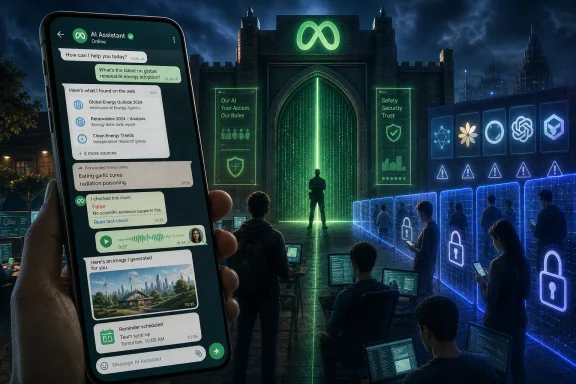 Overview
Perplexity on WhatsApp was essentially a compact version of the company’s answer engine placed inside an ordinary one-to-one conversation. Users saved the US number +1 (833) 436-3285, opened WhatsApp, and submitted questions as if they were texting another person.There was no separate Perplexity installation, conventional onboarding process, or mandatory account creation. That simplicity was the product’s most important feature because it removed nearly every obstacle between having a question and consulting an AI system.
From AI search engine to messaging contact
Perplexity built its reputation by combining large language models with live web retrieval. Instead of responding only from information encoded during model training, it searched for relevant material, synthesized the findings, and attached references that users could inspect.The WhatsApp integration compressed that workflow into a familiar chat interface. It did not offer the full research environment of Perplexity’s website, but it brought the service to people who might never install a dedicated AI application.
A short but revealing lifespan
The assistant appeared in late April 2025 and gained additional functions over the following months. Task scheduling and reminder support arrived in June, while image generation, voice-note handling, and multilingual fact-checking broadened the service beyond basic question answering.Its original availability ended on January 15, 2026, when revised WhatsApp Business Solution terms took effect for existing providers. Those rules prevented AI companies from using WhatsApp’s business infrastructure when a general-purpose AI assistant was the primary service being delivered.
That distinction matters. Meta did not prohibit all uses of artificial intelligence on WhatsApp. Businesses could still use AI for customer support, bookings, order tracking, sales assistance, and other defined commercial processes; what Meta restricted was the use of its infrastructure as a distribution channel for open-ended rival assistants.
Why WhatsApp Was Such an Important AI Channel
AI companies usually ask users to adopt a new destination: install an app, create an account, remember a password, accept permissions, and learn another interface. Perplexity reversed that relationship by placing its product inside an established communications habit.Frictionless access
The setup process was unusually short:- The user saved Perplexity’s WhatsApp number as a contact.
- The user opened a direct conversation with that contact.
- The user typed or recorded a question.
- Perplexity searched, generated an answer, and returned it in the same thread.
Reach beyond dedicated AI users
The strategy was particularly relevant in markets where WhatsApp functions as a primary digital platform rather than merely a messaging application. For many people, WhatsApp is already the interface for family communication, schools, local businesses, banking notifications, healthcare coordination, and government services.Embedding AI in that environment could expose web search and generative tools to people who would not independently seek out Perplexity. It also reduced the storage, device-performance, and digital-literacy barriers associated with installing another application.
The value of conversational continuity
A WhatsApp thread preserved enough conversational context for follow-up questions. A user could ask for an explanation, request a shorter version, challenge an assertion, or change the requested format without restating the entire subject.That continuity made the assistant useful for quick, iterative research. However, it should not be confused with durable account-based memory: the conversation existed in the WhatsApp chat, but it did not become a synchronized Perplexity research history available across the company’s other products.
Real-Time Answers and Web Sources
The assistant’s central capability was answering questions using current web information. This separated it from basic bots that depended on fixed scripts or model knowledge that might be months out of date.Retrieval before generation
For many requests, Perplexity followed a retrieval-augmented generation process. It interpreted the question, looked for relevant web pages, selected information from those results, and used a language model to construct a response.The process offered several advantages:
- Current information could be incorporated into answers, including recent news, product developments, and changing public information.
- References gave users a path to verification, rather than asking them to accept an untraceable paragraph.
- Follow-up questions could refine the search, allowing the assistant to correct course when the first interpretation was too broad.
- Natural-language synthesis reduced the need to open numerous search results, especially for straightforward questions.
Better for quick answers than deep research
WhatsApp’s conversational design encouraged short responses. That worked well for queries such as identifying a recent announcement, comparing two basic specifications, or explaining an unfamiliar term.It was less suitable for complex investigations requiring dozens of sources, long tables, extensive calculations, or carefully structured reports. Perplexity’s dedicated Research mode and desktop interface provided more space, controls, and visibility for those tasks.
Citation usability was compromised
References in a messaging thread were less elegant than citations in a browser-based Perplexity answer. Depending on the response and client behavior, users could encounter plain-text references or awkwardly presented links that were not as easy to inspect as the citation cards in the main service.This limitation weakened one of Perplexity’s biggest differentiators. A source is useful only if the user can identify it, open it, and understand which part of the answer it supports.
Fact-Checking Forwarded Messages
The most socially significant feature was the ability to forward suspicious content to the assistant. WhatsApp has long been an efficient distribution channel for rumors, manipulated images, miracle cures, fraudulent warnings, and decontextualized claims.A practical verification workflow
A user could forward a message, screenshot, or image to Perplexity and ask whether it was accurate. The service would attempt to identify the core claim, search for supporting or contradictory evidence, and produce a sourced explanation.That turned fact-checking into a simple behavioral loop:
- Pause before forwarding a questionable claim.
- Send the material to the Perplexity contact.
- Ask what is true, false, misleading, or missing.
- Open the strongest references when the issue is important.
- Share a correction only after independently checking the evidence.
Multilingual potential
Perplexity supported questions in numerous languages, making the feature relevant to the international nature of WhatsApp. A user could submit a claim in one language and request an explanation in another, potentially widening access to reputable information.Language support was not the same as equal source coverage, however. The quality of results depended on how much reliable, indexed material existed for the claim and language concerned. Local rumors could be difficult to verify when authoritative coverage was scarce.
Why it could not be treated as an arbiter of truth
Automated fact-checking involves several difficult steps: extracting the exact claim, determining its context, locating dependable evidence, assessing dates, and distinguishing factual statements from opinion or satire. A failure at any stage can produce a polished but misleading verdict.Perplexity was therefore best used as a research accelerator rather than a final authority. Medical advice, election information, legal claims, financial warnings, and emergency notices still required confirmation from primary or expert sources.
Image and Voice Features
Perplexity’s WhatsApp presence was more than a text search bot. Multimedia support made it feel closer to a lightweight assistant, although the available tools remained less comprehensive than those in dedicated applications.Image generation inside a chat
Users could request an image by describing what they wanted. A prompt such as create a watercolor illustration of a fox reading beside a Windows laptop could return a generated picture directly in the conversation.Basic iterative changes were also possible. A user could request another style, alter colors, add an object, or simplify the composition without beginning an entirely new workflow.
The attraction was obvious: image generation was accessible from an interface millions of people already understood. It avoided model selectors, generation settings, and specialist creative software, making the feature approachable for casual experimentation.
The hidden costs of free generation
Free access did not eliminate the computational expense of producing images. It shifted the cost to Perplexity, which could justify the expense as user acquisition, product testing, or competitive positioning.That arrangement raised questions about sustainability. Generous features can help a service spread rapidly, but unrestricted usage through a messaging platform can create unpredictable infrastructure demand, abuse, and content-moderation work.
Voice-note input
The assistant also accepted voice notes. Perplexity transcribed the recording, interpreted the resulting text, and replied in writing.This was useful for accessibility and hands-busy situations, but it was not equivalent to a fully interactive voice assistant. There was no continuous spoken dialogue comparable to dedicated real-time voice modes, and transcription quality could decline with background noise, accents, specialist vocabulary, or poor microphones.
Voice notes nevertheless exposed an important principle: the easiest AI interface is often whichever input method the user already prefers. On WhatsApp, that might be typing, forwarding a screenshot, sharing a photograph, or holding down the microphone button.
Reminders, Tasks, and News Digests
Perplexity expanded the integration in June 2025 with scheduled tasks and reminders. The change pushed the service beyond reactive question answering and toward proactive assistance.Time-based prompts
A user could ask the bot to send a message at a specified time, such as reminding them to call a dentist the next morning. Recurring instructions could also be used for scheduled information requests, including periodic news summaries.This mattered because an answer engine normally waits for the user to return. Scheduling allowed the assistant to initiate a useful interaction later, transforming WhatsApp into a delivery channel for generated briefings.
Lightweight automation
Potential uses included:- A morning summary could collect headlines concerning a selected industry.
- A recurring prompt could track public updates about a competitor or product.
- A one-time reminder could preserve a commitment made during a conversation.
- A periodic research request could monitor a topic without requiring a separate dashboard.
- A scheduled explainer could deliver educational material in manageable intervals.
Reliability and notification dependence
Reminders are useful only when they arrive correctly and on time. Their effectiveness depended on Perplexity’s scheduling infrastructure, WhatsApp delivery, the user’s notification settings, connectivity, and the clarity of the original instruction.Ambiguous phrases such as “tomorrow morning” could also create timezone or interpretation problems. For anything important, users needed to state the date, time, and timezone explicitly and verify that the assistant understood them.
What the WhatsApp Version Could Not Do
The integration’s accessibility came from stripping away complexity. Unfortunately, that same simplicity excluded several features that made the full Perplexity service more capable.No group participation
Perplexity operated in direct conversations rather than joining ordinary WhatsApp groups as an active participant. Users had to forward group content to the private assistant chat and then bring the result back manually.This was a substantial weakness for fact-checking. Group conversations are exactly where a shared verification tool could have interrupted the rapid circulation of questionable claims.
Allowing an AI bot into groups would have created additional privacy and moderation concerns, however. Participants might not consent to having their messages processed by an external AI provider, while automated replies could become intrusive or be manipulated by adversarial prompts.
No serious document workflow
The WhatsApp service did not reproduce the file-analysis environment available through Perplexity’s main products. Users could not rely on it for large PDF collections, detailed spreadsheet interrogation, or structured research across multiple uploaded documents.Screenshots could provide limited visual context, but a screenshot is not a substitute for a complete file. It may omit metadata, footnotes, formulas, hidden sheets, page order, or surrounding paragraphs necessary for accurate interpretation.
Limited output depth
Long-form research did not fit naturally inside messaging bubbles. Answers tended to be shorter and more conversational, with fewer controls over models, research modes, source selection, formatting, and output length.That made WhatsApp ideal for immediate questions but unsuitable as Perplexity’s definitive interface. The integration was a convenient doorway, not a full replacement for the web application.
The Missing Account and Subscription Layer
The lack of account synchronization was arguably the product’s most consequential design compromise. WhatsApp provided identity through a phone number, but Perplexity did not connect that identity to a conventional Perplexity profile.No cross-device research history
Conversations remained isolated from the user’s activity on Perplexity’s website or applications. A search begun on WhatsApp could not be seamlessly continued later in a desktop research workspace.Users could manually copy information, export a WhatsApp chat, or repeat the question elsewhere, but those workarounds defeated part of the convenience. Modern AI services increasingly depend on continuity across phone, browser, and PC, particularly for research that begins casually and becomes more involved.
Little value for Pro subscribers
A paying Perplexity customer did not automatically receive their normal subscription benefits in the anonymous WhatsApp experience. Premium model choices, higher allowances, advanced research tools, and account-level preferences were not fully carried into the messaging thread.This created an unusual inversion. The most frictionless interface could be the least connected to the customer relationship that funded the product.
Privacy gained and functionality lost
Anonymous access reduced onboarding friction and may have appealed to users reluctant to create another account. Yet anonymity also prevented synchronization, personalization, reliable entitlement management, and long-term memory.The trade-off illustrates a recurring tension in consumer AI. Users want assistants to understand their preferences and continue tasks across devices, but those capabilities require persistent identity and broader data retention.
Why Meta Restricted General-Purpose AI Assistants
Meta announced the relevant policy change in October 2025 and applied it broadly to existing WhatsApp Business Solution users on January 15, 2026. Perplexity was not the only affected provider; ChatGPT, Microsoft Copilot, and other general-purpose assistants also announced departures.The primary-function test
The policy focused on what a WhatsApp integration primarily did. If its main purpose was to distribute an open-ended large language model or general AI assistant, it fell within the restriction.A retailer using AI to answer questions about returns could remain. An airline using a chatbot to help passengers find bookings could remain. A provider offering an assistant that could discuss almost any subject, generate content, perform research, and answer general questions could not use the platform in the same way.
Meta’s infrastructure argument
Meta argued that the WhatsApp Business infrastructure had been designed primarily for communications between organizations and their customers. Open-ended AI conversations could produce message volumes and support demands different from appointment confirmations, order updates, or narrowly defined service interactions.The economics were also different. WhatsApp’s business pricing and operational model had not necessarily been designed to host a rival consumer AI product whose users might exchange long sequences of messages without conducting a business transaction.
Those are legitimate operational considerations, but they do not settle the competition question. A platform can face real infrastructure costs while also adopting rules that advantage its own adjacent product.
Meta AI’s privileged position
Meta AI remained integrated into WhatsApp and Meta’s other services. As a first-party product, it did not need to operate under exactly the same business relationship as an external AI provider using the WhatsApp Business platform.The result was difficult to ignore: Meta restricted rival general-purpose assistants while retaining its own. Even if infrastructure and pricing were genuine motivations, the policy also reduced consumer choice and strengthened Meta AI’s distribution advantage.
Competition and Regulatory Fallout
The policy quickly attracted antitrust scrutiny. Regulators examined whether Meta was protecting WhatsApp’s infrastructure or using control of a dominant communications platform to favor Meta AI.Europe’s intervention
The European Commission opened an antitrust investigation in December 2025 and later expressed preliminary concerns that excluding competing AI assistants could cause serious and irreparable harm in a fast-developing market. In June 2026, the Commission imposed interim measures requiring Meta to restore and preserve access for rival general-purpose AI assistants in the European Economic Area while the investigation continued.That order complicates any simple claim that the WhatsApp AI ban is final everywhere. The original shutdown occurred on January 15, but the regulatory position had materially changed by July 2026.
A legal obligation to reopen the platform does not automatically mean Perplexity’s old number has resumed service. Perplexity would still need to decide whether to relaunch, rebuild the integration, satisfy regional requirements, and support a product that Meta could eventually place under a new commercial structure.
Brazil’s response
Brazil’s competition authority also challenged the restrictions. It adopted interim measures intended to prevent the new terms from closing the market to rival AI providers and later maintained enforcement pressure when it concluded that Meta had not fully complied.The Brazilian proceedings highlighted another possibility: access might technically remain available but under pricing conditions that make large-scale assistants uneconomical. Competition authorities therefore had to consider both outright exclusion and discriminatory costs.
A test case for AI distribution
The dispute resembles earlier conflicts over app stores, browser defaults, mobile operating systems, and search placement. The central issue is not simply whether an AI company can build its own application; it is whether control over a major gateway can determine which assistants users encounter by default.For Perplexity, WhatsApp offered distribution. For Meta, WhatsApp offered a strategic surface on which its own AI could become habitual. The collision was therefore almost inevitable.
Impact on Windows and Microsoft Users
The Perplexity story may appear mobile-centric, but it has direct relevance to Windows users. Microsoft’s own Copilot lost its WhatsApp channel under the same policy, pushing users toward Microsoft-controlled applications, the web, and Windows itself.Fewer cross-platform entry points
A WhatsApp assistant worked across Android, iPhone, Windows, macOS, and the web because the conversation was tied to WhatsApp rather than a particular operating system. Removing that integration fragmented the experience into provider-specific applications.For Windows users, this can be both positive and negative. Dedicated desktop apps offer richer features, better formatting, account synchronization, file handling, and operating-system integration. They also require users to maintain separate AI destinations instead of consulting multiple assistants from a common messaging client.
Microsoft’s strategic lesson
Microsoft recommended that Copilot users move to its mobile, web, Windows, or Mac experiences. That transition gave Microsoft more control over identity, subscriptions, conversation history, model features, and product analytics.Perplexity faced a similar incentive. Losing WhatsApp reduced reach, but it also encouraged users to enter Perplexity’s own ecosystem, where the company could offer deeper research tools and build a direct customer relationship.
WhatsApp Desktop was never the full answer
Using the Perplexity contact through WhatsApp Desktop did not turn it into a desktop research application. The same limitations remained: no synchronized Perplexity workspace, reduced document functionality, compact responses, and fewer advanced controls.Windows users who need source comparison, PDF analysis, long-form output, or organized research are better served by the Perplexity website or desktop application. The WhatsApp service’s value lay in speed and familiarity, not superior desktop capability.
Consumer and Enterprise Implications
The shutdown affected consumers most visibly, but the policy’s boundaries also matter to companies building AI-powered WhatsApp services.Consumer impact
Consumers lost the ability to choose Perplexity as a general-purpose assistant inside a familiar communications platform. They could still access Perplexity elsewhere, but the added friction was meaningful.The effects were especially significant for users with limited device storage, older hardware, unreliable app-store access, or low willingness to create new accounts. In those circumstances, “just install the app” is not always a trivial alternative.
Enterprise impact
Businesses were not universally banned from using AI in WhatsApp workflows. A company could continue applying machine learning and generative AI when those technologies supported a defined business function.Compliant examples could include:
- A bank can use AI to explain its products and route support requests.
- A retailer can automate order-status questions and return instructions.
- A hotel can answer property-specific questions and manage reservations.
- An IT help desk can troubleshoot a supported catalog of company systems.
- A delivery service can provide tracking and rescheduling assistance.
Architectural consequences
Developers must now treat platform policy as a core system dependency. It is not enough to build a technically successful bot; the provider must continuously assess whether the bot’s purpose, prompts, marketing, and capabilities remain within contractual limits.Enterprises should also avoid making WhatsApp their only automation channel. A policy change can disable a carefully developed workflow even when the underlying AI system continues to function perfectly.
Strengths and Opportunities
Perplexity’s WhatsApp experiment showed why messaging-based AI remains attractive despite the shutdown and regulatory uncertainty.What the integration did well
- It minimized adoption friction. Users could begin with a phone number rather than an installation and registration process.
- It made source-backed answers more accessible. Web retrieval and references distinguished the service from a conventional conversational bot.
- It placed fact-checking next to forwarded content. That reduced the effort required to investigate suspicious messages.
- It supported multiple forms of input. Text, voice notes, images, and forwarded screenshots matched existing WhatsApp behavior.
- It introduced proactive assistance. Reminders and recurring digests showed that a messaging bot could initiate useful interactions.
- It reached users beyond the traditional AI market. WhatsApp’s broad adoption opened a path to people who might not seek out a dedicated research application.
- It demonstrated cross-platform portability. The same contact could be reached from a phone, browser, or Windows PC through WhatsApp.
Opportunities created by regulatory intervention
If third-party access is restored on workable terms, Perplexity could return with a more mature design. Account linking, clearer citation cards, controlled group interactions, regional data handling, and subscription recognition would address several original weaknesses.A relaunch could also force Meta to define transparent technical and commercial requirements for general-purpose assistants. Predictable rules would be better for developers and users than a system in which first-party AI enjoys broad access while competitors depend on revocable exceptions.
Risks and Concerns
The convenience of an AI contact can obscure significant technical, economic, and social risks.Persistent weaknesses
- Answers can still be wrong despite carrying references. Retrieval improves grounding but does not eliminate hallucinations or misinterpretation.
- Fact-checking can oversimplify disputed claims. Complex issues may not support a clean true-or-false verdict.
- Sensitive information may be exposed. Users can easily forward private messages, images, health details, or business data without considering where processing occurs.
- Voice transcription can introduce errors. A single mistranscribed number, name, medication, or date may alter the answer materially.
- Scheduled tasks may fail or arrive at the wrong time. Messaging reminders should not replace safety-critical alarm or calendar systems.
- Platform dependence threatens continuity. Meta’s policy change demonstrated that access can disappear even when users value the service.
- Free features may not remain economically sustainable. Image generation and web retrieval impose costs that eventually require limits, pricing, or monetization.
- First-party preference can reduce competition. A platform owner that controls both distribution and a competing assistant can shape user choice without winning solely on product quality.
Privacy deserves particular attention
A private WhatsApp conversation with another person is conceptually different from a message sent to an AI service for processing. Users may treat both as ordinary chats, even though the data flows, retention rules, and automated analysis can differ substantially.Forwarding someone else’s message to an AI may also reveal that person’s name, photograph, phone number, medical information, workplace details, or location. Responsible use requires removing unnecessary identifying information before requesting analysis.
What to Watch Next
The Perplexity WhatsApp story did not end cleanly with the January shutdown. Regulatory decisions in Europe and Brazil reopened the question of whether Meta can reserve general-purpose AI distribution for itself.Four developments will determine the outcome
- Meta must decide how it will implement regulatory orders. Restored access could use the old terms, revised regional terms, or a new technical and commercial framework.
- Perplexity must decide whether returning is worth the investment. Relaunching may require engineering work, policy review, support capacity, and confidence that access will not disappear again.
- Regulators must determine whether interim concerns become final findings. A preliminary competition remedy does not guarantee the ultimate result of an antitrust case.
- Users must decide whether convenience outweighs reduced functionality. Dedicated AI applications have advanced rapidly since the original WhatsApp integration launched.
The possibility of a regional patchwork
AI assistants may become available through WhatsApp in some jurisdictions while remaining restricted in others. Such fragmentation would complicate product support, phone-number routing, data governance, and public messaging.A user in one country could regain Perplexity access while another receives no response from the same contact. Providers might also delay a return until they can offer a coherent global product rather than a legally fragmented service.
Better integration would need stronger foundations
A credible second version should connect to Perplexity accounts without making registration mandatory for basic use. It should identify which subscription features are available, provide clearer controls over data retention, and offer an easy method for moving a conversation into a desktop research workspace.It should also explain the limits of automated fact-checking and distinguish sourced findings from uncertain inference. The original service excelled at immediacy, but a future version would need to combine that speed with greater transparency and continuity.
Perplexity on WhatsApp succeeded because it made advanced AI feel ordinary: users asked a question, forwarded a rumor, dictated a voice note, requested an image, or scheduled a briefing without leaving a familiar conversation. Its shutdown exposed the weakness behind that convenience, because the most accessible interface belonged not to Perplexity but to a platform owner with its own competing assistant and the power to rewrite the rules. Whether Perplexity returns will depend on regulatory enforcement, commercial negotiations, and product strategy, but the broader lesson is already clear: the next phase of AI competition will be decided not only by which model gives the best answer, but also by which companies control the places where people are allowed to ask.
References
- Primary source: autogpt.net
Published: 2026-07-20T22:11:44+00:00
- Related coverage: perplexity.ai
Features | Perplexity Help Center
www.perplexity.ai
- Related coverage: indianexpress.com
Perplexity AI WhatsApp assistant: Perplexity AI adds WhatsApp task scheduling support: Here’s how it works
Perplexity AI WhatsApp support, WhatsApp task scheduling AI: Perplexity on WhatsApp does not require users to create an account or sign in to the service.indianexpress.com - Related coverage: techradar.com
Samsung revives its Bixby assistant with an AI brain transplant from Perplexity | TechRadar
With One UI 8.5, Bixby gets real context, live answers, and maybe a second chancewww.techradar.com
