

CVE-2026-64036 is a newly published Linux kernel vulnerability that illustrates a familiar but increasingly important eBPF security lesson: a narrow validation mistake at the boundary between privileged kernel code and programmable observability tooling can create a serious local attack surface. The flaw affects the cgroup rstat accounting path exposed through the
Control groups, better known as cgroups, are one of the Linux kernel’s foundational resource-management mechanisms. They organize processes into groups and let the operating system account for and control CPU time, memory, I/O, process counts, and related resources. Containers, Kubernetes, systemd services, workload schedulers, and many hosting platforms rely on cgroups extensively.
The rstat subsystem supports a portion of that accounting model. It efficiently tracks updates across cgroup hierarchies, including per-CPU state, without forcing expensive global synchronization for every accounting event. This is precisely the kind of code that benefits from per-CPU data structures but must be exceptionally careful about the CPU identifiers used to access them.
That power also makes BPF-facing kernel interfaces security-sensitive. Linux’s BPF verifier is designed to reject unsafe programs before they execute, but a verifier cannot compensate for every incorrect assumption made by the kernel functions it calls. If a BPF-exposed function accepts a scalar parameter and later treats it as an array index without validating it, the kernel-side interface itself becomes the weak point.
However, kfuncs also bring a stricter engineering requirement: kernel developers must evaluate every argument as potentially influenced by BPF code, even where the same argument would be inherently trustworthy in an internal kernel call path. CVE-2026-64036 exists because a function originally suitable for internal callers was exposed in a BPF-accessible context without sufficient validation of its
That assumption no longer holds when the function is callable as a BPF kfunc. A BPF program can provide a scalar integer that is legal as a BPF value but nonsensical as a CPU index. The reported proof condition used
The important point is not that every production kernel will emit a clean sanitizer warning. Sanitizers make invalid accesses visible during testing. On a production build, an out-of-bounds access can instead produce a crash, memory corruption, unexpected behavior, or a condition that varies by architecture, compiler choices, hardening features, and the layout of adjacent kernel memory.
This distinction matters. Checking only whether a CPU is currently online could be too restrictive for code designed around per-CPU structures that exist independently of current online status. Checking nothing, as the vulnerable function did, leaves the kernel exposed to arbitrary index values.
Kernel developers should be particularly cautious with arguments that become:
That is a meaningful restriction. On a well-administered Linux system, ordinary unprivileged user accounts should not hold these capabilities. An attacker who already possesses them has already crossed an important security boundary. Still, “requires elevated local privileges” does not mean “irrelevant.”
Capabilities are frequently delegated to monitoring agents, diagnostic utilities, containerized infrastructure components, test environments, performance-analysis workflows, and custom security products. The more organizations adopt eBPF for legitimate operational purposes, the more carefully they must account for the privilege sets assigned to those tools.
Rather, it recognizes that the required capabilities can be less powerful than full root access in some deployments. If an attacker has gained control of a process running with BPF and performance-monitoring privileges, an out-of-bounds kernel access may offer a path to turn that constrained foothold into a broader compromise, depending on the target kernel and additional mitigations.
Confidentiality and integrity are harder to assess from a crash-oriented proof condition alone. Out-of-bounds reads and writes in kernel context are historically dangerous primitives, but exploitation depends heavily on the exact access behavior and memory layout. Administrators should not assume confirmed privilege escalation merely because the CVSS impact metrics are high, nor should they dismiss the issue as “only a sanitizer warning.”
In CVE-2026-64036, the kernel allowed a BPF program to call a function with a CPU argument. The integer was valid as an integer, but not valid as a CPU selector. That semantic gap is where the vulnerability emerged.
A mature eBPF deployment should answer practical questions such as:
The more accurate conclusion is that eBPF has matured into core infrastructure. As with any mature kernel interface, it deserves rigorous code review, least privilege, patch discipline, telemetry, and adversarial testing.
The proper operational question is therefore not simply, “Is this machine on kernel 6.18.34?” It is, “Has the distribution or kernel vendor incorporated the patch corresponding to CVE-2026-64036 into the exact kernel package currently booted?”
A basic validation workflow should include:
A standard personal WSL 2 installation is not automatically exposed merely because it runs Linux. The attack path requires access to the specific BPF functionality and capabilities described in the advisory. Still, developers and IT teams should not assume that WSL is outside their kernel patch-management responsibilities.
That combination makes practical hygiene important:
For enterprises, the safest assumption is that a compromised development environment can still endanger source code, tokens, cloud credentials, and lateral-movement opportunities even when the initial kernel vulnerability occurs in a Linux guest.
This CVE reinforces the reason behind that advice. Giving a container capabilities for troubleshooting or monitoring may be operationally convenient, but it can materially change the host attack surface. Teams should assess capability grants as security-sensitive design decisions rather than generic runtime toggles.
This is not a recommendation to remove all BPF tooling. It is a recommendation to distinguish carefully between a vetted, centrally managed agent and an arbitrary local program with BPF privileges. The operational benefit of eBPF remains substantial, but its privileges need lifecycle management.
Even where direct exploitation is difficult, a local kernel crash can have an outsized blast radius. A single node failure can disrupt workloads, trigger rescheduling, create noisy monitoring alerts, consume incident-response time, and reduce capacity during a peak period.
That trade-off is why patching the kernel remains the appropriate end state. Capability restrictions are most useful for buying time, reducing exposure, and preventing unnecessary privilege accumulation.
CVE-2026-64036 is a compact vulnerability with a large operational message: kernel interfaces exposed to programmable observability tools must enforce their own semantic limits, even when the underlying code was originally safe for internal callers. Linux administrators should install the relevant vendor kernel update, verify that systems have booted into it, and use the event to review BPF-related capabilities across hosts, containers, and monitoring agents. For Windows users running WSL 2, the practical risk is usually lower than for shared Linux infrastructure, but the same principle applies: a Linux environment inside a Windows workflow is still a Linux kernel that needs disciplined patching, privilege management, and careful treatment of powerful developer tooling.
css_rstat_updated() BPF kfunc, where an attacker able to load an appropriately privileged BPF program could supply an invalid CPU index and trigger an out-of-bounds per-CPU access. Kernel.org rates the issue 7.8 High under CVSS v3.1, and while it is not a remote bug or a simple route to compromise a standard desktop, administrators running modern Linux workloads, containers, observability stacks, or Windows Subsystem for Linux 2 should treat the kernel update as a meaningful defense-in-depth priority.
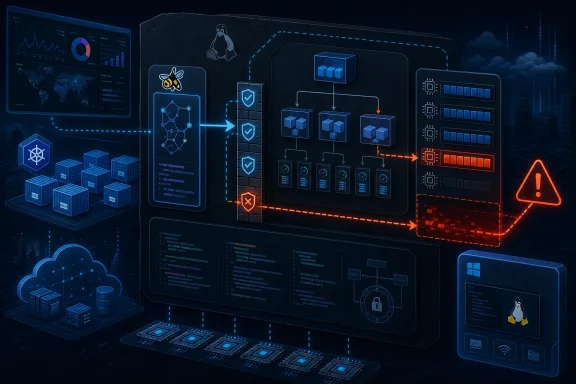 Background
Control groups, better known as cgroups, are one of the Linux kernel’s foundational resource-management mechanisms. They organize processes into groups and let the operating system account for and control CPU time, memory, I/O, process counts, and related resources. Containers, Kubernetes, systemd services, workload schedulers, and many hosting platforms rely on cgroups extensively.Why cgroup accounting matters
Cgroup resource controls are usually discussed in terms of limits: a container receives a certain amount of memory, a service gets a CPU quota, or an application is restricted to a specific I/O budget. Yet the accounting layer is just as important. The kernel must continually collect and aggregate resource-usage information so that user space can make scheduling, monitoring, enforcement, and billing decisions.The rstat subsystem supports a portion of that accounting model. It efficiently tracks updates across cgroup hierarchies, including per-CPU state, without forcing expensive global synchronization for every accounting event. This is precisely the kind of code that benefits from per-CPU data structures but must be exceptionally careful about the CPU identifiers used to access them.
The role of eBPF
Extended Berkeley Packet Filter, or eBPF, has expanded far beyond its networking roots. In current Linux systems, eBPF supports performance tracing, security monitoring, packet filtering, observability agents, custom policy enforcement, and programmatic inspection of kernel activity. It is powerful because verified bytecode can run in kernel context without requiring developers to ship a traditional kernel module.That power also makes BPF-facing kernel interfaces security-sensitive. Linux’s BPF verifier is designed to reject unsafe programs before they execute, but a verifier cannot compensate for every incorrect assumption made by the kernel functions it calls. If a BPF-exposed function accepts a scalar parameter and later treats it as an array index without validating it, the kernel-side interface itself becomes the weak point.
Kfuncs are a deliberate but demanding interface
The affected function is a BPF kfunc. Kfuncs allow approved BPF program types to call selected kernel functions more directly than traditional BPF helpers permit. They are useful because they expose specialized kernel capabilities without requiring a new helper for every use case.However, kfuncs also bring a stricter engineering requirement: kernel developers must evaluate every argument as potentially influenced by BPF code, even where the same argument would be inherently trustworthy in an internal kernel call path. CVE-2026-64036 exists because a function originally suitable for internal callers was exposed in a BPF-accessible context without sufficient validation of its
cpu parameter.The Vulnerability in Plain English
The vulnerable function,css_rstat_updated(), informs the cgroup rstat subsystem that the accounting state for a cgroup subsystem on a particular CPU has been updated. It accepts two principal inputs: a pointer to cgroup subsystem state and an integer identifying the CPU whose accounting structure should be updated.An unchecked CPU number
The flaw is straightforward in concept. The function used the supplied CPU number for a per-CPU rstat lookup, but it did not first establish that the CPU number represented a valid possible CPU on the machine. In normal internal use, code calling this function would generally be expected to provide a valid CPU identifier.That assumption no longer holds when the function is callable as a BPF kfunc. A BPF program can provide a scalar integer that is legal as a BPF value but nonsensical as a CPU index. The reported proof condition used
0x7fffffff, or 2,147,483,647, an obviously impossible CPU number for real-world systems.What the failure looks like
On an unfixed kernel built with the relevant Undefined Behavior Sanitizer bounds checks, passing that enormous CPU index produces an array-index-out-of-bounds report inkernel/cgroup/rstat.c. The observed call path runs from css_rstat_updated() through BPF iterator execution and cgroup sequence-file reading.The important point is not that every production kernel will emit a clean sanitizer warning. Sanitizers make invalid accesses visible during testing. On a production build, an out-of-bounds access can instead produce a crash, memory corruption, unexpected behavior, or a condition that varies by architecture, compiler choices, hardening features, and the layout of adjacent kernel memory.
Why “possible CPU” is the right check
Linux distinguishes between several CPU masks and concepts. A CPU may be possible, present, online, active, or isolated depending on topology and runtime state. For this code path, validating that the supplied index belongs to the possible CPU set is the appropriate baseline because it confirms that the index can safely address the per-CPU data structures allocated for the system.This distinction matters. Checking only whether a CPU is currently online could be too restrictive for code designed around per-CPU structures that exist independently of current online status. Checking nothing, as the vulnerable function did, leaves the kernel exposed to arbitrary index values.
The Fix: Separate the Trusted and Untrusted Paths
The upstream repair follows a clean defensive design. The BPF-facing version ofcss_rstat_updated() now validates its CPU argument before using it for the rstat lookup. The common operational logic has been moved into an internal __css_rstat_updated() implementation for regular in-kernel callers.Boundary validation rather than scattered checks
This split is more than cosmetic refactoring. It makes the trust boundary explicit:- The public BPF-facing wrapper receives potentially attacker-controlled input.
- The wrapper verifies that the CPU identifier is valid.
- Only then does it call the common internal implementation.
- Existing in-kernel callers can use the internal path where their arguments are governed by kernel invariants.
A useful pattern for future kfunc development
The patch offers a broader pattern for BPF-facing APIs. Any existing kernel routine that is exposed as a kfunc should be evaluated as if it were a new external interface, even if its symbol name and core logic remain unchanged. Scalar values that are harmless under internal calling conventions can become dangerous once they are supplied by BPF programs.Kernel developers should be particularly cautious with arguments that become:
- Array indices or offsets into per-CPU data.
- Object identifiers that select internal structures.
- Lengths used for memory access or copy operations.
- Flags that control locking, reference handling, or allocation behavior.
- Enumeration-like values where only a small finite set is valid.
Attack Preconditions and Practical Exploitability
CVE-2026-64036 is rated with a local attack vector. That classification is accurate but needs interpretation. The vulnerability does not allow an unauthenticated internet user to send a malformed packet to a server and immediately reach the bug. It requires a local actor with the ability to load a relevant BPF program and invoke the exposed kfunc through the applicable cgroup iterator path.Required capabilities raise the bar
The advisory identifiesCAP_BPF and CAP_PERFMON as the relevant capabilities for the demonstrated BPF iterator scenario. These are Linux capabilities intended to separate BPF and performance-monitoring privileges from the broad historical use of CAP_SYS_ADMIN.That is a meaningful restriction. On a well-administered Linux system, ordinary unprivileged user accounts should not hold these capabilities. An attacker who already possesses them has already crossed an important security boundary. Still, “requires elevated local privileges” does not mean “irrelevant.”
Capabilities are frequently delegated to monitoring agents, diagnostic utilities, containerized infrastructure components, test environments, performance-analysis workflows, and custom security products. The more organizations adopt eBPF for legitimate operational purposes, the more carefully they must account for the privilege sets assigned to those tools.
The CVSS score reflects the potential impact
Kernel.org’s CVSS v3.1 vector assigns a High severity score of 7.8, with low attack complexity, low privileges required, no user interaction, unchanged scope, and high potential impact to confidentiality, integrity, and availability. The “low privileges required” label is a standardized CVSS term; it does not mean that any ordinary user can exploit the bug.Rather, it recognizes that the required capabilities can be less powerful than full root access in some deployments. If an attacker has gained control of a process running with BPF and performance-monitoring privileges, an out-of-bounds kernel access may offer a path to turn that constrained foothold into a broader compromise, depending on the target kernel and additional mitigations.
Availability is the most immediate concern
The most direct consequence of a malformed index is a kernel fault or system instability. A local denial of service is therefore the most intuitive risk. On infrastructure systems, that can be significant: a monitoring account, compromised observability container, or misconfigured diagnostic process could potentially crash a host that runs critical workloads.Confidentiality and integrity are harder to assess from a crash-oriented proof condition alone. Out-of-bounds reads and writes in kernel context are historically dangerous primitives, but exploitation depends heavily on the exact access behavior and memory layout. Administrators should not assume confirmed privilege escalation merely because the CVSS impact metrics are high, nor should they dismiss the issue as “only a sanitizer warning.”
Why eBPF Expands the Security Conversation
BPF’s appeal lies in programmability. A fleet operator can deploy a new tracing or detection capability without rebuilding a kernel or inserting a third-party module. A cloud platform can analyze workloads at scale. A security vendor can observe system calls, process activity, and network events with lower overhead than many legacy collection methods.Programmability creates new API surfaces
Every BPF helper and kfunc is an API surface into kernel behavior. The verifier constrains bytecode execution, pointer provenance, object lifetimes, and program context. Yet helpers and kfuncs remain responsible for their own domain-specific rules.In CVE-2026-64036, the kernel allowed a BPF program to call a function with a CPU argument. The integer was valid as an integer, but not valid as a CPU selector. That semantic gap is where the vulnerability emerged.
Privileged observability deserves production-grade governance
Organizations often describe observability as harmless visibility. In reality, kernel-level observability is privileged code execution adjacent to the operating system’s most sensitive data and control paths. That does not make eBPF a bad choice; it makes sound governance essential.A mature eBPF deployment should answer practical questions such as:
- Which users, services, and containers have
CAP_BPF? - Which workloads have
CAP_PERFMON, and why? - Can BPF programs be loaded only from reviewed and signed operational tooling?
- Is unprivileged BPF disabled where business requirements do not demand it?
- Are kernel versions and BPF feature compatibility tracked across the fleet?
- Can security teams detect newly loaded BPF programs and unexpected BPF links?
The issue is a reminder, not an indictment
It would be a mistake to interpret this vulnerability as evidence that eBPF is inherently unsafe. Linux’s BPF ecosystem includes substantial safety mechanisms, and the discovery, repair, stable backports, and CVE publication show those mechanisms are accompanied by active maintenance.The more accurate conclusion is that eBPF has matured into core infrastructure. As with any mature kernel interface, it deserves rigorous code review, least privilege, patch discipline, telemetry, and adversarial testing.
Linux Version Scope and Patch Availability
The CVE record identifies Linux kernels from version 6.1 onward as affected prior to their respective fixes. The published affected-version data indicates that fixed maintenance releases include Linux 6.18.34 and Linux 7.0.11, while Linux 7.1 contains the original fix.Do not treat version labels as the whole story
Linux distributions do not always expose the upstream kernel version as the decisive patch indicator. Enterprise distributions commonly backport security fixes into a vendor-maintained kernel package while retaining an older-looking version string. Conversely, a custom kernel can report a newer base release but omit a particular stable fix if it has been heavily modified.The proper operational question is therefore not simply, “Is this machine on kernel 6.18.34?” It is, “Has the distribution or kernel vendor incorporated the patch corresponding to CVE-2026-64036 into the exact kernel package currently booted?”
Verify the running kernel, not just installed packages
On Linux systems,uname -r identifies the currently running kernel release. Package managers can show installed updates, but they do not prove the system has rebooted into the corrected kernel. This distinction is especially important after emergency patching windows, unattended update cycles, or rollback events.A basic validation workflow should include:
- Identify the active kernel with
uname -r. - Consult the distribution’s security advisory or package changelog for CVE-2026-64036.
- Install the vendor-provided kernel update if the running package is affected.
- Reboot or otherwise transition to the corrected kernel as required by the platform.
- Run
uname -ragain and verify that the expected fixed build is active. - Check that long-lived host agents, container runtimes, and nodes have returned to healthy service status.
Stable backports are especially valuable
The availability of multiple stable references matters because many production deployments do not track the newest upstream kernel line. Long-term and stable maintenance branches are where organizations need security fixes most. A targeted validation patch is generally low risk compared with broad functional changes, but standard change-control testing is still appropriate for critical environments.What This Means for Windows Users and WSL 2
WindowsForum readers may reasonably ask why a Linux kernel CVE deserves attention. The answer is that Linux is increasingly present inside Windows-centered environments: through WSL 2, development containers, Docker and Kubernetes tooling, virtual machines, CI systems, security appliances, and hybrid server fleets.WSL 2 uses a real Linux kernel
WSL 2 runs Linux distributions inside a lightweight virtual-machine architecture backed by a Microsoft-maintained Linux kernel. That means Linux kernel vulnerabilities can be relevant to WSL 2 environments, although their practical effect depends on the WSL kernel version, its configuration, enabled BPF features, and the privileges granted inside the Linux environment.A standard personal WSL 2 installation is not automatically exposed merely because it runs Linux. The attack path requires access to the specific BPF functionality and capabilities described in the advisory. Still, developers and IT teams should not assume that WSL is outside their kernel patch-management responsibilities.
Developer workstations can accumulate unusual privileges
Developer systems are often more likely than locked-down servers to have Docker, Kubernetes, tracing tools, local clusters, experimental BPF utilities, and broad administrative access. A workstation user may also run workloads from third-party repositories, test scripts from issue trackers, or security research tools that request elevated privileges.That combination makes practical hygiene important:
- Keep Windows and WSL updated through normal servicing channels.
- Update WSL distributions with their native package manager.
- Avoid granting broad Linux capabilities to containers unless required.
- Treat BPF tracing tools obtained from untrusted sources as privileged software.
- Review local Kubernetes and container development configurations for capability additions.
Virtualization reduces some risk but does not erase it
WSL 2’s virtual-machine boundary can limit the direct impact of a Linux guest kernel compromise on the Windows host. However, the precise security outcome depends on host-guest integration features, mounted filesystems, network exposure, credentials, development secrets, and the workload’s access to corporate resources.For enterprises, the safest assumption is that a compromised development environment can still endanger source code, tokens, cloud credentials, and lateral-movement opportunities even when the initial kernel vulnerability occurs in a Linux guest.
Enterprise Impact: Containers, Nodes, and Monitoring Agents
CVE-2026-64036 is most relevant to organizations that use Linux as an application platform and eBPF as an operational tool. That includes cloud-native environments, managed Kubernetes clusters, observability platforms, endpoint protection products, network appliances, and systems that run high-performance telemetry collectors.Containers are not a complete security boundary
A container shares its host kernel. If a containerized process can gain or is granted the relevant BPF-related capabilities, a host-kernel vulnerability has significance beyond that individual container. Modern container security guidance already warns against unnecessary capabilities, privileged containers, broad host mounts, and unsafe access to kernel interfaces.This CVE reinforces the reason behind that advice. Giving a container capabilities for troubleshooting or monitoring may be operationally convenient, but it can materially change the host attack surface. Teams should assess capability grants as security-sensitive design decisions rather than generic runtime toggles.
Observability agents deserve special review
Many eBPF observability products run with powerful access because they need to inspect system behavior. Some operate directly on the host; others use privileged DaemonSets in Kubernetes. The presence ofCAP_BPF and CAP_PERFMON should trigger an inventory exercise, especially where third-party agents, custom probes, or developer-created BPF programs are involved.This is not a recommendation to remove all BPF tooling. It is a recommendation to distinguish carefully between a vetted, centrally managed agent and an arbitrary local program with BPF privileges. The operational benefit of eBPF remains substantial, but its privileges need lifecycle management.
Shared infrastructure has the highest stakes
Multi-tenant and shared administrative environments should prioritize this update more aggressively. The gap between “a process has special BPF capabilities” and “that process can influence host integrity” matters most when different teams, tenants, or customers have access to the same physical or virtual Linux host.Even where direct exploitation is difficult, a local kernel crash can have an outsized blast radius. A single node failure can disrupt workloads, trigger rescheduling, create noisy monitoring alerts, consume incident-response time, and reduce capacity during a peak period.
Mitigation Before Patching
Installing the corrected kernel is the preferred solution. When an immediate reboot is not possible, organizations can reduce exposure by limiting who can load BPF programs and by restricting access to the capabilities identified in the advisory.Practical interim controls
The following measures can reduce risk until a patched kernel is deployed:- Audit
CAP_BPFassignments. Remove the capability from services, containers, and users that do not have a documented operational need. - Audit
CAP_PERFMONassignments. Performance monitoring should be granted narrowly, especially on production nodes and shared hosts. - Review privileged container policies. Identify privileged pods, host-networked diagnostics containers, and DaemonSets with broad capability sets.
- Restrict untrusted BPF tooling. Do not run unfamiliar tracing scripts or observability binaries with elevated Linux privileges.
- Monitor BPF activity. Where available, collect telemetry about program loading, pinning, attachment, and unexpected BPF link creation.
- Use workload isolation. Separate experimental performance tooling and BPF development from production systems whenever possible.
Mitigations have limits
These controls are compensating measures, not replacements for the patch. A legitimate monitoring agent may need exactly the capabilities that make the vulnerable path reachable. Removing those permissions may degrade operational visibility or break a security tool, while leaving them in place preserves the vulnerability.That trade-off is why patching the kernel remains the appropriate end state. Capability restrictions are most useful for buying time, reducing exposure, and preventing unnecessary privilege accumulation.
Strengths and Opportunities
The handling of CVE-2026-64036 reveals several positive aspects of the Linux kernel security ecosystem and provides useful guidance for administrators.A narrowly targeted upstream repair
The fix is technically focused. It validates the CPU parameter at the BPF-facing boundary and separates shared work into an internal implementation. That approach addresses the unsafe condition without needlessly changing the behavior expected by trusted in-kernel callers.Stable maintenance channels are part of the solution
Multiple stable fix references indicate that the repair is being propagated beyond the original development branch. This is crucial for infrastructure operators, who commonly depend on maintained kernels rather than the newest upstream release.The incident improves API review discipline
The vulnerability offers a concrete review checklist for BPF kfunc maintainers. In particular:- Every scalar input should be checked against the domain it represents.
- Internal assumptions must be reconsidered when code becomes BPF-accessible.
- Per-CPU accessors need explicit protection from invalid CPU indices.
- Public wrappers and trusted internal helpers can clarify security boundaries.
- Sanitizer findings should be treated as security-relevant signals, not merely test noise.
Enterprises can use this as an audit trigger
Security teams can use the CVE to improve their broader eBPF governance. An inventory of BPF-enabled agents, Linux capabilities, privileged containers, and kernel update processes provides value beyond this single issue.Risks and Concerns
Although the patch is concise, several operational and security concerns deserve attention.Delayed distribution packaging
There can be a gap between upstream disclosure, stable backport availability, vendor packaging, and local deployment. Organizations that wait only for generic monthly maintenance cycles may leave exposed systems running longer than necessary.Capability sprawl
CAP_BPF and CAP_PERFMON can be assigned deliberately, inherited through container configuration, or accumulated through broad operational templates. A capability audit may reveal more reachable systems than initially expected.False reassurance from non-root requirements
The vulnerability does not require a remote exploit or full root access, but it still affects a privileged local attack surface. Security teams should avoid treating “not remotely exploitable by default” as equivalent to “not important.”Incomplete reboot verification
Kernel packages are easy to install and easy to leave inactive. Systems that have not rebooted into the corrected image remain vulnerable, regardless of what the package inventory says.Overbroad emergency responses
Disabling all BPF functionality without analysis can break observability, performance analysis, security monitoring, and workload-management tools. The better response is a risk-based reduction of unnecessary BPF access combined with timely kernel patching.What to Watch Next
The immediate item to watch is vendor guidance. Distribution maintainers, cloud providers, appliance vendors, and WSL maintainers may publish their own advisories and package mappings that identify the exact fixed builds for supported products. Those vendor advisories are the authoritative source for production patch decisions where kernels are backported or customized.Watch for ecosystem-specific exposure reports
Kubernetes platform teams should determine whether any DaemonSets or node agents use BPF with the relevant capabilities. Endpoint-security and observability teams should confirm whether their agents depend on the affected kfunc or merely use BPF more generally. Most BPF deployments will not necessarily call this exact function, but the privilege inventory still matters.Watch NVD enrichment without waiting for it
The CVE has been published, but NVD assessment fields may not yet contain a completed independent score or detailed enrichment. That is common for newly published records and should not delay remediation planning. The Linux kernel CVE record, its stable references, and vendor package information are more actionable for patching than waiting for a database’s supplemental metadata.Watch the broader kfunc hardening trend
This flaw may prompt additional review of BPF kfuncs that accept indices, identifiers, or other scalar selectors. Such reviews can produce related fixes that are not necessarily evidence of widespread exploitation; they may simply reflect healthy hardening after a specific class of boundary-validation issue has been identified.CVE-2026-64036 is a compact vulnerability with a large operational message: kernel interfaces exposed to programmable observability tools must enforce their own semantic limits, even when the underlying code was originally safe for internal callers. Linux administrators should install the relevant vendor kernel update, verify that systems have booted into it, and use the event to review BPF-related capabilities across hosts, containers, and monitoring agents. For Windows users running WSL 2, the practical risk is usually lower than for shared Linux infrastructure, but the same principle applies: a Linux environment inside a Windows workflow is still a Linux kernel that needs disciplined patching, privilege management, and careful treatment of powerful developer tooling.
References
- Primary source: NVD / Linux Kernel
Published: 2026-07-21T01:01:29-07:00
NVD - CVE-2026-64036
 nvd.nist.gov
- Security advisory: MSRC
Published: 2026-07-21T01:01:29-07:00
Original feed URL
Security Update Guide - Microsoft Security Response Center
 msrc.microsoft.com
- Related coverage: kernel.googlesource.com
- Related coverage: android.googlesource.com
- Related coverage: cocalc.com