

CVE-2026-64078 is a newly published Linux kernel vulnerability that deserves attention from Windows users and administrators precisely because its impact is not confined to traditional Linux servers. The issue lies in Netfilter’s legacy x_tables infrastructure—the kernel machinery behind familiar iptables-family firewall tables—and affects kernels beginning with Linux 5.15 until the relevant stable fixes are applied. Kernel.org has assigned a CVSS 3.1 score of 7.8 High, but the vector is important: exploitation is local, requires low privileges, and does not require user interaction. That means the immediate risk is greatest where untrusted or semi-trusted users, workloads, containers, or development environments can interact with a vulnerable Linux kernel and its firewall-module lifecycle.
Linux Netfilter is the kernel framework responsible for packet filtering, network address translation, connection tracking integration, and related networking policy functions. While newer administration tools often expose nftables, the older iptables ecosystem remains deeply embedded in Linux distributions, network appliances, container hosts, scripts, security products, and operational runbooks.
This longevity is a double-edged sword. Mature kernel subsystems benefit from years of operational hardening, but they also accumulate complicated compatibility requirements. A flaw in a core framework can touch multiple protocol-specific implementations at once, which is why the affected file set for CVE-2026-64078 includes the central x_tables code as well as IPv4, IPv6, ARP, and NAT table components.
A remote attacker cannot simply send a malformed packet from the internet and expect a vulnerable host to be compromised. The reported attack model requires local access with low privileges, and successful exploitation appears tied to an interaction between userspace firewall-table operations and a module-removal path. This does not make the issue unimportant, but it does mean that exposure depends heavily on operational design.
The problem emerges when userspace is concurrently performing table-oriented
When a table is registered, its hook operations allow the kernel to consult rules during packet traversal. When the table is unregistered, those hook operations must be removed in a controlled way so that the packet path does not invoke code or state that is no longer valid.
The CVE’s mention of freeing “hook ops” underscores why this is security-sensitive. The packet path is performance-critical, highly concurrent, and deeply intertwined with kernel networking. Cleanup errors in this area can create inconsistent state and, depending on exact exploitation conditions, potentially produce serious integrity, confidentiality, or availability consequences.
That isolation is valuable, but it increases lifecycle complexity. A table may be visible and active in one namespace, be in teardown in another context, or be manipulated by a control plane that assumes a clean re-creation path. CVE-2026-64078 specifically references the per-net table list, making namespace-aware operations a relevant part of the risk picture.
The bug shows the danger of dividing responsibilities without preserving an unambiguous handoff. If a userspace request arrives in the middle, it must either see a valid, still-manageable table or see a consistently absent table that can be created again. A partially retired table is the most hazardous state because it can be neither safely operated nor cleanly reconstructed.
For Linux hosts, that normally means a reboot or an approved live-patching workflow where available. For WSL 2, it generally means ensuring both the WSL kernel update and the shutdown/restart of WSL instances have occurred. For containers, the host kernel—not the image’s userland packages—is the decisive component.
This matters most for developer machines where users run Docker tooling, Kubernetes-in-WSL environments, VPN and network test labs, security testing utilities, or locally built kernel modules. Such machines often blur the separation between a personal workstation and a shared software-development platform.
The practical exposure depends on whether the WSL environment uses affected x_tables functionality and whether a plausible local actor can exercise the required control-plane and module lifecycle conditions. Still, Windows administrators should include WSL 2 in their kernel vulnerability inventory rather than assuming Windows Update for the host OS alone resolves every Linux kernel issue.
That difference should not become a broad security conclusion that “WSL 1 is safer.” WSL 1 and WSL 2 have fundamentally different compatibility, networking, performance, and isolation characteristics. It simply means this particular Linux kernel flaw must be evaluated primarily in environments that execute an affected Linux kernel.
The same logic applies to endpoint security products. Detection and containment tools may reduce the likelihood or impact of an attack chain, but patching remains the direct corrective action for a kernel defect.
On Windows, the exact answer depends on the backend. Docker Desktop and similar tools may use a WSL 2-based Linux environment, a managed Linux virtual machine, or another virtualization layer. In each case, the kernel responsible for running Linux containers must be identified and patched independently of the Windows host’s normal application updates.
Not every container can load or unload host kernel modules. In a properly constrained configuration, module management is tightly restricted. But security reviews should not stop at whether a process is UID 0 inside a container. Linux capabilities, namespace configuration, device access, host mounts, runtime privileges, and orchestration policies can be more meaningful than the container’s nominal user ID.
This is why local kernel CVEs remain high-priority issues in shared and sensitive infrastructure. The fact that an attacker must first obtain low-level access does not neutralize the issue; it defines the security control layers that must fail before the kernel bug becomes reachable.
A responsible posture is to patch promptly, reduce unnecessary local privileges, and monitor for suspicious module-management and firewall-control activity. Security teams should base incident conclusions on evidence rather than on the CVE score alone.
That can materially reduce exploitability, but it is not a patch. Systems may still permit module operations during maintenance, use dynamically managed networking components, or carry custom modules with looser controls. Mitigation should be understood as reducing opportunity, not eliminating the underlying flaw.
Organizations should also inspect systems where Linux network namespaces are used as an isolation mechanism. Containers do not automatically make the bug exploitable, but the coexistence of namespaces, firewall-table operations, and privileged orchestration components makes lifecycle flaws more operationally relevant.
These systems can be difficult to patch because the kernel is part of a vendor firmware image rather than a separately managed operating-system package. Administrators should watch vendor advisories rather than attempting to transplant upstream kernel changes into unsupported appliances. A firewall appliance that is itself built around Netfilter may not be easily exploitable through this particular flaw, but its operational reliance on the subsystem warrants prompt vendor verification.
For audit purposes, evidence should include the running kernel version, the relevant vendor advisory status, the date of package installation, and proof that the host rebooted or otherwise activated the patched kernel.
The situation changes for developers, enthusiasts, and IT professionals who use Ubuntu, Kali, Fedora, Debian, or another Linux distribution under WSL 2. It also changes for users running Linux VMs through Hyper-V, VMware Workstation, VirtualBox, or other hypervisors. In those cases, the Linux guest must be evaluated separately.
That combination can make local kernel vulnerabilities more meaningful than they appear on paper. A laptop is not necessarily a low-risk asset if it contains production cloud credentials, source-code signing keys, VPN access, or privileged administrative tokens.
In WSL 2, administrators should confirm the WSL version and kernel information from the Windows host, then restart the WSL environment after updates. Merely closing a terminal window does not necessarily terminate every WSL instance or ensure that the updated kernel is in use.
That enrichment can be useful for automated vulnerability platforms, but it should not be treated as the starting gun for remediation. The existence of a published CVE, a described code defect, and fixed kernel releases is already enough for organizations to begin verification and patching.
The absence of public exploit detail should not lead to complacency. Linux kernel vulnerabilities with local, low-privilege prerequisites are often most consequential when combined with another weakness or when present on systems that already execute less-trusted code.
The practical lesson is not “remove iptables immediately.” It is to know which firewall stack is active, minimize unnecessary compatibility dependencies, keep kernel updates current, and test operational changes in a representative environment before broad rollout.
CVE-2026-64078 is a reminder that the most consequential vulnerabilities are often found not in flashy new features but in the difficult edges of trusted infrastructure: object teardown, concurrent state changes, legacy compatibility, and the boundary between userspace control tools and kernel code. For Windows users, the central message is equally clear: if a Windows machine runs WSL 2, Linux containers, or Linux virtual machines, it is part of the Linux kernel patching story. Promptly identifying and updating the actual running kernel—especially on shared, privileged, and developer-focused systems—is the most reliable way to close this particular gap.
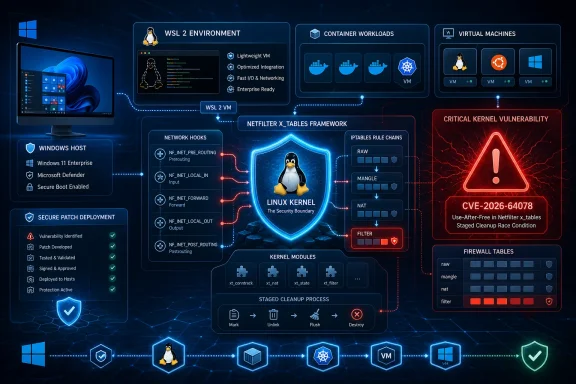 Background
Linux Netfilter is the kernel framework responsible for packet filtering, network address translation, connection tracking integration, and related networking policy functions. While newer administration tools often expose nftables, the older iptables ecosystem remains deeply embedded in Linux distributions, network appliances, container hosts, scripts, security products, and operational runbooks.Why x_tables still matters
Thex_tables layer is a shared framework supporting the traditional IPv4, IPv6, and ARP table implementations. In practical terms, it underpins major components associated with iptables, ip6tables, arptables, and NAT-oriented rule tables. Even environments that have moved toward nftables may retain compatibility paths, legacy automation, or kernel modules that make the older stack relevant.This longevity is a double-edged sword. Mature kernel subsystems benefit from years of operational hardening, but they also accumulate complicated compatibility requirements. A flaw in a core framework can touch multiple protocol-specific implementations at once, which is why the affected file set for CVE-2026-64078 includes the central x_tables code as well as IPv4, IPv6, ARP, and NAT table components.
A vulnerability about teardown, not packet parsing
CVE-2026-64078 is not described as a remote packet-parsing flaw. It is instead a lifecycle problem involving the removal of a Netfilter table and the ordering of cleanup operations when a related module is unloaded. That distinction significantly changes how organizations should triage it.A remote attacker cannot simply send a malformed packet from the internet and expect a vulnerable host to be compromised. The reported attack model requires local access with low privileges, and successful exploitation appears tied to an interaction between userspace firewall-table operations and a module-removal path. This does not make the issue unimportant, but it does mean that exposure depends heavily on operational design.
The newly published record
The CVE record was published on July 19, 2026, and modified on July 20, 2026. At publication time, the National Vulnerability Database had incorporated the record but had not yet issued its own CVSS assessment. Kernel.org’s supplied CVSS 3.1 vector is:- Attack Vector: Local.
- Attack Complexity: Low.
- Privileges Required: Low.
- User Interaction: None.
- Confidentiality, Integrity, and Availability impact: High.
What CVE-2026-64078 Fixes
The kernel change associated with CVE-2026-64078 introduces and uses a helper calledxtables_unregister_table_exit. Its purpose is to complete the second stage of safely unregistering an x_tables table after the table has been detached from active packet processing.The problematic sequence
Before the fix, an earlier cleanup stage,xtables_unregister_table_pre_exit, detached the table from the packet path and removed it from the active table list. That is an intuitively sensible first step: a table being removed should no longer be used to process live traffic.The problem emerges when userspace is concurrently performing table-oriented
setsockopt or getsockopt operations while a related module is being removed with rmmod. According to the vulnerability description, that timing can leave userspace unable to re-instantiate the table because two important conditions are already true:- The larval table has already been removed.
- The existing instantiated table is no longer present in the x_tables per-network-namespace table list.
The missing second stage
The correction adds a clearly defined second cleanup stage. The new helper performs the remaining work needed after the table is no longer active:- It unlinks the table from the dying list.
- It frees registered hook operations where they exist.
- It emits the appropriate audit notification.
- It replaces the previous
xt_unregister_table()path.
Understanding the Technical Context
The key to understanding this CVE is recognizing that Linux firewall rules are not merely a collection of text commands. They map to kernel-resident tables, rule chains, hooks, module references, namespace-specific state, and packet-path registrations.Tables, hooks, and the packet path
Netfilter tables are connected to points in the networking stack known as hooks. A hook can inspect, accept, drop, alter, or redirect traffic at a particular stage of processing. For example, firewall and NAT functions may operate at different points for inbound, outbound, forwarded, routed, or locally generated packets.When a table is registered, its hook operations allow the kernel to consult rules during packet traversal. When the table is unregistered, those hook operations must be removed in a controlled way so that the packet path does not invoke code or state that is no longer valid.
The CVE’s mention of freeing “hook ops” underscores why this is security-sensitive. The packet path is performance-critical, highly concurrent, and deeply intertwined with kernel networking. Cleanup errors in this area can create inconsistent state and, depending on exact exploitation conditions, potentially produce serious integrity, confidentiality, or availability consequences.
Per-network-namespace state
Modern Linux supports network namespaces, allowing separate networking contexts to coexist on one host. Containers commonly rely on network namespaces, as do some sandboxing and virtualization scenarios. The x_tables subsystem keeps table information on a per-network-namespace basis, rather than treating all firewall state as one global resource.That isolation is valuable, but it increases lifecycle complexity. A table may be visible and active in one namespace, be in teardown in another context, or be manipulated by a control plane that assumes a clean re-creation path. CVE-2026-64078 specifically references the per-net table list, making namespace-aware operations a relevant part of the risk picture.
Why the patch uses staged cleanup
Staged teardown is a common strategy in concurrent operating-system code. The first stage stops new operational use—here, detaching the table from packet processing and removing it from an active list. The second stage performs final disposal actions only after the object is known to be in a safe terminal state.The bug shows the danger of dividing responsibilities without preserving an unambiguous handoff. If a userspace request arrives in the middle, it must either see a valid, still-manageable table or see a consistently absent table that can be created again. A partially retired table is the most hazardous state because it can be neither safely operated nor cleanly reconstructed.
Affected Kernel Versions and Fixed Releases
The vulnerability metadata identifies Linux kernels beginning with version 5.15 as affected, subject to the usual caveat that vendor backports can alter the real-world status of a distribution kernel. It lists kernels earlier than 5.15 as unaffected and identifies fixed points in several stable series.Reported fixed versions
The published record identifies these remediation points:- Linux 6.18.34 contains the stable fix for the 6.18 series.
- Linux 7.0.11 contains the stable fix for the 7.0 series.
- Linux 7.1 contains the original upstream fix.
Version strings are not enough
A kernel release string is useful, but it is not a complete vulnerability verdict. Consider the following examples:- A supported enterprise Linux distribution may ship a 6.18-derived kernel with a vendor-specific release suffix and include the patch before the stock upstream version appears in its repository.
- A device vendor may ship a long-term-support kernel with many local networking modifications and delay incorporating the fix.
- A cloud image may have received a patched kernel package, while dormant virtual machines continue booting an older installed kernel.
- A Windows developer workstation may update its WSL distribution packages but still be using an older WSL kernel until the Windows-side component is updated and restarted.
Running versus installed kernels
Administrators should distinguish between the kernel package installed on disk and the one currently executing. A patch is not operationally effective until the relevant environment has restarted into the updated kernel.For Linux hosts, that normally means a reboot or an approved live-patching workflow where available. For WSL 2, it generally means ensuring both the WSL kernel update and the shutdown/restart of WSL instances have occurred. For containers, the host kernel—not the image’s userland packages—is the decisive component.
Why Windows Administrators Should Care
At first glance, a Netfilter x_tables CVE sounds like a Linux-only operational concern. For a WindowsForum audience, the important reality is that many Windows systems now run genuine Linux kernels through WSL 2, container platforms, virtual machines, developer tools, and security appliances.WSL 2 is in scope when its kernel is vulnerable
WSL 2 runs a real Linux kernel inside a lightweight managed virtual machine. Therefore, a vulnerable WSL 2 kernel can be affected by Linux kernel vulnerabilities, including those in Netfilter. The presence of Windows as the desktop operating system does not eliminate that exposure.This matters most for developer machines where users run Docker tooling, Kubernetes-in-WSL environments, VPN and network test labs, security testing utilities, or locally built kernel modules. Such machines often blur the separation between a personal workstation and a shared software-development platform.
The practical exposure depends on whether the WSL environment uses affected x_tables functionality and whether a plausible local actor can exercise the required control-plane and module lifecycle conditions. Still, Windows administrators should include WSL 2 in their kernel vulnerability inventory rather than assuming Windows Update for the host OS alone resolves every Linux kernel issue.
WSL 1 is architecturally different
WSL 1 does not run the same full Linux kernel model as WSL 2. It translates Linux system calls through a compatibility layer rather than booting a Microsoft-maintained Linux kernel virtual machine. The specific Netfilter kernel code implicated by CVE-2026-64078 is therefore not applicable to WSL 1 in the same direct manner.That difference should not become a broad security conclusion that “WSL 1 is safer.” WSL 1 and WSL 2 have fundamentally different compatibility, networking, performance, and isolation characteristics. It simply means this particular Linux kernel flaw must be evaluated primarily in environments that execute an affected Linux kernel.
Windows firewall does not patch the Linux kernel
Microsoft Defender Firewall and related Windows network controls are important layers, but they do not replace the security boundary inside a WSL 2 kernel. A Windows host firewall can reduce network exposure; it cannot correct an internal x_tables teardown bug in a Linux guest environment.The same logic applies to endpoint security products. Detection and containment tools may reduce the likelihood or impact of an attack chain, but patching remains the direct corrective action for a kernel defect.
Containers and Developer Workstations
CVE-2026-64078 is especially relevant to the modern workstation because containers make Linux kernel exposure easy to overlook. A container image can look self-contained, but its processes still use a host kernel.The host kernel is the security boundary
On a conventional Linux container host, all containers share the same Linux kernel. Updating an Ubuntu, Debian, Fedora, or Alpine image inside a container does not update the host’s x_tables code. If the host kernel is affected, containers that can reach relevant capabilities or interfaces may inherit the exposure.On Windows, the exact answer depends on the backend. Docker Desktop and similar tools may use a WSL 2-based Linux environment, a managed Linux virtual machine, or another virtualization layer. In each case, the kernel responsible for running Linux containers must be identified and patched independently of the Windows host’s normal application updates.
Root inside a container is not always enough—but it can matter
The CVSS vector calls for low privileges, not necessarily full administrative control. That is a warning sign for environments that grant powerful networking capabilities to container workloads. A container process with capabilities such asCAP_NET_ADMIN, privileged mode, access to host networking, or broad control over firewall tooling deserves careful scrutiny.Not every container can load or unload host kernel modules. In a properly constrained configuration, module management is tightly restricted. But security reviews should not stop at whether a process is UID 0 inside a container. Linux capabilities, namespace configuration, device access, host mounts, runtime privileges, and orchestration policies can be more meaningful than the container’s nominal user ID.
CI/CD systems deserve special attention
Build agents, test runners, and ephemeral development environments can combine several unfavorable conditions:- They may execute code from multiple developers, branches, or external contributors.
- They often use Docker-in-Docker, Kubernetes test clusters, or privileged networking tests.
- They may invoke firewall configuration tools as part of integration testing.
- They are frequently patched less consistently than core production servers.
- They can expose sensitive credentials, source code, signing keys, or deployment tokens.
Exploitability: High Severity Does Not Mean Internet-Wormable
The 7.8 High score is justified by the potential impact categories in the CVSS vector, but it should be read alongside the conditions required for exploitation. This is not presently described as a remote, no-authentication vulnerability.The local attack vector changes triage
A local vulnerability often becomes important after an attacker has already obtained a foothold. For example, an exposed web application flaw, stolen developer credential, malicious dependency, compromised container, or insider account may provide the initial access. A kernel flaw can then be used as part of a post-compromise escalation chain.This is why local kernel CVEs remain high-priority issues in shared and sensitive infrastructure. The fact that an attacker must first obtain low-level access does not neutralize the issue; it defines the security control layers that must fail before the kernel bug becomes reachable.
No public exploit claim should be inferred
The CVE description and CVSS record describe the affected code path and impact assessment, but they do not establish that a public proof of concept is available or that active exploitation has been observed. Administrators should avoid both extremes: dismissing the flaw because it is local, or assuming that every Linux instance is exposed to a trivial one-command attack.A responsible posture is to patch promptly, reduce unnecessary local privileges, and monitor for suspicious module-management and firewall-control activity. Security teams should base incident conclusions on evidence rather than on the CVE score alone.
Module unloading is a meaningful prerequisite
The described failure occurs “in case ofrmmod,” which points directly to module removal. Many hardened servers restrict module loading and unloading after boot, either through policy, kernel lockdown configurations, reduced privileges, or operational practices that avoid dynamic module management.That can materially reduce exploitability, but it is not a patch. Systems may still permit module operations during maintenance, use dynamically managed networking components, or carry custom modules with looser controls. Mitigation should be understood as reducing opportunity, not eliminating the underlying flaw.
Enterprise Impact
Enterprise risk is shaped less by the number of endpoints and more by the concentration of privilege, tenancy, and network control. A single exposed CI runner, Kubernetes node, or network-function appliance can present more risk than hundreds of locked-down employee laptops.Shared infrastructure and tenant boundaries
In multi-user Linux environments, the CVE’s local, low-privilege profile matters most where ordinary accounts can run arbitrary code. University systems, research clusters, software build farms, managed hosting platforms, and internal engineering servers should be examined first.Organizations should also inspect systems where Linux network namespaces are used as an isolation mechanism. Containers do not automatically make the bug exploitable, but the coexistence of namespaces, firewall-table operations, and privileged orchestration components makes lifecycle flaws more operationally relevant.
Network appliances and embedded systems
Firewalls, routers, VPN gateways, storage devices, hypervisors, and industrial appliances frequently run vendor-customized Linux kernels. Many use Netfilter heavily, and some retain iptables-compatible tooling for policy management.These systems can be difficult to patch because the kernel is part of a vendor firmware image rather than a separately managed operating-system package. Administrators should watch vendor advisories rather than attempting to transplant upstream kernel changes into unsupported appliances. A firewall appliance that is itself built around Netfilter may not be easily exploitable through this particular flaw, but its operational reliance on the subsystem warrants prompt vendor verification.
Compliance and vulnerability management
The lack of an NVD-assigned score at publication should not delay action. The record contains a kernel.org severity assessment, clear affected-code information, and identified stable fixes. Vulnerability management teams should track it as a Linux kernel remediation item and document any exceptions based on confirmed vendor backports or non-applicability.For audit purposes, evidence should include the running kernel version, the relevant vendor advisory status, the date of package installation, and proof that the host rebooted or otherwise activated the patched kernel.
Consumer and Small-Business Impact
For individual users, this CVE is generally more relevant to Linux-heavy workstations than to a typical Windows PC that does not use WSL, Linux virtual machines, or Linux container tooling.The likely exposure profile
A home Windows PC with no WSL 2 distributions, no Docker Desktop Linux backend, and no Linux virtual machines is not directly running the affected Linux Netfilter code. The CVE does not indicate a vulnerability in the Windows networking stack, Microsoft Defender Firewall, or ordinary Windows firewall-rule management.The situation changes for developers, enthusiasts, and IT professionals who use Ubuntu, Kali, Fedora, Debian, or another Linux distribution under WSL 2. It also changes for users running Linux VMs through Hyper-V, VMware Workstation, VirtualBox, or other hypervisors. In those cases, the Linux guest must be evaluated separately.
Workstations often have unusual privileges
Developer workstations frequently permit actions that production servers do not. They may run Docker with elevated access, expose local Kubernetes APIs, enable experimental networking, build custom kernel components, and execute third-party code from repositories or package managers.That combination can make local kernel vulnerabilities more meaningful than they appear on paper. A laptop is not necessarily a low-risk asset if it contains production cloud credentials, source-code signing keys, VPN access, or privileged administrative tokens.
A Practical Response Plan
The right response is deliberate and measurable: identify actual kernel instances, confirm vendor remediation, deploy updates, restart affected environments, and reduce conditions that make local exploitation practical.Immediate verification steps
Use the following sequence to handle CVE-2026-64078 efficiently:- Inventory every Linux kernel instance. Include physical Linux servers, cloud instances, appliance firmware, virtual machines, WSL 2 distributions, Docker Desktop backends, Kubernetes nodes, and CI runners.
- Identify the running kernel, not just installed packages. On Linux systems, compare the active kernel release with the vendor’s patched-build information. In WSL 2, verify the kernel associated with the WSL environment and ensure instances are restarted after an update.
- Check whether the vendor has backported the fix. Do not rely only on upstream version numbers. A supported distribution may have patched the issue under a vendor-specific kernel release string.
- Prioritize shared and privileged environments. Address build agents, container hosts, Kubernetes nodes, bastion systems, multi-user servers, and systems where less-trusted users can execute code before isolated single-user test machines.
- Deploy the patched kernel and activate it. Schedule a reboot, maintenance restart, or validated live-patching procedure. Confirm afterward that the running kernel changed as expected.
- Review module and networking privileges. Identify unnecessary use of
CAP_NET_ADMIN, privileged containers, host networking, broad access to/lib/modules, and policies that permit non-administrative module manipulation. - Record exceptions clearly. If a system is not affected because it uses WSL 1, does not run Linux, or has a vendor-confirmed backport, document the evidence rather than relying on informal assumptions.
Useful local checks
On a Linux system,uname -r identifies the currently running kernel release. Package-manager history can establish whether a newer kernel is installed, but only a reboot or equivalent activation confirms that the new kernel is executing.In WSL 2, administrators should confirm the WSL version and kernel information from the Windows host, then restart the WSL environment after updates. Merely closing a terminal window does not necessarily terminate every WSL instance or ensure that the updated kernel is in use.
Hardening while patching proceeds
Temporary controls can reduce exposure where patching requires a maintenance window:- Restrict shell access for untrusted users on vulnerable hosts.
- Avoid granting containers privileged mode or unnecessary network-administration capabilities.
- Limit access to CI runners that execute unreviewed or external code.
- Enforce module-signing and module-loading policies where appropriate for the platform.
- Monitor for unexpected firewall-table manipulation and module unload activity.
- Reduce use of legacy iptables management paths where operationally feasible, while recognizing that migration alone is not a substitute for patching.
Strengths and Opportunities
CVE-2026-64078 also highlights several positive developments in the Linux security and maintenance ecosystem.- The fix is narrowly scoped and technically understandable. The patch clarifies a table-unregistration lifecycle by separating pre-exit detachment from final cleanup, making future maintenance easier to reason about.
- Stable fixes are already identified. Administrators are not left with an abstract upstream-only issue; the published record identifies patched stable-series release points.
- The flaw has a constrained access model. Local access and low privileges are still serious, but the absence of a stated remote, unauthenticated vector gives defenders useful opportunities to contain risk through least privilege and segmentation.
- Windows environments can be assessed systematically. WSL 2, Linux VMs, and container backends are identifiable assets. This is not an unknowable exposure problem if organizations maintain an accurate software and kernel inventory.
- The CVE offers a reason to improve container governance. Reviewing capabilities, host networking, privileged workloads, and build-runner isolation can reduce risk from this issue and many future kernel vulnerabilities.
Risks and Concerns
The operational details that make the fix necessary also point to several broader concerns.- Kernel lifecycle flaws are difficult to validate with ordinary functional testing. A firewall configuration may appear to work normally until a rare race involving module removal and concurrent control-plane activity occurs.
- Legacy compatibility layers remain widely deployed. Even organizations that consider themselves nftables-first may still rely on x_tables indirectly through scripts, tooling, or compatibility modes.
- Container privilege is often over-granted. A workload that only needs outbound network access rarely needs broad network-administration capabilities, yet such permissions remain common in development and troubleshooting setups.
- WSL 2 can create inventory blind spots. Corporate vulnerability management may track Windows patches well while overlooking the Linux kernel version running beneath developer distributions and container tooling.
- Vendor kernel backports complicate automated scanning. A scanner that compares only an upstream version number may report false positives or false negatives unless it understands distribution-specific security metadata.
- The initial access requirement may be easy to satisfy in CI environments. Shared runners and automated build systems can turn a local kernel bug into a material supply-chain and credential-exposure concern.
What to Watch Next
The next important development will be the appearance of distribution-specific advisories and patched packages. Linux vendors will determine whether and how they backport the fix into supported long-term kernel streams, and appliance vendors may need more time to incorporate the change into firmware releases.NVD enrichment and vendor analysis
As of July 21, 2026, the NVD record reflects kernel.org’s CVSS 3.1 assessment but does not yet include an NVD-generated CVSS score or a CWE classification. Those additions may arrive later, along with broader configuration data and vendor references.That enrichment can be useful for automated vulnerability platforms, but it should not be treated as the starting gun for remediation. The existence of a published CVE, a described code defect, and fixed kernel releases is already enough for organizations to begin verification and patching.
Research into exploit conditions
Security researchers may provide more detail about whether the affected state can be turned into reliable privilege escalation, denial of service, information disclosure, or another outcome under practical conditions. Until then, organizations should avoid overstating certainty about exploit mechanics.The absence of public exploit detail should not lead to complacency. Linux kernel vulnerabilities with local, low-privilege prerequisites are often most consequential when combined with another weakness or when present on systems that already execute less-trusted code.
The broader migration question
CVE-2026-64078 may also renew discussion around legacy iptables/x_tables usage versus nftables. The modern nftables framework offers a different architecture and management model, but large estates cannot safely treat migration as a weekend task. Existing automation, third-party tooling, appliance dependencies, and compliance-tested rule sets all need careful handling.The practical lesson is not “remove iptables immediately.” It is to know which firewall stack is active, minimize unnecessary compatibility dependencies, keep kernel updates current, and test operational changes in a representative environment before broad rollout.
CVE-2026-64078 is a reminder that the most consequential vulnerabilities are often found not in flashy new features but in the difficult edges of trusted infrastructure: object teardown, concurrent state changes, legacy compatibility, and the boundary between userspace control tools and kernel code. For Windows users, the central message is equally clear: if a Windows machine runs WSL 2, Linux containers, or Linux virtual machines, it is part of the Linux kernel patching story. Promptly identifying and updating the actual running kernel—especially on shared, privileged, and developer-focused systems—is the most reliable way to close this particular gap.
References
- Primary source: NVD / Linux Kernel
Published: 2026-07-21T01:02:56-07:00
NVD - CVE-2026-64078
 nvd.nist.gov
- Security advisory: MSRC
Published: 2026-07-21T01:02:56-07:00
Original feed URL
Security Update Guide - Microsoft Security Response Center
 msrc.microsoft.com
