

Tesla has begun deploying software update 2026.20.6.10, a narrowly distributed build associated with Full Self-Driving (Supervised) v14 Lite and aimed primarily at bringing newer driving behavior and interface features to older vehicles equipped with Hardware 3. The July 20 release initially appeared on only a tiny number of cars, and complete vehicle-generated release notes were not immediately available, making this less a conventional fleet-wide launch than a carefully controlled validation step. Even so, the build matters because it tests how far Tesla can extend its latest neural-network driving stack across a vast installed base whose computing hardware is now several generations behind the company’s newest autonomy platform.
Tesla’s software numbering can make a small patch look more straightforward than it really is. Version 2026.20.6.10 belongs to the broader 2026.20 firmware family, but its importance appears to come from the FSD package bundled inside it rather than from major changes to infotainment, charging, climate control, or general vehicle functions.
Early tracking data classified the release as FSD v14 Lite for North America. The reported feature set includes Start Self-Driving from Park, Arrival Options, Speed Profiles, interface improvements, and the familiar Full Self-Driving (Supervised) driving capabilities, although Tesla had not published a detailed new changelog for the specific .10 build when the rollout first appeared.
That distinction is especially important for FSD. Two vehicles can display nearly identical release notes while running models with different tuning, inference behavior, safety constraints, or hardware-specific optimizations.
Instead, it suggests one of three possibilities:
Version 14 subsequently evolved through a series of point releases. By spring 2026, Tesla said FSD v14.3 incorporated reinforcement-learning improvements for rare edge cases, a sharper neural-network vision encoder for difficult visibility conditions, and a redesigned compiler and runtime capable of reducing inference latency by as much as 20 percent on supported hardware.
This architectural shift changed the nature of software updates. A patch no longer has to introduce a recognizable rule such as “allow lane changes on city streets” to alter the driving experience. Retrained models can subtly affect following distance, gap selection, lane positioning, acceleration, braking, and the confidence with which the vehicle enters an intersection.
The company later introduced Hardware 4, now commonly called AI4, with improved cameras, greater processing capability, and a newer inference platform. That created a widening software gap: AI4 vehicles could run larger and more computationally demanding models, while HW3 vehicles increasingly received older FSD branches or delayed adaptations.
FSD v14 Lite is Tesla’s answer to that gap, but the word Lite carries unavoidable implications. It indicates that the full AI4 implementation cannot simply be copied onto older computers without modification.
That work is technically significant. Compressing a large model while preserving acceptable driving behavior requires more than lowering graphical settings, as a PC gamer might do to improve frame rates.
Every optimization creates trade-offs. A smaller model may run quickly enough to control the car but lose some ability to interpret rare situations, maintain context over time, or distinguish between visually similar objects.
The engineering target is therefore not “make v14 smaller.” It is preserve the most useful improvements while remaining within a fixed latency and power budget.
A delayed response can affect:
The visible additions may be more important to everyday owners than obscure model metrics. They reduce friction around the moments when the human and automation exchange control.
The feature closes a long-standing gap in the automated trip. Previously, the driver might have needed to shift, maneuver out of a parking position, and reach a usable road before handing control to FSD.
Its inclusion in v14 Lite is notable because low-speed parking environments are difficult. They contain pedestrians, shopping carts, curbs, painted lines, vehicles reversing unpredictably, and objects that may be poorly visible to cameras.
This is more than an interface convenience. Navigation traditionally defines success as reaching a coordinate, while a human passenger thinks in terms of reaching a usable place to exit the vehicle.
A route can technically end at the correct address while still producing an awkward result. The car might stop on the wrong side of a building, approach a restricted entrance, or arrive on a busy road where unloading is impractical.
The key challenge is predictability. If a profile changes too many behaviors at once, drivers may struggle to understand why the car accepted one gap, rejected another, or followed traffic at a particular distance.
A successful implementation should make personality differences noticeable without encouraging the driver to treat the most assertive setting as a performance mode.
For HW3 owners, interface parity also has symbolic value. Even if the underlying model differs from AI4, receiving familiar v14 controls makes an older Tesla feel less isolated from the company’s current software platform.
Owners should not assume that seeing 2026.20.6.10 online means it is immediately available for their vehicle. Manually checking the Software screen repeatedly will not force a car into an update group that Tesla has not enabled.
The vehicle cannot be driven during installation. Owners should also allow time after the update to review settings, because major FSD changes may present new agreements, reset selected preferences, or alter the location of controls.
That requirement applies equally to v14 Lite, regardless of how capable the software appears during a successful trip. A system that handles 99 routine situations correctly can still require immediate intervention in the one unusual scenario that matters most.
If Tesla abandoned HW3 prematurely, owners who purchased FSD could argue that they paid for a promised capability that migrated to newer hardware before reaching its intended form. Continuing to optimize v14 for HW3 therefore protects more than customer satisfaction.
Conversely, visible software segmentation can accelerate perceived obsolescence. If AI4 vehicles gain every major FSD improvement while HW3 cars remain on older branches, buyers may discount used HW3 models even when their batteries, motors, and conventional driving functions remain healthy.
FSD v14 Lite gives Tesla a way to extend the useful software life of these cars. It does not eliminate the hardware difference, but it demonstrates continued investment.
That wording may be technically honest while still frustrating customers. Some bought FSD outright when Tesla described the installed hardware as sufficient for future capability, and they may regard a reduced model as an incomplete delivery rather than a welcome optimization.
Version 2026.20.6.10 may therefore represent a bridge to the best experience Tesla can deliver on HW3, not proof that older and newer cars will eventually converge on identical functionality.
AI4 has the resources to run larger models and support features that may be impractical on HW3. That can produce different release schedules, different visualizations, and potentially different behavior in the same road scenario.
Owners should therefore avoid assuming that a v14 Lite video predicts exactly how full v14.3.5 will behave, or vice versa. Even two cars on nominally identical software can encounter different camera views, calibration states, traffic conditions, and navigation data.
The more branches Tesla supports, the greater the risk of:
The earliest reports deserve caution because a handful of drives cannot establish reliability. Road geometry, weather, traffic density, map quality, and driving culture vary enormously across North America.
Recording behavior can help document regressions, but the driver’s first obligation remains controlling the vehicle. Cameras and social-media reactions should never take priority over safety.
However, customers should evaluate the product based on present behavior, not future promises. A subscription is easier to cancel than a permanent purchase, making it a practical way to test whether FSD adds enough value for a particular commute or travel pattern.
A fleet operator needs to know not only that a vehicle has FSD v14, but also whether it runs the Lite branch, which hardware computer is installed, what features are enabled, and whether organizational policy permits their use.
Fleet policies should specify:
A car awaiting an update may behave differently from the rest of the fleet. A newly installed build may require a short validation drive before the vehicle returns to ordinary service, particularly when the update affects automated driving.
Businesses should assume that supervised software does not transfer legal accountability to the manufacturer. Internal training, incident documentation, and clear rules remain essential.
The arrival of AI-focused PCs has made this divide even clearer. A feature can belong to the same operating system while requiring an NPU or newer CPU that older machines lack.
Microsoft can sometimes permit an unsupported Windows installation with warnings. Tesla cannot responsibly offer an oversized driving model if the computer cannot guarantee real-time execution.
A reduced FSD model can likewise be a legitimate engineering solution. The crucial questions are whether it remains safe, whether Tesla communicates the limitations accurately, and whether it satisfies commitments made when customers purchased the hardware.
The limited notes around 2026.20.6.10 highlight that transparency gap. A safety-relevant update can arrive with a generic or repeated description, leaving enthusiasts to infer its purpose from trackers and community reports.
The build number alone cannot reveal the outcome. Rollout behavior and owner reports will provide the first meaningful evidence.
A broad release would likely begin with vehicles already running a compatible 2026.20 build. Cars on older firmware families may need an intermediate update or may receive a later consolidated version instead.
Short videos can illustrate behavior, but they rarely show all relevant context. Navigation instructions, driver inputs, speed settings, traffic conditions, and events before the clip may explain what otherwise looks like an inexplicable decision.
Owners moving directly from older FSD versions should separate general v14 Lite changes from improvements unique to .6.10. That will be difficult without detailed notes, reinforcing the need for careful comparison rather than anecdotal impressions.
Owners should watch whether HW3 receives future v14 Lite point releases at a reasonable pace or falls behind again after the initial deployment. The answer will reveal more about Tesla’s commitment than any single build.
Tesla would prefer to solve as much as possible through software. Version 2026.20.6.10 is therefore not merely an update; it is part of a continuing experiment to determine whether optimization can postpone or avoid costly hardware intervention.
Owners should also expect more divergence beneath apparently unified branding. AI4 will continue advancing, AI5 is under development, and older computers will require increasingly deliberate optimization to remain involved.
The most credible path forward would combine three elements: efficient models for legacy hardware, explicit disclosure of capability differences, and detailed release documentation. Tesla has shown strength in the first area but remains inconsistent in the other two.
Software update 2026.20.6.10 is still too limited to justify sweeping conclusions, yet its strategic significance is clear. It is a test of whether Tesla can carry an ambitious AI platform forward without abandoning the customers who financed its earlier promises, and the outcome will influence not only how HW3 owners view FSD, but how the broader technology industry thinks about long-term support for expensive, software-defined hardware.
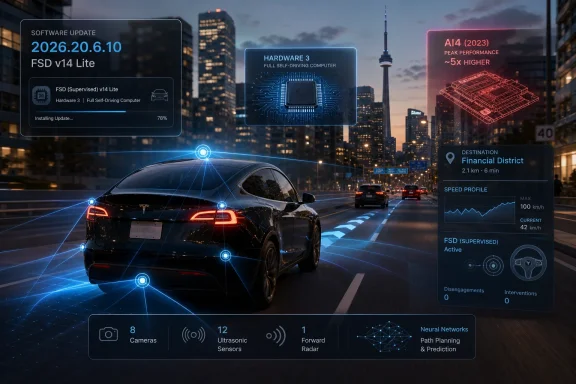 Overview
Tesla’s software numbering can make a small patch look more straightforward than it really is. Version 2026.20.6.10 belongs to the broader 2026.20 firmware family, but its importance appears to come from the FSD package bundled inside it rather than from major changes to infotainment, charging, climate control, or general vehicle functions.Early tracking data classified the release as FSD v14 Lite for North America. The reported feature set includes Start Self-Driving from Park, Arrival Options, Speed Profiles, interface improvements, and the familiar Full Self-Driving (Supervised) driving capabilities, although Tesla had not published a detailed new changelog for the specific .10 build when the rollout first appeared.
A release with incomplete notes
The absence of detailed release notes does not necessarily mean the software contains no meaningful changes. Tesla frequently uses later point releases to adjust neural-network weights, correct regressions, change eligibility rules, or modify low-level runtime behavior without introducing a visible feature that deserves a new paragraph in the car’s update screen.That distinction is especially important for FSD. Two vehicles can display nearly identical release notes while running models with different tuning, inference behavior, safety constraints, or hardware-specific optimizations.
Why the tiny rollout matters
Initial third-party trackers detected the build on effectively zero percent of the monitored fleet, with only one or a handful of installations visible. Such a small sample should not be treated as evidence of a broad consumer launch.Instead, it suggests one of three possibilities:
- Tesla is conducting an early-access validation wave before expanding distribution.
- The company is testing a hardware-specific fix on a limited group of eligible vehicles.
- The build is a replacement candidate for an earlier FSD v14 Lite release that did not progress beyond a very small deployment.
Background
Tesla introduced FSD v14 to consumer vehicles in late 2025, describing it as a significant step toward integrating technology developed for its Robotaxi program into customer-owned cars. The software remained explicitly supervised: the person in the driver’s seat had to monitor the road, remain ready to intervene, and accept legal responsibility for the vehicle.Version 14 subsequently evolved through a series of point releases. By spring 2026, Tesla said FSD v14.3 incorporated reinforcement-learning improvements for rare edge cases, a sharper neural-network vision encoder for difficult visibility conditions, and a redesigned compiler and runtime capable of reducing inference latency by as much as 20 percent on supported hardware.
From rules to neural networks
Earlier generations of Autopilot and FSD relied on a complicated combination of perception networks and hand-written planning logic. Tesla gradually moved toward end-to-end neural-network systems that consume camera data and produce driving decisions with less traditional code between perception and control.This architectural shift changed the nature of software updates. A patch no longer has to introduce a recognizable rule such as “allow lane changes on city streets” to alter the driving experience. Retrained models can subtly affect following distance, gap selection, lane positioning, acceleration, braking, and the confidence with which the vehicle enters an intersection.
Hardware 3 becomes the central question
Hardware 3, also called HW3 or AI3, entered Tesla production in 2019. Tesla designed the computer internally and promoted it as the foundation for future self-driving capability, including to customers who bought FSD years before the technology reached its current form.The company later introduced Hardware 4, now commonly called AI4, with improved cameras, greater processing capability, and a newer inference platform. That created a widening software gap: AI4 vehicles could run larger and more computationally demanding models, while HW3 vehicles increasingly received older FSD branches or delayed adaptations.
FSD v14 Lite is Tesla’s answer to that gap, but the word Lite carries unavoidable implications. It indicates that the full AI4 implementation cannot simply be copied onto older computers without modification.
What FSD v14 Lite Represents
FSD v14 Lite is best understood as a hardware-constrained adaptation rather than a separate autonomy product. Tesla appears to be transferring selected v14 behaviors and user-facing functions to HW3 while tailoring the neural networks and runtime to fit the older computer’s memory, bandwidth, and processing limits.That work is technically significant. Compressing a large model while preserving acceptable driving behavior requires more than lowering graphical settings, as a PC gamer might do to improve frame rates.
Model compression is not a free upgrade
Tesla can use several techniques to make a neural network run on less capable hardware. These may include reducing model size, pruning less influential parameters, lowering numerical precision, changing input resolution, simplifying temporal processing, or dividing workloads differently across the computer.Every optimization creates trade-offs. A smaller model may run quickly enough to control the car but lose some ability to interpret rare situations, maintain context over time, or distinguish between visually similar objects.
The engineering target is therefore not “make v14 smaller.” It is preserve the most useful improvements while remaining within a fixed latency and power budget.
Latency matters as much as intelligence
An advanced model is not useful if it responds too slowly. Driving software must process camera frames, understand the scene, predict motion, select a path, and issue control commands within strict time limits.A delayed response can affect:
- How quickly the vehicle reacts when another car cuts into its lane.
- Whether it recognizes a changing traffic light in time to stop smoothly.
- How confidently it proceeds through an unprotected turn.
- How early it notices a pedestrian emerging from behind an obstruction.
- Whether steering corrections feel stable or arrive as abrupt adjustments.
The Feature Set Expected in 2026.20.6.10
Although the specific build initially lacked a complete new changelog, release tracking and Tesla community records associate 2026.20.6.10 with the established v14 Lite feature package. These functions focus on making supervised driving easier to start, easier to customize, and more natural at the end of a journey.The visible additions may be more important to everyday owners than obscure model metrics. They reduce friction around the moments when the human and automation exchange control.
Start Self-Driving from Park
Start Self-Driving from Park allows an eligible vehicle to begin an FSD journey while stationary rather than requiring the driver to pull onto the road manually before activating the system. When available, the option appears after the car verifies that FSD is enabled, environmental conditions are suitable, and an attentive driver is present.The feature closes a long-standing gap in the automated trip. Previously, the driver might have needed to shift, maneuver out of a parking position, and reach a usable road before handing control to FSD.
Its inclusion in v14 Lite is notable because low-speed parking environments are difficult. They contain pedestrians, shopping carts, curbs, painted lines, vehicles reversing unpredictably, and objects that may be poorly visible to cameras.
Arrival Options
Arrival Options let the driver influence where FSD completes a navigation route. Depending on the destination and software configuration, the system may offer choices such as stopping near the entrance, pulling over, using a parking lot, or selecting a mapped parking area.This is more than an interface convenience. Navigation traditionally defines success as reaching a coordinate, while a human passenger thinks in terms of reaching a usable place to exit the vehicle.
A route can technically end at the correct address while still producing an awkward result. The car might stop on the wrong side of a building, approach a restricted entrance, or arrive on a busy road where unloading is impractical.
Speed Profiles
Speed Profiles replace some of the burden of repeatedly adjusting a single maximum-speed value. The available profiles allow the driver to communicate a broader preference for cautious, normal, or more assertive progress while the system still accounts for road conditions, speed limits, traffic, and safety constraints.The key challenge is predictability. If a profile changes too many behaviors at once, drivers may struggle to understand why the car accepted one gap, rejected another, or followed traffic at a particular distance.
A successful implementation should make personality differences noticeable without encouraging the driver to treat the most assertive setting as a performance mode.
Interface improvements
FSD v14 introduced several interface refinements intended to explain what the system is doing and reduce ambiguity around activation. On-screen status, route visualization, parking choices, and post-drive feedback all contribute to whether users trust the automation.For HW3 owners, interface parity also has symbolic value. Even if the underlying model differs from AI4, receiving familiar v14 controls makes an older Tesla feel less isolated from the company’s current software platform.
Installation and Eligibility
Tesla does not make every update available to every car at the same time. Vehicle model, production date, region, installed computer, camera configuration, FSD purchase or subscription status, current firmware branch, and internal rollout cohort can all affect eligibility.Owners should not assume that seeing 2026.20.6.10 online means it is immediately available for their vehicle. Manually checking the Software screen repeatedly will not force a car into an update group that Tesla has not enabled.
How the rollout normally proceeds
Tesla’s over-the-air deployment process generally follows a staged sequence:- A small internal or early-access group receives the candidate build.
- Tesla reviews installation results, diagnostic reports, interventions, and safety telemetry.
- The company expands distribution to a larger but still controlled population.
- Additional hardware and vehicle configurations enter the rollout.
- The build either reaches broad release, pauses for review, or is replaced by another point version.
Preparing a vehicle for the update
Owners who are eligible can improve the likelihood of a smooth installation by connecting the car to stable Wi-Fi, maintaining sufficient battery charge, and avoiding scheduling the installation immediately before a necessary trip.The vehicle cannot be driven during installation. Owners should also allow time after the update to review settings, because major FSD changes may present new agreements, reset selected preferences, or alter the location of controls.
FSD remains supervised
Tesla continues to state that Full Self-Driving (Supervised) does not make the vehicle autonomous. The driver must remain attentive, monitor the road, and be prepared to take control.That requirement applies equally to v14 Lite, regardless of how capable the software appears during a successful trip. A system that handles 99 routine situations correctly can still require immediate intervention in the one unusual scenario that matters most.
Why Hardware 3 Support Matters
Millions of Tesla vehicles were sold with Hardware 3 during a period when the company marketed their computers as capable of supporting future self-driving software. The exact size of the eligible fleet is not publicly itemized in Tesla’s update data, but it is large enough to create financial, technical, and reputational pressure.If Tesla abandoned HW3 prematurely, owners who purchased FSD could argue that they paid for a promised capability that migrated to newer hardware before reaching its intended form. Continuing to optimize v14 for HW3 therefore protects more than customer satisfaction.
Preserving the value of older vehicles
Software support influences used-car values. A 2020 or 2021 Tesla can remain desirable if it receives useful navigation, charging, safety, entertainment, and driver-assistance improvements years after delivery.Conversely, visible software segmentation can accelerate perceived obsolescence. If AI4 vehicles gain every major FSD improvement while HW3 cars remain on older branches, buyers may discount used HW3 models even when their batteries, motors, and conventional driving functions remain healthy.
FSD v14 Lite gives Tesla a way to extend the useful software life of these cars. It does not eliminate the hardware difference, but it demonstrates continued investment.
The promise-versus-capability tension
Tesla faces a difficult balancing act. The company must avoid overstating what HW3 can do, but openly labeling the software “Lite” reminds owners that their once-premium computer now requires compromises.That wording may be technically honest while still frustrating customers. Some bought FSD outright when Tesla described the installed hardware as sufficient for future capability, and they may regard a reduced model as an incomplete delivery rather than a welcome optimization.
A potential bridge, not a permanent solution
The practical ceiling of HW3 remains unknown. Better compilers, more efficient architectures, and model compression can extend its life, but software cannot create unlimited memory bandwidth or inference capacity.Version 2026.20.6.10 may therefore represent a bridge to the best experience Tesla can deliver on HW3, not proof that older and newer cars will eventually converge on identical functionality.
Relationship to FSD v14.3.5 on AI4
At the time 2026.20.6.10 appeared, Tesla was also distributing builds associated with FSD v14.3.5 to newer hardware. The parallel branches illustrate the company’s growing challenge: maintaining one recognizable FSD product while deploying materially different implementations underneath it.AI4 has the resources to run larger models and support features that may be impractical on HW3. That can produce different release schedules, different visualizations, and potentially different behavior in the same road scenario.
Shared features do not guarantee shared models
A HW3 car and an AI4 car may both offer Arrival Options and Speed Profiles while using distinct neural networks. User-interface parity can conceal substantial differences in perception resolution, planning depth, temporal context, or reaction time.Owners should therefore avoid assuming that a v14 Lite video predicts exactly how full v14.3.5 will behave, or vice versa. Even two cars on nominally identical software can encounter different camera views, calibration states, traffic conditions, and navigation data.
Tesla must manage branch complexity
Maintaining multiple FSD branches carries engineering cost. Every behavioral improvement must be evaluated across vehicle types, processors, camera generations, regulatory regions, and firmware foundations.The more branches Tesla supports, the greater the risk of:
- A fix reaching one hardware generation months before another.
- A regression appearing only on a particular model or camera configuration.
- Release notes becoming too generic to describe meaningful differences.
- Diagnostic tooling producing inconsistent results across the fleet.
- Owners misunderstanding which features their cars actually support.
Consumer Impact
For consumers, the success of 2026.20.6.10 will not be measured by benchmark figures. Owners will judge it by whether the car drives more smoothly, makes fewer embarrassing decisions, and requires fewer interventions on familiar routes.The earliest reports deserve caution because a handful of drives cannot establish reliability. Road geometry, weather, traffic density, map quality, and driving culture vary enormously across North America.
What owners should test carefully
Drivers who receive the update should begin with familiar roads and compare behavior methodically. Useful observations include whether the vehicle:- Selects appropriate lanes earlier instead of making late corrections.
- Maintains stable speed without unnecessary braking or acceleration.
- Handles stop signs consistently while preserving good visibility.
- Chooses sensible gaps at unprotected turns.
- Recognizes the intended arrival area rather than merely reaching the map pin.
- Leaves parking spaces cautiously when Start Self-Driving from Park is used.
- Responds predictably to the selected Speed Profile.
What owners should not do
Drivers should not create artificial tests that endanger other road users. Blocking traffic to see whether FSD becomes assertive, withholding an obvious intervention, or provoking unusual interactions can turn software evaluation into reckless driving.Recording behavior can help document regressions, but the driver’s first obligation remains controlling the vehicle. Cameras and social-media reactions should never take priority over safety.
Subscription decisions
Tesla’s increasing emphasis on FSD subscriptions makes releases like v14 Lite commercially important. Owners who stopped paying because HW3 remained on an older branch may reconsider if the new software delivers a noticeable improvement.However, customers should evaluate the product based on present behavior, not future promises. A subscription is easier to cancel than a permanent purchase, making it a practical way to test whether FSD adds enough value for a particular commute or travel pattern.
Enterprise and Fleet Implications
Tesla is primarily a consumer automaker, but its software strategy also offers lessons for commercial fleets, rental companies, insurers, repair providers, and businesses managing connected vehicles. Version fragmentation complicates support even when the update arrives automatically.A fleet operator needs to know not only that a vehicle has FSD v14, but also whether it runs the Lite branch, which hardware computer is installed, what features are enabled, and whether organizational policy permits their use.
Policy must follow capability
Companies cannot safely write one blanket rule for every Tesla if hardware and software behavior differ. A Model Y with AI4 and a Model 3 with HW3 may present similar controls while operating different models.Fleet policies should specify:
- Which driver-assistance features employees may activate.
- Whether FSD use is permitted during business travel.
- How drivers must report interventions or unexpected behavior.
- Who is responsible for approving and scheduling software installations.
- How dashcam and telemetry data are handled under privacy rules.
- Whether insurance coverage changes when supervised automation is active.
Maintenance increasingly includes software
Traditional fleet maintenance revolves around tires, brakes, fluids, inspections, and mechanical faults. Connected vehicles add firmware state as another operational variable.A car awaiting an update may behave differently from the rest of the fleet. A newly installed build may require a short validation drive before the vehicle returns to ordinary service, particularly when the update affects automated driving.
Insurance and liability remain complicated
Tesla has promoted safety benefits associated with FSD use and has connected supervised-driving activity with parts of its insurance ecosystem in supported states. Yet claims about fleet-level safety do not remove responsibility from the driver in an individual incident.Businesses should assume that supervised software does not transfer legal accountability to the manufacturer. Internal training, incident documentation, and clear rules remain essential.
The Windows and PC Industry Parallel
Tesla’s HW3 challenge has a familiar counterpart in the Windows ecosystem. Microsoft can add features to Windows, but whether a device receives or runs them well depends on processor generation, security hardware, drivers, memory, and vendor support.The arrival of AI-focused PCs has made this divide even clearer. A feature can belong to the same operating system while requiring an NPU or newer CPU that older machines lack.
Hardware requirements shape software promises
Windows 11’s hardware requirements showed how contentious platform transitions become when users believe capable machines are being excluded. Tesla faces a more sensitive version of that problem because the software controls a moving vehicle and because many buyers paid specifically for future self-driving capability.Microsoft can sometimes permit an unsupported Windows installation with warnings. Tesla cannot responsibly offer an oversized driving model if the computer cannot guarantee real-time execution.
“Lite” can be sensible engineering
The PC industry has a long history of scaled software configurations. Games adjust texture quality, Windows disables unsupported security features, and AI applications use quantized models to run locally on less capable GPUs.A reduced FSD model can likewise be a legitimate engineering solution. The crucial questions are whether it remains safe, whether Tesla communicates the limitations accurately, and whether it satisfies commitments made when customers purchased the hardware.
Servicing transparency matters
Windows administrators expect build numbers, known-issue lists, deployment rings, and recovery options. Tesla exposes far less detail to vehicle owners.The limited notes around 2026.20.6.10 highlight that transparency gap. A safety-relevant update can arrive with a generic or repeated description, leaving enthusiasts to infer its purpose from trackers and community reports.
Strengths and Opportunities
Version 2026.20.6.10 could become an important release if it advances beyond its initial test group. Its strongest opportunities are tied to extending support rather than introducing a dramatic new feature.- It may narrow the experience gap between HW3 and AI4. Shared controls and v14 behaviors can make older vehicles feel less stranded on a legacy branch.
- It gives Tesla a large real-world optimization target. The HW3 fleet can generate supervised-driving data across diverse roads and conditions.
- It may improve the value proposition of FSD subscriptions. Owners can test newer behavior without committing to a permanent purchase.
- It extends the software life of older Teslas. Continued updates can support resale values and strengthen confidence in Tesla’s connected-car model.
- It demonstrates the value of compiler optimization. Runtime improvements may recover useful performance without replacing physical computers.
- It provides a controlled path for validating compressed models. Tesla can compare Lite and full v14 behavior while monitoring interventions and disengagements.
- It could inform future edge-AI products. Lessons from running complex networks on constrained automotive hardware apply to robotics and other local AI systems.
Risks and Concerns
The same release also exposes unresolved problems around safety, customer expectations, and software fragmentation.- The Lite designation may hide substantial capability differences. Similar interfaces can lead drivers to assume parity where none exists.
- Sparse release notes limit informed consent. Owners should know when a safety-relevant driving model has changed materially.
- Tiny rollout samples can encourage premature conclusions. Enthusiastic reports from one region may not predict fleet-wide performance.
- Model compression can create uneven regressions. Improvements in routine driving may coincide with weaker behavior in rare scenarios.
- Branch proliferation increases testing complexity. Tesla must validate multiple computers, camera suites, vehicles, and geographic configurations.
- Driver overconfidence remains a major hazard. Smooth operation can reduce vigilance even though supervision is still mandatory.
- HW3 owners may view Lite as a broken promise. Technical effort does not automatically resolve disputes over what customers originally purchased.
- A rapid replacement cycle can obscure accountability. Builds may disappear before the public understands why deployment stopped.
- Regional limitations can frustrate customers. Regulatory approval and feature availability continue to differ across markets.
- Used-vehicle values may diverge by computer generation. Buyers are increasingly likely to treat AI hardware as a core specification rather than an invisible component.
What to Watch Next
The immediate question is whether Tesla expands 2026.20.6.10 beyond its initial handful of installations. A sustained increase over several days would indicate confidence, while a flat deployment curve or quick successor would suggest the build served mainly as a test candidate.The build number alone cannot reveal the outcome. Rollout behavior and owner reports will provide the first meaningful evidence.
Fleet expansion
Watch for movement from effectively zero percent to a measurable share of monitored HW3 vehicles. Tesla may expand in waves based on model, model year, region, or previous firmware branch.A broad release would likely begin with vehicles already running a compatible 2026.20 build. Cars on older firmware families may need an intermediate update or may receive a later consolidated version instead.
Intervention quality, not viral clips
The most useful owner reports will document repeatable changes on known routes. Particularly important areas include unprotected turns, lane selection, parking-lot departures, arrival behavior, speed control, and reactions to emergency vehicles or temporary road layouts.Short videos can illustrate behavior, but they rarely show all relevant context. Navigation instructions, driver inputs, speed settings, traffic conditions, and events before the clip may explain what otherwise looks like an inexplicable decision.
Differences from the first v14 Lite build
Update 2026.20.5.1 previously introduced v14 Lite to a very small HW3 population. Version 2026.20.6.10 may be a refined replacement, a new test branch, or a broader candidate built on the later 2026.20.6 firmware foundation.Owners moving directly from older FSD versions should separate general v14 Lite changes from improvements unique to .6.10. That will be difficult without detailed notes, reinforcing the need for careful comparison rather than anecdotal impressions.
Tesla’s long-term HW3 policy
The larger issue is whether Tesla treats v14 Lite as a maintained product line. One release proves compatibility; sustained support requires ongoing bug fixes, model improvements, and feature updates.Owners should watch whether HW3 receives future v14 Lite point releases at a reasonable pace or falls behind again after the initial deployment. The answer will reveal more about Tesla’s commitment than any single build.
Potential hardware remedies
If HW3 cannot meet the eventual capability Tesla promised to FSD purchasers, pressure for a computer retrofit or another customer remedy will increase. Such an upgrade would be complicated because newer cameras, wiring, power requirements, and vehicle electronics may not map cleanly onto older models.Tesla would prefer to solve as much as possible through software. Version 2026.20.6.10 is therefore not merely an update; it is part of a continuing experiment to determine whether optimization can postpone or avoid costly hardware intervention.
Looking Ahead
Tesla’s next task is to prove that v14 Lite offers durable progress rather than temporary feature parity. Start Self-Driving from Park, Arrival Options, and Speed Profiles make the system easier to use, but the lasting judgment will depend on intervention frequency, consistency, and behavior in difficult edge cases.Owners should also expect more divergence beneath apparently unified branding. AI4 will continue advancing, AI5 is under development, and older computers will require increasingly deliberate optimization to remain involved.
The most credible path forward would combine three elements: efficient models for legacy hardware, explicit disclosure of capability differences, and detailed release documentation. Tesla has shown strength in the first area but remains inconsistent in the other two.
Software update 2026.20.6.10 is still too limited to justify sweeping conclusions, yet its strategic significance is clear. It is a test of whether Tesla can carry an ambitious AI platform forward without abandoning the customers who financed its earlier promises, and the outcome will influence not only how HW3 owners view FSD, but how the broader technology industry thinks about long-term support for expensive, software-defined hardware.