

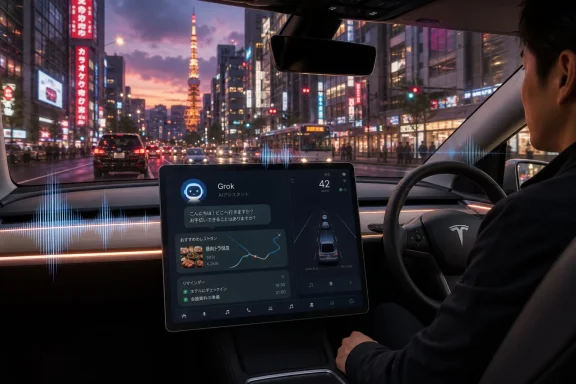
Tesla’s Japanese owners are getting a significant upgrade to the in-car experience as the company formally rolls out xAI’s Grok conversational assistant to compatible vehicles. Delivered through an over-the-air software update, Grok can interpret open-ended requests, hold spoken conversations, recommend destinations, create navigation routes, and use driving context to make its answers more useful. The result is not yet a fully autonomous digital chauffeur, but it is a meaningful shift from rigid voice commands toward an AI “co-pilot” that can understand what occupants are trying to accomplish rather than merely matching their words to a predefined command.
Tesla has treated the automobile as an upgradeable computing platform for more than a decade. Features that would traditionally require a dealership appointment, replacement infotainment unit, or entirely new vehicle can often be delivered through the same basic software distribution model familiar to Windows PC and smartphone users.
That architecture has enabled Tesla to change navigation behavior, add entertainment applications, revise charging logic, improve driver-assistance visualizations, and introduce new interface functions long after a car leaves the factory. Grok’s arrival in Japan demonstrates the strategic value of that model: a sufficiently modern Tesla can gain an entirely new human-machine interface without any physical modification.
That approach works reasonably well for narrow requests such as setting a destination, calling a saved contact, or adjusting the cabin temperature. It often breaks down when the user speaks conversationally, combines multiple requirements, refers to previous dialogue, or leaves important details unstated.
Large language models change the interaction model. Instead of treating every utterance as an isolated command, they can interpret relationships between words, preserve conversational context, ask clarifying questions, and convert a broad objective into one or more structured actions.
Navigation integration followed as Tesla and xAI connected the language model to controlled software tools. This distinction matters: the language model does not need unrestricted access to every subsystem. It can instead formulate a request that a separate, constrained navigation interface validates and executes.
The Japanese rollout comes roughly a year after the initial American deployment. Although Tesla formally announced domestic availability on July 21, 2026, compatible Japanese vehicles reportedly began receiving software version 2026.20.3 in stages from July 10.
That staged approach allows Tesla to monitor reliability, network demand, localization quality, and unexpected behavior before expanding availability. Owners with apparently identical vehicles can therefore receive the same update on different days.
Owners can identify their infotainment processor through the vehicle interface:
Wi-Fi is practical while parked at home, at a charging location, or near a trusted hotspot, but it is less useful during a journey unless the vehicle is tethered to a phone or mobile router. Owners who want consistent access while driving will therefore have the smoothest experience with Tesla’s cellular connectivity service.
A Grok subscription is not currently required simply to use the vehicle integration. Tesla and xAI may revise account requirements, feature limits, or connectivity conditions later, however, particularly as voice inference and real-time search impose continuing cloud-computing costs.
A driver asking Grok to set the cabin temperature may therefore encounter a refusal or redirection, even though the older voice interface can perform that action. Tesla is effectively operating two voice systems in parallel.
A generative model is more flexible but probabilistic. It can misunderstand references, produce inaccurate information, or infer an action the user did not intend. Connecting such a model directly to safety-relevant vehicle controls would require stronger permission boundaries, confirmation rules, state awareness, and extensive validation.
The current architecture reflects a sensible trust hierarchy:
Personality options make sense for casual conversation, quizzes, or entertainment. For navigation, however, a restrained assistant mode is the more practical choice because it prioritizes direct answers and clearer action confirmation over novelty.
A request such as “I’m hungry; find somewhere within ten minutes that has parking and works for children” contains several separate conditions. The assistant must identify the request as a restaurant search, interpret ten minutes as travel time rather than distance, prioritize parking availability, account for family suitability, and return a destination that the navigation system can use.
A competent assistant should understand that these statements refer to the active search rather than treating them as entirely new requests. This reduces the need to repeat every condition and can make voice interaction more efficient than drilling through touchscreen filters.
The feature will still depend on the freshness and accuracy of external business information. Parking details, opening times, child-friendly facilities, and temporary closures can all be incomplete or outdated, so recommendations should not be treated as guaranteed facts.
That sounds simple, but it combines conversational interpretation, task storage, destination understanding, GPS data, and event-based notification. Unlike a timer, the reminder is tied to physical context.
A location-triggered reminder follows the actual journey. It can surface information when the user is most able to act on it, which is the same principle behind smartphone geofencing and location-based automation.
In a vehicle, useful examples might include:
The same combination raises privacy questions. Location, travel patterns, destination history, voice recordings, and conversational content can reveal far more about a person than an ordinary search query. Tesla and xAI must therefore provide clear controls over retention, account synchronization, guest use, and deletion.
This is safer and more reliable than asking a model to generate raw instructions for the vehicle. The assistant can request a destination search or route change through a defined interface, and the vehicle software can reject malformed or unsupported operations.
Performance depends on several layers: microphone quality, background-noise suppression, speech recognition, mobile-network coverage, server load, model inference, search latency, and the responsiveness of Tesla’s navigation software. A failure in any one layer can make the system feel unreliable.
Japanese localization adds further complexity. The assistant must handle polite and casual speech, omitted subjects, regional accents, foreign place names, mixed Japanese and English terminology, and the context-heavy phrasing common in ordinary conversation.
Yet conversational AI can also become a source of cognitive distraction. A fascinating story, argumentative personality, complicated answer, or lengthy list of recommendations may occupy more mental attention than a quick glance at a conventional interface.
Tesla and xAI should optimize the driving context around brevity. Responses delivered while the vehicle is moving should favor concise options, clear confirmations, and the minimum information needed to make a decision.
Good in-car behavior would include:
This could be genuinely useful during long trips or charging stops. The assistant’s ability to adapt content by age, topic, and journey length could make it more flexible than a fixed library of games.
Tesla must nevertheless ensure that entertainment modes do not produce inappropriate material in a family setting. Personality presets marketed as provocative or “unhinged” deserve particularly careful safeguards when used in a shared vehicle.
That division is important, but the word anonymous should not end the discussion. Consumers need to understand which company processes the audio, whether transcripts are retained, how diagnostic logs are handled, whether conversations contribute to product improvement, and what changes when an account is linked.
Tesla owners should examine settings rather than assuming that vehicle use behaves exactly like the standalone Grok application. In-car context may include destinations, route requests, nearby businesses, and incidental speech from passengers.
Particularly sensitive categories include:
Trust will depend not only on written privacy policies but also on predictable interface behavior. Drivers should never have to guess whether Grok is listening, recording, or waiting for another instruction.
The feature may be especially useful in unfamiliar cities, on family trips, or when a driver knows the kind of destination needed but not its name. It can also lower the learning curve for owners who find complex menu structures intimidating.
That is not unique to Tesla. Windows users have experienced similar dividing lines when new operating-system functions require a supported processor, neural processing unit, security module, or graphics architecture.
The automotive version feels more consequential because vehicles are expected to remain in service far longer than consumer electronics. Tesla will face pressure to explain whether Intel-based models are permanently excluded, could receive a reduced cloud-driven implementation, or might qualify through a paid infotainment upgrade where technically possible.
Drivers should verify important details on the display before committing to a route. Grok’s confident tone must not be confused with certainty.
A delivery driver might ask for the next destination with suitable loading access. A field technician could request a reminder to collect equipment on arrival. A rental customer could ask the car to explain charging procedures without navigating a manual.
A managed implementation could eventually support:
Tesla’s advantage is vertical integration. It controls the vehicle software, central interface, OTA pipeline, navigation experience, connectivity service, and much of the hardware stack. Its relationship with xAI adds a closely aligned language-model provider.
Grok strengthens Tesla’s native approach because it gives owners another reason to interact directly with the vehicle rather than reaching for a phone. If it becomes more capable, it could reduce dependence on separate mobile assistants for destination discovery, reminders, and general questions.
Competitors still possess meaningful advantages. Google has extensive mapping, local-business, traffic, and voice-assistant infrastructure, while Microsoft has deep enterprise relationships and a broad AI ecosystem. Amazon has years of experience with ambient voice computing, and Apple retains unusually strong customer loyalty and device integration.
The winner will not necessarily be the assistant with the most entertaining personality. Automotive success will depend on reliability, latency, privacy, localization, and safe access to vehicle functions.
Microsoft’s Copilot strategy, local neural processing in newer PCs, and agent-oriented application interfaces follow the same broad direction. The computer interprets language, gathers context, and invokes approved tools.
The Japanese Grok rollout illustrates several issues familiar to Windows administrators:
Several developments will indicate how serious Tesla is about making Grok a core vehicle interface.
A gradual sequence would be safer than a broad release:
Tesla will need to make context permissions granular. Users should be able to permit navigation access without automatically exposing conversation history, contacts, calendars, or long-term location patterns.
Tesla’s decision will help define what “software-defined vehicle” ownership really means. OTA capability is valuable, but it does not make hardware limitations disappear.
Tesla should favor visible confirmation cards, concise summaries, and reversible actions. A system that says “I found a child-friendly restaurant with parking, eight minutes away—start navigation?” is safer than one that silently changes the route based on an uncertain interpretation.
Regulators may also examine how conversational systems handle driver distraction, personal data, advertising, and misleading recommendations. If AI assistants begin favoring paid destinations or commercial partners, transparent disclosure will become essential.
Tesla’s launch of Grok in Japan marks a practical turning point for conversational AI in cars: the assistant is no longer confined to answering questions but can interpret loosely expressed needs, connect them to location and navigation, and help occupants act without navigating layers of menus. The current beta remains limited, cloud-dependent, and separated from most direct vehicle controls, which is an important safeguard rather than merely a missing feature. If Tesla and xAI can improve accuracy, preserve privacy, minimize distraction, and extend capabilities through tightly controlled tools, Grok could evolve from an entertaining chatbot into the central interface for the software-defined vehicle—an AI passenger that understands not only what the driver says, but what the journey requires.
 Background
Tesla has treated the automobile as an upgradeable computing platform for more than a decade. Features that would traditionally require a dealership appointment, replacement infotainment unit, or entirely new vehicle can often be delivered through the same basic software distribution model familiar to Windows PC and smartphone users.That architecture has enabled Tesla to change navigation behavior, add entertainment applications, revise charging logic, improve driver-assistance visualizations, and introduce new interface functions long after a car leaves the factory. Grok’s arrival in Japan demonstrates the strategic value of that model: a sufficiently modern Tesla can gain an entirely new human-machine interface without any physical modification.
From command recognition to conversational computing
Traditional automotive voice systems depend heavily on intent classification. A driver speaks a phrase, the software attempts to match it to a supported action, and the system either executes a command or returns an error.That approach works reasonably well for narrow requests such as setting a destination, calling a saved contact, or adjusting the cabin temperature. It often breaks down when the user speaks conversationally, combines multiple requirements, refers to previous dialogue, or leaves important details unstated.
Large language models change the interaction model. Instead of treating every utterance as an isolated command, they can interpret relationships between words, preserve conversational context, ask clarifying questions, and convert a broad objective into one or more structured actions.
Grok’s path from chatbot to vehicle assistant
Grok began as xAI’s general-purpose conversational AI and subsequently expanded into voice interaction, real-time information retrieval, and tool-based actions. Tesla first introduced in-car Grok support in the United States in July 2025, initially limiting it largely to conversation and information rather than direct control of the vehicle.Navigation integration followed as Tesla and xAI connected the language model to controlled software tools. This distinction matters: the language model does not need unrestricted access to every subsystem. It can instead formulate a request that a separate, constrained navigation interface validates and executes.
The Japanese rollout comes roughly a year after the initial American deployment. Although Tesla formally announced domestic availability on July 21, 2026, compatible Japanese vehicles reportedly began receiving software version 2026.20.3 in stages from July 10.
How the Japanese Rollout Works
Grok is being distributed as an OTA update, so owners do not need to visit a Tesla service center or replace the infotainment computer. As with other Tesla updates, delivery may be staggered rather than reaching every eligible vehicle simultaneously.That staged approach allows Tesla to monitor reliability, network demand, localization quality, and unexpected behavior before expanding availability. Owners with apparently identical vehicles can therefore receive the same update on different days.
Hardware and software requirements
Not every Tesla in Japan can run the in-car Grok experience. Current eligibility centers on vehicles equipped with an AMD-based infotainment processor, generally found in newer production vehicles, along with an appropriate software version.Owners can identify their infotainment processor through the vehicle interface:
- Open Controls on the center display.
- Select Software.
- Open Additional Vehicle Information.
- Check the entry for the infotainment processor.
- Confirm that the installed vehicle software supports Grok in the local market.
Connectivity remains essential
Grok relies on cloud processing rather than operating entirely inside the car. Tesla documentation says that Premium Connectivity or a stable Wi-Fi connection is required.Wi-Fi is practical while parked at home, at a charging location, or near a trusted hotspot, but it is less useful during a journey unless the vehicle is tethered to a phone or mobile router. Owners who want consistent access while driving will therefore have the smoothest experience with Tesla’s cellular connectivity service.
A Grok subscription is not currently required simply to use the vehicle integration. Tesla and xAI may revise account requirements, feature limits, or connectivity conditions later, however, particularly as voice inference and real-time search impose continuing cloud-computing costs.
Grok Is Not Just a Replacement for Existing Voice Commands
The most important limitation is also one of the easiest to misunderstand: Grok does not currently replace all of Tesla’s established vehicle commands. It can converse, retrieve information, interpret destination requests, and interact with navigation, but functions such as climate adjustment and media control still rely on Tesla’s conventional voice-command system.A driver asking Grok to set the cabin temperature may therefore encounter a refusal or redirection, even though the older voice interface can perform that action. Tesla is effectively operating two voice systems in parallel.
Why Tesla is keeping the systems separate
A conventional command parser is narrow but predictable. If “set the temperature to 22 degrees” maps to an approved climate-control function, the action has a defined range and an easily tested result.A generative model is more flexible but probabilistic. It can misunderstand references, produce inaccurate information, or infer an action the user did not intend. Connecting such a model directly to safety-relevant vehicle controls would require stronger permission boundaries, confirmation rules, state awareness, and extensive validation.
The current architecture reflects a sensible trust hierarchy:
- Conversational Grok handles open-ended language, information, recommendations, and supported navigation tasks.
- Tesla’s established command system continues handling deterministic cabin and media controls.
- Driving functions remain separate from both conversational entertainment and ordinary infotainment commands.
Activation and personality options
Drivers can launch Grok from the application launcher, press and hold the relevant steering-wheel control, or use the supported “Hey Grok” wake phrase. Tesla also offers selectable voices and personalities, ranging from straightforward assistant behavior to more expressive modes such as Storyteller.Personality options make sense for casual conversation, quizzes, or entertainment. For navigation, however, a restrained assistant mode is the more practical choice because it prioritizes direct answers and clearer action confirmation over novelty.
Natural Conversation Changes the Navigation Experience
Navigation is where Grok can offer more than a superficial chatbot bolted onto a dashboard. A traditional system expects the driver to know the name, category, or address of a destination. Grok can begin with the user’s underlying need.A request such as “I’m hungry; find somewhere within ten minutes that has parking and works for children” contains several separate conditions. The assistant must identify the request as a restaurant search, interpret ten minutes as travel time rather than distance, prioritize parking availability, account for family suitability, and return a destination that the navigation system can use.
Turning vague intent into structured criteria
A language model can transform an informal sentence into a set of machine-readable constraints:- The destination type should be a restaurant or comparable food venue.
- Estimated travel time should remain within the requested limit.
- The venue should offer parking or have practical parking nearby.
- The recommendation should be appropriate for a family with children.
- The venue should likely be open at the expected arrival time.
- The final result must resolve to a location that Tesla navigation recognizes.
Multi-turn refinement
Conversational continuity makes destination search more useful. After receiving several suggestions, a driver might say, “Not that one—the quieter place,” “Choose the option with faster charging nearby,” or “Make it somewhere we can reach before it closes.”A competent assistant should understand that these statements refer to the active search rather than treating them as entirely new requests. This reduces the need to repeat every condition and can make voice interaction more efficient than drilling through touchscreen filters.
The feature will still depend on the freshness and accuracy of external business information. Parking details, opening times, child-friendly facilities, and temporary closures can all be incomplete or outdated, so recommendations should not be treated as guaranteed facts.
Location-Aware Reminders Expand the Car’s Role
One of the more interesting Japanese use cases is a reminder connected to the vehicle’s location. An occupant can ask Grok to provide a reminder when the car approaches or reaches a destination, such as remembering to buy milk on arrival at a supermarket.That sounds simple, but it combines conversational interpretation, task storage, destination understanding, GPS data, and event-based notification. Unlike a timer, the reminder is tied to physical context.
Why location is more useful than time
A reminder scheduled for 6:00 p.m. assumes the journey will proceed as planned. Traffic, charging stops, weather, or a route change may make the reminder arrive too early or too late.A location-triggered reminder follows the actual journey. It can surface information when the user is most able to act on it, which is the same principle behind smartphone geofencing and location-based automation.
In a vehicle, useful examples might include:
- The assistant can remind an owner to collect an item when approaching home.
- It can surface a shopping list on arrival at a store.
- It can remind a driver to use a particular parking entrance near a venue.
- It can prompt an employee to bring equipment when reaching a customer site.
- It can remind a family to retrieve luggage or a child’s bag at the destination.
Context creates both value and sensitivity
The usefulness comes from combining information that would otherwise remain separate. The car knows where it is, where it is going, and approximately when it will arrive, while the assistant understands the user’s spoken intent.The same combination raises privacy questions. Location, travel patterns, destination history, voice recordings, and conversational content can reveal far more about a person than an ordinary search query. Tesla and xAI must therefore provide clear controls over retention, account synchronization, guest use, and deletion.
The Technical Architecture Behind an AI Co-Pilot
Tesla has not published every implementation detail, but the broad structure resembles an increasingly common agent architecture. The language model interprets the user’s request, while specialized software tools retrieve data or perform approved actions.This is safer and more reliable than asking a model to generate raw instructions for the vehicle. The assistant can request a destination search or route change through a defined interface, and the vehicle software can reject malformed or unsupported operations.
Cloud inference and vehicle-side execution
The likely interaction flow is:- The vehicle captures the spoken request.
- Audio or a transcription is sent through an encrypted network connection.
- xAI’s voice and language systems interpret the request.
- Grok determines whether it can answer conversationally or needs a navigation tool.
- A constrained request is passed to the vehicle’s supported service.
- The car displays or announces the result.
- The driver confirms or continues the conversation where appropriate.
Latency becomes part of product quality
Conversational intelligence means little if responses arrive too slowly. In a moving car, users expect an assistant to acknowledge a request quickly, especially when changing a route or finding an urgent stop.Performance depends on several layers: microphone quality, background-noise suppression, speech recognition, mobile-network coverage, server load, model inference, search latency, and the responsiveness of Tesla’s navigation software. A failure in any one layer can make the system feel unreliable.
Japanese localization adds further complexity. The assistant must handle polite and casual speech, omitted subjects, regional accents, foreign place names, mixed Japanese and English terminology, and the context-heavy phrasing common in ordinary conversation.
Driver Attention and Road Safety
A successful voice assistant can reduce the need to look at a touchscreen. That is especially valuable in Tesla vehicles, where many controls and information panels are concentrated on the central display.Yet conversational AI can also become a source of cognitive distraction. A fascinating story, argumentative personality, complicated answer, or lengthy list of recommendations may occupy more mental attention than a quick glance at a conventional interface.
Hands-free does not mean distraction-free
Physical distraction and cognitive distraction are different. Keeping both hands on the wheel does not guarantee that the driver is mentally focused on traffic.Tesla and xAI should optimize the driving context around brevity. Responses delivered while the vehicle is moving should favor concise options, clear confirmations, and the minimum information needed to make a decision.
Good in-car behavior would include:
- The assistant should shorten answers automatically while the vehicle is moving.
- It should avoid reading long search results unless explicitly requested.
- It should confirm destination changes without demanding a complicated dialogue.
- It should defer non-urgent content when driving conditions require attention.
- It should distinguish clearly between verified navigation actions and speculative recommendations.
Passenger entertainment is a legitimate use case
The traffic-jam example involving bored children highlights a different role. Grok can generate trivia, quizzes, explanations, or improvised stories without requiring the driver to operate another device.This could be genuinely useful during long trips or charging stops. The assistant’s ability to adapt content by age, topic, and journey length could make it more flexible than a fixed library of games.
Tesla must nevertheless ensure that entertainment modes do not produce inappropriate material in a family setting. Personality presets marketed as provocative or “unhinged” deserve particularly careful safeguards when used in a shared vehicle.
Privacy, Data Handling, and Trust
Tesla’s Japanese owner documentation says Grok conversations are sent in a way that is anonymous to Tesla and are not associated with the vehicle. Processing is handled by xAI, and users can interact without necessarily linking a persistent Grok account.That division is important, but the word anonymous should not end the discussion. Consumers need to understand which company processes the audio, whether transcripts are retained, how diagnostic logs are handled, whether conversations contribute to product improvement, and what changes when an account is linked.
Account linking changes the privacy model
Guest mode can minimize personalization and prevent conversations from following the user across devices. Signing in can provide history synchronization, preferences, and continuity, but it also creates a more persistent identity relationship.Tesla owners should examine settings rather than assuming that vehicle use behaves exactly like the standalone Grok application. In-car context may include destinations, route requests, nearby businesses, and incidental speech from passengers.
Particularly sensitive categories include:
- Home, work, school, and medical destinations can reveal private routines.
- Spoken conversations may capture information from passengers who never agreed to use the service.
- Search requests can disclose health, financial, political, or relationship concerns.
- Location-aware reminders can expose planned purchases and personal obligations.
- Synced history can make vehicle conversations accessible from other logged-in devices.
Clear feedback is essential
The vehicle should make it obvious when the microphone is active, when cloud processing is occurring, and whether the user is in guest or signed-in mode. A wake-word system must also minimize false activations caused by ordinary conversation, radio audio, or passengers.Trust will depend not only on written privacy policies but also on predictable interface behavior. Drivers should never have to guess whether Grok is listening, recording, or waiting for another instruction.
What This Means for Tesla Owners in Japan
For consumers, the immediate value will depend on how often they use navigation and how comfortable they are speaking to their car. Drivers who already rely on the center display for restaurant searches, charging stops, and route changes are likely to notice the greatest benefit.The feature may be especially useful in unfamiliar cities, on family trips, or when a driver knows the kind of destination needed but not its name. It can also lower the learning curve for owners who find complex menu structures intimidating.
The hardware divide may frustrate existing customers
Owners of older Tesla vehicles may see Grok as another example of software support becoming dependent on newer infotainment hardware. Their cars can remain mechanically capable and receive routine updates while missing highly visible features delivered to more recent models.That is not unique to Tesla. Windows users have experienced similar dividing lines when new operating-system functions require a supported processor, neural processing unit, security module, or graphics architecture.
The automotive version feels more consequential because vehicles are expected to remain in service far longer than consumer electronics. Tesla will face pressure to explain whether Intel-based models are permanently excluded, could receive a reduced cloud-driven implementation, or might qualify through a paid infotainment upgrade where technically possible.
The feature is still a beta
Owners should approach Grok as an evolving assistant rather than an infallible source. It can misunderstand a destination, recommend an unsuitable business, produce inaccurate information, or fail when connectivity deteriorates.Drivers should verify important details on the display before committing to a route. Grok’s confident tone must not be confused with certainty.
Enterprise and Fleet Implications
Although Tesla presents Grok mainly as a consumer convenience, the underlying architecture has potential fleet applications. Natural-language interfaces can reduce training requirements for drivers who need to locate sites, manage stops, or retrieve procedural information.A delivery driver might ask for the next destination with suitable loading access. A field technician could request a reminder to collect equipment on arrival. A rental customer could ask the car to explain charging procedures without navigating a manual.
Business deployment requires stronger controls
Enterprise operators will need features beyond those required by individual owners. They may want centralized policy management, restricted personality modes, audit controls, data-retention settings, and the ability to disable account linking.A managed implementation could eventually support:
- Fleet-approved destinations and preferred charging networks.
- Location-triggered checklists for service calls.
- Company-specific safety instructions.
- Multilingual guidance for temporary drivers.
- Integration with dispatch and scheduling systems.
- Restrictions on entertainment or unapproved external searches.
Competitive Implications for the Automotive Industry
Tesla is not alone in pursuing conversational in-car AI. Automakers, infotainment suppliers, smartphone-platform companies, and AI developers are all attempting to replace brittle voice menus with assistants that can understand intent.Tesla’s advantage is vertical integration. It controls the vehicle software, central interface, OTA pipeline, navigation experience, connectivity service, and much of the hardware stack. Its relationship with xAI adds a closely aligned language-model provider.
The battle is moving beyond smartphone projection
Apple CarPlay and Android Auto established the smartphone as the driver’s primary digital ecosystem. Automakers responded by investing in native infotainment platforms that keep navigation, data, subscriptions, and customer relationships under their own control.Grok strengthens Tesla’s native approach because it gives owners another reason to interact directly with the vehicle rather than reaching for a phone. If it becomes more capable, it could reduce dependence on separate mobile assistants for destination discovery, reminders, and general questions.
Competitors still possess meaningful advantages. Google has extensive mapping, local-business, traffic, and voice-assistant infrastructure, while Microsoft has deep enterprise relationships and a broad AI ecosystem. Amazon has years of experience with ambient voice computing, and Apple retains unusually strong customer loyalty and device integration.
The winner will not necessarily be the assistant with the most entertaining personality. Automotive success will depend on reliability, latency, privacy, localization, and safe access to vehicle functions.
Why Windows and PC Users Should Pay Attention
Grok in Tesla reflects the same transition now reshaping Windows: software is moving from menu-driven interaction toward intent-driven agents. Instead of learning the exact location of a setting or the syntax of a command, users increasingly describe a desired outcome.Microsoft’s Copilot strategy, local neural processing in newer PCs, and agent-oriented application interfaces follow the same broad direction. The computer interprets language, gathers context, and invokes approved tools.
Cars are becoming managed endpoint devices
A modern Tesla resembles a specialized network endpoint more than a conventional dashboard. It has a processor architecture, operating environment, application layer, cloud identity, update channel, network subscription, sensors, permissions, and long-term support constraints.The Japanese Grok rollout illustrates several issues familiar to Windows administrators:
- Hardware generations determine access to new software experiences.
- Cloud features can create recurring connectivity costs.
- AI assistants require carefully limited permissions.
- Updates must be staged and monitored.
- Identity choices affect personalization and privacy.
- Legacy compatibility remains a long-term support challenge.
- A natural-language interface does not eliminate the need for deterministic controls.
Strengths and Opportunities
Grok’s Japanese debut is significant because it combines conversation with practical vehicle context rather than limiting AI to a dashboard chatbot. Its strongest opportunities are clear.- Natural-language destination search lowers interaction friction. Drivers can describe constraints and intentions instead of knowing an exact venue name.
- Navigation integration gives the assistant a practical purpose. The system can convert a recommendation into an actionable route rather than merely discussing possibilities.
- OTA delivery demonstrates Tesla’s software-platform advantage. Compatible vehicles gain a major interface feature without workshop labor or replacement hardware.
- Location-aware reminders can surface information at the right moment. GPS context is often more useful than a fixed alarm during an unpredictable journey.
- Conversational entertainment can improve family travel. Quizzes, stories, and age-appropriate explanations offer a flexible alternative to additional screens.
- Japanese language support broadens xAI’s localization test bed. Real-world driving provides demanding conditions involving noise, accents, place names, and mixed-language speech.
- The tool-based architecture can expand gradually. Tesla can add tightly controlled capabilities without granting unrestricted vehicle access.
- Fleet workflows could emerge later. Destination management, site reminders, charging guidance, and company knowledge could support commercial use if administrative controls mature.
Risks and Concerns
The same combination of AI, location, identity, and vehicle software creates risks that Tesla and xAI cannot treat as ordinary chatbot imperfections.- Hallucinated information can produce bad destination decisions. Opening hours, parking availability, accessibility, and suitability for children may be incorrect or outdated.
- Conversation can become cognitively distracting. A hands-free interface may still divert attention from traffic if answers are lengthy or emotionally engaging.
- Cloud dependence reduces reliability. Weak cellular coverage, service interruptions, or server congestion can make the assistant unavailable when it is most needed.
- Privacy explanations may be too abstract for ordinary drivers. Users need understandable controls for recordings, transcripts, history, account linking, and deletion.
- Passengers may be captured incidentally. A shared cabin complicates consent, especially when children, employees, or rental customers are present.
- The split between Grok and legacy voice commands may confuse owners. Users must learn which assistant handles navigation and which system controls climate or media.
- Older vehicles face increasing feature exclusion. The AMD processor requirement may deepen concerns about the software lifespan of otherwise serviceable cars.
- Provocative personality modes create brand and safety exposure. Humor or edgy responses that might be acceptable on a personal phone can be inappropriate in a family vehicle.
- Broader control permissions could increase future security consequences. Every additional vehicle tool must be authenticated, constrained, logged, and protected from accidental or malicious activation.
What to Watch Next
The Japanese rollout should be viewed as the beginning of a localization and integration cycle, not the final form of Tesla’s in-car assistant. Real-world usage will show whether Grok can consistently recognize Japanese speech in noisy cabins and whether its destination recommendations are sufficiently accurate to earn driver trust.Several developments will indicate how serious Tesla is about making Grok a core vehicle interface.
Expansion beyond navigation
The most obvious next step is controlled access to climate, media, charging, messaging, and vehicle information. Tesla may initially require explicit confirmation for actions that change settings, initiate communications, or affect energy use.A gradual sequence would be safer than a broad release:
- Grok could first answer questions about current vehicle status.
- It could then suggest an action without executing it.
- Low-risk controls could become available with verbal confirmation.
- More consequential commands could require an on-screen approval.
- Safety-sensitive systems would remain isolated or subject to much stricter rules.
Better awareness without excessive surveillance
A truly capable co-pilot could consider route progress, charging state, weather, calendar commitments, passenger preferences, and expected arrival time. Each additional context source makes the assistant more useful, but it also increases the sensitivity of the profile it can construct.Tesla will need to make context permissions granular. Users should be able to permit navigation access without automatically exposing conversation history, contacts, calendars, or long-term location patterns.
Support for older vehicles
The treatment of Intel-based infotainment systems will be closely watched. A reduced feature set, phone-assisted mode, or hardware retrofit could preserve customer goodwill, although technical and economic limitations may prevent universal support.Tesla’s decision will help define what “software-defined vehicle” ownership really means. OTA capability is valuable, but it does not make hardware limitations disappear.
Accuracy and confirmation design
The best measure of success will not be how human Grok sounds. It will be how often the assistant selects the right destination, displays the correct action, and gives the driver an easy opportunity to catch a mistake.Tesla should favor visible confirmation cards, concise summaries, and reversible actions. A system that says “I found a child-friendly restaurant with parking, eight minutes away—start navigation?” is safer than one that silently changes the route based on an uncertain interpretation.
International policy and localization
Japan’s dense urban geography, complex addresses, multilingual place names, extensive parking constraints, and highly developed public infrastructure create a demanding environment for location-based AI. Performance there may reveal weaknesses that were less visible in American testing.Regulators may also examine how conversational systems handle driver distraction, personal data, advertising, and misleading recommendations. If AI assistants begin favoring paid destinations or commercial partners, transparent disclosure will become essential.
Tesla’s launch of Grok in Japan marks a practical turning point for conversational AI in cars: the assistant is no longer confined to answering questions but can interpret loosely expressed needs, connect them to location and navigation, and help occupants act without navigating layers of menus. The current beta remains limited, cloud-dependent, and separated from most direct vehicle controls, which is an important safeguard rather than merely a missing feature. If Tesla and xAI can improve accuracy, preserve privacy, minimize distraction, and extend capabilities through tightly controlled tools, Grok could evolve from an entertaining chatbot into the central interface for the software-defined vehicle—an AI passenger that understands not only what the driver says, but what the journey requires.
References
- Primary source: finance.biggo.com
Published: 2026-07-21T04:05:34+00:00
Tesla's Conversational AI 'Grok' Lands in Japan, Becoming a "Co-Pilot Assistant" That Handles Voice Chat and Navigation — BigGo Finance
Tesla began rolling out its conversational AI assistant "Grok" to compatible vehicles in Japan on July 21. The update is delivered via an over-the-air…finance.biggo.com - Related coverage: tesla.com
- Related coverage: x.ai
- Related coverage: touchlab.jp
【新機能】国内のテスラに対話型AI「Grok」が追加〜無料アップデートで配信 | Touch Lab - タッチ ラボ
日本経済新聞が、テスラが日本国内で対話型AI「Grok」のTesla車への搭載を始めた、と報じました。 ソフトウエアを無線通信で更新するOTA(Over-the-Air)を通じて、対応車種へ順次無料で配信するとのこと。対話は日本語や英語など touchlab.jp
- Related coverage: techradar.com
Tesla introduces Grok AI into some of its cars, but it can’t control the vehicle… yet | TechRadar
It is happy to answer silly questions thoughwww.techradar.com - Related coverage: cincodias.elpais.com