

A viral demonstration in which former NASA engineer and YouTuber Mark Rober drove a Tesla Model Y toward a Looney Tunes-style wall painted to resemble an open road has returned to the spotlight, reigniting an unusually important debate beneath the cartoon spectacle: Can a camera-dependent driver-assistance system reliably distinguish a convincing image from a real, traversable environment? The Tesla struck the lightweight wall used in the test, while a specially equipped Lexus test vehicle using lidar stopped before impact. Yet the experiment, originally published in March 2025 and recirculated on July 21, 2026, is not the clean verdict on Tesla Autopilot, Full Self-Driving, or lidar that viral retellings suggest. It is better understood as a vivid demonstration of sensor limitations, software ambiguity, testing pitfalls, and the dangerous gap between what automated driving technology can do and what drivers may believe it can do.
Mark Rober built his online following by turning engineering concepts into large-scale, visually memorable experiments. A painted wall inspired by Wile E. Coyote’s doomed attempts to catch the Road Runner was therefore a natural fit: immediately understandable, inherently entertaining, and capable of communicating a complex machine-perception problem in seconds.
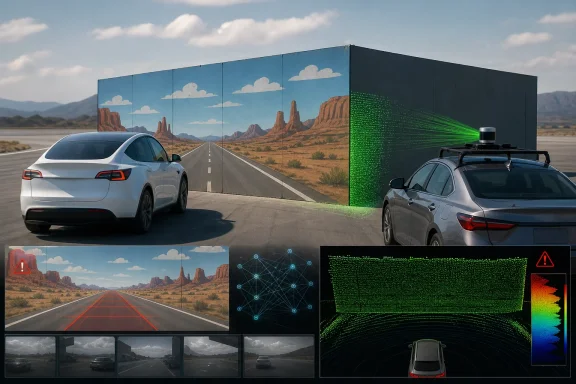
The demonstration compared Rober’s Tesla Model Y with a Lexus RX modified as a research vehicle and fitted with lidar technology supplied by automotive sensor company Luminar. The Lexus was not simply an ordinary showroom model with a consumer driver-assistance package comparable to Tesla Autopilot. It was a specially configured test platform, an important distinction that many shortened reports have omitted.
The lidar-equipped Lexus identified a physical obstruction and stopped. The Model Y continued through the barrier, producing the video’s dramatic conclusion and Rober’s joke that his Tesla was “less Road Runner, and more Wile E. Coyote.”
The significant question is not whether drivers should fear cartoon murals. It is whether a vehicle can maintain an accurate understanding of depth and free space when visual information becomes confusing, incomplete, or deliberately deceptive.
Tesla Autopilot generally refers to a collection of Level 2 driver-assistance functions centered on traffic-aware cruise control and automated lane steering. Full Self-Driving (Supervised), commonly abbreviated to FSD, is a more ambitious software package designed to perform a broader range of driving tasks, but it also remains supervised and requires an attentive human driver.
That legal and technical limitation does not excuse poor obstacle detection. It does, however, change what the test proves. A failure by a Level 2 system is not automatically evidence that every version of Tesla’s driving software would respond identically, nor is it a test of a fully autonomous Tesla service.
Later unofficial recreations reportedly produced mixed results depending on the Tesla model, hardware generation, software version, wall construction, approach angle, and selected driver-assistance mode. Some newer vehicles running FSD stopped, while other configurations appeared to fail.
Those results do not invalidate Rober’s collision. They show why one run involving one vehicle and one software configuration cannot establish a universal rule about an evolving fleet.
Even if disengagement occurred only moments before impact, the test would still raise a perception question: why had the vehicle not reacted earlier? But the distinction matters scientifically. A system that remained engaged and chose to drive into an obstacle represents a different failure from one that disengaged and returned control to the driver without enough time or clarity to avoid it.
The strategy reflects Tesla’s belief that visual sensing, large-scale fleet data, and sufficiently capable artificial intelligence can solve driving without expensive active sensors. Humans drive primarily with vision, the argument goes, so a machine equipped with multiple cameras should ultimately be able to do the same—while looking in several directions continuously.
With overlapping camera views and movement through the environment, a neural network can estimate depth and build an internal representation of lanes, vehicles, pedestrians, curbs, signs, traffic lights, and open space. This is often called occupancy or scene understanding, although specific implementations vary.
The difficult part is that the camera does not directly measure distance. It captures visual evidence from which distance must be estimated.
A human quickly recognizes the trick because of contextual clues, binocular depth perception, head movement, surface reflections, edge visibility, prior knowledge, and the improbability of a road continuing through a vertical sheet. A vehicle’s network may not combine those cues correctly, particularly if the image resembles training examples associated with open roadway.
The result need not be a literal belief that the wall is a tunnel. The system may simply assign insufficient confidence to the presence of a collision-relevant obstacle.
The real engineering dispute is therefore not “cameras or no cameras.” Every serious automated-driving platform uses cameras. The debate concerns whether cameras should operate as the primary environmental sensor or be supported by independent depth-measuring technologies.
Unlike a camera, lidar does not need to infer all depth from the visual appearance of an object. A wall printed with an image of a road may look visually open, but the laser returns still indicate a surface occupying space directly ahead.
For an automated-driving stack, direct range measurements can provide several benefits:
A lidar unit can report that an object exists without explaining what it is. Cameras and classification software are still needed to determine whether a shape is a pedestrian, a plastic bag, a road sign, vegetation, or an overhead structure that does not block the vehicle’s path.
The strongest case for lidar is not that it replaces vision. It is that different sensors fail in different ways, allowing the vehicle to cross-check its interpretation.
That decline weakens the historical argument that lidar is automatically too expensive for consumer vehicles. Cost still matters at automotive scale, but the debate now includes packaging, software complexity, supply chains, aesthetics, reliability, and Tesla’s enormous investment in a vision-first architecture.
The vehicles did not simply differ by one sensor. They used different hardware, different software, different control systems, and potentially different intervention logic. One was a consumer Tesla using an available driver-assistance feature; the other was a modified Lexus carrying a lidar supplier’s development system.
That is difficult outside a laboratory or automotive proving ground. It is also less entertaining than sending two visibly different vehicles toward a cartoon wall.
The Lexus result establishes that its particular sensor-and-software configuration detected the obstruction. It does not prove that every lidar-equipped production car would stop, because lidar data must still be interpreted and connected to braking logic.
A sensor supplier naturally designs a demonstration around situations where its technology performs well. Tesla could similarly produce scenarios favoring fleet-trained vision, semantic recognition, or cost-efficient deployment.
A proper safety evaluation would require hundreds or thousands of repeatable tests. It would vary speed, lighting, weather, wall angle, image resolution, hardware version, software release, approach path, and driver inputs while recording raw sensor data and system state.
The principle is simple: a single failure should not immediately produce a catastrophic outcome. Automated-driving perception complicates that principle because multiple cameras processed by one model may appear redundant while still sharing the same underlying weakness.
Adding radar or lidar can create informational redundancy. Radar measures radio reflections and relative velocity. Lidar measures distance through laser returns. Cameras record rich visual information. Their errors are not perfectly independent, but they are different enough to support cross-checking.
Poorly designed fusion can produce phantom braking, hesitation, or unsafe confidence. Engineers must calibrate sensors precisely, synchronize timestamps, account for occlusion, model uncertainty, and establish fail-safe behavior when inputs conflict.
The central advantage is optionality. A well-designed multimodal system has another source of evidence when one modality encounters its blind spot.
That strategy offers lower hardware cost and simpler manufacturing across millions of vehicles. It also gives Tesla access to an enormous stream of driving examples that can be used to identify failures and train improved models.
The unresolved question is whether scale and neural networks can provide enough reliability for unsupervised operation without an independent active depth sensor.
In practical use, Tesla instructs drivers to remain attentive, keep control of the vehicle, and be prepared to intervene. These systems are generally categorized as SAE Level 2 assistance, meaning they can control steering and speed simultaneously but do not transfer responsibility away from the driver.
The better the system drives under ordinary conditions, the easier it becomes for a person to relax, become distracted, or assume that unusual hazards will also be handled. When intervention is finally required, the driver may have only seconds—or less—to understand the situation and act.
A painted-wall test dramatizes this paradox. If the driver sees the obstacle and knows the system may fail, responsibility clearly requires braking. But a system marketed for convenience can encourage users to wait for it to react, especially when they are intentionally testing its limits.
This is why arguments about whether Autopilot remained active are not merely defensive details. They expose a fundamental design issue: A safety-critical system must make its operational state obvious to the human expected to supervise it.
Regulators, safety organizations, and automakers continue to wrestle with how terminology affects misuse. The engineering challenge cannot be separated from the communication challenge.
The goal should not be to make Tesla win or fail. It should be to determine what the vehicle detected, when it detected it, what control command followed, and how consistently the behavior could be reproduced.
Mixing a production Level 2 feature with a supplier-operated prototype risks confusing technological potential with deployed capability. The prototype may demonstrate what lidar can enable, while the Tesla shows how a current consumer implementation behaves; those are both useful findings, but they answer different questions.
The best benchmark would combine ordinary frequency with high-consequence edge cases. Rare events still matter in road safety, but common situations provide the statistical foundation needed to evaluate practical performance.
The lesson is that assistance must remain assistance. Drivers cannot assume the vehicle understands every object simply because the visualization shows lane lines, surrounding traffic, or a planned path.
Hardware generations matter as well. Camera resolution, placement, processing performance, and available sensing can differ across production years even when the vehicles carry the same Model Y badge.
Owners should therefore avoid treating any viral success or failure as proof of how their exact car will behave. The only safe assumption is that supervision remains necessary.
Tesla’s strategy is especially influential because the company deploys software rapidly across a large fleet. If vision-first automation proves scalable and safe, competitors carrying more expensive sensor packages may face pressure to simplify their designs.
A standardized camera suite also allows Tesla to collect broadly comparable data and distribute one evolving software architecture. That scale is a genuine competitive advantage.
However, lower hardware cost is valuable only if software can meet the required safety target. A cheap sensor suite that produces costly liability, recalls, insurance losses, or regulatory restrictions is not economically efficient.
That makes familiar IT concerns directly relevant: version control, rollback capability, regression testing, hardware compatibility, cybersecurity, logs, user permissions, and transparent release notes. A perception update can alter physical behavior in a way that an ordinary desktop patch cannot.
The software-defined vehicle therefore needs stronger—not weaker—change management. A model that improves urban driving but regresses on obstacle recognition would represent a serious safety defect even if overall performance appeared better.
Rare does not mean irrelevant when a system is expected to operate across billions of miles.
The decisive issue will be whether those systems can demonstrate reliable behavior across both common roads and difficult edge cases without relying on a human to rescue them at the last second.
Future programs should include low-contrast obstacles, misleading visual patterns, partial occlusion, emergency vehicles, temporary traffic control, and sudden sensor degradation. Results should clearly identify the active software version and hardware configuration.
Manufacturers must protect privacy and intellectual property, but those concerns should not prevent meaningful investigation of safety-critical behavior. Trust improves when failures can be reconstructed precisely.
That transition magnifies every issue raised by the painted wall. Sensor blind spots, ambiguous free space, unclear system state, and weak fallback behavior become much harder to tolerate once the steering wheel is empty.
The most informative result may be inconsistency. A safety system that stops nine times and collides once still requires investigation, particularly if developers cannot predict the conditions that produce the failure.
Mark Rober’s cartoon wall succeeded because it condensed a sprawling technical dispute into one unforgettable image: a sophisticated electric vehicle driving through scenery that a laser-equipped machine recognized as solid. The collision should not be treated as a final judgment against Tesla Vision, nor should methodological criticism make the failure irrelevant. It demonstrates that machine perception is not equivalent to human understanding, that the label attached to a driver-assistance feature matters, and that sensor choice is only one part of a much larger safety architecture. As Tesla and its competitors move toward increasingly automated vehicles, the winners will not be determined by the most entertaining stunt or the loudest online defense. They will be determined by which systems recognize their own uncertainty, respond safely to the unexpected, and prove through repeatable evidence that they can handle the real world—even when the real world briefly looks like a cartoon.
 Background
Mark Rober built his online following by turning engineering concepts into large-scale, visually memorable experiments. A painted wall inspired by Wile E. Coyote’s doomed attempts to catch the Road Runner was therefore a natural fit: immediately understandable, inherently entertaining, and capable of communicating a complex machine-perception problem in seconds.The demonstration compared Rober’s Tesla Model Y with a Lexus RX modified as a research vehicle and fitted with lidar technology supplied by automotive sensor company Luminar. The Lexus was not simply an ordinary showroom model with a consumer driver-assistance package comparable to Tesla Autopilot. It was a specially configured test platform, an important distinction that many shortened reports have omitted.
The basic experiment
Rober placed a printed or painted representation of the road and surrounding landscape across a lightweight barrier. From the approaching vehicle’s viewpoint, the image was intended to create the illusion that the road continued through the structure.The lidar-equipped Lexus identified a physical obstruction and stopped. The Model Y continued through the barrier, producing the video’s dramatic conclusion and Rober’s joke that his Tesla was “less Road Runner, and more Wile E. Coyote.”
More than a cartoon stunt
A fake tunnel painted on a wall is not a normal road hazard. Even so, the underlying problem is relevant because real roads contain less theatrical forms of visual ambiguity, including unusual trailers, low-contrast obstacles, shadows, glare, smoke, heavy rain, temporary barriers, road works, and objects whose printed appearance does not match their physical shape.The significant question is not whether drivers should fear cartoon murals. It is whether a vehicle can maintain an accurate understanding of depth and free space when visual information becomes confusing, incomplete, or deliberately deceptive.
What the Video Actually Tested
The first challenge in interpreting the experiment is terminology. Reports have frequently used “Autopilot,” “Full Self-Driving,” “self-driving,” and “autonomous” as though they describe the same Tesla product. They do not.Tesla Autopilot generally refers to a collection of Level 2 driver-assistance functions centered on traffic-aware cruise control and automated lane steering. Full Self-Driving (Supervised), commonly abbreviated to FSD, is a more ambitious software package designed to perform a broader range of driving tasks, but it also remains supervised and requires an attentive human driver.
Autopilot is not autonomous driving
Neither ordinary Autopilot nor consumer FSD turns a Tesla into a vehicle whose occupant can safely stop monitoring the road. The human driver remains responsible for supervising the system, recognizing failures, and intervening before a collision.That legal and technical limitation does not excuse poor obstacle detection. It does, however, change what the test proves. A failure by a Level 2 system is not automatically evidence that every version of Tesla’s driving software would respond identically, nor is it a test of a fully autonomous Tesla service.
The FSD question
Rober’s presentation focused broadly on “self-driving cars,” but the Tesla footage was widely understood to involve Autopilot rather than the newer FSD software stack. Critics argued that this created an uneven comparison because FSD uses more sophisticated neural-network-based perception and planning than Tesla’s basic lane-centering system.Later unofficial recreations reportedly produced mixed results depending on the Tesla model, hardware generation, software version, wall construction, approach angle, and selected driver-assistance mode. Some newer vehicles running FSD stopped, while other configurations appeared to fail.
Those results do not invalidate Rober’s collision. They show why one run involving one vehicle and one software configuration cannot establish a universal rule about an evolving fleet.
Questions about engagement
Observers also scrutinized the Tesla’s on-screen status indicators and argued that Autopilot may have disengaged shortly before impact. A steering input, accelerator override, loss of lane confidence, or another intervention can cancel or partially override driver assistance.Even if disengagement occurred only moments before impact, the test would still raise a perception question: why had the vehicle not reacted earlier? But the distinction matters scientifically. A system that remained engaged and chose to drive into an obstacle represents a different failure from one that disengaged and returned control to the driver without enough time or clarity to avoid it.
How Tesla Vision Sees the Road
Tesla’s current consumer vehicles rely heavily on cameras and neural-network software to interpret their surroundings. The company progressively removed forward radar from major models beginning in 2021 and later removed ultrasonic parking sensors from many vehicles, shifting those functions toward its camera-based Tesla Vision architecture.The strategy reflects Tesla’s belief that visual sensing, large-scale fleet data, and sufficiently capable artificial intelligence can solve driving without expensive active sensors. Humans drive primarily with vision, the argument goes, so a machine equipped with multiple cameras should ultimately be able to do the same—while looking in several directions continuously.
From pixels to geometry
A camera records light projected onto a two-dimensional sensor. Software must infer the three-dimensional world from image features such as perspective, motion, texture, object boundaries, relative size, occlusion, and changes between consecutive frames.With overlapping camera views and movement through the environment, a neural network can estimate depth and build an internal representation of lanes, vehicles, pedestrians, curbs, signs, traffic lights, and open space. This is often called occupancy or scene understanding, although specific implementations vary.
The difficult part is that the camera does not directly measure distance. It captures visual evidence from which distance must be estimated.
Why a mural can create uncertainty
A high-quality image of an empty road contains many cues that normally indicate free space. Lane markings narrow toward a vanishing point, the horizon appears distant, and the scene’s scale can match the approach view.A human quickly recognizes the trick because of contextual clues, binocular depth perception, head movement, surface reflections, edge visibility, prior knowledge, and the improbability of a road continuing through a vertical sheet. A vehicle’s network may not combine those cues correctly, particularly if the image resembles training examples associated with open roadway.
The result need not be a literal belief that the wall is a tunnel. The system may simply assign insufficient confidence to the presence of a collision-relevant obstacle.
Cameras still provide essential information
The painted-wall result should not be interpreted as evidence that cameras are unsuitable for automated driving. Cameras capture color, text, lane markings, hand gestures, traffic-light states, brake lights, and semantic detail that lidar alone does not naturally provide.The real engineering dispute is therefore not “cameras or no cameras.” Every serious automated-driving platform uses cameras. The debate concerns whether cameras should operate as the primary environmental sensor or be supported by independent depth-measuring technologies.
What Lidar Adds
Lidar—light detection and ranging—emits laser pulses and measures how long reflected light takes to return. By repeating that process across the sensor’s field of view, it generates a three-dimensional point cloud representing nearby surfaces and their distances.Unlike a camera, lidar does not need to infer all depth from the visual appearance of an object. A wall printed with an image of a road may look visually open, but the laser returns still indicate a surface occupying space directly ahead.
Direct range measurement
This difference explains the Lexus test vehicle’s advantage in Rober’s scenario. Its lidar system reportedly recognized the barrier as a physical object and triggered a stop even though the printed image depicted a continuation of the road.For an automated-driving stack, direct range measurements can provide several benefits:
- Lidar can identify geometric obstructions even when their color or printed texture is deceptive.
- It can provide accurate distance estimates without relying entirely on visual perspective.
- It can help separate a flat image from the three-dimensional scene represented by that image.
- Its measurements can serve as an independent check when camera interpretation becomes uncertain.
- It can improve localization and mapping in systems designed around detailed three-dimensional maps.
Lidar is not infallible
Lidar also has limits. Heavy rain, fog, snow, dust, reflective materials, dark surfaces, sensor contamination, and interference can degrade the useful point cloud. The hardware adds cost, power consumption, packaging complexity, cleaning requirements, and another stream of data that the driving computer must process.A lidar unit can report that an object exists without explaining what it is. Cameras and classification software are still needed to determine whether a shape is a pedestrian, a plastic bag, a road sign, vegetation, or an overhead structure that does not block the vehicle’s path.
The strongest case for lidar is not that it replaces vision. It is that different sensors fail in different ways, allowing the vehicle to cross-check its interpretation.
Falling costs changed the debate
Early automotive lidar prototypes could cost tens of thousands of dollars, making them impractical for mainstream cars. Solid-state designs, improved manufacturing, shared components, and higher production volumes have substantially reduced costs.That decline weakens the historical argument that lidar is automatically too expensive for consumer vehicles. Cost still matters at automotive scale, but the debate now includes packaging, software complexity, supply chains, aesthetics, reliability, and Tesla’s enormous investment in a vision-first architecture.
The Problem with the Camera-versus-Lidar Framing
Rober’s video presented the wall as an intuitive comparison between vision and lidar. As entertainment, it worked exceptionally well. As a controlled engineering benchmark, the setup was less definitive.The vehicles did not simply differ by one sensor. They used different hardware, different software, different control systems, and potentially different intervention logic. One was a consumer Tesla using an available driver-assistance feature; the other was a modified Lexus carrying a lidar supplier’s development system.
An uneven comparison
A scientifically stronger test would hold as many variables constant as possible. Ideally, researchers would use the same base vehicle, braking system, tires, speed, trajectory, weather conditions, obstacle, and software policy, changing only the sensor inputs available to the perception stack.That is difficult outside a laboratory or automotive proving ground. It is also less entertaining than sending two visibly different vehicles toward a cartoon wall.
The Lexus result establishes that its particular sensor-and-software configuration detected the obstruction. It does not prove that every lidar-equipped production car would stop, because lidar data must still be interpreted and connected to braking logic.
Supplier involvement deserves disclosure
Luminar participated in the test and supplied relevant technology, creating an obvious commercial interest in demonstrating lidar’s strengths. Such involvement does not make the result false, but viewers should understand the relationship when judging claims about competing architectures.A sensor supplier naturally designs a demonstration around situations where its technology performs well. Tesla could similarly produce scenarios favoring fleet-trained vision, semantic recognition, or cost-efficient deployment.
A demonstration is not a safety study
The video’s greatest value is educational rather than statistical. It illustrates a plausible class of perception failure but provides no meaningful failure rate, confidence interval, reproducibility analysis, or comparison across representative road conditions.A proper safety evaluation would require hundreds or thousands of repeatable tests. It would vary speed, lighting, weather, wall angle, image resolution, hardware version, software release, approach path, and driver inputs while recording raw sensor data and system state.
Why Sensor Redundancy Matters
Automotive safety traditionally relies on layers. Brakes use multiple hydraulic circuits; critical controllers monitor faults; airbags use carefully validated sensors; and advanced vehicles may combine cameras, radar, ultrasonic sensors, high-definition maps, inertial measurements, and satellite positioning.The principle is simple: a single failure should not immediately produce a catastrophic outcome. Automated-driving perception complicates that principle because multiple cameras processed by one model may appear redundant while still sharing the same underlying weakness.
Physical redundancy versus informational redundancy
Eight cameras do not necessarily provide eight independent ways of understanding the world. They may use similar imaging technology, encounter the same glare or fog, and feed data into related neural networks trained with overlapping assumptions.Adding radar or lidar can create informational redundancy. Radar measures radio reflections and relative velocity. Lidar measures distance through laser returns. Cameras record rich visual information. Their errors are not perfectly independent, but they are different enough to support cross-checking.
Fusion creates its own challenges
Sensor fusion is not a free safety upgrade. If sensors disagree, the system must decide which one to trust. A radar return may correspond to a harmless overhead sign, lidar may detect airborne particles, and a camera may classify open space where another sensor reports an obstruction.Poorly designed fusion can produce phantom braking, hesitation, or unsafe confidence. Engineers must calibrate sensors precisely, synchronize timestamps, account for occlusion, model uncertainty, and establish fail-safe behavior when inputs conflict.
The central advantage is optionality. A well-designed multimodal system has another source of evidence when one modality encounters its blind spot.
Tesla’s counterargument
Tesla’s approach attempts to shift redundancy into software, overlapping cameras, temporal analysis, and massive quantities of real-world video. Instead of adding lidar, the company seeks to make visual perception sufficiently capable to infer geometry and understand unusual scenes.That strategy offers lower hardware cost and simpler manufacturing across millions of vehicles. It also gives Tesla access to an enormous stream of driving examples that can be used to identify failures and train improved models.
The unresolved question is whether scale and neural networks can provide enough reliability for unsupervised operation without an independent active depth sensor.
Autopilot, FSD, and Driver Responsibility
Tesla’s naming has long complicated public understanding. “Autopilot” evokes an aircraft system capable of controlling much of a journey, while “Full Self-Driving” sounds complete even with “Supervised” added in parentheses.In practical use, Tesla instructs drivers to remain attentive, keep control of the vehicle, and be prepared to intervene. These systems are generally categorized as SAE Level 2 assistance, meaning they can control steering and speed simultaneously but do not transfer responsibility away from the driver.
The supervision paradox
Level 2 systems ask humans to monitor automation that may perform competently for long periods and then fail suddenly. That is a difficult human-factors problem.The better the system drives under ordinary conditions, the easier it becomes for a person to relax, become distracted, or assume that unusual hazards will also be handled. When intervention is finally required, the driver may have only seconds—or less—to understand the situation and act.
A painted-wall test dramatizes this paradox. If the driver sees the obstacle and knows the system may fail, responsibility clearly requires braking. But a system marketed for convenience can encourage users to wait for it to react, especially when they are intentionally testing its limits.
Disengagement must be clear
If driver assistance disengages near a hazard, the vehicle needs to communicate that transition immediately and unambiguously. A subtle visual icon or short alert may be inadequate when collision risk is already high.This is why arguments about whether Autopilot remained active are not merely defensive details. They expose a fundamental design issue: A safety-critical system must make its operational state obvious to the human expected to supervise it.
Names influence behavior
Warnings in manuals and on-screen agreements are important, but words used in product branding also shape expectations. Consumers may understand intellectually that FSD is supervised while still treating it as more autonomous than a conventional assistance package.Regulators, safety organizations, and automakers continue to wrestle with how terminology affects misuse. The engineering challenge cannot be separated from the communication challenge.
How a Rigorous Retest Should Work
The controversy could produce useful evidence if independent researchers recreated the scenario under controlled conditions. A credible retest would need to examine the system rather than recreate only the spectacle.The goal should not be to make Tesla win or fail. It should be to determine what the vehicle detected, when it detected it, what control command followed, and how consistently the behavior could be reproduced.
A repeatable protocol
A more rigorous painted-wall program could proceed as follows:- Researchers would document each vehicle’s model year, computer generation, camera configuration, calibration state, tire condition, software version, and selected assistance mode.
- They would construct a standardized soft target with measured dimensions, reflectivity, visual resolution, support structure, and printed perspective.
- Each vehicle would approach on the same marked path at multiple speeds under remote supervision, with physical safeguards capable of preventing injury or property damage.
- The team would repeat every run enough times to identify inconsistent behavior rather than publishing a single successful or failed attempt.
- Tests would vary daylight, darkness, glare, rain simulation, fog, approach angle, and the contrast between the image and its surroundings.
- Researchers would log vehicle status, driver inputs, system warnings, braking commands, raw sensor outputs where available, and the exact moment of disengagement.
- Independent experts would review the methodology and disclose supplier funding, equipment loans, software modifications, and commercial relationships.
Production systems should be compared with production systems
One useful test could compare showroom vehicles using features available to ordinary buyers. Another could compare development platforms, but those results should be labeled separately.Mixing a production Level 2 feature with a supplier-operated prototype risks confusing technological potential with deployed capability. The prototype may demonstrate what lidar can enable, while the Tesla shows how a current consumer implementation behaves; those are both useful findings, but they answer different questions.
Testing should include ordinary hazards
A painted wall is a valuable adversarial case, but researchers should also use realistic stationary targets, partially occluded vehicles, fallen cargo, emergency scenes, unusual road barriers, faded lane markings, and low-contrast objects.The best benchmark would combine ordinary frequency with high-consequence edge cases. Rare events still matter in road safety, but common situations provide the statistical foundation needed to evaluate practical performance.
Consumer Impact
For Tesla owners, the immediate lesson is not to disable every assistance feature. Properly used lane keeping, adaptive cruise control, collision warnings, and automated braking can reduce workload and may help prevent some crashes.The lesson is that assistance must remain assistance. Drivers cannot assume the vehicle understands every object simply because the visualization shows lane lines, surrounding traffic, or a planned path.
What drivers should take from the test
Consumers should adopt several practical habits:- Drivers should monitor the physical road rather than relying on the center-screen visualization as proof that a hazard has been detected.
- They should intervene early when an obstacle, lane split, temporary barrier, or unusual road layout creates uncertainty.
- They should keep cameras clean and respond promptly to reduced-visibility or calibration warnings.
- They should learn which feature is active and understand how steering, braking, or accelerator inputs can override or disengage it.
- They should never conduct homemade collision tests on public roads or around people.
Software versions matter
A Tesla’s behavior can change through over-the-air updates. That flexibility allows rapid improvements, but it also means a video involving one release may not describe another vehicle months later.Hardware generations matter as well. Camera resolution, placement, processing performance, and available sensing can differ across production years even when the vehicles carry the same Model Y badge.
Owners should therefore avoid treating any viral success or failure as proof of how their exact car will behave. The only safe assumption is that supervision remains necessary.
Enterprise and Industry Impact
The painted-wall debate reaches beyond Tesla owners. Automakers, fleet operators, insurers, regulators, and software developers are all deciding how much trust to place in increasingly capable Level 2 systems.Tesla’s strategy is especially influential because the company deploys software rapidly across a large fleet. If vision-first automation proves scalable and safe, competitors carrying more expensive sensor packages may face pressure to simplify their designs.
A contest between architectures
The industry broadly contains three approaches:- Vision-first systems attempt to solve perception mainly through cameras, neural networks, and large training datasets.
- Multimodal Level 2 and Level 3 systems combine cameras with radar and sometimes lidar to improve redundancy.
- Dedicated autonomous-vehicle platforms use extensive sensor suites, detailed operational boundaries, remote support, and tightly controlled deployment areas.
Fleet economics favor simplicity
Removing sensors can reduce bill-of-materials costs, assembly steps, calibration work, repair expense, and supply-chain exposure. Across millions of cars, even modest savings become substantial.A standardized camera suite also allows Tesla to collect broadly comparable data and distribute one evolving software architecture. That scale is a genuine competitive advantage.
However, lower hardware cost is valuable only if software can meet the required safety target. A cheap sensor suite that produces costly liability, recalls, insurance losses, or regulatory restrictions is not economically efficient.
Windows and the software-defined vehicle
WindowsForum readers will recognize the broader computing pattern. Modern cars increasingly resemble distributed computer systems with cameras, accelerators, networks, signed software, telemetry, staged updates, and machine-learning models.That makes familiar IT concerns directly relevant: version control, rollback capability, regression testing, hardware compatibility, cybersecurity, logs, user permissions, and transparent release notes. A perception update can alter physical behavior in a way that an ordinary desktop patch cannot.
The software-defined vehicle therefore needs stronger—not weaker—change management. A model that improves urban driving but regresses on obstacle recognition would represent a serious safety defect even if overall performance appeared better.
Strengths and Opportunities
The experiment highlights weaknesses, but it also points toward productive improvements for Tesla and the wider industry.- Adversarial training could make vision systems better at detecting printed scenes, deceptive textures, and physically implausible free-space predictions.
- Occupancy models can be trained to prioritize geometric consistency rather than relying too heavily on semantic appearance.
- Temporal analysis can identify a flat surface when expected parallax and depth changes do not match a real road extending into the distance.
- Uncertainty-aware planning can trigger a cautious slowdown when visual evidence is contradictory instead of demanding perfect object classification.
- Independent automatic emergency braking can serve as a final protective layer even when the primary driving stack misinterprets the scene.
- Standardized public testing could replace social-media arguments with repeatable data across hardware and software generations.
- Clearer product language could help drivers understand that capable automation remains supervised assistance.
Risks and Concerns
The wall test also exposes risks that extend beyond one collision with a disposable prop.- Viral videos can overstate conclusions by presenting a single dramatic run as a definitive comparison of entire sensor architectures.
- Commercial involvement can shape test design, particularly when a technology supplier provides equipment and expertise.
- Ambiguous terminology can lead viewers to confuse basic Autopilot, FSD (Supervised), and genuinely driverless operation.
- Driver-assistance disengagement may transfer control at precisely the moment when the human has the least time to respond.
- Over-the-air updates can create inconsistent behavior across vehicles that look externally identical.
- Camera-only systems may share common-mode failures under glare, darkness, obscuration, deceptive imagery, or damaged lenses.
- Multisensor systems can still fail if their fusion software dismisses valid measurements or responds to false returns.
- Public imitation of the stunt could cause injury, vehicle damage, or danger to bystanders.
Rare does not mean irrelevant when a system is expected to operate across billions of miles.
What to Watch Next
The next phase of automated-driving development will depend less on spectacular demonstrations and more on transparent evidence. Tesla continues to improve its neural-network software, while rivals and autonomous-vehicle developers continue investing in combinations of cameras, radar, lidar, maps, and specialized compute.The decisive issue will be whether those systems can demonstrate reliable behavior across both common roads and difficult edge cases without relying on a human to rescue them at the last second.
Better regulatory benchmarks
Regulators and independent testing bodies need scenarios that evaluate perception under degraded and deceptive conditions. Existing consumer tests often focus on lane support, pedestrian targets, rear-end collision avoidance, and driver monitoring.Future programs should include low-contrast obstacles, misleading visual patterns, partial occlusion, emergency vehicles, temporary traffic control, and sudden sensor degradation. Results should clearly identify the active software version and hardware configuration.
Greater access to system data
After a controversial test or real crash, outside analysts often rely on dashboard icons, edited footage, and speculation. More accessible event data could reveal whether the system detected an object, issued a braking command, disengaged, or was overridden.Manufacturers must protect privacy and intellectual property, but those concerns should not prevent meaningful investigation of safety-critical behavior. Trust improves when failures can be reconstructed precisely.
The transition beyond supervision
A vision-first Level 2 system and a driverless robotaxi face different requirements. In a supervised car, Tesla can instruct the driver to intervene. In a vehicle operating without an attentive human, the automated system must detect its own uncertainty and reach a safe state.That transition magnifies every issue raised by the painted wall. Sensor blind spots, ambiguous free space, unclear system state, and weak fallback behavior become much harder to tolerate once the steering wheel is empty.
Replication will matter more than rhetoric
Independent recreations using current production software will remain useful if they document their methods carefully. A newer Tesla stopping for the wall would demonstrate progress or a configuration difference, not prove that the original collision was fabricated. Another failure would identify a continuing edge case, not establish that cameras can never support safe automation.The most informative result may be inconsistency. A safety system that stops nine times and collides once still requires investigation, particularly if developers cannot predict the conditions that produce the failure.
Mark Rober’s cartoon wall succeeded because it condensed a sprawling technical dispute into one unforgettable image: a sophisticated electric vehicle driving through scenery that a laser-equipped machine recognized as solid. The collision should not be treated as a final judgment against Tesla Vision, nor should methodological criticism make the failure irrelevant. It demonstrates that machine perception is not equivalent to human understanding, that the label attached to a driver-assistance feature matters, and that sensor choice is only one part of a much larger safety architecture. As Tesla and its competitors move toward increasingly automated vehicles, the winners will not be determined by the most entertaining stunt or the loudest online defense. They will be determined by which systems recognize their own uncertainty, respond safely to the unexpected, and prove through repeatable evidence that they can handle the real world—even when the real world briefly looks like a cartoon.
References
- Primary source: supercarblondie.com
Published: 2026-07-21T01:52:00+00:00
Man constructs a Looney Tunes-style painted brick wall to see if his Tesla's autopilot can detect it when driving at speed
This man wanted to put Tesla's autopilot to the ultimate test and set up a Looney Tunes-style wall to see if it could be fooled supercarblondie.com
- Related coverage: tesla.com
- Related coverage: vuink.com
Mark Rober’s Tesla video was more than a little weird | Vuink.com
Over the weekend, former NASA engineer and YouTuber Mark Rober published a video that sought to demonstrate the difference between Tesla’s camera-only Autopilo… vuink.com
- Related coverage: notateslaapp.com
Breaking Down Tesla’s Autopilot vs. Wall “Wile E. Coyote” Video - Not a Tesla App
Taking a look at Mark Rober's Infamous Tesla Invisible Wall Video - and breaking it down with evidence.www.notateslaapp.com - Related coverage: insideevs.com
YouTuber Fools Tesla Autopilot With A Painted Wall (Updated)
Call it the 'Road Runner test.' And it shows the weaknesses of Tesla's camera-only approach to autonomous driving. insideevs.com
- Related coverage: hindustantimes.com
YouTuber Mark Rober tests Tesla on autopilot, car hits wall painted as road. But, people cry 'It's a hoax' | Trending
YouTuber Mark Rober tested Tesla Model Y in various situations, including one in which he created a fake wall and painted it to look just like the road. | Trendingwww.hindustantimes.com