

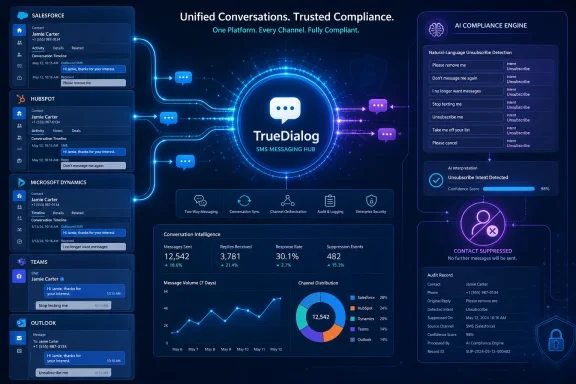
TrueDialog is expanding its enterprise messaging platform with two products aimed at problems that become increasingly expensive as customer data, communications, and compliance controls spread across multiple business systems. TrueConnect is designed to replicate SMS activity across connected CRM and marketing records, while TrueOptOut uses machine learning and a large language model to identify unsubscribe requests that do not contain conventional commands such as “STOP.” Together, the additions reflect a broader shift in business texting: enterprises no longer need only a reliable way to send messages, but also a defensible system for preserving conversational context and recognizing when a recipient wants the conversation to end.
Austin-based TrueDialog announced TrueConnect and TrueOptOut on July 21, 2026, positioning them as complementary parts of the same enterprise communications strategy. TrueConnect addresses the operational side of business messaging by distributing conversation activity across systems such as Salesforce, HubSpot, and Microsoft Dynamics, while TrueOptOut focuses on the compliance boundary between wanted and unwanted communication.
The pairing is significant because SMS rarely operates as an isolated channel inside a large organization. A customer might receive a promotional text generated by a marketing automation platform, reply to a sales representative working in Salesforce, and later contact a support or operations team whose staff primarily use Microsoft tools.
Without synchronization, each team sees only a partial history. More seriously, an opt-out request received through one workflow may not immediately influence activity initiated from another unless all applications share a common suppression mechanism.
A sales department may regard Salesforce as the authoritative customer record, while marketing uses HubSpot for segmentation and campaign attribution. Operations may depend on Dynamics 365, internal line-of-business software, or Microsoft Teams, and executives may still rely heavily on Outlook for day-to-day communication.
The limitation appears when messages originate elsewhere. If the integration records activity only in the originating application, the conversation fragments across several timelines. An employee looking at a Dynamics record may not know that marketing sent a message from HubSpot, while a salesperson working in Salesforce may miss a response handled through another interface.
These gaps create several operational failures:
Usage-based middleware can also become expensive when every inbound and outbound message counts as one or more billable tasks. A modest workflow may generate multiple operations for record lookup, transformation, matching, writing, error handling, and notification.
TrueConnect is effectively a specialized alternative to those general-purpose integration chains. Instead of asking customers to design an SMS synchronization workflow from basic building blocks, TrueDialog is packaging the routing logic as a platform capability.
A text can reportedly originate from Salesforce, HubSpot, Microsoft Dynamics, TrueDialog’s web interface, or its mobile application. TrueConnect then writes the activity to applicable records in the other connected systems.
TrueConnect instead uses TrueDialog as a central messaging authority. The messaging platform receives or generates the event and then fans it out to configured destinations.
In simplified terms, the process is:
The distinction between a packaged connector and an API connection will matter during deployment. A prebuilt connector generally implies more standardized authentication, mappings, and error handling, while an API-based integration may require additional configuration and governance.
The webhook option could be particularly useful for organizations with older systems that cannot support a modern application marketplace integration. It could also allow enterprises to feed SMS activity into data warehouses, case-management platforms, industry-specific applications, or internally developed customer portals.
That restriction may sound conservative, but it addresses a common integration hazard. Once a synchronization service can edit general CRM data, it can collide with deduplication rules, territory assignments, lead-scoring models, and established master-data policies.
By limiting TrueConnect to communication activity, TrueDialog is attempting to avoid becoming an uninvited master-data management system. Existing integrations and deduplication controls can continue to govern contact creation and profile updates.
This boundary offers several potential advantages:
Yet a telephone number is not a permanent personal identity. Numbers can be reassigned, household members may share a line, employees can use corporate phones, and contacts may enter the same number in several formats.
Enterprise administrators will therefore need to evaluate normalization, country codes, duplicate records, recycled-number handling, and exception reporting. TrueConnect may reduce fragmentation, but it cannot by itself repair weak identity data.
TrueConnect’s proposed value is not that it replaces Dynamics messaging capabilities. Rather, it can make TrueDialog-managed SMS activity available in Microsoft-oriented workflows even when another department initiated the conversation elsewhere.
SMS synchronization can extend that activity timeline with a channel that employees increasingly use for appointment reminders, sales conversations, alerts, customer service, and campaign responses. If TrueConnect reliably writes events to the right records, Dynamics users could gain useful context without switching to another application.
That matters for several Microsoft-centered roles:
A successful Teams integration should deliver information into a clearly defined context, such as a channel, app panel, workflow notification, or customer-linked workspace. An Outlook integration similarly needs to distinguish between useful record visibility and the creation of another uncontrolled copy of customer communication.
Microsoft 365 administrators will want to understand where content is stored, which identities can retrieve it, how permissions are enforced, and whether messages become subject to Microsoft Purview retention, eDiscovery, and data-loss prevention policies. Cross-platform visibility is valuable only when it does not produce cross-platform ambiguity.
A recipient may write that they do not want further messages, ask to be removed from a list, express frustration about continued contact, or use slang and sarcasm. A strict keyword engine may classify the reply as an ordinary inbound message because none of its exact commands appears.
Its weakness is linguistic variation. Human intent can survive misspellings, abbreviations, indirect wording, punctuation, profanity, and context, while a literal string comparison cannot.
Consider the semantic similarity among these types of replies:
TrueOptOut attempts to close that gap by examining meaning after the standard keyword filter has completed its work. Importantly, the company says the AI system augments rather than replaces deterministic processing.
High-confidence opt-out signals are processed automatically. Mid-confidence messages move asynchronously to a large language model for additional adjudication, while uncertain cases can involve human review.
The architecture separates messages into practical decision bands:
A system can raise recall by classifying more messages as opt-outs, but that may also increase false positives. Conversely, a highly cautious system may preserve more contacts while allowing genuine revocations to slip through.
That asymmetry explains the company’s deliberately conservative bias. In compliance-sensitive environments, it is usually safer to stop messaging an uncertain recipient than to treat an apparent revocation as ordinary conversation.
Even so, enterprises should demand more than a headline recall target. Meaningful evaluation requires testing against real traffic, including:
Administrators should also know whether thresholds can be tuned by account, campaign, message category, or jurisdiction. A marketing campaign may reasonably use a lower threshold for suppression than an emergency-alert program in which an erroneous opt-out could prevent a recipient from receiving important notices.
The practical message for enterprises is straightforward: standardized keywords are important, but they should not be treated as the only possible expression of revocation. If a reasonable person would understand a reply as a request to stop, ignoring it because the customer failed to use exact syntax is an increasingly difficult position to defend.
Nevertheless, the arithmetic explains why enterprises are interested in automated intent detection. If a suppression failure allows a high-volume campaign to continue contacting recipients who have revoked consent, exposure may accumulate on a per-message basis.
TrueOptOut should therefore be viewed as one control within a wider program that includes:
This distinction can create tension between customer intent, regulatory requirements, and system design. A platform must know whether a suppression applies to a campaign, telephone number, business unit, message category, sender identity, or the entire organization.
TrueDialog’s announcement emphasizes detection and auditability, but prospective customers should investigate how TrueOptOut maps an intent decision to the appropriate suppression scope. Correctly detecting “stop sending promotions” is only half the task; the platform must also stop the right communications without incorrectly blocking everything else.
This capability may prove as important as the classifier itself. When a customer complains or a legal team investigates, an enterprise needs to explain not only the final suppression status but also when the request arrived, how it was interpreted, and which action followed.
Still, preserving the input, model version, threshold, output, and subsequent human activity can make the process reproducible enough for operational review. Enterprises should ask whether TrueDialog records model-version changes and whether historical decisions can be reconstructed under the logic active at the time.
Strong AI governance should include:
The company also points to SOC 2 Type II, TX-RAMP, and ISO 9001 credentials. These indicators may support enterprise procurement, but customers should still review the scope of each assessment, data flows, encryption, access controls, regional storage, subcontractors, retention, and incident-response commitments.
Message content can contain personal data, account information, health-related details, employee communications, or confidential business material. Centralizing more conversations and analyzing every inbound reply increases the importance of strict least-privilege access.
For consumers, the more meaningful improvement may be simpler: they should not need to memorize a command to make an unwanted conversation stop. Natural-language recognition makes the unsubscribe process behave more like an interaction with a responsible human.
Customer service teams also benefit because frustration is often visible in conversational replies before it appears in a formal complaint. A properly configured system could treat an angry request to stop as a compliance event rather than leaving it unread in an individual employee’s inbox.
A natural-language opt-out system acknowledges that the burden should not fall entirely on the recipient. If a business can use AI to optimize content, timing, targeting, and deliverability, it is reasonable to use comparable technology to recognize withdrawal of consent.
TrueOptOut, meanwhile, extends competition into AI-assisted compliance. Messaging vendors have long supported suppression lists and standard keywords, but natural-language intent detection could become a differentiating feature as regulators, carriers, and enterprise buyers demand better handling of conversational replies.
Together with TrueConnect, these features indicate a shift from transport toward orchestration and decision support. The platform is trying to manage what is sent, where the resulting conversation is visible, whether the message is likely to arrive, and when communication must cease.
That broader position could appeal to organizations that do not want to assemble separate products for:
Particular attention should be paid to how the products perform during partial failures. If Salesforce accepts an activity while Dynamics rejects it, administrators need a visible retry queue, actionable error information, and a way to prove whether synchronization eventually completed.
TrueOptOut’s success will similarly depend on what happens around the model. Fast classification is useful, but enterprise value comes from timely suppression, correct propagation, reliable auditing, manageable review queues, and continuous measurement after deployment.
TrueDialog’s latest additions point toward a future in which enterprise messaging platforms are judged less by raw sending capacity and more by their ability to preserve context, interpret customer intent, and enforce communication boundaries across complex software estates. If TrueConnect can keep CRM timelines aligned without disrupting established data ownership, and if TrueOptOut can recognize natural-language revocations with consistently conservative accuracy, the combination could remove meaningful operational and compliance friction from large-scale business texting. The larger lesson extends beyond TrueDialog: as AI makes outbound communication easier to generate and optimize, enterprises will need equally capable systems for remembering what was said, understanding the reply, and knowing when to stop.
 Overview
Austin-based TrueDialog announced TrueConnect and TrueOptOut on July 21, 2026, positioning them as complementary parts of the same enterprise communications strategy. TrueConnect addresses the operational side of business messaging by distributing conversation activity across systems such as Salesforce, HubSpot, and Microsoft Dynamics, while TrueOptOut focuses on the compliance boundary between wanted and unwanted communication.The pairing is significant because SMS rarely operates as an isolated channel inside a large organization. A customer might receive a promotional text generated by a marketing automation platform, reply to a sales representative working in Salesforce, and later contact a support or operations team whose staff primarily use Microsoft tools.
Without synchronization, each team sees only a partial history. More seriously, an opt-out request received through one workflow may not immediately influence activity initiated from another unless all applications share a common suppression mechanism.
Two products built around one conversation
TrueDialog presents the products as operating at opposite ends of a messaging exchange:- TrueConnect distributes message activity so that authorized employees can see the relevant conversation from multiple connected systems.
- TrueOptOut interprets inbound replies to identify recipients who want future messages to stop, even when they do not use a standard keyword.
- TrueDialog remains the messaging system of record, rather than attempting to turn every connected CRM into an independent source of messaging truth.
- Audit records document automated and human decisions, giving compliance teams a history of how ambiguous messages were handled.
Why CRM Messaging Becomes Fragmented
The conventional CRM integration model assumes that an organization has one dominant customer database. That assumption increasingly fails in enterprises where different departments have selected software according to their own workflows, budgets, and reporting needs.A sales department may regard Salesforce as the authoritative customer record, while marketing uses HubSpot for segmentation and campaign attribution. Operations may depend on Dynamics 365, internal line-of-business software, or Microsoft Teams, and executives may still rely heavily on Outlook for day-to-day communication.
Native integrations solve only part of the problem
A native SMS integration can deliver a polished experience within one application. Users may be able to send a text from a contact page, view incoming replies, trigger workflows, and report on engagement without leaving the CRM.The limitation appears when messages originate elsewhere. If the integration records activity only in the originating application, the conversation fragments across several timelines. An employee looking at a Dynamics record may not know that marketing sent a message from HubSpot, while a salesperson working in Salesforce may miss a response handled through another interface.
These gaps create several operational failures:
- Employees repeat questions because they cannot see what another team has already discussed.
- Follow-ups are delayed or missed when an inbound reply appears only in the application that received it.
- Campaign attribution becomes unreliable because the originating system lacks visibility into later responses or conversions.
- Compliance teams struggle to reconstruct events when records are divided among multiple platforms.
- Customers receive inconsistent treatment as each department acts on a different version of the relationship.
The cost of stitching systems together
Organizations frequently address fragmentation with integration-platform-as-a-service tools, custom APIs, scheduled exports, or Power Automate-style workflows. These approaches can work, but they introduce another layer that must be configured, monitored, secured, and updated.Usage-based middleware can also become expensive when every inbound and outbound message counts as one or more billable tasks. A modest workflow may generate multiple operations for record lookup, transformation, matching, writing, error handling, and notification.
TrueConnect is effectively a specialized alternative to those general-purpose integration chains. Instead of asking customers to design an SMS synchronization workflow from basic building blocks, TrueDialog is packaging the routing logic as a platform capability.
How TrueConnect Synchronizes SMS Activity
TrueConnect sits above TrueDialog’s existing CRM integrations and distributes message activity to other connected applications. The company says it uses the recipient’s telephone number as the matching key, allowing the same exchange to appear on records associated with that number.A text can reportedly originate from Salesforce, HubSpot, Microsoft Dynamics, TrueDialog’s web interface, or its mobile application. TrueConnect then writes the activity to applicable records in the other connected systems.
A fan-out model rather than point-to-point wiring
Traditional integration projects often produce a web of point-to-point connections. Salesforce may connect to HubSpot, HubSpot to an internal database, and Dynamics to a separate messaging gateway, with each link using different data mappings and retry policies.TrueConnect instead uses TrueDialog as a central messaging authority. The messaging platform receives or generates the event and then fans it out to configured destinations.
In simplified terms, the process is:
- TrueDialog processes an inbound or outbound message.
- TrueConnect identifies the telephone number associated with the event.
- The platform checks which connected systems contain a corresponding record.
- It writes the SMS activity to those existing records according to configured flows.
- TrueDialog retains the authoritative messaging history and processing audit trail.
Prebuilt connectors and extensibility
TrueDialog says TrueConnect includes prebuilt connectors for Salesforce Sales Cloud, HubSpot, and Microsoft Dynamics. Microsoft Teams and Outlook can be connected through APIs, while webhooks are available for legacy CRMs, proprietary databases, and internal applications.The distinction between a packaged connector and an API connection will matter during deployment. A prebuilt connector generally implies more standardized authentication, mappings, and error handling, while an API-based integration may require additional configuration and governance.
The webhook option could be particularly useful for organizations with older systems that cannot support a modern application marketplace integration. It could also allow enterprises to feed SMS activity into data warehouses, case-management platforms, industry-specific applications, or internally developed customer portals.
A Deliberately Limited Write Model
One of TrueConnect’s more consequential design choices is what it reportedly does not synchronize. The feature writes SMS activity to existing records but does not create contacts, alter customer fields, change ownership, update lead status, influence routing, or modify scoring.That restriction may sound conservative, but it addresses a common integration hazard. Once a synchronization service can edit general CRM data, it can collide with deduplication rules, territory assignments, lead-scoring models, and established master-data policies.
Protecting existing CRM governance
Enterprises often spend years deciding which system owns each type of data. Marketing may own campaign engagement, sales may own opportunity status, and a master-data platform may control identity resolution.By limiting TrueConnect to communication activity, TrueDialog is attempting to avoid becoming an uninvited master-data management system. Existing integrations and deduplication controls can continue to govern contact creation and profile updates.
This boundary offers several potential advantages:
- CRM administrators retain control over record ownership and lifecycle rules.
- TrueConnect is less likely to trigger unintended automations tied to field changes.
- Deployment may require fewer approvals from data-governance teams.
- Rollback is conceptually simpler because the product adds activities rather than rewriting core customer data.
- Existing identity and deduplication systems remain responsible for resolving conflicting profiles.
Phone numbers are practical but imperfect identifiers
Telephone numbers are attractive matching keys because every SMS event already includes one. They avoid the need for a universal CRM contact ID that would rarely exist across unrelated platforms.Yet a telephone number is not a permanent personal identity. Numbers can be reassigned, household members may share a line, employees can use corporate phones, and contacts may enter the same number in several formats.
Enterprise administrators will therefore need to evaluate normalization, country codes, duplicate records, recycled-number handling, and exception reporting. TrueConnect may reduce fragmentation, but it cannot by itself repair weak identity data.
The Microsoft Ecosystem Impact
For Windows-oriented enterprises, the Microsoft side of the announcement deserves particular attention. Dynamics 365 already supports texting through selected providers and provides broad integration with Outlook, Teams, Dataverse, and the Power Platform, but organizations still face gaps when conversations originate outside the Microsoft stack.TrueConnect’s proposed value is not that it replaces Dynamics messaging capabilities. Rather, it can make TrueDialog-managed SMS activity available in Microsoft-oriented workflows even when another department initiated the conversation elsewhere.
Dynamics 365 and Dataverse context
Dynamics 365 applications typically organize customer interactions around records stored in or connected through Microsoft Dataverse. Emails, appointments, meetings, calls, tasks, and other activities can be associated with contacts, accounts, leads, opportunities, or cases.SMS synchronization can extend that activity timeline with a channel that employees increasingly use for appointment reminders, sales conversations, alerts, customer service, and campaign responses. If TrueConnect reliably writes events to the right records, Dynamics users could gain useful context without switching to another application.
That matters for several Microsoft-centered roles:
- Sales representatives can see recent text exchanges before calling a prospect.
- Customer service agents can review messaging context while handling a case.
- Operations teams can confirm that reminders or alerts were delivered and answered.
- Managers can include SMS activity in broader engagement reviews.
- Compliance personnel can compare CRM timelines with the authoritative TrueDialog audit history.
Teams and Outlook need careful implementation
TrueDialog describes Teams and Outlook connections as API-based, which leaves important implementation details to be examined. Neither application is simply a CRM database, and indiscriminately copying messages into collaboration or email environments could create noise, retention complexity, and access-control problems.A successful Teams integration should deliver information into a clearly defined context, such as a channel, app panel, workflow notification, or customer-linked workspace. An Outlook integration similarly needs to distinguish between useful record visibility and the creation of another uncontrolled copy of customer communication.
Microsoft 365 administrators will want to understand where content is stored, which identities can retrieve it, how permissions are enforced, and whether messages become subject to Microsoft Purview retention, eDiscovery, and data-loss prevention policies. Cross-platform visibility is valuable only when it does not produce cross-platform ambiguity.
TrueOptOut Moves Beyond Keyword Matching
TrueOptOut addresses a different weakness in conventional business-texting systems: recipients do not always unsubscribe using the prescribed syntax. Standard filters recognize words such as STOP, QUIT, END, CANCEL, REVOKE, OPT OUT, and UNSUBSCRIBE, but people frequently communicate the same intention conversationally.A recipient may write that they do not want further messages, ask to be removed from a list, express frustration about continued contact, or use slang and sarcasm. A strict keyword engine may classify the reply as an ordinary inbound message because none of its exact commands appears.
Why exact-match systems miss obvious intent
Keyword matching is fast, predictable, and easy to audit. It remains an essential first line of defense because standardized commands should trigger immediate and deterministic action.Its weakness is linguistic variation. Human intent can survive misspellings, abbreviations, indirect wording, punctuation, profanity, and context, while a literal string comparison cannot.
Consider the semantic similarity among these types of replies:
- “Please remove me from these messages.”
- “I never want another text from this number.”
- “Why do you keep contacting me?”
- “Take my phone off your list.”
- “Don’t message me again.”
- “Lose my number.”
TrueOptOut attempts to close that gap by examining meaning after the standard keyword filter has completed its work. Importantly, the company says the AI system augments rather than replaces deterministic processing.
A layered classification pipeline
According to TrueDialog, inbound messages that clear conventional keyword matching enter an intent-analysis pipeline. A purpose-built machine-learning classifier evaluates them in 10 milliseconds or less, with the company targeting recall of at least 90%.High-confidence opt-out signals are processed automatically. Mid-confidence messages move asynchronously to a large language model for additional adjudication, while uncertain cases can involve human review.
The architecture separates messages into practical decision bands:
- Known keywords receive immediate rule-based handling.
- High-confidence natural-language requests trigger an automatic opt-out.
- Ambiguous messages receive deeper model analysis.
- Cases that cannot be resolved safely can be escalated for human judgment.
- Every path produces a record of the input, confidence, action, and time.
Why Recall, Precision, and Thresholds Matter
TrueDialog’s stated target of at least 90% recall is notable, but recall alone does not describe the quality of a compliance classifier. Recall measures the proportion of actual opt-out requests detected; precision measures how many messages labeled as opt-outs were truly intended that way.A system can raise recall by classifying more messages as opt-outs, but that may also increase false positives. Conversely, a highly cautious system may preserve more contacts while allowing genuine revocations to slip through.
The asymmetric cost of mistakes
TrueOptOut’s design is based on the premise that these errors have unequal consequences. A false positive disconnects a recipient who might have wanted to continue receiving messages, potentially reducing engagement or revenue. A false negative can expose the sender to complaints, carrier action, reputational harm, and legal risk if additional messages are transmitted.That asymmetry explains the company’s deliberately conservative bias. In compliance-sensitive environments, it is usually safer to stop messaging an uncertain recipient than to treat an apparent revocation as ordinary conversation.
Even so, enterprises should demand more than a headline recall target. Meaningful evaluation requires testing against real traffic, including:
- Misspellings and abbreviated language.
- Sarcasm, insults, jokes, and rhetorical questions.
- Multilingual and code-switched messages.
- Negation, such as “Do not stop sending alerts.”
- Requests limited to one category of communication.
- Messages quoting or discussing the word “stop” without revoking consent.
- Industry-specific language and internal abbreviations.
- Short replies whose meaning depends on earlier conversation context.
Confidence scores require operational policy
Confidence scores do not eliminate uncertainty; they quantify it. Customers still need policies defining the thresholds for automatic action, secondary analysis, human review, and eventual closure.Administrators should also know whether thresholds can be tuned by account, campaign, message category, or jurisdiction. A marketing campaign may reasonably use a lower threshold for suppression than an emergency-alert program in which an erroneous opt-out could prevent a recipient from receiving important notices.
Compliance and the Expanding Meaning of Revocation
Business texting compliance extends beyond displaying “Reply STOP to unsubscribe.” Wireless-industry practices emphasize consent and accessible opt-out mechanisms, while federal rules recognize that consumers can use reasonable methods to revoke previously granted consent.The practical message for enterprises is straightforward: standardized keywords are important, but they should not be treated as the only possible expression of revocation. If a reasonable person would understand a reply as a request to stop, ignoring it because the customer failed to use exact syntax is an increasingly difficult position to defend.
TCPA exposure scales with message volume
The Telephone Consumer Protection Act can permit statutory damages of $500 per violation, with potential increases to $1,500 for knowing or willful violations. The applicability of the statute depends on the facts, technology, consent, message type, and legal interpretation, so no software feature can guarantee compliance.Nevertheless, the arithmetic explains why enterprises are interested in automated intent detection. If a suppression failure allows a high-volume campaign to continue contacting recipients who have revoked consent, exposure may accumulate on a per-message basis.
TrueOptOut should therefore be viewed as one control within a wider program that includes:
- Documented consent acquisition and storage.
- Clear identification of the sender and messaging purpose.
- Reliable keyword processing and suppression lists.
- Propagation of revocation across campaigns and systems.
- Training for employees who handle one-to-one replies.
- Monitoring, exception reporting, and periodic model testing.
- Legal review appropriate to the organization’s jurisdictions and use cases.
Partial and contextual opt-outs remain difficult
Some recipients want marketing messages to stop but still expect transactional notices, security alerts, appointment reminders, or account updates. Others may withdraw consent from one brand or department without understanding that the same parent company operates several messaging programs.This distinction can create tension between customer intent, regulatory requirements, and system design. A platform must know whether a suppression applies to a campaign, telephone number, business unit, message category, sender identity, or the entire organization.
TrueDialog’s announcement emphasizes detection and auditability, but prospective customers should investigate how TrueOptOut maps an intent decision to the appropriate suppression scope. Correctly detecting “stop sending promotions” is only half the task; the platform must also stop the right communications without incorrectly blocking everything else.
Auditability, Privacy, and AI Governance
TrueDialog says every TrueOptOut decision generates an immutable audit record containing the original message, confidence score, action, and timestamp. Human-review decisions are also logged, creating what the company describes as a full chain of custody.This capability may prove as important as the classifier itself. When a customer complains or a legal team investigates, an enterprise needs to explain not only the final suppression status but also when the request arrived, how it was interpreted, and which action followed.
Explainability without pretending the model is simple
An audit record does not necessarily explain why a neural model reached a particular conclusion. A confidence score is evidence of the model’s certainty, not a plain-language rationale.Still, preserving the input, model version, threshold, output, and subsequent human activity can make the process reproducible enough for operational review. Enterprises should ask whether TrueDialog records model-version changes and whether historical decisions can be reconstructed under the logic active at the time.
Strong AI governance should include:
- Versioned models and documented deployment dates.
- Controlled threshold changes with administrator attribution.
- Representative validation datasets.
- False-positive and false-negative monitoring.
- A defined human-review process and response deadline.
- Procedures for correcting mistaken decisions.
- Retention rules aligned with legal and privacy requirements.
Private infrastructure reduces one category of risk
TrueDialog says the AI operates entirely within its private infrastructure and does not share message content with third-party or open-source model providers. That approach can reduce exposure associated with sending customer communications to an external generative-AI service.The company also points to SOC 2 Type II, TX-RAMP, and ISO 9001 credentials. These indicators may support enterprise procurement, but customers should still review the scope of each assessment, data flows, encryption, access controls, regional storage, subcontractors, retention, and incident-response commitments.
Message content can contain personal data, account information, health-related details, employee communications, or confidential business material. Centralizing more conversations and analyzing every inbound reply increases the importance of strict least-privilege access.
Enterprise and Consumer Impact
For enterprises, TrueConnect and TrueOptOut could reduce two forms of hidden labor. The first is the technical effort required to maintain CRM synchronization, and the second is the compliance effort required to manually identify unconventional opt-out requests.For consumers, the more meaningful improvement may be simpler: they should not need to memorize a command to make an unwanted conversation stop. Natural-language recognition makes the unsubscribe process behave more like an interaction with a responsible human.
Benefits for revenue and service teams
Sales and marketing teams gain value when SMS context follows the customer across tools. A complete timeline can prevent duplicated outreach, improve handoffs, and make attribution less dependent on which application happened to send the message.Customer service teams also benefit because frustration is often visible in conversational replies before it appears in a formal complaint. A properly configured system could treat an angry request to stop as a compliance event rather than leaving it unread in an individual employee’s inbox.
Consumer expectations are setting the standard
Text messaging enters a highly personal space: the same device people use for family, authentication codes, medical reminders, banking alerts, and emergency information. Unwanted messages therefore generate a stronger reaction than many conventional marketing channels.A natural-language opt-out system acknowledges that the burden should not fall entirely on the recipient. If a business can use AI to optimize content, timing, targeting, and deliverability, it is reasonable to use comparable technology to recognize withdrawal of consent.
Competitive Implications
TrueConnect places TrueDialog in competition not only with SMS platforms but also with integration middleware, CRM marketplaces, and communications-platform-as-a-service vendors. Its pitch is that a messaging-specific synchronization layer can be easier to deploy and more predictable to price than a collection of general-purpose automation tasks.TrueOptOut, meanwhile, extends competition into AI-assisted compliance. Messaging vendors have long supported suppression lists and standard keywords, but natural-language intent detection could become a differentiating feature as regulators, carriers, and enterprise buyers demand better handling of conversational replies.
A move up the enterprise software stack
TrueDialog’s earlier TrueDelivery product applies machine learning to outbound messages, attempting to identify content that might be incorrectly blocked by carrier filtering. TrueOptOut applies AI in the opposite direction by analyzing inbound customer intent.Together with TrueConnect, these features indicate a shift from transport toward orchestration and decision support. The platform is trying to manage what is sent, where the resulting conversation is visible, whether the message is likely to arrive, and when communication must cease.
That broader position could appeal to organizations that do not want to assemble separate products for:
- CRM activity synchronization.
- Messaging delivery optimization.
- Consent and suppression management.
- Conversation auditing.
- Multichannel business texting.
- Employee-facing web and mobile interfaces.
Strengths and Opportunities
The announcement identifies several practical opportunities for organizations with mature but fragmented technology estates.- TrueConnect focuses on an identifiable enterprise problem. It addresses the gap created when SMS activity is trapped inside whichever CRM or interface originated it.
- The limited write model reduces integration risk. Writing activities without altering contact ownership, scoring, routing, or fields respects existing data-governance boundaries.
- Centralized message authority can improve consistency. Keeping TrueDialog as the system of record may make reconciliation and compliance investigation easier than maintaining multiple independent histories.
- Natural-language opt-out detection reflects real consumer behavior. People communicate intent in varied language, and a system that recognizes meaning can outperform exact keyword lists.
- Layered processing balances speed with sophistication. Deterministic keywords, a fast classifier, asynchronous LLM review, and human escalation provide more control than a single-model approach.
- Immutable audit records strengthen defensibility. Logged messages, confidence scores, timestamps, actions, and reviewer decisions can help organizations demonstrate their process.
- Microsoft ecosystem visibility broadens the addressable audience. Dynamics 365, Teams, Outlook, and custom Dataverse environments are central to many enterprise workflows.
- Predictable integration pricing could be attractive at scale. The absence of per-task fees and monthly automation caps may appeal to high-volume senders currently paying for middleware operations.
Risks and Concerns
The products also raise questions that enterprises should resolve through testing, contractual review, and governance rather than accepting marketing claims at face value.- Phone-number matching can produce identity errors. Shared, reassigned, duplicated, or badly formatted numbers may lead to missing activity or incorrect associations.
- Broad synchronization can expand data exposure. Copying SMS content into more applications increases the number of users, retention systems, and security policies involved.
- AI accuracy will vary by traffic profile. Recall targets must be validated against the customer’s languages, industries, message types, and conversational patterns.
- False opt-outs have business consequences. Conservative classification reduces legal risk but may suppress wanted communication and distort engagement metrics.
- Missed opt-outs remain possible. A 90% recall target, if achieved, still implies that some unconventional requests may require other controls or human attention.
- Suppression scope may be difficult to determine. Systems must distinguish between revoking all communication and stopping only a particular campaign or message category.
- API-based Teams and Outlook connections need detailed governance. Administrators should determine exactly where content appears, who can access it, and which retention rules apply.
- Vendor centralization creates dependency. Making TrueDialog the messaging authority simplifies architecture but increases the impact of an outage, configuration error, or contractual dispute.
- Certifications do not replace due diligence. Buyers must review assessment scope, data handling, access control, disaster recovery, and incident-response procedures.
What to Watch Next
The most important next step will be independent evidence from production deployments. TrueDialog has described an ambitious architecture, but customers will need measurable results covering synchronization reliability, duplicate handling, model accuracy, review workloads, and suppression latency.Particular attention should be paid to how the products perform during partial failures. If Salesforce accepts an activity while Dynamics rejects it, administrators need a visible retry queue, actionable error information, and a way to prove whether synchronization eventually completed.
Key questions for prospective customers
Enterprise buyers should evaluate the platform in a structured sequence:- Map every system that can originate or receive SMS activity.
- Define which application remains authoritative for messaging, consent, identity, and customer status.
- Test phone-number matching against duplicates, shared numbers, international formats, and recycled records.
- Measure TrueOptOut on a representative set of real, anonymized replies.
- Review false positives and false negatives separately rather than relying on one accuracy figure.
- Define suppression scope for marketing, transactional, service, and emergency communications.
- Confirm how Teams, Outlook, Dynamics, and other destinations store and protect message content.
- Exercise failure recovery, retry, audit-export, and human-review workflows before production rollout.
- Document accountability for threshold changes and model-related exceptions.
- Have legal and compliance teams assess the entire messaging program, not merely the software feature.
Product maturity will determine the outcome
TrueConnect’s drag-and-drop flow builder could make synchronization accessible to revenue-operations teams, but usability must not conceal operational complexity. Administrators still need visibility into authentication failures, rate limits, record-matching conflicts, API changes, and downstream permissions.TrueOptOut’s success will similarly depend on what happens around the model. Fast classification is useful, but enterprise value comes from timely suppression, correct propagation, reliable auditing, manageable review queues, and continuous measurement after deployment.
TrueDialog’s latest additions point toward a future in which enterprise messaging platforms are judged less by raw sending capacity and more by their ability to preserve context, interpret customer intent, and enforce communication boundaries across complex software estates. If TrueConnect can keep CRM timelines aligned without disrupting established data ownership, and if TrueOptOut can recognize natural-language revocations with consistently conservative accuracy, the combination could remove meaningful operational and compliance friction from large-scale business texting. The larger lesson extends beyond TrueDialog: as AI makes outbound communication easier to generate and optimize, enterprises will need equally capable systems for remembering what was said, understanding the reply, and knowing when to stop.
References
- Primary source: Morningstar
Published: 2026-07-21T17:11:00+00:00
- Related coverage: ctia.org
CTIA - Home
CTIA represents the U.S. wireless communications industry and companies throughout the mobile ecosystem.www.ctia.org - Related coverage: aijourn.com
TrueDialog Introduces TrueConnect® for CRM Text Messaging Visibility and TrueOptOut for SMS Compliance | The AI Journal
TrueConnect puts every SMS conversation on every connected record; TrueOptOut is an AI-powered intent-detection engine that catches opt-out requests thataijourn.com - Official source: learn.microsoft.com
Text messaging FAQs | Microsoft Learn
Get answers to frequently asked questions about text messaging.learn.microsoft.com