

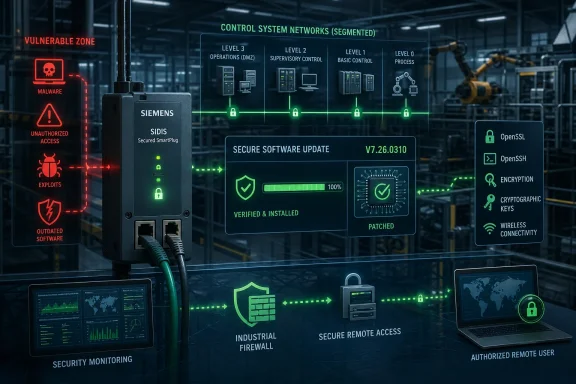
Siemens has issued a security update for SIDIS Secured SmartPlug, closing a broad collection of third-party component vulnerabilities that affect every release before V7.26.0310. The advisory, first published by Siemens on July 14, 2026, and republished by CISA on July 21, does not describe a single defect or a single attack path. Instead, it highlights a familiar but consequential industrial-security reality: a specialized operational technology product can inherit serious exposure through the cryptographic, remote-access, archive-processing, wireless, and supporting open-source packages embedded beneath its own application layer. With a highest listed CVSS v3 severity of 9.8, organizations using SIDIS Secured SmartPlug should treat the update as a priority remediation item, while still planning deployment around operational continuity rather than rushing an untested change into a live environment.
SIDIS Secured SmartPlug is not the same thing as a consumer smart outlet sold for home automation. The name may invite that comparison, but the advisory concerns a Siemens product used in a critical-manufacturing context, where software components can sit close to operational workflows, managed equipment, and constrained networks. That distinction matters because the likely consequences of a compromise are less about an isolated device malfunction and more about disruption, unauthorized access, or an attacker gaining a foothold within an environment designed to prioritize uptime.
The CISA republication identifies the affected deployment category as Critical Manufacturing and notes worldwide use. Siemens, headquartered in Germany, has released an updated software version and recommends that operators move to the latest release. All SIDIS Secured SmartPlug versions earlier than V7.26.0310 are affected.
For administrators, the important date is operational: the time when every affected instance has either been upgraded to V7.26.0310 or protected by documented compensating controls pending upgrade.
That clarity helps, but it also creates a potential blind spot. Version ranges are useful only when organizations have a reliable way to identify versions across their estate. In industrial environments, products may be inventoried by cabinet, site, operational function, or project identifier rather than by a current software-bill-of-materials record.
This is particularly important where a staging system runs a newer build while production remains on a prior maintenance release. In that scenario, an organization can mistakenly report that the product family is patched when the live operational instance is not.
A practical discovery effort should include:
The practical meaning of a 9.8 score depends heavily on exposure. A vulnerable component behind layered segmentation, strict access controls, and no route from untrusted networks presents a different immediate risk from one exposed through a broad management subnet, remote-access gateway, or flat enterprise network.
A sound local assessment evaluates:
That is why a software stack containing issues in OpenSSL, OpenSSH, wireless-related components, and other packages should be evaluated as an ecosystem problem. The presence of multiple vulnerability classes increases the number of questions defenders must answer about exposed services, trust boundaries, secrets, and administrative workflows.
Open-source dependencies are not a weakness in themselves. They are indispensable to modern software engineering, widely reviewed, and often patched rapidly. The challenge arises when a product’s lifecycle, validation requirements, and update cadence lag behind the pace of upstream vulnerability disclosure.
For an operational product, the implication is broader than “encrypted traffic may be vulnerable.” Certificates, encrypted sessions, update verification, management interfaces, and machine-to-machine trust relationships can all depend on the integrity of the cryptographic stack. Security teams should examine where SIDIS Secured SmartPlug establishes encrypted sessions and whether those connections cross network zones.
The right conclusion is not to disable remote access indiscriminately. Some environments depend on it for support and incident response. Instead, operators should reduce exposure through tightly controlled jump hosts, multi-factor authentication where supported, role-based access, source restrictions, credential rotation, and comprehensive logging.
The diversity is instructive. It means this should not be approached as an “OpenSSL update” or an “SSH update” alone. The vendor-provided SIDIS Secured SmartPlug release is the correct remediation vehicle because it addresses the integrated software image rather than asking customers to patch individual embedded packages themselves.
The precise impact varies by code path, compiler protections, process privileges, and the attacker’s ability to control input. In severe cases, memory corruption can enable application crashes, denial of service, data exposure, or arbitrary code execution. In industrial environments, even a service crash can be consequential if it interrupts monitoring, configuration, communications, or an operational workflow.
These issues are often difficult to assess from the outside because the relevant protocol behavior may be internal to the product. That uncertainty is exactly why organizations should avoid attempting to manually remediate library versions or disable cryptographic features without vendor guidance. Upgrade the supported product release, then verify that expected trust relationships still function correctly.
These categories matter because industrial systems are often administered by multiple teams with different levels of privilege. If access is too broad, an otherwise limited account, a compromised engineering workstation, or a misconfigured service account may become more dangerous than intended.
The question is not whether a theoretical flaw exists somewhere in the stack. The question is whether the organization has created a feasible path from an attacker-controlled environment to the affected software.
A search engine or attacker scanning an exposed service does not care whether the asset is described internally as an appliance, a smart plug, a gateway, or an industrial support component. If it is reachable and fingerprintable, it becomes a target. Direct exposure should therefore be treated as an urgent exception requiring immediate containment.
An attacker who compromises a corporate Windows endpoint may seek administrative credentials, scan internal networks, and move laterally to systems that were assumed to be protected simply because they were not public. Network segmentation, strict firewall rules, and jump-host architecture reduce the chance that a routine Windows compromise becomes an operational technology event.
Where remote access is unavoidable, organizations should establish a deliberate sequence:
The patch itself belongs to the Siemens product lifecycle. The surrounding defense posture, however, frequently belongs to Windows and enterprise infrastructure teams.
Organizations should consider the following controls:
That review can catch issues that otherwise appear only during maintenance windows. For example, a successful update followed by a failure to reconnect to a management environment could be caused by a certificate-chain issue, an obsolete cipher policy, a DNS dependency, or a firewall rule that was never documented.
The appropriate model is coordinated responsibility: Windows teams protect the identity, remote-access, logging, backup, and workstation layers, while product owners apply the Siemens-supported update and validate operational behavior.
The ideal approach is a short, disciplined remediation cycle with explicit owners, rollback planning, and proof of completion.
Temporary containment measures may include restricting firewall rules, disabling unnecessary remote services, revoking obsolete accounts, limiting VPN routes, and removing direct internet exposure. These actions do not replace the update, but they reduce the window of risk while the change is prepared.
At minimum, the change plan should state:
If no representative environment exists, the organization should compensate with a more conservative production change: stronger pre-change backups, greater vendor or integrator involvement, a defined rollback window, and post-change checks performed by both IT and operations personnel.
Documentation closes the loop. Update the asset inventory, vulnerability-management record, software baseline, and change ticket with the installed version and validation results. This evidence will matter during future audits, incident investigations, and the next dependency-driven advisory.
That does not mean OT systems should remain unpatched. It means patching should be engineered as a controlled operational activity.
A mature program resolves this tension by building repeatable maintenance practices: accurate asset inventory, approved maintenance windows, tested backups, representative testing, vendor coordination, and clear operational sign-off. The goal is not zero risk. It is reducing both cyber risk and change risk in a measured way.
This is especially important if the upgrade changes bundled components with stricter security behavior. Updated cryptographic libraries or remote-access services may reject legacy algorithms, deprecated key types, or weak configurations that older versions tolerated. That is a security improvement, but it must be anticipated.
The decision criteria might include loss of a required communications path, inability to authenticate approved administrators, unexpected impact on connected systems, or a failure of a critical health check. Assigning authority in advance prevents a technical problem from becoming a management bottleneck.
Those improvements pay dividends during the next advisory, regardless of vendor. They also help reduce the time required to determine exposure when a critical flaw appears in a commonly embedded library.
Patch management is therefore necessary but insufficient. The enduring control is a hardened architecture in which a single flaw does not automatically grant an attacker a path to sensitive operational systems.
Security teams should also monitor their own environments rather than relying solely on public reports. Review firewall logs for unexpected connection attempts to industrial subnets, remote-access logs for anomalous sessions, identity records for unusual privilege changes, and endpoint telemetry from engineering or administrative workstations.
These are not proof of exploitation by themselves. They are signals that should be correlated with asset context, maintenance activity, user behavior, and known support workflows. The key is to preserve enough logging to distinguish normal operational support from anomalous access.
That calls for an ongoing discipline: maintain current asset records, track vendor advisories, define emergency maintenance procedures, and practice coordination among security, infrastructure, engineering, and operations teams before a critical update arrives.
The SIDIS Secured SmartPlug advisory should therefore be handled as more than a version-check exercise. Updating to V7.26.0310 or later closes a documented set of vulnerabilities, including issues with critical potential impact, but the deeper objective is to ensure that the product is reachable only by the people and systems that truly need it, administered from secure endpoints, and maintained through a tested operational process. Organizations that combine the Siemens update with stronger segmentation, disciplined remote access, accurate inventory, and validated recovery plans will be better prepared not only for this advisory, but for the next inherited vulnerability that reaches the industrial edge.
 Background
SIDIS Secured SmartPlug is not the same thing as a consumer smart outlet sold for home automation. The name may invite that comparison, but the advisory concerns a Siemens product used in a critical-manufacturing context, where software components can sit close to operational workflows, managed equipment, and constrained networks. That distinction matters because the likely consequences of a compromise are less about an isolated device malfunction and more about disruption, unauthorized access, or an attacker gaining a foothold within an environment designed to prioritize uptime.The CISA republication identifies the affected deployment category as Critical Manufacturing and notes worldwide use. Siemens, headquartered in Germany, has released an updated software version and recommends that operators move to the latest release. All SIDIS Secured SmartPlug versions earlier than V7.26.0310 are affected.
Why an “update available” advisory deserves attention
Security teams can be tempted to classify bundled-component advisories as routine maintenance because the product vendor has already done the hard work of integrating fixes. That is only partly true. A vendor-maintained update reduces the complexity of selecting upstream patches, but it does not eliminate the questions that matter most in operational technology:- Does the affected product have a reachable management or service interface?
- Is it segmented from corporate networks and from external connectivity?
- Does the update require a restart, re-enrollment, certificate change, or service interruption?
- Are there compatibility dependencies with management servers, clients, or connected systems?
- Can the organization accurately prove which version is installed?
The advisory’s timing
Siemens published advisory SSA-585531 on July 14, 2026. CISA’s republication on July 21, 2026, increased visibility of the issue across industrial and critical-infrastructure security communities. The seven-day interval should not be mistaken for a grace period. It simply reflects the normal process by which vendor advisories can be converted and distributed through government channels.For administrators, the important date is operational: the time when every affected instance has either been upgraded to V7.26.0310 or protected by documented compensating controls pending upgrade.
What Is Affected
The affected range is concise but significant: SIDIS Secured SmartPlug releases before V7.26.0310. Siemens has not framed the issue as a hardware recall or a defect requiring device replacement. The stated remedy is a software update to the current version.That clarity helps, but it also creates a potential blind spot. Version ranges are useful only when organizations have a reliable way to identify versions across their estate. In industrial environments, products may be inventoried by cabinet, site, operational function, or project identifier rather than by a current software-bill-of-materials record.
A version boundary that should be checked literally
The boundary is not “version 7.26” in general. It is V7.26.0310. Administrators should not infer safety from a visually similar version number, a major-release label, or a vendor package date. The safest approach is to verify the exact installed build using the product’s supported administration interface, release metadata, or documented local maintenance procedure.This is particularly important where a staging system runs a newer build while production remains on a prior maintenance release. In that scenario, an organization can mistakenly report that the product family is patched when the live operational instance is not.
Inventory should include indirect ownership
A product can be operationally owned by engineering, facilities, plant operations, a managed-services team, an equipment integrator, or a site-specific support group. Security teams should therefore ask more than, “Do we own SIDIS Secured SmartPlug?” A stronger question is, “Which business unit, integrator, or facility has administrative responsibility for SIDIS Secured SmartPlug, and where is its version recorded?”A practical discovery effort should include:
- Searching configuration-management records for the exact product name, common abbreviations, and Siemens support contracts.
- Reviewing network and firewall inventories for known management hosts, appliance interfaces, and documentation references.
- Checking engineering workstations and support repositories for installers, release notes, backups, and project exports.
- Contacting site operators and integrators who may maintain local systems outside central IT tooling.
- Documenting the result, including a formal “not deployed” conclusion where appropriate.
Why the Severity Rating Matters
The advisory lists vulnerabilities spanning multiple underlying components and assigns a highest CVSS v3 score of 9.8, which is in the critical range. CVSS is not a prediction that every installation will be compromised, nor is it a substitute for a local risk assessment. It is, however, a strong signal that at least one included issue can have severe confidentiality, integrity, and availability implications under the right conditions.The practical meaning of a 9.8 score depends heavily on exposure. A vulnerable component behind layered segmentation, strict access controls, and no route from untrusted networks presents a different immediate risk from one exposed through a broad management subnet, remote-access gateway, or flat enterprise network.
CVSS is a starting point, not the finish line
Security teams should resist two opposite errors. The first is dismissing the advisory because a particular exploit path may require conditions not present at their site. The second is declaring every deployment equally exploitable merely because the headline score is critical.A sound local assessment evaluates:
- Reachability: Whether an attacker can reach affected interfaces, services, or protocol handlers.
- Privilege requirements: Whether exploitation requires existing credentials, local access, or a trusted network position.
- Operational role: Whether the product has access to systems that control, monitor, authorize, or exchange data with critical processes.
- Lateral movement potential: Whether the system can be used as a stepping stone to more valuable assets.
- Recovery cost: Whether a failed or compromised component would trigger downtime, manual fallback procedures, or safety-related escalation.
A bundle of flaws can be more dangerous than any one CVE
The risk here is cumulative. A remote-access weakness may not provide full control by itself, while a memory-safety defect or authorization issue may be difficult to exploit independently. But real attackers do not need to rely on one elegant, single-step exploit. They chain weaknesses, misuse valid credentials, and take advantage of weak segmentation or inconsistent monitoring.That is why a software stack containing issues in OpenSSL, OpenSSH, wireless-related components, and other packages should be evaluated as an ecosystem problem. The presence of multiple vulnerability classes increases the number of questions defenders must answer about exposed services, trust boundaries, secrets, and administrative workflows.
The Component Exposure Behind the Advisory
Siemens identifies OpenSSL, OpenSSH, and several additional packages as affected components. This is a classic embedded-software supply-chain problem: the customer deploys a branded industrial product, but the security posture of that product is influenced by a large set of upstream libraries and utilities.Open-source dependencies are not a weakness in themselves. They are indispensable to modern software engineering, widely reviewed, and often patched rapidly. The challenge arises when a product’s lifecycle, validation requirements, and update cadence lag behind the pace of upstream vulnerability disclosure.
OpenSSL: security controls become part of the attack surface
OpenSSL commonly supports encrypted communications, certificate handling, key management, and transport-layer security. When flaws affect cryptographic software, the impact can range from denial of service to data disclosure, authentication problems, or compromise of the trust placed in secure communication channels.For an operational product, the implication is broader than “encrypted traffic may be vulnerable.” Certificates, encrypted sessions, update verification, management interfaces, and machine-to-machine trust relationships can all depend on the integrity of the cryptographic stack. Security teams should examine where SIDIS Secured SmartPlug establishes encrypted sessions and whether those connections cross network zones.
OpenSSH: administrative access is never merely administrative
OpenSSH is frequently used for secure remote administration, file transfer, automation, and service-to-service operations. Vulnerabilities in this area are especially important because remote administration is often a bridge between IT and OT: it is useful for maintenance and support, but it can also provide a high-value route for an attacker who obtains access to the wrong network segment or valid credentials.The right conclusion is not to disable remote access indiscriminately. Some environments depend on it for support and incident response. Instead, operators should reduce exposure through tightly controlled jump hosts, multi-factor authentication where supported, role-based access, source restrictions, credential rotation, and comprehensive logging.
Other packages reveal the limits of perimeter thinking
The advisory’s wider list of vulnerability classes includes improper enforcement of message integrity, nonce or cryptographic key-pair reuse, out-of-bounds reads and writes, classic buffer-overflow conditions, integer overflow or wraparound, covert timing channels, failure to act on detected error conditions, and incorrect authorization. These categories point to different potential outcomes, from reliability failure to privilege abuse or information leakage.The diversity is instructive. It means this should not be approached as an “OpenSSL update” or an “SSH update” alone. The vendor-provided SIDIS Secured SmartPlug release is the correct remediation vehicle because it addresses the integrated software image rather than asking customers to patch individual embedded packages themselves.
Understanding the Vulnerability Classes
Not all vulnerability labels are equally intuitive, especially for Windows administrators who may be more accustomed to a monthly patch model than to product-specific firmware and appliance updates. Translating the technical categories into operational meaning helps teams prioritize both patching and temporary mitigations.Memory-safety defects can become code-execution paths
Out-of-bounds write, out-of-bounds read, buffer-overflow, and integer-overflow weaknesses are all forms of input-handling failure. At a high level, software receives data, computes a length or offset incorrectly, and then reads or writes memory beyond the intended boundary.The precise impact varies by code path, compiler protections, process privileges, and the attacker’s ability to control input. In severe cases, memory corruption can enable application crashes, denial of service, data exposure, or arbitrary code execution. In industrial environments, even a service crash can be consequential if it interrupts monitoring, configuration, communications, or an operational workflow.
Cryptographic issues undermine assumptions, not just data secrecy
Improper message-integrity enforcement and nonce or key-pair reuse can undermine the assumptions that make encrypted or authenticated communications trustworthy. Encryption without strong integrity validation may fail to detect manipulation. Reused cryptographic material can weaken guarantees that a system assumes are unique per transaction, session, or device.These issues are often difficult to assess from the outside because the relevant protocol behavior may be internal to the product. That uncertainty is exactly why organizations should avoid attempting to manually remediate library versions or disable cryptographic features without vendor guidance. Upgrade the supported product release, then verify that expected trust relationships still function correctly.
Authorization and error-handling failures can amplify routine access
Incorrect authorization does not necessarily mean an anonymous internet attacker can become an administrator. It can mean a user, process, or connection that should be restricted receives access beyond its intended scope. Similarly, detecting an error but failing to act on it may let a dangerous condition continue rather than causing the system to reject a request safely.These categories matter because industrial systems are often administered by multiple teams with different levels of privilege. If access is too broad, an otherwise limited account, a compromised engineering workstation, or a misconfigured service account may become more dangerous than intended.
Likely Attack Paths and Real-World Context
The public advisory does not establish that exploitation is occurring in the wild, and organizations should not invent evidence of active compromise. Nevertheless, the absence of a public exploitation claim is not a reason for delay. Attackers regularly use published vulnerability information, exposed services, reused credentials, and weaknesses in network architecture to identify opportunities after updates become available.The question is not whether a theoretical flaw exists somewhere in the stack. The question is whether the organization has created a feasible path from an attacker-controlled environment to the affected software.
Internet exposure remains the first problem to eliminate
CISA’s general guidance is straightforward: minimize network exposure, prevent control-system devices from being directly accessible from the internet, place operational networks and remote devices behind firewalls, and isolate them from business networks. These basics can sound repetitive, but their importance increases when a high-severity vulnerability affects remote-access and communications components.A search engine or attacker scanning an exposed service does not care whether the asset is described internally as an appliance, a smart plug, a gateway, or an industrial support component. If it is reachable and fingerprintable, it becomes a target. Direct exposure should therefore be treated as an urgent exception requiring immediate containment.
Flat networks turn isolated defects into enterprise incidents
Even if SIDIS Secured SmartPlug is not internet-facing, a flat or poorly segmented network can make it accessible after phishing, endpoint compromise, credential theft, or access through a third-party remote-support channel. This is where the distinction between IT and OT risks becomes less useful than it once was: modern incidents often begin in one domain and move toward the other.An attacker who compromises a corporate Windows endpoint may seek administrative credentials, scan internal networks, and move laterally to systems that were assumed to be protected simply because they were not public. Network segmentation, strict firewall rules, and jump-host architecture reduce the chance that a routine Windows compromise becomes an operational technology event.
Remote access requires disciplined design
VPNs are valuable tools, but they are not magic walls. CISA correctly cautions that VPN security depends on the security and patch status of connected systems. A remote user with broad VPN access can effectively carry the enterprise attack surface into an OT-adjacent network.Where remote access is unavoidable, organizations should establish a deliberate sequence:
- Authenticate users through centrally managed identity controls.
- Restrict access to a hardened jump host rather than granting broad network reachability.
- Enforce least privilege and allow only required protocols and destinations.
- Monitor sessions, administrative commands where feasible, and unusual connection times.
- Remove temporary access promptly and review standing exceptions on a schedule.
What Windows Administrators Should Do
WindowsForum readers may not directly administer the affected Siemens product, but Windows infrastructure is often deeply involved in the environment around it. Engineering workstations, management servers, Active Directory, certificate services, file shares, backup platforms, endpoint protection consoles, and remote-access systems can all influence whether an embedded operational product is protected or exposed.The patch itself belongs to the Siemens product lifecycle. The surrounding defense posture, however, frequently belongs to Windows and enterprise infrastructure teams.
Secure the systems that can administer the product
An industrial product is only as protected as the endpoints allowed to manage it. If a Windows engineering workstation has local administrator sprawl, weak credential hygiene, unsupported software, unrestricted web browsing, or broad network access, it can become the practical entry point to a system that is otherwise well maintained.Organizations should consider the following controls:
- Use dedicated administrative workstations for engineering and operational support tasks where practical.
- Separate privileged accounts from everyday productivity accounts to limit credential theft and accidental misuse.
- Apply endpoint hardening and timely Windows security updates to management systems.
- Limit local administrator rights and monitor creation of new privileged accounts.
- Use application control or allowlisting on sensitive workstations when operational requirements permit it.
- Protect backups and configuration exports because they may contain credentials, certificates, network details, or restoration data.
Review identity and certificate dependencies
A SIDIS Secured SmartPlug update may interact with existing certificates, service credentials, or trust configurations. Before making the change, determine whether the system relies on Windows-based certificate authorities, domain identities, shared service accounts, network file locations, or remote administration tooling.That review can catch issues that otherwise appear only during maintenance windows. For example, a successful update followed by a failure to reconnect to a management environment could be caused by a certificate-chain issue, an obsolete cipher policy, a DNS dependency, or a firewall rule that was never documented.
Avoid treating the device as a normal Windows endpoint
Do not deploy generic Windows endpoint agents, vulnerability scanners, registry-oriented scripts, or unapproved package updates to an embedded Siemens product merely because it appears on a Windows-managed network. Industrial appliances often have specific performance, supportability, and integrity requirements.The appropriate model is coordinated responsibility: Windows teams protect the identity, remote-access, logging, backup, and workstation layers, while product owners apply the Siemens-supported update and validate operational behavior.
A Safe Remediation Plan
The central remediation is clear: update affected SIDIS Secured SmartPlug systems to V7.26.0310 or later using Siemens’ supported process. The execution should be equally clear, but not reckless. A critical CVSS score supports accelerated action; it does not justify bypassing the operational validation needed to prevent avoidable downtime.The ideal approach is a short, disciplined remediation cycle with explicit owners, rollback planning, and proof of completion.
Phase 1: Triage and containment
Begin by identifying all affected systems and ranking them according to exposure and operational criticality. Prioritize systems that are directly reachable from untrusted networks, accessible from broad corporate segments, used for remote support, or associated with critical production processes.Temporary containment measures may include restricting firewall rules, disabling unnecessary remote services, revoking obsolete accounts, limiting VPN routes, and removing direct internet exposure. These actions do not replace the update, but they reduce the window of risk while the change is prepared.
Phase 2: Validate the update path
Obtain the approved software package through the vendor-supported channel. Confirm the target version, read the applicable release documentation, and determine whether the update has prerequisites, service impacts, compatibility considerations, or a required reboot.At minimum, the change plan should state:
- The current installed version and the target version.
- The asset’s operational purpose and business owner.
- The maintenance window and expected service impact.
- The backup or configuration-export procedure.
- The rollback path if validation fails.
- The person authorized to approve operational restoration.
- The exact success criteria after the update.
Phase 3: Test where a representative environment exists
A lab or staging system is preferable, especially where the product connects to production equipment or tightly controlled communications workflows. Testing should include normal authentication, expected communications, administrative functions, monitoring integration, backups, and any interface used by operators or support staff.If no representative environment exists, the organization should compensate with a more conservative production change: stronger pre-change backups, greater vendor or integrator involvement, a defined rollback window, and post-change checks performed by both IT and operations personnel.
Phase 4: Deploy, verify, and document
After the update, verify the exact installed version rather than relying on a completed installer message. Confirm that expected services are running, logs are clean, authorized remote support still functions, connected systems communicate normally, and previously disabled temporary services have not been re-enabled unnecessarily.Documentation closes the loop. Update the asset inventory, vulnerability-management record, software baseline, and change ticket with the installed version and validation results. This evidence will matter during future audits, incident investigations, and the next dependency-driven advisory.
Operational Technology Change Management
Industrial cybersecurity differs from ordinary desktop patching because the potential cost of an outage can be high. A workstation update that fails may inconvenience a user; an operational-system update that fails can interrupt a production line, delay a shipment, affect maintenance activity, or trigger a difficult recovery sequence.That does not mean OT systems should remain unpatched. It means patching should be engineered as a controlled operational activity.
Availability and security must be planned together
The false choice between security and availability has harmed industrial environments for years. Leaving vulnerable systems untouched protects short-term continuity while increasing the likelihood of a more disruptive future incident. Applying every update without operational review can create immediate instability.A mature program resolves this tension by building repeatable maintenance practices: accurate asset inventory, approved maintenance windows, tested backups, representative testing, vendor coordination, and clear operational sign-off. The goal is not zero risk. It is reducing both cyber risk and change risk in a measured way.
Preserve configuration before making changes
Configuration drift is a persistent industrial problem. A device may have undocumented firewall rules, certificates, custom scripts, local accounts, network settings, or integrations that were installed years earlier. Before updating, take a supported configuration backup and record relevant settings in a secure system of record.This is especially important if the upgrade changes bundled components with stricter security behavior. Updated cryptographic libraries or remote-access services may reject legacy algorithms, deprecated key types, or weak configurations that older versions tolerated. That is a security improvement, but it must be anticipated.
Establish a recovery decision point
A rollback plan should not simply say, “Restore the prior version if needed.” Teams need to define who can make that decision and how long they will investigate before rolling back. In a production outage, ambiguity causes delay.The decision criteria might include loss of a required communications path, inability to authenticate approved administrators, unexpected impact on connected systems, or a failure of a critical health check. Assigning authority in advance prevents a technical problem from becoming a management bottleneck.
Strengths and Opportunities
This advisory creates urgency, but it also provides an opportunity to improve the wider security posture around industrial software maintenance.- The affected version range is specific. Organizations know that releases before V7.26.0310 need attention, which enables focused inventory and remediation rather than vague, open-ended investigation.
- A vendor-supported update is available. Customers do not need to individually patch OpenSSL, OpenSSH, or other embedded packages, reducing the risk of unsupported modifications.
- The advisory reinforces segmentation priorities. Teams can use this event to verify that control-system assets are not internet-exposed and are properly separated from business networks.
- It supports better software-bill-of-materials practices. The incident demonstrates why organizations need visibility into products that embed numerous third-party components.
- It encourages closer IT–OT cooperation. Windows, identity, network, operations, and engineering teams all have a role in reducing exposure and validating the update.
Turning a patch event into a resilience exercise
The best outcome is not merely a completed upgrade. It is an organization that emerges with a better asset inventory, cleaner remote-access rules, more reliable configuration backups, clearer ownership, and tested incident-response contacts.Those improvements pay dividends during the next advisory, regardless of vendor. They also help reduce the time required to determine exposure when a critical flaw appears in a commonly embedded library.
Risks and Concerns
Even with an update available, several risks can complicate response and should be managed directly.- Unidentified deployments can remain vulnerable. Decentralized ownership, integrator-managed installations, and incomplete inventory records may hide affected systems.
- Unplanned updates can create operational disruption. Product dependencies, certificate behavior, or network integrations may fail if a change is not tested and validated.
- Compensating controls can become permanent excuses. Firewall restrictions and access controls reduce risk, but they do not remove the vulnerable code from the system.
- Broad remote-access arrangements can negate segmentation. A VPN, jump host, or shared administrative workstation with excessive privileges can create a route into otherwise isolated environments.
- Legacy cryptographic dependencies may surface after upgrading. Older keys, ciphers, certificate chains, or automation workflows may need modernization to work safely with updated components.
- A lack of monitoring can obscure compromise attempts. Without logs from remote access, firewalls, identity systems, and management endpoints, organizations may not see suspicious activity directed toward affected assets.
The risk of overconfidence
A completed firmware or software update can create a false sense of closure if underlying access problems remain. If an industrial component is reachable from too many networks, administered from insecure endpoints, or protected by shared credentials, the next vulnerability may be just as dangerous.Patch management is therefore necessary but insufficient. The enduring control is a hardened architecture in which a single flaw does not automatically grant an attacker a path to sensitive operational systems.
What to Watch Next
The immediate priority is confirmation that every affected SIDIS Secured SmartPlug deployment is on V7.26.0310 or later. After that, organizations should watch for any Siemens revisions to the advisory, updated implementation guidance, product-specific release notes, and changes to the vulnerability records associated with the bundled components.Security teams should also monitor their own environments rather than relying solely on public reports. Review firewall logs for unexpected connection attempts to industrial subnets, remote-access logs for anomalous sessions, identity records for unusual privilege changes, and endpoint telemetry from engineering or administrative workstations.
Indicators that deserve investigation
The advisory does not provide a universal detection signature, so defenders should focus on behavior and exposure. Examples include unexpected SSH activity, failed or repeated authentication attempts, unusual connections from corporate endpoints into restricted operational networks, unexpected configuration changes, and unexplained service restarts or crashes on systems related to the affected deployment.These are not proof of exploitation by themselves. They are signals that should be correlated with asset context, maintenance activity, user behavior, and known support workflows. The key is to preserve enough logging to distinguish normal operational support from anomalous access.
The broader dependency lesson
This Siemens update is another reminder that industrial products inherit the security history of the libraries they include. A device or appliance can appear stable for years while its embedded dependencies accumulate known flaws. When the vendor releases a consolidated update, customers need the organizational ability to assess and deploy it quickly.That calls for an ongoing discipline: maintain current asset records, track vendor advisories, define emergency maintenance procedures, and practice coordination among security, infrastructure, engineering, and operations teams before a critical update arrives.
The SIDIS Secured SmartPlug advisory should therefore be handled as more than a version-check exercise. Updating to V7.26.0310 or later closes a documented set of vulnerabilities, including issues with critical potential impact, but the deeper objective is to ensure that the product is reachable only by the people and systems that truly need it, administered from secure endpoints, and maintained through a tested operational process. Organizations that combine the Siemens update with stronger segmentation, disciplined remote access, accurate inventory, and validated recovery plans will be better prepared not only for this advisory, but for the next inherited vulnerability that reaches the industrial edge.
References
- Primary source: CISA
Published: 2026-07-21T12:00:00+00:00

Siemens SIDIS Secured SmartPlug | CISA
www.cisa.gov