

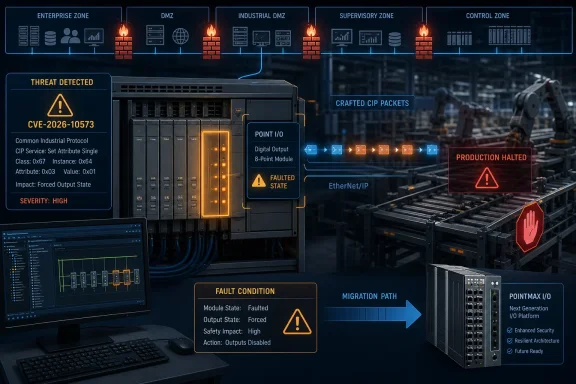
Rockwell Automation has disclosed a high-severity denial-of-service vulnerability affecting the 1734-OB8 eight-point digital output module in its longstanding POINT I/O family, a development that deserves immediate attention from manufacturers using EtherNet/IP-connected distributed I/O. Tracked as CVE-2026-10573, the issue allows specially crafted Common Industrial Protocol messages to force an affected module into a faulted state that requires a restart to recover. The flaw does not appear to enable code execution, data theft, or direct manipulation of logic, but in an industrial setting, the loss of an output module can be serious enough: interrupted sequences, halted conveyors, unavailable actuators, unexpected process holds, and potentially extended downtime while technicians diagnose a “simple” I/O fault that may actually be a network security event.
A typical POINT I/O installation includes a communications adapter, power components, terminal bases, and several I/O modules. The adapter exposes the assembly to an EtherNet/IP network, while the modules handle discrete inputs, discrete outputs, analog signals, safety functions, specialty devices, or communications tasks. The architecture is efficient, but it also means that field-level hardware can become reachable through an industrial Ethernet network.
The 1734-OB8 is the sort of module used to command real-world devices. Depending on the control-panel design and the external interface circuits, its outputs may energize relays, actuate pneumatic solenoids, drive indicator lamps, enable contactors, trigger machine functions, or provide control signals to other equipment. The ultimate consequence of a fault depends on how the system was engineered, including whether outputs are designed to fail to a safe state and whether a process can tolerate the temporary loss of those commands.
That is why the vulnerability’s availability-only classification should not cause organizations to downgrade its importance. Availability is often the primary security property in industrial automation. A disruption that causes no data loss and no unauthorized control action can still produce lost throughput, missed shipment windows, equipment resets, quality issues, or an unnecessary safety response.
The vulnerability has been classified under CWE-770, Allocation of Resources Without Limits or Throttling. In practical terms, that category points to a condition in which malformed or specially constructed requests can consume or exhaust device resources without adequate limits. Small embedded devices have far less processing headroom and memory than a Windows server or industrial PC, so resilient handling of abnormal traffic is especially important.
Those metrics should be read carefully. “Network reachable” does not mean “reachable from the public internet” in a properly designed plant. It means the attack becomes technically feasible once an adversary can reach the relevant control network segment. That access might result from a compromised engineering workstation, an exposed remote-access environment, a misconfigured firewall, an infected laptop, a poorly segmented wireless network, or unauthorized access inside the facility.
Industrial organizations should avoid the common mistake of treating “no known exploitation” as equivalent to “no exploitation.” Security teams rarely have perfect visibility into plant-floor incidents, and an unexplained module fault may be attributed to wiring, power quality, firmware behavior, or routine equipment instability unless packet captures and logs are available.
That operational importance creates a security challenge. Devices need to exchange predictable real-time traffic, while engineering workstations may also need to browse, configure, diagnose, and commission those same devices. A network that permits unrestricted CIP traffic from broad portions of the enterprise may be convenient, but it substantially enlarges the opportunity for mistakes, malformed requests, discovery scans, and malicious activity to reach sensitive equipment.
For defenders, the important distinction is between the data plane and the management plane. The periodic traffic required for the PLC and I/O system to operate must remain reliable and low latency. At the same time, message types and session activity associated with diagnostics, browsing, configuration, or unusual explicit messaging should be constrained to the systems and personnel that genuinely need them.
A well-designed architecture places cell and area zones behind industrial firewalls, defines traffic paths explicitly, and permits only approved communications between the controller, I/O, engineering assets, historians, and supervisory systems. Controls should be based on a documented operational need rather than a broad assumption that all production devices must be discoverable by all plant systems.
Consider a machine that uses standard outputs to operate pneumatic diverters, start auxiliary motors, select product lanes, or energize non-safety valves. If the I/O module faults, the controller may detect a communications or module-status error and halt the machine. In other designs, the physical output state may drop away and create a process interruption that must be cleared manually.
In a highly automated facility, a few minutes of technical intervention can become a longer production stoppage if material must be removed, product must be inspected, machine state must be re-established, or related equipment has already transitioned into a fault condition. This is why the vulnerability should be assessed alongside the facility’s actual recovery time, not merely its CVSS number.
Organizations should make sure their incident-response process includes OT-specific triage. A module fault that coincides with unusual network sessions, abnormal scan activity, changes in firewall logs, suspicious engineering workstation behavior, or multiple devices faulting in quick succession should be treated as more than a maintenance event.
A useful inventory record should include the module catalog number, series where applicable, firmware revision, chassis or station location, associated communications adapter, controller relationship, machine or process served, and whether the device sits behind a firewall boundary. It should also identify the engineering workstation or software used to manage the device.
Passive discovery is generally preferable in sensitive OT networks because aggressive scans can disrupt fragile devices or generate unnecessary network load. The immediate goal is not to enumerate every possible property of every asset; it is to establish whether the vulnerable 1734-OB8 firmware is deployed, where it is deployed, and how exposed it is.
That changes the remediation conversation. A firmware update is often manageable through a maintenance window and a tested deployment process. A hardware migration can involve engineering review, procurement, electrical work, configuration changes, commissioning, documentation updates, spare-parts planning, and production downtime.
The migration must be treated as an engineering change. Teams should verify physical fit, field wiring requirements, output characteristics, load type, current limits, protections, power distribution, enclosure layout, environmental ratings, controller compatibility, network architecture, and test procedures. Any safety implications must be reviewed separately by qualified personnel, even if the affected output module itself is standard rather than safety-rated I/O.
This is especially valuable when the affected device is located in a critical production bottleneck. Rather than simply restoring equivalent outputs, a modernization project can add better diagnostics, clearer fault annunciation, structured spare strategy, improved network zoning, and tested fallback procedures.
The relevant question is not merely, “Do we have a firewall?” It is, “Can an unapproved host send the abnormal CIP traffic required to fault this module?” If the answer is yes, the organization has not adequately contained the risk.
The right response balances urgency with operational discipline. Security and controls engineers should jointly validate changes in a lab environment where possible, schedule production work appropriately, confirm rollback steps, and preserve current configuration backups before modifying an active control network.
A compromised engineering workstation can give an adversary privileged network position, awareness of controller and I/O topology, access to configuration data, and the ability to send traffic from a trusted subnet. In that scenario, the firewall may see the activity as originating from a legitimate management asset unless segmentation and monitoring are designed with that possibility in mind.
The answer is not to exempt these devices from security controls because they are “too important to patch.” It is to manage them as high-value OT assets. That means testing updates, maintaining known-good images, limiting internet access, using dedicated accounts, controlling software installation, and separating engineering tasks from email, web browsing, and general office activity.
For WindowsForum readers responsible for the IT side of industrial environments, this is an important distinction. Traditional file backup is necessary but incomplete. A recoverable OT environment also requires the configuration intelligence needed to rebuild the relationship between Windows-based engineering tools, controllers, networks, and field devices.
For these organizations, the most important question is not whether the vulnerability affects a “computer” in the conventional sense. It is whether the module is part of a production process where a fault creates measurable operational consequences. Downtime analysis, alternate production capacity, spare module availability, and recovery labor are all part of the risk calculation.
This does not mean CVE-2026-10573 should be treated as an imminent consumer crisis. There is no reported public exploitation targeting this vulnerability. It does illustrate, however, why industrial cybersecurity increasingly matters beyond the factory floor: vulnerabilities in comparatively small field devices can influence the reliability of systems that underpin everyday supply chains.
Users should also monitor whether future advisories clarify the precise message conditions that cause the fault or provide detection guidance that network-monitoring tools can use. Technical detail can improve defensive visibility, although it may also increase the need for careful access control and prompt remediation.
A mature organization will also use this advisory as a prompt to review other field devices that lack a straightforward patch path. Industrial environments often contain hardware with long service lives, and the question is not whether every legacy device can be replaced immediately. The question is whether its exposure, recovery procedures, and compensating controls are understood well enough to manage the risk responsibly.
Rockwell Automation’s 1734-OB8 vulnerability is a reminder that cybersecurity at the edge of industrial networks is inseparable from operational resilience. The affected module may be small, but the function it performs can be central to a larger machine or production cell. The sensible response is neither panic nor complacency: identify version 3.023 deployments, reduce unnecessary CIP reachability, protect the Windows engineering systems that sit near the control boundary, prepare for safe recovery, and treat migration to the recommended successor platform as a planned reliability and security improvement rather than a last-minute hardware swap.
 Background
POINT I/O’s role in industrial control systems
Rockwell Automation’s POINT I/O platform has been a familiar component of Allen-Bradley automation architectures for years. Its appeal is straightforward: compact modular I/O can be installed close to field devices rather than forcing every sensor and actuator cable back to a central PLC panel. That distributed design reduces wiring costs, simplifies machine construction, and makes POINT I/O particularly common on packaging lines, material-handling systems, assembly equipment, and retrofitted production cells.A typical POINT I/O installation includes a communications adapter, power components, terminal bases, and several I/O modules. The adapter exposes the assembly to an EtherNet/IP network, while the modules handle discrete inputs, discrete outputs, analog signals, safety functions, specialty devices, or communications tasks. The architecture is efficient, but it also means that field-level hardware can become reachable through an industrial Ethernet network.
The affected module is not the entire POINT I/O ecosystem
The advisory should not be interpreted as a blanket vulnerability across every POINT I/O module or every device carrying a 1734 catalog prefix. The identified affected product is the 1734-OB8, an eight-point digital output module, at firmware version 3.023. That precision matters because a large industrial site may have dozens or hundreds of POINT I/O nodes, but only a subset may include the affected output card.The 1734-OB8 is the sort of module used to command real-world devices. Depending on the control-panel design and the external interface circuits, its outputs may energize relays, actuate pneumatic solenoids, drive indicator lamps, enable contactors, trigger machine functions, or provide control signals to other equipment. The ultimate consequence of a fault depends on how the system was engineered, including whether outputs are designed to fail to a safe state and whether a process can tolerate the temporary loss of those commands.
Why an I/O fault is a cybersecurity concern
In office IT, a denial-of-service event may mean an unavailable website or a slowed application. In operational technology, a denial-of-service condition can be more disruptive because the unavailable component is tied to a physical process. A module fault can trigger controller alarms, stop a line, inhibit a sequence, place equipment in a recovery state, or require manual inspection before operations can resume.That is why the vulnerability’s availability-only classification should not cause organizations to downgrade its importance. Availability is often the primary security property in industrial automation. A disruption that causes no data loss and no unauthorized control action can still produce lost throughput, missed shipment windows, equipment resets, quality issues, or an unnecessary safety response.
The July 21 Advisory at a Glance
What CVE-2026-10573 describes
CVE-2026-10573 concerns improper handling of crafted CIP messages by the affected 1734-OB8 module. An attacker who can deliver the necessary network traffic to the device may cause the module to enter a faulted condition. Recovery requires a restart, which makes this more than a transient communications glitch.The vulnerability has been classified under CWE-770, Allocation of Resources Without Limits or Throttling. In practical terms, that category points to a condition in which malformed or specially constructed requests can consume or exhaust device resources without adequate limits. Small embedded devices have far less processing headroom and memory than a Windows server or industrial PC, so resilient handling of abnormal traffic is especially important.
Severity scores emphasize availability impact
The issue carries a CVSS v3.1 base score of 7.5 out of 10, rated High, and a CVSS v4.0 base score of 8.7 out of 10, also rated High. The v3.1 vector characterizes the attack as network reachable, low complexity, requiring no privileges or user interaction, with a high impact on availability and no direct confidentiality or integrity impact.Those metrics should be read carefully. “Network reachable” does not mean “reachable from the public internet” in a properly designed plant. It means the attack becomes technically feasible once an adversary can reach the relevant control network segment. That access might result from a compromised engineering workstation, an exposed remote-access environment, a misconfigured firewall, an infected laptop, a poorly segmented wireless network, or unauthorized access inside the facility.
No public exploitation has been reported
As of the July 21, 2026 publication of the advisory, no known public exploitation specifically targeting this vulnerability had been reported. That is encouraging, but it is not a reason to defer action. Public disclosure gives defenders the information needed to protect equipment, but it also gives threat actors a clear description of a potentially useful disruption technique.Industrial organizations should avoid the common mistake of treating “no known exploitation” as equivalent to “no exploitation.” Security teams rarely have perfect visibility into plant-floor incidents, and an unexplained module fault may be attributed to wiring, power quality, firmware behavior, or routine equipment instability unless packet captures and logs are available.
Understanding CIP Exposure
CIP is central to modern industrial communications
The Common Industrial Protocol, or CIP, is widely used across industrial automation environments and is closely associated with EtherNet/IP networks. It supports the exchange of I/O data, device configuration, diagnostics, control functions, and other industrial services. In a Rockwell-oriented environment, CIP traffic is part of ordinary operations rather than an exotic administrative channel.That operational importance creates a security challenge. Devices need to exchange predictable real-time traffic, while engineering workstations may also need to browse, configure, diagnose, and commission those same devices. A network that permits unrestricted CIP traffic from broad portions of the enterprise may be convenient, but it substantially enlarges the opportunity for mistakes, malformed requests, discovery scans, and malicious activity to reach sensitive equipment.
Crafted messages are not normal I/O updates
The advisory refers specifically to crafted CIP messages. This does not imply that routine controller-to-module I/O traffic will trigger the fault under normal circumstances. The issue is associated with input handling, meaning the threat arises when the affected module receives messages that exploit the resource-management weakness.For defenders, the important distinction is between the data plane and the management plane. The periodic traffic required for the PLC and I/O system to operate must remain reliable and low latency. At the same time, message types and session activity associated with diagnostics, browsing, configuration, or unusual explicit messaging should be constrained to the systems and personnel that genuinely need them.
Network segmentation remains the decisive control
The most effective immediate mitigation is not a generic antivirus deployment or a workstation patch alone. It is segmentation that prevents untrusted or nonessential systems from reaching POINT I/O devices in the first place. A flat network where office endpoints, engineering stations, wireless devices, remote support platforms, and I/O adapters can freely communicate is a poor fit for contemporary industrial security.A well-designed architecture places cell and area zones behind industrial firewalls, defines traffic paths explicitly, and permits only approved communications between the controller, I/O, engineering assets, historians, and supervisory systems. Controls should be based on a documented operational need rather than a broad assumption that all production devices must be discoverable by all plant systems.
What a Faulted 1734-OB8 Can Mean on the Plant Floor
Output loss is context dependent
A digital output module is not inherently equivalent to a safety controller, and an individual module fault does not automatically create a hazardous condition. Properly designed machinery should use separate safety circuits, safety-rated control components where required, and clearly defined fault behavior. Nevertheless, the loss of standard outputs can interrupt the sequence logic that keeps a production process moving.Consider a machine that uses standard outputs to operate pneumatic diverters, start auxiliary motors, select product lanes, or energize non-safety valves. If the I/O module faults, the controller may detect a communications or module-status error and halt the machine. In other designs, the physical output state may drop away and create a process interruption that must be cleared manually.
Restart requirements complicate recovery
The advisory notes that a restart is required for recovery. That creates an operational burden beyond simply waiting for a communication timeout to clear. Restarting a module can require controlled access to the panel, coordination with operators, validation that the machine is in a safe state, and a deliberate recovery procedure in the PLC or HMI.In a highly automated facility, a few minutes of technical intervention can become a longer production stoppage if material must be removed, product must be inspected, machine state must be re-established, or related equipment has already transitioned into a fault condition. This is why the vulnerability should be assessed alongside the facility’s actual recovery time, not merely its CVSS number.
Fault diagnostics can obscure the root cause
An attacker-induced fault can resemble a normal reliability incident. Maintenance personnel may first investigate loose terminal connections, a failing power supply, noise on the network, an overloaded chassis, an intermittent Ethernet link, or a software configuration mismatch. Those are all reasonable possibilities when an I/O module fails, but they can also delay recognition of a security cause.Organizations should make sure their incident-response process includes OT-specific triage. A module fault that coincides with unusual network sessions, abnormal scan activity, changes in firewall logs, suspicious engineering workstation behavior, or multiple devices faulting in quick succession should be treated as more than a maintenance event.
Inventory Comes Before Remediation
Confirm the exact catalog number and firmware
The first step is to identify whether the affected 1734-OB8 module exists in the environment and whether it is running firmware version 3.023. Asset inventories often identify a POINT I/O station at the rack or adapter level but omit the specific modules and firmware installed within the assembly. That level of detail is no longer sufficient for effective vulnerability management.A useful inventory record should include the module catalog number, series where applicable, firmware revision, chassis or station location, associated communications adapter, controller relationship, machine or process served, and whether the device sits behind a firewall boundary. It should also identify the engineering workstation or software used to manage the device.
Do not rely only on central asset databases
Central CMDB entries and procurement records are helpful, but they may not reflect years of line modifications, replacement parts, emergency maintenance, or firmware changes. The most reliable inventory combines multiple sources: controller project files, automation configuration tools, switch-port records, passive asset-discovery data, maintenance documentation, and physical verification during planned access windows.Passive discovery is generally preferable in sensitive OT networks because aggressive scans can disrupt fragile devices or generate unnecessary network load. The immediate goal is not to enumerate every possible property of every asset; it is to establish whether the vulnerable 1734-OB8 firmware is deployed, where it is deployed, and how exposed it is.
A practical assessment sequence
A disciplined assessment can proceed in the following order:- Identify every 1734-OB8 module and record its firmware version.
- Map each affected module to its EtherNet/IP path, adapter, controller, switch port, and production process.
- Determine which hosts can currently send CIP traffic to the device or its network segment.
- Review the process impact of a module fault and the local restart procedure.
- Prioritize remediation based on exposure, production criticality, and the quality of compensating controls.
- Document the decision, including equipment that cannot be immediately migrated.
Rockwell’s Recommended Migration Path
There is no corrected firmware for the affected device
One of the most consequential details in the advisory is that Rockwell Automation does not list a corrected firmware version for the affected 1734-OB8. Instead, the vendor recommends migration to the 5034-OB8, part of the newer PointMax I/O family.That changes the remediation conversation. A firmware update is often manageable through a maintenance window and a tested deployment process. A hardware migration can involve engineering review, procurement, electrical work, configuration changes, commissioning, documentation updates, spare-parts planning, and production downtime.
A successor module is not automatically a drop-in swap
The 5034-OB8 may serve a similar functional purpose as an eight-point digital output module, but organizations should not assume that replacing a 1734-OB8 is as simple as unplugging one card and inserting another. Different I/O families can use different bases, terminal systems, mechanical arrangements, power considerations, configuration workflows, and diagnostic models.The migration must be treated as an engineering change. Teams should verify physical fit, field wiring requirements, output characteristics, load type, current limits, protections, power distribution, enclosure layout, environmental ratings, controller compatibility, network architecture, and test procedures. Any safety implications must be reviewed separately by qualified personnel, even if the affected output module itself is standard rather than safety-rated I/O.
Migration is also an architectural opportunity
Although a hardware replacement creates cost and complexity, it can be used to address accumulated technical debt. Older remote I/O islands are frequently installed in cabinets that lack adequate labeling, spare capacity, segmented switching, managed network visibility, or documented recovery instructions. A planned migration can improve all of those conditions.This is especially valuable when the affected device is located in a critical production bottleneck. Rather than simply restoring equivalent outputs, a modernization project can add better diagnostics, clearer fault annunciation, structured spare strategy, improved network zoning, and tested fallback procedures.
Containment for Organizations That Cannot Migrate Immediately
Compensating controls should be specific
Many plants cannot replace vulnerable hardware on the day an advisory is published. Production schedules, validated processes, contractor availability, supply-chain lead times, and shutdown constraints may delay a migration. In that case, compensating controls should be designed around the actual attack path.The relevant question is not merely, “Do we have a firewall?” It is, “Can an unapproved host send the abnormal CIP traffic required to fault this module?” If the answer is yes, the organization has not adequately contained the risk.
High-value interim measures
Organizations operating affected modules should prioritize the following actions:- Remove direct internet exposure from all industrial control devices and supporting management interfaces.
- Isolate POINT I/O networks from business networks with properly configured firewalls and routed boundaries.
- Allow CIP communications only from required PLCs, engineering workstations, and approved management systems.
- Restrict remote access through hardened, monitored jump hosts or virtual private network gateways.
- Disable or remove inactive switch ports, unused wireless access, and unmanaged connections near control panels.
- Use managed industrial switches where possible to support port visibility, access controls, and traffic troubleshooting.
- Establish alerting for unusual communications paths and unexpected device faults.
- Maintain a documented, safe restart process for every affected module.
Avoid unsafe “quick fixes”
Plant teams should resist untested countermeasures that could be more disruptive than the vulnerability itself. Blocking broad categories of industrial traffic, changing switch settings during production, or modifying controller communication parameters without an impact analysis can cause loss of control or unplanned equipment stoppage.The right response balances urgency with operational discipline. Security and controls engineers should jointly validate changes in a lab environment where possible, schedule production work appropriately, confirm rollback steps, and preserve current configuration backups before modifying an active control network.
Why Windows Systems Are Part of the Security Boundary
Engineering workstations are a likely pivot point
Windows-based engineering workstations are central to many Rockwell environments. They often host development tools, HMI software, remote-support clients, diagnostic utilities, project files, and network access that ordinary office PCs do not possess. Even when the I/O module itself runs embedded firmware, the Windows systems around it can determine whether an attacker can reach it.A compromised engineering workstation can give an adversary privileged network position, awareness of controller and I/O topology, access to configuration data, and the ability to send traffic from a trusted subnet. In that scenario, the firewall may see the activity as originating from a legitimate management asset unless segmentation and monitoring are designed with that possibility in mind.
Hardening requires OT-aware tradeoffs
Standard Windows security practices remain valuable: supported operating systems, timely security updates, endpoint protection, least-privilege accounts, multifactor authentication, restricted local administrator rights, application control, logging, and controlled removable media. However, industrial engineering stations also need carefully managed exceptions for specialized software, drivers, legacy dependencies, and offline commissioning workflows.The answer is not to exempt these devices from security controls because they are “too important to patch.” It is to manage them as high-value OT assets. That means testing updates, maintaining known-good images, limiting internet access, using dedicated accounts, controlling software installation, and separating engineering tasks from email, web browsing, and general office activity.
Backup strategy must include configuration, not just data
A restart can restore a faulted module, but a broader incident may require reconfiguration, replacement hardware, or controller project recovery. Plants should maintain secure, version-controlled backups of PLC programs, I/O configurations, HMI projects, network switch configurations, drive parameters, and device firmware records.For WindowsForum readers responsible for the IT side of industrial environments, this is an important distinction. Traditional file backup is necessary but incomplete. A recoverable OT environment also requires the configuration intelligence needed to rebuild the relationship between Windows-based engineering tools, controllers, networks, and field devices.
Enterprise Impact Versus Consumer Relevance
Enterprises face the direct operational burden
The immediate audience for this advisory is industrial organizations using the affected 1734-OB8 module. Manufacturers, system integrators, machine builders, warehouse operators, and critical-infrastructure operators may all have a direct exposure depending on their installed base.For these organizations, the most important question is not whether the vulnerability affects a “computer” in the conventional sense. It is whether the module is part of a production process where a fault creates measurable operational consequences. Downtime analysis, alternate production capacity, spare module availability, and recovery labor are all part of the risk calculation.
Consumers are indirectly affected
Most consumers will never encounter a POINT I/O module, but they may still feel the broader consequences of industrial control disruptions. Distributed I/O is embedded in the machinery that produces packaged goods, vehicles, building materials, food products, consumer electronics, and countless other items.This does not mean CVE-2026-10573 should be treated as an imminent consumer crisis. There is no reported public exploitation targeting this vulnerability. It does illustrate, however, why industrial cybersecurity increasingly matters beyond the factory floor: vulnerabilities in comparatively small field devices can influence the reliability of systems that underpin everyday supply chains.
Strengths and Opportunities
The advisory offers a clear starting point
Several aspects of the disclosure help defenders act quickly:- The affected module and firmware are identified with useful specificity, reducing unnecessary scope expansion.
- The disclosed impact is focused on denial of service, allowing teams to prioritize availability and recovery planning.
- The absence of a firmware fix is explicit, preventing false confidence that a routine patch will resolve the problem.
- The recommended migration direction gives organizations a defined long-term remediation target.
- The advisory reinforces foundational controls such as segmentation, firewalling, restricted remote access, and impact analysis.
- The event creates an opportunity to improve asset inventory accuracy at the module and firmware level.
Risks and Concerns
The migration recommendation introduces real complexity
The principal concerns are not limited to the vulnerability itself:- Affected organizations may have no in-place firmware remediation and must plan a hardware migration.
- A successor product family may require changes beyond the output module, increasing engineering scope.
- A faulted module can be mistaken for an ordinary equipment problem, delaying cybersecurity investigation.
- Flat networks can make a low-complexity network attack materially easier after an initial compromise.
- Remote support arrangements may expose control networks to more systems than plant teams realize.
- Emergency replacement work can introduce wiring, configuration, or commissioning errors if performed without adequate validation.
- Overly aggressive network scanning or untested firewall changes can create availability problems of their own.
What to Watch Next
More detail from the vendor could shape migration planning
Organizations should watch for additional Rockwell Automation guidance on migration design, compatibility, lifecycle planning, and recommended configuration practices for PointMax I/O deployments. A product-family migration may involve questions that go beyond cybersecurity, including wiring conversion, tooling support, controller compatibility, spare-part strategy, and the best time to consolidate multiple legacy I/O changes into one shutdown.Users should also monitor whether future advisories clarify the precise message conditions that cause the fault or provide detection guidance that network-monitoring tools can use. Technical detail can improve defensive visibility, although it may also increase the need for careful access control and prompt remediation.
Threat intelligence should inform urgency, not replace engineering judgment
If public exploitation, proof-of-concept code, or related industrial campaigns emerge, the urgency for exposed environments will rise. Even then, the response should remain structured: validate exposure, confirm controls, protect the operational network, and conduct changes through a safe process.A mature organization will also use this advisory as a prompt to review other field devices that lack a straightforward patch path. Industrial environments often contain hardware with long service lives, and the question is not whether every legacy device can be replaced immediately. The question is whether its exposure, recovery procedures, and compensating controls are understood well enough to manage the risk responsibly.
Rockwell Automation’s 1734-OB8 vulnerability is a reminder that cybersecurity at the edge of industrial networks is inseparable from operational resilience. The affected module may be small, but the function it performs can be central to a larger machine or production cell. The sensible response is neither panic nor complacency: identify version 3.023 deployments, reduce unnecessary CIP reachability, protect the Windows engineering systems that sit near the control boundary, prepare for safe recovery, and treat migration to the recommended successor platform as a planned reliability and security improvement rather than a last-minute hardware swap.
References
- Primary source: CISA
Published: 2026-07-21T12:00:00+00:00
Loading…
www.cisa.gov - Related coverage: securityweek.com
Rockwell Automation Patches Vulnerabilities in ICS Controllers and Software - SecurityWeek
Rockwell Automation informed customers that patches are available for several vulnerabilities affecting its ICS controllers and software.www.securityweek.com