

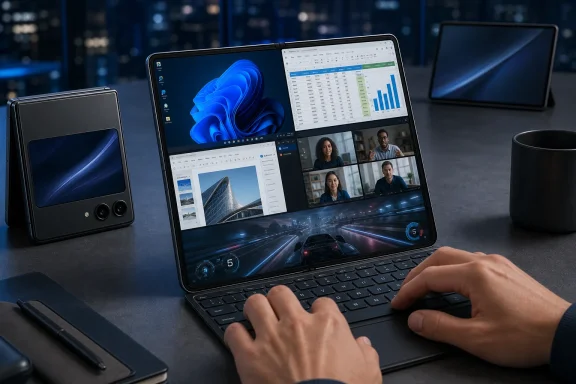
The smartphone industry spent years stretching displays upward, shrinking bezels, and persuading buyers that a taller screen automatically meant a more useful device. Now the pendulum appears ready to swing sideways. A new generation of shorter, wider foldable phones could revive the original phablet promise: a pocketable computer that is genuinely better for typing, reading, editing, multitasking, gaming, and watching video—not merely a conventional handset with more vertical scrolling space. Samsung’s expected Galaxy Z Fold 8 redesign may lead that shift, while Huawei has already explored the idea and Apple is widely rumored to be preparing a similarly broad foldable. The comeback is not guaranteed, and “fixing everything” overstates what hardware geometry alone can achieve, but wider devices could address many of the compromises that have made both modern slabs and early foldables feel less useful than their dimensions suggest.
Samsung’s early Galaxy Note models became the most commercially important examples. Their large screens, broad bodies, and integrated S Pen made size a functional advantage rather than a specification included primarily for marketing. The Note was designed around annotation, handwriting, document review, and dense information, even if many buyers ultimately used it as a premium entertainment phone.
Other manufacturers experimented more aggressively. The nearly square LG Optimus Vu prioritized width, the BlackBerry Passport paired a broad display with a physical keyboard, and the Xperia Z Ultra approached small-tablet proportions. These products were not universally comfortable, but they demonstrated that screen shape could define how a device was used.
That change solved several problems. Tall phones were easier to grip, offered more vertical space for social feeds, and accommodated larger batteries without becoming excessively wide. They also matched the increasingly vertical nature of mobile software, including portrait video, messaging timelines, and endless scrolling interfaces.
However, modern phones inherited the phablet’s diagonal measurements without preserving its usable breadth. A tall 6.8-inch handset can look enormous on a specification sheet while still offering limited horizontal room for a document, spreadsheet, drawing canvas, desktop-style website, or two-column interface. The industry made phones larger, but not necessarily more capable.
A narrow display works well for single-column applications. It can show more messages, social posts, or lines of an article at once, but it does not give interface elements much room to sit beside one another. Tool palettes obscure content, keyboards consume much of the remaining view, and desktop-oriented pages become miniature versions of themselves.
A wider screen changes those trade-offs. It can support a navigation pane next to content, preserve more of an image while editing, expose additional spreadsheet columns, and make landscape applications feel less constrained. Width is especially valuable when software needs to present controls and content simultaneously.
That makes the emerging design movement more significant than another increase in screen size. Samsung is expected to introduce a shorter and wider Galaxy Z Fold 8 variant around a tablet-like internal aspect ratio, although the final name, specifications, and product positioning remain unconfirmed until the company’s July 22, 2026 Galaxy Unpacked event. Recent leaks suggest Samsung may sell both a broad model and a more conventionally shaped premium Fold, allowing buyers to choose between different display philosophies.
If those reports prove accurate, Samsung will not merely be adjusting dimensions. It will be testing whether buyers value a more useful canvas enough to accept reduced one-handed reach and potentially different compromises in cameras, battery capacity, or component placement.
Successive generations improved the outer screen, while the Galaxy Z Fold 7 moved closer to the proportions of a regular flagship. Yet Samsung’s established book-style design still opens into an almost square internal panel. That shape is useful for side-by-side multitasking and reading, but less efficient for widescreen video and applications that expect a more familiar tablet canvas.
The rumored Galaxy Z Fold 8 approach changes the equation. A shorter, wider body could produce a cover screen resembling a compact traditional smartphone while unfolding into something closer to a small 4:3 tablet. The closed device would remain thick relative to a slab, but it could occupy less vertical pocket space and feel less top-heavy in use.
A well-designed wide Fold could divide its responsibilities naturally:
A wider cover display could provide a more comfortable two-thumb keyboard with better key separation. On the internal panel, a split keyboard could leave the center of the screen unobstructed while reducing thumb travel. Users who prefer swipe input would gain wider gesture paths, while handwriting recognition could work with more natural line lengths if pen support were available.
Samsung removed S Pen compatibility from the Galaxy Z Fold 7 as part of its effort to make the device thinner. Current reports do not establish that the wider Galaxy Z Fold 8 will restore it, so buyers should not assume that a larger canvas will automatically become a Galaxy Note replacement. That omission would be particularly frustrating because the broad internal panel is exactly where annotation, sketching, and precision selection would make sense.
A wide internal display would not eliminate the need for scaling, but it could make several tasks less punishing:
On an almost square screen, two tall applications fit reasonably well beside each other, but media and tablet-style layouts can become awkward. A broader ratio could better support a document alongside email, a browser beside notes, or a video call next to shared material. Three-app arrangements would remain cramped, but two-window work could feel less like a technical demonstration and more like a normal operating mode.
A broader internal screen can reduce those bars, but it cannot eliminate every mismatch. A 4:3 display still differs from 16:9 television and wider cinematic formats. The actual improvement will depend on the Fold’s precise dimensions, and buyers should be skeptical of comparisons based solely on diagonal size.
Even so, a wider panel offers a more balanced compromise. It can preserve useful height for reading while presenting landscape video at a size that more clearly exceeds a standard flagship phone. That is important for a product expected to command an ultra-premium price.
A tablet-like ratio gives developers a familiar target. Android tablets, iPads, handheld gaming systems, and emulation applications have already established interface patterns for broader screens. Touch controls can sit farther from the central action, maps and inventory panels can occupy dedicated columns, and strategy games can expose more of their interfaces.
Cloud gaming may benefit as well. Xbox Cloud Gaming, GeForce Now, Steam Link, and similar services generally transmit widescreen images designed for televisions or monitors. A wider foldable can display those streams more efficiently, particularly when paired with a telescopic controller.
A wide foldable could serve both patterns. Closed, it remains suitable for quick reading and messaging. Open, it can display a wider text column, a two-page book layout, or a PDF at a legible scale without as much horizontal panning.
The critical software feature will be intelligent layout switching. Simply enlarging a phone interface wastes the potential of the internal screen. Applications need responsive columns, adjustable margins, persistent navigation, and controls that do not float across the content.
A shorter foldable may fit more securely even if it is wider and thicker. The reduced vertical dimension can lower the chance of the device levering itself out of a pocket, while the folded construction protects the expensive inner screen. A passport-like footprint could also fit more naturally into small bags and jacket compartments.
Thickness remains the counterargument. Two halves, a hinge, multiple display layers, and protective structures cannot disappear through aspect-ratio changes. Samsung and other manufacturers have reduced foldable thickness significantly, but adding a case can still turn an elegant engineering achievement into a substantial object.
Software can mitigate the problem through one-handed modes, edge panels, movable keyboards, bottom-aligned navigation, and gesture zones. It cannot repeal anatomy. Manufacturers must therefore resist presenting width as an ergonomic victory for everyone.
Weight distribution also matters as much as total mass. A broad device with balanced halves may feel more stable than a tall phone whose camera assembly concentrates weight near the top. Conversely, opening a wide foldable with one hand could be difficult if the hinge is stiff or the frame offers no purchase.
Nevertheless, the form factor can introduce useful friction. If the cover display is comfortable for communication but less immersive for entertainment, users may handle notifications, send a message, and put the device away. Opening the phone becomes a conscious decision to enter a larger visual environment.
That behavioral boundary is more meaningful than it first appears. Conventional smartphones present every activity through the same always-ready slab, so checking the weather can turn into 20 minutes of algorithmic feeds. A dual-mode device can separate lightweight utility from immersive consumption, provided users configure the software accordingly.
Digital wellbeing will still depend on notification settings, app limits, focus modes, bedtime schedules, and personal habits. The form factor offers a prompt, not a cure. Its greatest contribution may be making the difference between checking and settling in physically obvious.
Users who want to exploit that distinction could follow a simple setup process:
Android has improved support for large displays, window resizing, task continuity, and responsive application layouts. Google has also pushed developers toward adaptive interfaces that work across phones, tablets, foldables, desktop windows, and connected displays. Yet compliance remains inconsistent, particularly among applications that assume a fixed portrait phone canvas.
A wider Fold may expose those weaknesses immediately. Applications could stretch awkwardly, display oversized blank regions, force portrait windows, restart when the device opens, or place essential controls near the hinge. Samsung can patch high-profile applications through compatibility settings, but it cannot redesign the entire Play Store.
That work may carry over conceptually—and sometimes technically—to Android. Cross-platform frameworks, shared design systems, and responsive web applications could spread improvements across both ecosystems. A popular folding iPhone would also normalize the form factor among consumers who currently regard foldables as experimental Android hardware.
However, Apple’s participation could create another fragmented target rather than a universal standard. Developers may optimize carefully for Apple’s exact dimensions while leaving Android compatibility to automatic scaling. Samsung will still need strong tools, documentation, testing programs, and commercial partnerships to ensure its wider screen receives more than enlarged phone layouts.
A broader phone could make those connections more practical. Users might review Windows notifications on the cover screen, edit a Microsoft 365 document inside, and continue on a PC without manually moving files. The Fold could also serve as a portable secondary display, webcam, authentication device, or touch controller.
The strongest strategy would treat the phone and PC as complementary endpoints rather than pretending the Fold replaces Windows. Samsung DeX may cover occasional desktop-style use, but millions of customers still depend on full Windows applications, enterprise management, peripherals, and local storage workflows.
The cover screen can support quick scanning and communication, while the internal display provides room for forms, diagrams, signatures, photographs, and reference material. Split-screen workflows could let employees compare an asset with its service record or enter notes while maintaining a video call.
The financial case depends on durability and lifecycle cost. Saving the price of a tablet is irrelevant if foldable displays require frequent replacement or if specialized cases make the device cumbersome. Procurement teams will need failure-rate data, repair terms, guaranteed update periods, accessory availability, and total-cost modeling rather than impressive demonstrations.
Enterprise mobility management platforms should be tested for:
A wider internal panel strengthens the substitution argument. Travelers could carry one cellular device for navigation, boarding passes, books, shows, games, and communications. People who mainly use tablets in bed or on the sofa might stop upgrading that second device.
The replacement will not work for everyone. Artists may need a larger pen-enabled canvas, students may prefer a keyboard case and longer battery life, and families may want a shared tablet that is not tied to one person’s phone number and private accounts. Still, a well-proportioned foldable can reduce the number of devices needed for lighter use.
That matters because a design cannot reshape the mass market if most buyers encounter it only in stores. Samsung’s scale may help bring wider Fold designs into lower price tiers over time, particularly if Apple validates demand and Chinese manufacturers continue aggressive development.
Carrier promotions and trade-ins can obscure the full cost, but they do not eliminate it. Buyers should compare the Fold’s total ownership expense with a flagship phone plus a modest tablet. The foldable wins on portability and continuity, not necessarily on price.
A wide Galaxy Z Fold 8 would let Samsung compete on a more fundamental level: the purpose of the form factor. Rather than winning a specification contest inside an established template, it could establish a new mainstream geometry before Apple enters the category.
Offering multiple Fold shapes would also provide useful market intelligence. Sales, return rates, app usage, customer satisfaction, and screen-mode data could reveal whether people prefer the established tall-and-square combination or a compact-and-wide alternative.
Huawei’s limited availability in Western markets reduces its direct influence on many WindowsForum readers, but its design remains strategically important. It indicates that multiple manufacturers have independently identified aspect ratio as the next major area of foldable differentiation.
Chinese brands are likely to continue experimenting with passport-like bodies, larger batteries, thinner hinges, and unusual outer screens. Samsung and Apple may popularize the format internationally, but they did not invent the underlying idea.
Its rumored short-and-wide design would also validate the central criticism of existing phones: height has reached diminishing returns. If Apple emphasizes tablet applications, continuity, multitasking, and low-crease engineering, Samsung will face pressure to improve polish rather than merely offer more hardware features.
The competition could benefit Android buyers through better hinges, tougher panels, longer software support, and more responsive applications. It could also drive prices higher if both companies position folding devices as exclusive “Ultra” products above existing flagships.
Several details will determine whether the wide design is a breakthrough or a carefully segmented alternative:
If it appears, attention should focus on more than the hinge. Apple will need to show how iOS applications transition between displays, how multitasking works, whether iPad-style interfaces appear on the inner panel, and how developers are expected to support the new dimensions.
Pricing and availability could also shape the broader market. A foldable positioned above the iPhone Pro Max may remain a luxury showcase, while a supply-constrained launch could limit its immediate software impact. Even so, Apple’s formal commitment would signal that wide foldables are becoming a durable category rather than a single-year Android trend.
Watch for broader support in Android development tools, more adaptive Microsoft applications, specialized gaming accessories, compact folding keyboards, and enterprise cases. These ecosystem products will indicate whether companies see a lasting installed base rather than temporary curiosity.
The smartphone market does not need another race to add a fraction of an inch to already enormous displays. It needs devices whose dimensions support the activities manufacturers have promised for years. Wider foldable phablets cannot fix fragile screens, high prices, inconsistent applications, camera compromises, or the attention economy by themselves, but they can correct a fundamental design mistake: confusing height with usefulness. If Samsung delivers a polished Galaxy Z Fold 8, Apple follows with a credible foldable, and developers embrace responsive interfaces, the revived phablet may finally become what its awkward ancestors were trying to build—a pocketable computer whose larger screen genuinely changes what its owner can accomplish.
 Background
The original meaning of “phablet”
The word phablet emerged when smartphones and tablets were still clearly separated product categories. A phone was expected to fit comfortably in one hand, while a tablet offered enough display area for reading, media, games, and light productivity. Devices such as the Dell Streak, Samsung Galaxy Note, Sony Xperia Z Ultra, LG Optimus Vu, and Huawei Ascend Mate deliberately occupied the territory between them.Samsung’s early Galaxy Note models became the most commercially important examples. Their large screens, broad bodies, and integrated S Pen made size a functional advantage rather than a specification included primarily for marketing. The Note was designed around annotation, handwriting, document review, and dense information, even if many buyers ultimately used it as a premium entertainment phone.
Other manufacturers experimented more aggressively. The nearly square LG Optimus Vu prioritized width, the BlackBerry Passport paired a broad display with a physical keyboard, and the Xperia Z Ultra approached small-tablet proportions. These products were not universally comfortable, but they demonstrated that screen shape could define how a device was used.
How every flagship became a phablet
The phablet label faded because large phones stopped being unusual. Once manufacturers reduced bezels and switched to taller aspect ratios, they could advertise six-inch-plus displays without building devices as wide as the earliest tablet-phone hybrids.That change solved several problems. Tall phones were easier to grip, offered more vertical space for social feeds, and accommodated larger batteries without becoming excessively wide. They also matched the increasingly vertical nature of mobile software, including portrait video, messaging timelines, and endless scrolling interfaces.
However, modern phones inherited the phablet’s diagonal measurements without preserving its usable breadth. A tall 6.8-inch handset can look enormous on a specification sheet while still offering limited horizontal room for a document, spreadsheet, drawing canvas, desktop-style website, or two-column interface. The industry made phones larger, but not necessarily more capable.
Why Width Matters More Than Diagonal Size
Display measurements conceal the real experience
Screen size is usually advertised as a diagonal measurement, but that number says little about the shape or usable area of the panel. Two displays with identical diagonals can provide substantially different working spaces if one is long and narrow while the other is closer to a traditional tablet ratio.A narrow display works well for single-column applications. It can show more messages, social posts, or lines of an article at once, but it does not give interface elements much room to sit beside one another. Tool palettes obscure content, keyboards consume much of the remaining view, and desktop-oriented pages become miniature versions of themselves.
A wider screen changes those trade-offs. It can support a navigation pane next to content, preserve more of an image while editing, expose additional spreadsheet columns, and make landscape applications feel less constrained. Width is especially valuable when software needs to present controls and content simultaneously.
A useful canvas instead of an extended feed
The distinction is between seeing more of the same thing and seeing more kinds of information at once. Tall phones excel at the former. Wider phablets can improve the latter.That makes the emerging design movement more significant than another increase in screen size. Samsung is expected to introduce a shorter and wider Galaxy Z Fold 8 variant around a tablet-like internal aspect ratio, although the final name, specifications, and product positioning remain unconfirmed until the company’s July 22, 2026 Galaxy Unpacked event. Recent leaks suggest Samsung may sell both a broad model and a more conventionally shaped premium Fold, allowing buyers to choose between different display philosophies.
If those reports prove accurate, Samsung will not merely be adjusting dimensions. It will be testing whether buyers value a more useful canvas enough to accept reduced one-handed reach and potentially different compromises in cameras, battery capacity, or component placement.
The Galaxy Z Fold 8 as a Turning Point
From narrow cover display to compact conventional phone
Samsung’s first Galaxy Fold devices had unusually narrow cover screens. Those displays were adequate for notifications and quick interactions, but typing, browsing, and running many ordinary Android applications could feel awkward. Opening the device was often necessary rather than optional.Successive generations improved the outer screen, while the Galaxy Z Fold 7 moved closer to the proportions of a regular flagship. Yet Samsung’s established book-style design still opens into an almost square internal panel. That shape is useful for side-by-side multitasking and reading, but less efficient for widescreen video and applications that expect a more familiar tablet canvas.
The rumored Galaxy Z Fold 8 approach changes the equation. A shorter, wider body could produce a cover screen resembling a compact traditional smartphone while unfolding into something closer to a small 4:3 tablet. The closed device would remain thick relative to a slab, but it could occupy less vertical pocket space and feel less top-heavy in use.
Two modes with genuinely different purposes
The best foldable designs do not simply provide a small screen and a larger version of the same screen. They create distinct usage modes.A well-designed wide Fold could divide its responsibilities naturally:
- The cover display could handle calls, messaging, authentication, navigation, music controls, and quick searches without requiring the hinge.
- The internal display could become the deliberate workspace for documents, reading, photography, video, games, and multiple applications.
- Flex modes could support video calls, tabletop photography, presentation controls, and laptop-like arrangements.
- Continuity software could move an active task between screens without reloading or losing the user’s position.
Productivity Beyond Marketing Claims
Typing and document work
Smartphone productivity is often demonstrated with carefully selected applications, styluses, and desktop accessories. In daily use, the most basic limitation is usually simpler: there is not enough horizontal room.A wider cover display could provide a more comfortable two-thumb keyboard with better key separation. On the internal panel, a split keyboard could leave the center of the screen unobstructed while reducing thumb travel. Users who prefer swipe input would gain wider gesture paths, while handwriting recognition could work with more natural line lengths if pen support were available.
Samsung removed S Pen compatibility from the Galaxy Z Fold 7 as part of its effort to make the device thinner. Current reports do not establish that the wider Galaxy Z Fold 8 will restore it, so buyers should not assume that a larger canvas will automatically become a Galaxy Note replacement. That omission would be particularly frustrating because the broad internal panel is exactly where annotation, sketching, and precision selection would make sense.
Spreadsheets, remote desktops, and Windows access
Windows users stand to benefit because a wider foldable is better suited to remote access than a narrow handset. Microsoft Remote Desktop alternatives, Windows 365, Azure Virtual Desktop, vendor-specific remote support tools, and browser-based business applications all depend on interfaces originally designed for larger horizontal canvases.A wide internal display would not eliminate the need for scaling, but it could make several tasks less punishing:
- Users could inspect more spreadsheet columns before panning.
- Administrators could reach desktop controls without constant zooming.
- Remote support technicians could view a Windows desktop and on-screen keyboard with less obstruction.
- Cloud PC users could pair a Bluetooth keyboard and mouse for emergency work.
- Business travelers could review dashboards without carrying a separate tablet.
Multitasking becomes more intelligible
Samsung has offered sophisticated multiwindow features for years, including app pairs, floating windows, taskbar controls, and drag-and-drop support. The limiting factor has often been physical room rather than software capability.On an almost square screen, two tall applications fit reasonably well beside each other, but media and tablet-style layouts can become awkward. A broader ratio could better support a document alongside email, a browser beside notes, or a video call next to shared material. Three-app arrangements would remain cramped, but two-window work could feel less like a technical demonstration and more like a normal operating mode.
Entertainment Finally Fits the Expensive Screen
Video and the black-bar problem
One of the enduring ironies of book-style foldables is that their enormous internal displays do not always produce dramatically larger video. Most films and television programs use wide aspect ratios, so an almost square panel leaves substantial empty space above and below the picture.A broader internal screen can reduce those bars, but it cannot eliminate every mismatch. A 4:3 display still differs from 16:9 television and wider cinematic formats. The actual improvement will depend on the Fold’s precise dimensions, and buyers should be skeptical of comparisons based solely on diagonal size.
Even so, a wider panel offers a more balanced compromise. It can preserve useful height for reading while presenting landscape video at a size that more clearly exceeds a standard flagship phone. That is important for a product expected to command an ultra-premium price.
Gaming gains a more familiar viewport
Mobile games vary widely in how they handle unusual displays. Some expand the field of view, others crop the image, and poorly optimized titles may stretch interface elements or place controls in uncomfortable positions. Square foldables can therefore offer more panel area without guaranteeing a better gaming experience.A tablet-like ratio gives developers a familiar target. Android tablets, iPads, handheld gaming systems, and emulation applications have already established interface patterns for broader screens. Touch controls can sit farther from the central action, maps and inventory panels can occupy dedicated columns, and strategy games can expose more of their interfaces.
Cloud gaming may benefit as well. Xbox Cloud Gaming, GeForce Now, Steam Link, and similar services generally transmit widescreen images designed for televisions or monitors. A wider foldable can display those streams more efficiently, particularly when paired with a telescopic controller.
Reading sits between phone and tablet behavior
Books, comics, PDFs, and long articles do not all prefer the same proportions. A tall phone is excellent for single-column text, while a large tablet handles magazine pages and technical documents more naturally.A wide foldable could serve both patterns. Closed, it remains suitable for quick reading and messaging. Open, it can display a wider text column, a two-page book layout, or a PDF at a legible scale without as much horizontal panning.
The critical software feature will be intelligent layout switching. Simply enlarging a phone interface wastes the potential of the internal screen. Applications need responsive columns, adjustable margins, persistent navigation, and controls that do not float across the content.
Pocketability and Ergonomics
Shorter can be easier to carry
The tallest current flagships can protrude from shallow pockets, interfere with sitting, and feel unstable when placed in loose clothing. This problem disproportionately affects users whose clothes have small or decorative pockets, making claims of universal pocketability questionable.A shorter foldable may fit more securely even if it is wider and thicker. The reduced vertical dimension can lower the chance of the device levering itself out of a pocket, while the folded construction protects the expensive inner screen. A passport-like footprint could also fit more naturally into small bags and jacket compartments.
Thickness remains the counterargument. Two halves, a hinge, multiple display layers, and protective structures cannot disappear through aspect-ratio changes. Samsung and other manufacturers have reduced foldable thickness significantly, but adding a case can still turn an elegant engineering achievement into a substantial object.
One-handed operation is not automatically solved
A shorter body improves reach to top controls, but a wide phone is harder to wrap fingers around. Users with smaller hands may struggle to grip it securely, especially while typing or reaching across the cover screen.Software can mitigate the problem through one-handed modes, edge panels, movable keyboards, bottom-aligned navigation, and gesture zones. It cannot repeal anatomy. Manufacturers must therefore resist presenting width as an ergonomic victory for everyone.
Weight distribution also matters as much as total mass. A broad device with balanced halves may feel more stable than a tall phone whose camera assembly concentrates weight near the top. Conversely, opening a wide foldable with one hand could be difficult if the hinge is stiff or the frame offers no purchase.
Digital Wellbeing Through Deliberate Friction
A cover screen for essentials
The suggestion that a foldable phablet could support a digital detox seems contradictory. These are expensive, powerful devices with multiple displays specifically designed to invite interaction.Nevertheless, the form factor can introduce useful friction. If the cover display is comfortable for communication but less immersive for entertainment, users may handle notifications, send a message, and put the device away. Opening the phone becomes a conscious decision to enter a larger visual environment.
That behavioral boundary is more meaningful than it first appears. Conventional smartphones present every activity through the same always-ready slab, so checking the weather can turn into 20 minutes of algorithmic feeds. A dual-mode device can separate lightweight utility from immersive consumption, provided users configure the software accordingly.
Hardware cannot defeat engagement design
The benefit should not be romanticized. Social applications will adapt to any screen, and a broad cover panel could make feeds more attractive rather than less. The novelty of unfolding may itself encourage more use during the first months of ownership.Digital wellbeing will still depend on notification settings, app limits, focus modes, bedtime schedules, and personal habits. The form factor offers a prompt, not a cure. Its greatest contribution may be making the difference between checking and settling in physically obvious.
Users who want to exploit that distinction could follow a simple setup process:
- Keep communication, authentication, navigation, and music applications available on the cover screen.
- Restrict high-engagement entertainment applications to intentional use on the internal display.
- Disable nonessential notification badges and promotional alerts.
- Create work, travel, reading, and bedtime modes with separate home-screen layouts.
- Review weekly usage data to determine whether unfolding actually corresponds to purposeful sessions.
Software Will Decide Whether the Revival Works
Android’s adaptive layout challenge
Hardware companies can alter aspect ratios in one product cycle. Application ecosystems move more slowly.Android has improved support for large displays, window resizing, task continuity, and responsive application layouts. Google has also pushed developers toward adaptive interfaces that work across phones, tablets, foldables, desktop windows, and connected displays. Yet compliance remains inconsistent, particularly among applications that assume a fixed portrait phone canvas.
A wider Fold may expose those weaknesses immediately. Applications could stretch awkwardly, display oversized blank regions, force portrait windows, restart when the device opens, or place essential controls near the hinge. Samsung can patch high-profile applications through compatibility settings, but it cannot redesign the entire Play Store.
Apple could accelerate developer investment
Apple’s rumored foldable is important even for Android users. If Apple launches a short, wide book-style iPhone in 2026, major developers will have a powerful commercial incentive to support broader, dynamically resizing interfaces.That work may carry over conceptually—and sometimes technically—to Android. Cross-platform frameworks, shared design systems, and responsive web applications could spread improvements across both ecosystems. A popular folding iPhone would also normalize the form factor among consumers who currently regard foldables as experimental Android hardware.
However, Apple’s participation could create another fragmented target rather than a universal standard. Developers may optimize carefully for Apple’s exact dimensions while leaving Android compatibility to automatic scaling. Samsung will still need strong tools, documentation, testing programs, and commercial partnerships to ensure its wider screen receives more than enlarged phone layouts.
Windows integration could become a selling point
Samsung’s close relationship with Microsoft gives it an opportunity to distinguish the wide Fold through Windows integration. Link to Windows already supports notifications, messaging, file access, clipboard synchronization, application streaming on compatible devices, and camera-related workflows.A broader phone could make those connections more practical. Users might review Windows notifications on the cover screen, edit a Microsoft 365 document inside, and continue on a PC without manually moving files. The Fold could also serve as a portable secondary display, webcam, authentication device, or touch controller.
The strongest strategy would treat the phone and PC as complementary endpoints rather than pretending the Fold replaces Windows. Samsung DeX may cover occasional desktop-style use, but millions of customers still depend on full Windows applications, enterprise management, peripherals, and local storage workflows.
Enterprise Impact
A more credible single-device field tool
Enterprises have long experimented with phones that replace scanners, clipboards, cameras, rugged terminals, and laptops. Wider foldables could improve that consolidation for inspectors, healthcare staff, logistics workers, sales teams, insurance adjusters, and technicians.The cover screen can support quick scanning and communication, while the internal display provides room for forms, diagrams, signatures, photographs, and reference material. Split-screen workflows could let employees compare an asset with its service record or enter notes while maintaining a video call.
The financial case depends on durability and lifecycle cost. Saving the price of a tablet is irrelevant if foldable displays require frequent replacement or if specialized cases make the device cumbersome. Procurement teams will need failure-rate data, repair terms, guaranteed update periods, accessory availability, and total-cost modeling rather than impressive demonstrations.
Management and security considerations
A folding design does not fundamentally change mobile security, but it creates new interface states that management software must understand. Sensitive information could remain visible when applications transition between displays, while multitasking may increase the chance of data appearing beside an untrusted app.Enterprise mobility management platforms should be tested for:
- Consistent policy enforcement across the cover and internal displays.
- Reliable application behavior during folding and unfolding.
- Screen-capture and clipboard restrictions in multiwindow mode.
- Remote-support compatibility at unusual resolutions.
- Kiosk-mode behavior when the device changes posture.
- Accessory support for barcode readers, keyboards, docks, and secure cases.
Consumer Impact
The possibility of replacing a second screen
Consumers often justify a foldable by arguing that it replaces both a phone and a tablet. Existing models can already do that for reading, browsing, and casual entertainment, but the nearly square screen reduces the advantage in some media and gaming scenarios.A wider internal panel strengthens the substitution argument. Travelers could carry one cellular device for navigation, boarding passes, books, shows, games, and communications. People who mainly use tablets in bed or on the sofa might stop upgrading that second device.
The replacement will not work for everyone. Artists may need a larger pen-enabled canvas, students may prefer a keyboard case and longer battery life, and families may want a shared tablet that is not tied to one person’s phone number and private accounts. Still, a well-proportioned foldable can reduce the number of devices needed for lighter use.
Premium prices remain exclusionary
The phablet revival will initially be an expensive one. Foldable displays, complex hinges, multiple panels, advanced materials, and low production volumes keep prices far above mainstream smartphones.That matters because a design cannot reshape the mass market if most buyers encounter it only in stores. Samsung’s scale may help bring wider Fold designs into lower price tiers over time, particularly if Apple validates demand and Chinese manufacturers continue aggressive development.
Carrier promotions and trade-ins can obscure the full cost, but they do not eliminate it. Buyers should compare the Fold’s total ownership expense with a flagship phone plus a modest tablet. The foldable wins on portability and continuity, not necessarily on price.
Competitive Implications
Samsung gains a chance to redefine the category
Samsung helped establish large-screen Android phones and later became the global face of book-style foldables. Yet rivals have frequently challenged it on thinness, charging speed, battery capacity, crease visibility, and camera hardware.A wide Galaxy Z Fold 8 would let Samsung compete on a more fundamental level: the purpose of the form factor. Rather than winning a specification contest inside an established template, it could establish a new mainstream geometry before Apple enters the category.
Offering multiple Fold shapes would also provide useful market intelligence. Sales, return rates, app usage, customer satisfaction, and screen-mode data could reveal whether people prefer the established tall-and-square combination or a compact-and-wide alternative.
Huawei proved that “wide folding” is not theoretical
Huawei’s Pura X demonstrated a wide-folding concept before the anticipated Samsung and Apple models. Its broad internal layout showed that folding phones do not have to follow either the tall book-style format or the narrow clamshell convention.Huawei’s limited availability in Western markets reduces its direct influence on many WindowsForum readers, but its design remains strategically important. It indicates that multiple manufacturers have independently identified aspect ratio as the next major area of foldable differentiation.
Chinese brands are likely to continue experimenting with passport-like bodies, larger batteries, thinner hinges, and unusual outer screens. Samsung and Apple may popularize the format internationally, but they did not invent the underlying idea.
Apple could turn an experiment into an expectation
Apple routinely enters hardware categories after competitors, then reshapes consumer expectations through integration, retail visibility, and developer support. A folding iPhone would expose millions of users to the concept while forcing accessory makers and software companies to treat dynamic screen sizes as a mainstream requirement.Its rumored short-and-wide design would also validate the central criticism of existing phones: height has reached diminishing returns. If Apple emphasizes tablet applications, continuity, multitasking, and low-crease engineering, Samsung will face pressure to improve polish rather than merely offer more hardware features.
The competition could benefit Android buyers through better hinges, tougher panels, longer software support, and more responsive applications. It could also drive prices higher if both companies position folding devices as exclusive “Ultra” products above existing flagships.
Strengths and Opportunities
The wider foldable phablet has a credible path to becoming more than a nostalgic design revival. Its strongest advantages come from matching physical shape to real computing tasks.- A broader working area can make documents, spreadsheets, image editors, remote desktops, and two-app layouts substantially more usable.
- A shorter closed body may fit pockets and small bags more securely than today’s tallest flagship phones.
- A tablet-like internal ratio can reduce wasted display area in games and video, even though cinematic content will still produce bars.
- Two distinct screen modes can separate quick communication from immersive work or entertainment.
- Windows integration can turn the device into a practical companion for cloud PCs, remote support, Microsoft 365, and cross-device workflows.
- A successful Samsung launch could encourage Android developers to adopt responsive layouts more quickly.
- Apple’s expected entry could normalize foldables and expand the commercial incentive for large-screen application design.
- Consumers may be able to replace a lightly used tablet, simplifying travel and reducing device duplication.
- Enterprises could consolidate field data capture, communication, documentation, and remote access into one managed endpoint.
- Competing aspect ratios may finally give buyers meaningful design choices instead of another collection of nearly identical tall slabs.
Risks and Concerns
Wider foldables solve spatial problems, but they introduce or preserve several serious compromises. Buyers should treat first-generation claims cautiously, particularly when much of the Galaxy Z Fold 8 information remains unofficial before Samsung’s announcement.- A wider body may be difficult to hold securely, especially for users with smaller hands or limited dexterity.
- Foldable thickness remains noticeable, and protective cases can undermine the promised pocketability.
- Flexible displays are softer and more complex than conventional glass screens, increasing repair anxiety and long-term durability questions.
- Application scaling may remain inconsistent despite improvements in Android’s large-screen framework.
- The absence of S Pen support would limit one of the most obvious productivity benefits of the larger canvas.
- Premium pricing could make the category irrelevant to mainstream buyers for several more product cycles.
- Large internal screens can consume significant power, while a shorter chassis may complicate battery packaging.
- Camera systems may be compromised to control thickness, weight, and cost.
- Reduced black bars do not guarantee dramatically larger video if the panel’s diagonal measurement or usable width remains modest.
- More complex devices produce more complex repair, recycling, and insurance requirements.
- Manufacturers may split their lineups into standard, Wide, Ultra, and other variants that confuse buyers and fragment accessory support.
- A new shape may encourage additional screen time rather than the digital restraint some users expect.
What to Watch Next
Samsung’s July 22 announcement
The first major checkpoint is Samsung’s Galaxy Unpacked event on Wednesday, July 22, 2026. Until then, the Galaxy Z Fold 8’s design, specifications, pricing, S Pen compatibility, camera configuration, battery capacity, and regional availability should be treated as reported information rather than established fact.Several details will determine whether the wide design is a breakthrough or a carefully segmented alternative:
- The exact cover and internal display dimensions will reveal how much practical width users gain.
- The device’s folded thickness and weight will determine whether the compact footprint translates into comfort.
- Battery capacity and charging behavior will show whether the redesigned chassis imposes endurance compromises.
- Application demonstrations will indicate whether Samsung has secured meaningful software optimization.
- The relationship between standard and Ultra models will reveal whether the wide Fold receives flagship-grade cameras and performance.
- Pricing will establish whether Samsung views the design as a mainstream Fold or a specialized experiment.
- Repair coverage and durability claims will affect whether cautious consumers and enterprises are willing to adopt it.
Apple’s rumored foldable launch
The second checkpoint is Apple’s expected 2026 iPhone cycle. Reports have repeatedly pointed toward a book-style foldable with a broad internal display, but Apple has not confirmed the device, its name, or its release schedule.If it appears, attention should focus on more than the hinge. Apple will need to show how iOS applications transition between displays, how multitasking works, whether iPad-style interfaces appear on the inner panel, and how developers are expected to support the new dimensions.
Pricing and availability could also shape the broader market. A foldable positioned above the iPhone Pro Max may remain a luxury showcase, while a supply-constrained launch could limit its immediate software impact. Even so, Apple’s formal commitment would signal that wide foldables are becoming a durable category rather than a single-year Android trend.
The second generation will be more revealing
First-generation wide models will establish interest, but their successors will reveal whether manufacturers can sustain the concept. The decisive evidence will include repeat purchases, trade-in values, repair statistics, developer adoption, and whether the form factor spreads into lower price bands.Watch for broader support in Android development tools, more adaptive Microsoft applications, specialized gaming accessories, compact folding keyboards, and enterprise cases. These ecosystem products will indicate whether companies see a lasting installed base rather than temporary curiosity.
The smartphone market does not need another race to add a fraction of an inch to already enormous displays. It needs devices whose dimensions support the activities manufacturers have promised for years. Wider foldable phablets cannot fix fragile screens, high prices, inconsistent applications, camera compromises, or the attention economy by themselves, but they can correct a fundamental design mistake: confusing height with usefulness. If Samsung delivers a polished Galaxy Z Fold 8, Apple follows with a credible foldable, and developers embrace responsive interfaces, the revived phablet may finally become what its awkward ancestors were trying to build—a pocketable computer whose larger screen genuinely changes what its owner can accomplish.
References
- Primary source: How-To Geek
Published: 2026-07-21T14:30:13+00:00
Loading…
www.howtogeek.com