

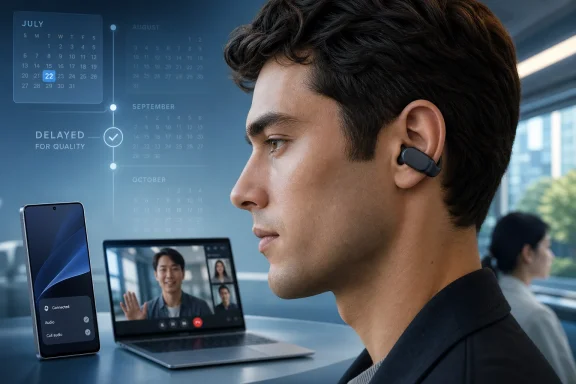
Samsung’s first clip-on, open-ear earbuds reportedly will not appear at the Galaxy Unpacked event on July 22, 2026, despite earlier clues pointing to an imminent debut. The device, found in Samsung software under the possible name Galaxy Buds Able and separately rumored to launch as Galaxy Buds On, is now expected in late September or October after Samsung reconsidered its quality and launch schedule. That delay may disappoint anyone hoping for a surprise audio announcement in London, but it also reveals how seriously Samsung is treating a form factor that could become the most consequential expansion of the Galaxy Buds family since the unconventional Galaxy Buds Live.
Samsung has sold true wireless earbuds under the Galaxy Buds name since 2019, steadily adding better microphones, active noise cancellation, higher-quality codecs, tighter Galaxy integration, and increasingly sophisticated software. Most models have followed familiar in-ear or open-fit templates, even when Samsung experimented with distinctive shapes and controls.
The apparent Galaxy Buds Able project represents something different. Rather than sitting inside the ear canal or hanging from the ear like a conventional stem-style earbud, each device would reportedly clip around the outer ear, placing its speaker near the canal while leaving the canal physically unobstructed.
Samsung’s boldest ergonomic experiment arrived with the Galaxy Buds Live in 2020. Their bean-shaped shells rested in the outer ear rather than creating the deep seal used by many noise-canceling earbuds, making them visually distinctive and potentially more comfortable for users sensitive to silicone tips.
The Buds Live generated a loyal following, but their fit varied dramatically between ears, and their open structure limited the effectiveness of active noise cancellation. Samsung subsequently returned to more conventional designs before adopting prominent stems for the Galaxy Buds3 generation in 2024.
A clip-on model would not need to replace any of those products. Instead, it could establish a parallel category focused on comfort, continuous awareness, fitness, work calls, and all-day wear rather than maximum isolation.
That distinction helps explain why Samsung is reportedly considering a separate launch. The new earbuds may require more explanation than another iterative Buds upgrade, especially if the company wants consumers to understand what open-ear listening can and cannot provide.
The report indicates that Samsung reviewed both product quality and launch timing before postponing the announcement. Samsung has not publicly confirmed the device, its retail name, its specifications, its price, or the revised schedule, so the information should still be treated as an informed report rather than an official commitment.
Samsung’s own invitation confirms that Galaxy Unpacked will take place on Wednesday, July 22, 2026, at 2 p.m. British Summer Time, or 9 a.m. Eastern Daylight Time. Open-ear earbuds could have complemented the expected wearable and mobile announcements without requiring an entirely separate event.
Software references also tend to appear when manufacturers begin preparing companion applications for unreleased hardware. They are not guarantees of an immediate launch, but they usually indicate that development has progressed beyond a speculative concept.
A dedicated launch would let Samsung explain the ergonomics, acoustic trade-offs, target audience, and relationship to the Galaxy Buds4 family. It could also prevent customers from incorrectly assuming that the clip-on product is simply another Buds4 variant.
The strategy would make particular sense if Samsung intends to position the device as a lifestyle wearable rather than a conventional pair of headphones. Clip-on products often resemble ear jewelry, and their appeal depends as much on fit, appearance, and unobtrusive daily use as on traditional audio specifications.
Neither name has been formally announced. Internal software labels can survive into retail branding, but manufacturers also use temporary project names, development identifiers, and translation placeholders.
The unusual branding might also signal that Samsung sees the product as the beginning of a new subfamily. That would give the company room to release multiple open-ear models without confusing them with the Buds4 and Buds4 Pro.
However, “Able” does not immediately communicate how the product is worn. Consumers encountering the name in a store might not know whether it refers to sports earbuds, accessibility hardware, or a lower-cost Galaxy Buds model.
The name is short, memorable, and compatible with Samsung’s broader Galaxy branding. It could nevertheless create confusion with older Samsung products or with generic phrases such as “buds on,” making trademark clearance and search visibility important considerations.
Until Samsung makes an announcement, both names should be regarded as provisional. The underlying device and its design matter more than the label appearing in unfinished software.
The bridge gently grips the outer ear, producing a cuff-like fit without placing a silicone tip inside the canal. Audio travels through the air, unlike traditional bone-conduction headsets that transmit vibrations through the user’s skull.
Open-ear products deliberately give up that seal. Their drivers must direct sound toward the canal while digital signal processing compensates for the loss of acoustic pressure, differences in ear anatomy, and environmental noise.
This is a difficult engineering problem. Increasing volume can restore perceived impact, but excessive output may cause leakage that nearby people can hear, drain the battery more quickly, and expose the listener to unnecessarily high sound levels.
Ear shapes vary considerably, making universal fit challenging. Glasses, earrings, hearing aids, piercings, hair, hats, and helmets add further complications, although clip-on designs can sometimes interfere less with eyewear than products using large hooks behind the ear.
Samsung’s reported quality review may therefore involve more than tuning sound. A small change to the spring force or module angle could determine whether the earbuds feel almost weightless or become uncomfortable after an hour.
Samsung already uses adaptive audio processing in its premium Galaxy Buds products. Extending those capabilities to an open-ear design could be one of the project’s most important technical differentiators, particularly if the earbuds can compensate for inconsistent placement.
Bose, Huawei, Shokz, and other manufacturers have demonstrated that clip-on earbuds can be sold as premium consumer electronics rather than specialized athletic equipment. Samsung would enter a market with established competitors, but also with an enormous installed base of Galaxy phones, tablets, watches, televisions, and Windows PCs.
That natural awareness can be useful while walking, working in a shared office, waiting at an airport gate, or exercising in places where situational awareness matters. It also avoids the artificial character, latency, and wind artifacts that can affect microphone-driven transparency systems.
Open-ear audio is not automatically safe in every situation. Loud playback can still mask hazards, and headphones should never substitute for attention, particularly around traffic, machinery, or other dangerous environments.
Clip-on earbuds offer an alternative that may be better suited to podcasts, background music, videoconferencing, and notifications throughout the day. Their value proposition is not necessarily “the best sound,” but rather audio that remains available without dominating the user’s physical or social environment.
This behavioral shift matters. As earbuds become interfaces for assistants, translation, messaging, navigation, and health-related features, manufacturers need designs that users are willing to wear longer.
Samsung has experience selling technology as fashion through foldable phones, watches, color-matched accessories, and collaborations. A clip-on product could fit that strategy, particularly if it launches in multiple finishes or alongside a broader lifestyle campaign.
The challenge is that the competition has already moved beyond first-generation experiments. Samsung must deliver a polished product, not merely demonstrate that it can copy the form factor.
Bose emphasizes controlled sound projection and reduced leakage, two areas that Samsung will need to address convincingly. It also markets the earbuds as an all-day wearable, not just a product for workouts.
Samsung can counter with deeper Galaxy integration, potentially lower pricing, and a larger mobile ecosystem. Bose, however, retains a strong audio reputation and supports a broad range of devices without making one smartphone brand the center of the experience.
Huawei’s presence varies by region, giving Samsung an opportunity to take the concept mainstream in markets where Galaxy devices have much stronger retail distribution. A Samsung model would also be easier for many customers to test in carrier stores, electronics retailers, and Samsung experience centers.
The comparison will inevitably focus on comfort, leakage, microphone quality, battery life, and bass. Samsung cannot rely solely on its logo when competing against products refined over multiple generations.
These features create a practical checklist for Samsung. Buyers will expect the Galaxy model to resist sweat, remain secure during movement, connect to more than one device, and last through a full working day.
Samsung may have an advantage in software and component integration, but Shokz understands the comfort and stability requirements of open-ear products. That specialized experience should not be underestimated.
Samsung has reasons to be cautious. The Galaxy Buds3 Pro rollout in 2024 encountered early quality-control complaints and temporary shipment disruption in some markets, demonstrating how small manufacturing inconsistencies can overshadow a major accessory launch.
The charging case also requires careful engineering. Clip-on designs are irregularly shaped, and users must be able to place each earbud into the correct charging position without struggling or leaving it partially disconnected.
Microphone performance presents another difficulty. The microphones may sit farther from the mouth than those on stem-style earbuds, forcing Samsung to rely on beamforming, voice-detection sensors, and machine-learning noise suppression.
The company is effectively asking customers to adopt a new wearing style. That requires confidence, clear demonstrations, favorable reviews, and enough inventory for buyers to experience the product in person.
If a few additional months allow Samsung to resolve pressure points, improve leakage control, or stabilize manufacturing yields, the postponement will have been worthwhile. A delayed launch is preferable to turning early adopters into involuntary beta testers.
Samsung could use external microphones to monitor ambient volume and adjust playback automatically. Such a system should increase intelligibility without encouraging dangerously high listening levels, perhaps by emphasizing speech frequencies rather than simply raising overall output.
Adaptive equalization could also compensate for fit. If sensors determine that the speaker has moved away from its ideal position, the earbuds might alter bass and treble response in real time.
Samsung has already invested in neural processing for voice isolation across its Galaxy Buds lineup. Applying that technology to the more challenging clip-on geometry could become a central selling point.
Users should remain cautious about marketing demonstrations conducted in controlled conditions. Independent tests will need to examine wind, keyboard noise, nearby conversations, traffic, and competing voices.
The controls should cover playback, calls, volume, voice assistants, and device switching without requiring constant access to a phone. Samsung should also let users reassign commands through its software.
Interchangeable left and right units would add convenience. If orientation sensors can determine which ear each device occupies, users would not need to inspect tiny markings before putting them on.
An ideal implementation would support:
Samsung already offers Galaxy Buds software for Windows, although compatibility and available controls vary by model. A new device gives the company an opportunity to improve that desktop experience.
Firmware delivery matters because earbuds increasingly depend on software for audio tuning, connection stability, battery management, and microphone processing. Samsung should make updates equally convenient from Windows and Android.
The app also needs dependable background behavior. Users should not have to leave a large companion window open simply to preserve settings or view battery information.
Newer Bluetooth LE Audio implementations can improve efficiency, latency, and flexibility, but support depends on the PC’s hardware, drivers, Windows version, and the earbuds themselves. Samsung should communicate compatibility precisely rather than advertising a feature that works only on a small subset of computers.
A USB adapter could provide more predictable enterprise performance, although there is no indication that Samsung plans one. Without such an accessory, much will depend on Microsoft’s Bluetooth stack and the quality of individual PC radios.
Windows users should therefore view them as a complementary tool. A sealed headset may remain preferable for concentration, while clip-on earbuds could handle calls, notifications, and background audio during less focused work.
Likely use cases include:
Enterprises will need answers about sanitation, replacement parts, firmware support, device inventory, warranty service, and interoperability with conferencing platforms. Consumer-oriented Galaxy features alone will not make the earbuds an enterprise solution.
Privacy is another concern. Sound leakage that is harmless during music playback may expose confidential calls in quiet shared spaces, while open ears allow surrounding conversations to interfere with comprehension.
Organizations should test the actual devices in their intended environments rather than treating “open-ear” as universally safer or more collaborative.
Several developments will determine whether the reported fourth-quarter plan remains credible.
Branding could also reveal the target audience. Fitness-focused language would suggest competition with Shokz, while premium fashion branding would place Bose and Huawei more directly in Samsung’s sights.
They rarely provide a complete picture, but they can distinguish an active launch program from an experimental software entry. Matching identifiers across Samsung applications and regulatory records would significantly strengthen the evidence.
Regional availability will matter just as much. Samsung’s scale could make clip-on earbuds broadly accessible across North America, Europe, and Asia, but experimental accessories sometimes receive limited initial releases.
A staggered launch would allow Samsung to monitor return rates and fit complaints before expanding production. It could also frustrate buyers who expected a globally available Galaxy accessory.
The schedule remains vulnerable to further change if quality evaluation is still underway. Until Samsung confirms a date, retailers and consumers should avoid treating late September or October as guaranteed.
The next few months should reveal whether Samsung can translate its strengths in mobile software, adaptive sound, wireless connectivity, and retail reach into a compelling new wearable. The Galaxy Buds Able or Galaxy Buds On could give users a genuinely useful alternative to sealed earbuds, particularly for long workdays, outdoor activity, and mixed Windows-and-Galaxy setups.
Success will depend on restraint as much as innovation. Samsung must resist exaggerated claims, provide reliable multipoint support, expose useful settings on Windows, and acknowledge that open-ear designs trade isolation and bass impact for awareness and comfort. If the company uses the reported delay to solve those fundamentals, an autumn launch could make its clip-on earbuds one of the most important Galaxy accessories of 2026 rather than merely the product that was missing from July’s Unpacked stage.
 Background
Samsung has sold true wireless earbuds under the Galaxy Buds name since 2019, steadily adding better microphones, active noise cancellation, higher-quality codecs, tighter Galaxy integration, and increasingly sophisticated software. Most models have followed familiar in-ear or open-fit templates, even when Samsung experimented with distinctive shapes and controls.The apparent Galaxy Buds Able project represents something different. Rather than sitting inside the ear canal or hanging from the ear like a conventional stem-style earbud, each device would reportedly clip around the outer ear, placing its speaker near the canal while leaving the canal physically unobstructed.
From Galaxy Buds to Buds Live
The original Galaxy Buds established Samsung as a credible alternative to Apple’s AirPods, particularly for Android users. Galaxy Buds Plus improved battery life, while the Galaxy Buds Pro and Buds2 Pro moved further into premium audio with active noise cancellation, water resistance, and Samsung-specific high-resolution playback features.Samsung’s boldest ergonomic experiment arrived with the Galaxy Buds Live in 2020. Their bean-shaped shells rested in the outer ear rather than creating the deep seal used by many noise-canceling earbuds, making them visually distinctive and potentially more comfortable for users sensitive to silicone tips.
The Buds Live generated a loyal following, but their fit varied dramatically between ears, and their open structure limited the effectiveness of active noise cancellation. Samsung subsequently returned to more conventional designs before adopting prominent stems for the Galaxy Buds3 generation in 2024.
A broader Galaxy Buds portfolio
By 2026, Samsung’s audio lineup has become more segmented. The Galaxy Buds4 and Galaxy Buds4 Pro, released in March, address the traditional mainstream and premium markets, while lower-priced models serve buyers who prioritize affordability.A clip-on model would not need to replace any of those products. Instead, it could establish a parallel category focused on comfort, continuous awareness, fitness, work calls, and all-day wear rather than maximum isolation.
That distinction helps explain why Samsung is reportedly considering a separate launch. The new earbuds may require more explanation than another iterative Buds upgrade, especially if the company wants consumers to understand what open-ear listening can and cannot provide.
What the Latest Report Says
According to a report from South Korea’s Electronic Times, Samsung no longer plans to reveal its clip-on earbuds at the July 22 Galaxy Unpacked presentation. The company is instead targeting the beginning of the fourth quarter, making late September or October 2026 the most plausible release window.The report indicates that Samsung reviewed both product quality and launch timing before postponing the announcement. Samsung has not publicly confirmed the device, its retail name, its specifications, its price, or the revised schedule, so the information should still be treated as an informed report rather than an official commitment.
Why July 22 seemed plausible
The timing initially appeared logical. Samsung had scheduled a major Galaxy Unpacked event in London, evidence of the new earbuds had already surfaced in software, and accessory launches commonly accompany new phones, tablets, or watches.Samsung’s own invitation confirms that Galaxy Unpacked will take place on Wednesday, July 22, 2026, at 2 p.m. British Summer Time, or 9 a.m. Eastern Daylight Time. Open-ear earbuds could have complemented the expected wearable and mobile announcements without requiring an entirely separate event.
Software references also tend to appear when manufacturers begin preparing companion applications for unreleased hardware. They are not guarantees of an immediate launch, but they usually indicate that development has progressed beyond a speculative concept.
Why Samsung may prefer a separate unveiling
A crowded Unpacked presentation can be an inefficient place to introduce an unfamiliar audio category. Foldable phones, watches, software features, and artificial intelligence demonstrations compete for attention, leaving accessories with only a few minutes of stage time.A dedicated launch would let Samsung explain the ergonomics, acoustic trade-offs, target audience, and relationship to the Galaxy Buds4 family. It could also prevent customers from incorrectly assuming that the clip-on product is simply another Buds4 variant.
The strategy would make particular sense if Samsung intends to position the device as a lifestyle wearable rather than a conventional pair of headphones. Clip-on products often resemble ear jewelry, and their appeal depends as much on fit, appearance, and unobtrusive daily use as on traditional audio specifications.
Galaxy Buds Able or Galaxy Buds On?
The device’s final name remains unresolved. References discovered in Galaxy Buds application code reportedly identify it as Galaxy Buds Able, while a separate leak claims that Samsung will use Galaxy Buds On for the commercial product.Neither name has been formally announced. Internal software labels can survive into retail branding, but manufacturers also use temporary project names, development identifiers, and translation placeholders.
What “Able” could signify
“Galaxy Buds Able” would distinguish the device from Samsung’s numbered Buds lineup. It could imply accessibility, adaptability, or a product designed to remain usable throughout the day, although that interpretation is speculative.The unusual branding might also signal that Samsung sees the product as the beginning of a new subfamily. That would give the company room to release multiple open-ear models without confusing them with the Buds4 and Buds4 Pro.
However, “Able” does not immediately communicate how the product is worn. Consumers encountering the name in a store might not know whether it refers to sports earbuds, accessibility hardware, or a lower-cost Galaxy Buds model.
Why “Buds On” may be stronger retail branding
“Galaxy Buds On” more directly evokes a wearable that stays on the ear rather than being inserted into it. It also supports the idea of leaving the earbuds on for extended periods while moving between music, calls, exercise, commuting, and face-to-face conversations.The name is short, memorable, and compatible with Samsung’s broader Galaxy branding. It could nevertheless create confusion with older Samsung products or with generic phrases such as “buds on,” making trademark clearance and search visibility important considerations.
Until Samsung makes an announcement, both names should be regarded as provisional. The underlying device and its design matter more than the label appearing in unfinished software.
How Clip-On Open-Ear Earbuds Work
Clip-on earbuds generally use a flexible bridge connecting two modules. One module rests behind the ear and contains a battery or supporting electronics, while the other places a small speaker near the entrance of the ear canal.The bridge gently grips the outer ear, producing a cuff-like fit without placing a silicone tip inside the canal. Audio travels through the air, unlike traditional bone-conduction headsets that transmit vibrations through the user’s skull.
Air conduction without an acoustic seal
Conventional in-ear earbuds create a partial or complete seal. That seal traps low-frequency energy, reduces external noise, and gives active noise cancellation a controlled acoustic environment in which to operate.Open-ear products deliberately give up that seal. Their drivers must direct sound toward the canal while digital signal processing compensates for the loss of acoustic pressure, differences in ear anatomy, and environmental noise.
This is a difficult engineering problem. Increasing volume can restore perceived impact, but excessive output may cause leakage that nearby people can hear, drain the battery more quickly, and expose the listener to unnecessarily high sound levels.
Comfort depends on pressure distribution
A successful clip-on design must grip firmly enough to survive walking or running but gently enough to avoid soreness. The flexible connector, weight distribution, contact materials, and spacing between modules all contribute to comfort.Ear shapes vary considerably, making universal fit challenging. Glasses, earrings, hearing aids, piercings, hair, hats, and helmets add further complications, although clip-on designs can sometimes interfere less with eyewear than products using large hooks behind the ear.
Samsung’s reported quality review may therefore involve more than tuning sound. A small change to the spring force or module angle could determine whether the earbuds feel almost weightless or become uncomfortable after an hour.
Why fit affects sound
Because the speaker does not lock into one fixed position inside the canal, a few millimeters of movement can change perceived bass, volume, stereo balance, and sound leakage. The earbuds may need sensors or calibration algorithms to detect their orientation and adjust output.Samsung already uses adaptive audio processing in its premium Galaxy Buds products. Extending those capabilities to an open-ear design could be one of the project’s most important technical differentiators, particularly if the earbuds can compensate for inconsistent placement.
Why Open-Ear Audio Is Growing
Open-ear headphones once occupied a relatively narrow sports niche, led largely by bone-conduction products. The category has expanded as buyers seek alternatives to ear tips, stronger environmental awareness, and devices comfortable enough to wear for much of the working day.Bose, Huawei, Shokz, and other manufacturers have demonstrated that clip-on earbuds can be sold as premium consumer electronics rather than specialized athletic equipment. Samsung would enter a market with established competitors, but also with an enormous installed base of Galaxy phones, tablets, watches, televisions, and Windows PCs.
Awareness is the primary benefit
Open-ear earbuds allow traffic, announcements, colleagues, family members, and other environmental sounds to reach the ear naturally. They do not need to reproduce the surroundings through microphones in the same way that sealed earbuds use transparency or ambient modes.That natural awareness can be useful while walking, working in a shared office, waiting at an airport gate, or exercising in places where situational awareness matters. It also avoids the artificial character, latency, and wind artifacts that can affect microphone-driven transparency systems.
Open-ear audio is not automatically safe in every situation. Loud playback can still mask hazards, and headphones should never substitute for attention, particularly around traffic, machinery, or other dangerous environments.
Comfort is becoming a purchasing priority
Many users experience pressure, heat, itching, or fatigue from sealed ear tips. Others simply dislike the sensation of placing an object in the ear canal for hours.Clip-on earbuds offer an alternative that may be better suited to podcasts, background music, videoconferencing, and notifications throughout the day. Their value proposition is not necessarily “the best sound,” but rather audio that remains available without dominating the user’s physical or social environment.
This behavioral shift matters. As earbuds become interfaces for assistants, translation, messaging, navigation, and health-related features, manufacturers need designs that users are willing to wear longer.
The fashion component
Bose and Huawei have treated clip-on earbuds partly as wearable accessories. Their shapes resemble ear cuffs, while metallic finishes and compact silhouettes help them look less like miniature communications headsets.Samsung has experience selling technology as fashion through foldable phones, watches, color-matched accessories, and collaborations. A clip-on product could fit that strategy, particularly if it launches in multiple finishes or alongside a broader lifestyle campaign.
Samsung’s Competitive Position
Samsung would not be first to this market. That may actually work in its favor, because existing products have validated demand while exposing technical weaknesses that Samsung can try to solve.The challenge is that the competition has already moved beyond first-generation experiments. Samsung must deliver a polished product, not merely demonstrate that it can copy the form factor.
Bose occupies the premium end
The Bose Ultra Open Earbuds helped define the high-end ear-cuff category when they launched in 2024. Their open design, physical controls, spatial processing, multipoint Bluetooth support, and premium presentation established a high benchmark, accompanied by a premium price.Bose emphasizes controlled sound projection and reduced leakage, two areas that Samsung will need to address convincingly. It also markets the earbuds as an all-day wearable, not just a product for workouts.
Samsung can counter with deeper Galaxy integration, potentially lower pricing, and a larger mobile ecosystem. Bose, however, retains a strong audio reputation and supports a broad range of devices without making one smartphone brand the center of the experience.
Huawei established the clip-on aesthetic
Huawei’s FreeClip line uses a C-shaped bridge between an acoustic module and a rear comfort module. Its lightweight construction and jewelry-inspired design helped turn clip-on earbuds into a recognizable product category.Huawei’s presence varies by region, giving Samsung an opportunity to take the concept mainstream in markets where Galaxy devices have much stronger retail distribution. A Samsung model would also be easier for many customers to test in carrier stores, electronics retailers, and Samsung experience centers.
The comparison will inevitably focus on comfort, leakage, microphone quality, battery life, and bass. Samsung cannot rely solely on its logo when competing against products refined over multiple generations.
Shokz brings sports credibility
Shokz built its reputation around open-ear listening and has expanded into clip-on air-conduction products such as the OpenDots ONE. That model offers multipoint connectivity, an IP54 rating, interchangeable left and right earbuds, wireless charging, and up to 40 hours of total battery life with its case.These features create a practical checklist for Samsung. Buyers will expect the Galaxy model to resist sweat, remain secure during movement, connect to more than one device, and last through a full working day.
Samsung may have an advantage in software and component integration, but Shokz understands the comfort and stability requirements of open-ear products. That specialized experience should not be underestimated.
The Importance of the Reported Delay
Product delays are often framed as negative news, yet releasing immature hardware can cause greater damage. Earbuds are physically intimate devices, and defects involving fit, batteries, charging contacts, heat, or skin irritation can quickly become reputational problems.Samsung has reasons to be cautious. The Galaxy Buds3 Pro rollout in 2024 encountered early quality-control complaints and temporary shipment disruption in some markets, demonstrating how small manufacturing inconsistencies can overshadow a major accessory launch.
Quality means more than reliability
For clip-on earbuds, quality includes acoustic consistency across different ear shapes. Samsung must ensure that the speaker remains properly aimed, the flexible bridge retains its tension, and the materials tolerate sweat, cosmetics, repeated cleaning, and thousands of insertion cycles.The charging case also requires careful engineering. Clip-on designs are irregularly shaped, and users must be able to place each earbud into the correct charging position without struggling or leaving it partially disconnected.
Microphone performance presents another difficulty. The microphones may sit farther from the mouth than those on stem-style earbuds, forcing Samsung to rely on beamforming, voice-detection sensors, and machine-learning noise suppression.
A delay can protect the new category
A poor first-generation launch could persuade consumers that clip-on Galaxy earbuds are uncomfortable or sonically weak, even if later versions improve. Samsung therefore has more at stake than the sales of one accessory.The company is effectively asking customers to adopt a new wearing style. That requires confidence, clear demonstrations, favorable reviews, and enough inventory for buyers to experience the product in person.
If a few additional months allow Samsung to resolve pressure points, improve leakage control, or stabilize manufacturing yields, the postponement will have been worthwhile. A delayed launch is preferable to turning early adopters into involuntary beta testers.
Features Samsung Needs to Deliver
No reliable final specification sheet has appeared, but the competitive landscape makes several requirements predictable. Samsung must combine basic open-ear competence with ecosystem functions that justify choosing Galaxy earbuds over established alternatives.Adaptive sound and automatic volume
Open-ear products encounter rapidly changing noise levels. Audio that sounds balanced in a quiet room can become inaudible beside a road or inside a busy station.Samsung could use external microphones to monitor ambient volume and adjust playback automatically. Such a system should increase intelligibility without encouraging dangerously high listening levels, perhaps by emphasizing speech frequencies rather than simply raising overall output.
Adaptive equalization could also compensate for fit. If sensors determine that the speaker has moved away from its ideal position, the earbuds might alter bass and treble response in real time.
Strong call quality
Calls may be more important than music for all-day open-ear earbuds. Remote workers, commuters, and enterprise users need clear voice pickup in offices, streets, vehicles, and windy outdoor environments.Samsung has already invested in neural processing for voice isolation across its Galaxy Buds lineup. Applying that technology to the more challenging clip-on geometry could become a central selling point.
Users should remain cautious about marketing demonstrations conducted in controlled conditions. Independent tests will need to examine wind, keyboard noise, nearby conversations, traffic, and competing voices.
Sensible controls
Touch controls can be awkward on clip-on earbuds because tapping the device may push it against the ear or change its position. Physical buttons, pressure-sensitive surfaces, or reliable pinch gestures may produce a better experience.The controls should cover playback, calls, volume, voice assistants, and device switching without requiring constant access to a phone. Samsung should also let users reassign commands through its software.
Interchangeable left and right units would add convenience. If orientation sensors can determine which ear each device occupies, users would not need to inspect tiny markings before putting them on.
Multipoint and ecosystem switching
True Bluetooth multipoint is essential for users moving between a Windows PC and a Galaxy phone. Proprietary automatic switching within the Galaxy ecosystem is helpful, but it should supplement rather than replace standards-based connectivity.An ideal implementation would support:
- The earbuds would connect simultaneously to a Windows 11 PC and a smartphone.
- PC audio would pause when an incoming phone call is answered.
- The earbuds would return to the PC after the call ends.
- Galaxy devices would still receive enhanced pairing, spatial audio, codec, and account-based switching features.
- Users could manage device priority without repeatedly deleting Bluetooth pairings.
What the Earbuds Could Mean for Windows Users
Clip-on Galaxy earbuds may be especially useful with Windows PCs because the form factor suits long calls and mixed office environments. A user could listen to Teams audio while still hearing a colleague, doorbell, or household activity without relying on an electronic transparency mode.Samsung already offers Galaxy Buds software for Windows, although compatibility and available controls vary by model. A new device gives the company an opportunity to improve that desktop experience.
A better Galaxy Buds app for Windows
The Windows application should expose battery levels, equalizer settings, firmware updates, control assignments, microphone options, and multipoint management. It should also provide clear explanations when a feature requires a Galaxy phone rather than leaving PC users to discover limitations after purchase.Firmware delivery matters because earbuds increasingly depend on software for audio tuning, connection stability, battery management, and microphone processing. Samsung should make updates equally convenient from Windows and Android.
The app also needs dependable background behavior. Users should not have to leave a large companion window open simply to preserve settings or view battery information.
Bluetooth limitations still apply
Even excellent earbuds must operate within Windows’ Bluetooth audio architecture. Traditional Bluetooth profiles can force compromises when the microphone and stereo playback operate simultaneously, causing call audio to sound less detailed than music playback.Newer Bluetooth LE Audio implementations can improve efficiency, latency, and flexibility, but support depends on the PC’s hardware, drivers, Windows version, and the earbuds themselves. Samsung should communicate compatibility precisely rather than advertising a feature that works only on a small subset of computers.
A USB adapter could provide more predictable enterprise performance, although there is no indication that Samsung plans one. Without such an accessory, much will depend on Microsoft’s Bluetooth stack and the quality of individual PC radios.
Productivity versus isolation
Open-ear earbuds solve a different problem from a noise-canceling headset. They may be excellent for a private office, home workspace, or collaborative environment but poorly suited to a loud open-plan floor.Windows users should therefore view them as a complementary tool. A sealed headset may remain preferable for concentration, while clip-on earbuds could handle calls, notifications, and background audio during less focused work.
Consumer and Enterprise Impact
Samsung’s potential move into clip-on audio affects consumers and organizations differently. Consumers may prioritize comfort, exercise, style, and ecosystem features, while enterprise buyers care more about management, call reliability, hygiene, durability, and total cost.Consumer use cases
The strongest consumer scenarios involve extended wear. These earbuds could remain attached while a user moves through several activities without repeatedly switching between isolation and transparency modes.Likely use cases include:
- Walking and commuting: Users can hear approaching vehicles, bicycles, announcements, and other environmental cues while listening at moderate levels.
- Exercise: A secure clip may remain stable without trapping heat around the ear or relying on an invasive ear tip.
- Parenting and caregiving: Open ears make it easier to monitor children, dependents, alarms, and household activity.
- Office listening: Background music and calls can coexist with face-to-face communication.
- Ear-tip sensitivity: Users who experience discomfort from silicone tips gain another option within the Galaxy ecosystem.
Enterprise possibilities
Open-ear devices can support employees who need communication audio without becoming fully isolated from their surroundings. Retail staff, warehouse supervisors, reception workers, and field personnel could benefit, subject to workplace safety policies.Enterprises will need answers about sanitation, replacement parts, firmware support, device inventory, warranty service, and interoperability with conferencing platforms. Consumer-oriented Galaxy features alone will not make the earbuds an enterprise solution.
Privacy is another concern. Sound leakage that is harmless during music playback may expose confidential calls in quiet shared spaces, while open ears allow surrounding conversations to interfere with comprehension.
Organizations should test the actual devices in their intended environments rather than treating “open-ear” as universally safer or more collaborative.
Strengths and Opportunities
Samsung’s entry into clip-on audio could succeed because it combines a growing product category with one of the world’s largest mobile ecosystems. The company does not need to invent demand, but it must translate existing interest into a polished Galaxy experience.- Samsung can address users who avoid traditional Galaxy Buds because of ear-canal discomfort.
- The product can expand the portfolio without directly replacing the Galaxy Buds4 or Buds4 Pro.
- Galaxy phones, tablets, watches, televisions, and Windows software give Samsung multiple integration points.
- A separate launch could provide enough space to explain the form factor and its intended uses.
- Samsung’s adaptive audio and voice-processing expertise may improve call quality and fit compensation.
- Broad retail distribution could make clip-on earbuds more visible and easier to test.
- Competitive pricing could pressure Bose and other premium open-ear brands.
- A jewelry-like design would support Samsung’s wider effort to turn personal technology into fashion.
Risks and Concerns
The open-ear category’s strengths are inseparable from its weaknesses. Samsung must avoid presenting the design as a universal upgrade over sealed earbuds when it is actually a different set of compromises.- Bass response is inherently more difficult without an acoustic seal, particularly at lower listening levels.
- Environmental noise can overwhelm podcasts, calls, and quieter music passages.
- Increasing volume to compensate for outside noise may undermine hearing-safety benefits.
- Sound leakage could disturb nearby people or expose private content.
- A fixed clip pressure may feel comfortable on some ears and painful or insecure on others.
- Microphones may struggle because of the distance between the ear-mounted hardware and the user’s mouth.
- Galaxy-exclusive features could reduce the product’s value for Windows-only, non-Samsung Android, and iPhone users.
- A high price would place Samsung against experienced premium competitors rather than budget open-ear products.
- Marketing them as safer could create false confidence in situations requiring complete attention.
- Another delay could push the launch into a crowded holiday period or signal unresolved engineering problems.
What to Watch Next
The absence of the clip-on earbuds from Galaxy Unpacked will not end speculation. Attention will instead shift to Samsung’s software, regulatory filings, supply chain activity, retail databases, and any clues embedded in upcoming One UI builds.Several developments will determine whether the reported fourth-quarter plan remains credible.
An official retail name
Confirmation of Galaxy Buds Able, Galaxy Buds On, or an entirely different name will clarify how Samsung intends to position the product. A standalone brand would support the theory that this is a new audio family rather than an extension of the Buds4 range.Branding could also reveal the target audience. Fitness-focused language would suggest competition with Shokz, while premium fashion branding would place Bose and Huawei more directly in Samsung’s sights.
Model numbers and certifications
Bluetooth, radio, safety, and regional certifications often appear before consumer electronics reach stores. These filings may confirm battery capacities, Bluetooth versions, charging methods, model numbers, or supported frequency bands.They rarely provide a complete picture, but they can distinguish an active launch program from an experimental software entry. Matching identifiers across Samsung applications and regulatory records would significantly strengthen the evidence.
Price and geographic availability
Price will define the competitive set. A product near $200 would challenge Shokz and upper-midrange alternatives, while a price approaching $300 would invite direct comparison with Bose.Regional availability will matter just as much. Samsung’s scale could make clip-on earbuds broadly accessible across North America, Europe, and Asia, but experimental accessories sometimes receive limited initial releases.
A staggered launch would allow Samsung to monitor return rates and fit complaints before expanding production. It could also frustrate buyers who expected a globally available Galaxy accessory.
The actual fourth-quarter date
“Early fourth quarter” generally points to October, although a late-September announcement followed by October sales would fit the reported timeframe. Samsung may also coordinate the product with holiday promotions or another device launch.The schedule remains vulnerable to further change if quality evaluation is still underway. Until Samsung confirms a date, retailers and consumers should avoid treating late September or October as guaranteed.
Looking Ahead
Samsung’s reported decision to postpone its first clip-on earbuds is less significant than the reason behind it. A quality and timing review suggests that the company sees open-ear audio as more than a disposable experiment and understands the consequences of entering a category where comfort and acoustic consistency are unusually difficult to perfect.The next few months should reveal whether Samsung can translate its strengths in mobile software, adaptive sound, wireless connectivity, and retail reach into a compelling new wearable. The Galaxy Buds Able or Galaxy Buds On could give users a genuinely useful alternative to sealed earbuds, particularly for long workdays, outdoor activity, and mixed Windows-and-Galaxy setups.
Success will depend on restraint as much as innovation. Samsung must resist exaggerated claims, provide reliable multipoint support, expose useful settings on Windows, and acknowledge that open-ear designs trade isolation and bass impact for awareness and comfort. If the company uses the reported delay to solve those fundamentals, an autumn launch could make its clip-on earbuds one of the most important Galaxy accessories of 2026 rather than merely the product that was missing from July’s Unpacked stage.
References
- Primary source: SoundGuys
Published: 2026-07-21T16:13:53+00:00
Samsung's first clip-on earbuds might not arrive until later this year
A new report claims that the much anticipated Galaxy Buds Able will have its own separate launch later this year.www.soundguys.com - Related coverage: sammobile.com
Samsung Galaxy Buds On could be company's first clip-on style earbuds - SamMobile
It is being reported that Samsung could call its first-ever clip-on style wireless earbuds the Galaxy Buds On. www.sammobile.com
- Related coverage: androidcentral.com
'Galaxy Buds On' could be the name of Samsung's rumored 'clip-on' earbuds | Android Central
A unique earbud design for sure, and even more interesting audio.www.androidcentral.com