

YouTube’s 2026 AI strategy puts creators in an increasingly powerful—and increasingly accountable—position: artificial intelligence can now accelerate scripting, editing, localization, music, visual effects, and Shorts production, but realistic synthetic media must be disclosed when it could change what viewers believe actually happened. The platform is also expanding likeness protection so eligible adults can search for videos that appear to use an AI-altered or generated version of their face. The practical dividing line is not whether AI touched a video, but whether AI created a believable false reality involving a person, place, action, or event.
YouTube entered 2026 with AI embedded across both sides of its platform. Creators are gaining generative production tools, while viewers increasingly encounter automated dubbing, recommendation systems, conversational features, generated backgrounds, synthetic music, and AI-assisted Shorts.
In a January 21, 2026 letter outlining the company’s priorities, YouTube CEO Neal Mohan said that more than one million channels used YouTube’s AI creation tools each day on average during December 2025. He also previewed the ability to create a Short using a creator’s own likeness, experiment with music, and produce games from text prompts.
What has changed is the visibility of the output. A recommendation model operates mostly behind the scenes, but a generated presenter, cloned voice, synthetic performance, or fabricated real-world scene appears directly in front of the audience. That shift raises questions about authenticity, consent, editorial responsibility, and the evidentiary value of video.
Conflating the two can cause mistakes. Owning or controlling a likeness does not eliminate the duty to tell viewers that a realistic performance was generated, while detecting a face in someone else’s upload does not automatically establish an actionable violation.
Creators should disclose material that makes a real person appear to say or do something they did not say or do, changes footage of a real place or event in a meaningful way, or generates a realistic scene that never occurred. The rule can apply to an entire AI-generated video or to a small but consequential synthetic element inserted into otherwise authentic footage.
For example, a photorealistic AI avatar of a creator delivering a newly written script is not an actual recording of that performance. Even if the words accurately represent the creator’s opinions, viewers may reasonably believe the creator stood in front of a camera and spoke them.
The same principle applies outside avatar videos. A travel creator who generates convincing footage of a real beach, hotel, city, or attraction may create a false impression that the depicted conditions or events were recorded on location.
Examples include replacing a person’s words, modifying facial movements to create new speech, adding people to a real event, generating realistic damage at a real location, or making an actual individual appear to participate in an incident that never occurred. A few synthetic seconds can be more consequential than several minutes of routine AI-assisted editing.
This is particularly important for reaction videos, investigative content, political commentary, product demonstrations, and news-adjacent channels. In those formats, viewers often treat footage as evidence rather than illustration.
The platform’s examples include assistance with outlines, scripts, titles, thumbnails, infographics, captions, idea generation, image enhancement, sharpening, audio repair, and routine color or lighting adjustments. Minor aesthetic effects typically do not require the AI-use setting either.
That does not remove the creator’s responsibility for accuracy. AI-generated scripts can contain invented facts, nonexistent product features, false quotations, or misleading explanations even when no disclosure label is required.
Disclosure rules and factual standards therefore solve different problems. A video can be free of realistic synthetic media and still be inaccurate, while a properly labeled AI-generated scene can still violate other YouTube policies.
However, creators should not read this as permission to disguise the nature of a consequential statement. A synthetic voice delivering medical, financial, political, or accusatory claims may warrant additional context because the audience could interpret the speech as a fresh, personally recorded endorsement.
A small label cannot correct every misleading impression created in the opening seconds. Creators should therefore evaluate the content itself, not merely whether the platform will attach a disclosure notice.
A realistic synthetic version of the creator remains a generated performance. If it appears to be a genuine camera recording, the creator should select the AI-use disclosure even when the face, script, and channel all belong to the same person.
Ownership answers the question of authorization. Disclosure answers the separate question of what the viewer is being shown.
Consider four common Shorts scenarios:
The risk becomes higher during breaking news, elections, armed conflicts, public-health emergencies, financial events, and natural disasters. YouTube may display a more prominent player-level label for sensitive material, but creators should also include unmistakable context within the video when confusion could cause harm.
The exact wording and interface placement can evolve as YouTube tests product changes. In the current workflow, creators should look under the video’s attributes for the AI use setting.
Creators can correct an inaccurate status in many cases, but not every automatic decision is editable. Labels tied to YouTube’s native AI tools, C2PA information, or manual enforcement may remain locked.
This makes provenance part of the production pipeline. Exporting an asset from a tool that attaches content credentials may affect how YouTube describes the finished video, even if the creator did not manually select the disclosure setting.
Third-party tools are different. The creator remains responsible for assessing the result and selecting the correct option during upload.
That statement should not be interpreted as a guarantee that every AI-assisted video will monetize. Videos must still satisfy the YouTube Partner Program’s rules, advertiser-friendly guidelines, copyright requirements, and broader Community Guidelines.
Similarly, an AI-generated video may be eligible for monetization when it contains meaningful original work, but a channel built around repetitive, low-value output can run into YouTube’s systems for spam, clickbait, and inauthentic or mass-produced content. The platform is signaling that AI is acceptable as a tool, not that automation automatically qualifies as creative contribution.
Potential outcomes include:
The company compares the concept to Content ID because both systems scan uploaded material and produce potential matches. The comparison describes the workflow, however, not the legal status or technical certainty of a result.
Users must be over 18 and hold an appropriate channel role. A Channel Owner or Manager can set up the feature, while other authorized channel roles may be allowed to review matches and submit reports on behalf of an enrolled person.
Enrollment requires identity verification using a government-issued ID and a brief face video. YouTube uses the face video as a reference for finding potential matches and says verification may take several days.
This creates several limitations:
A match is not proof of wrongdoing. The system may surface commentary, parody, satire, licensed material, fair use, genuine footage, or a video in which the resemblance is coincidental or non-infringing.
A synthetic depiction may primarily concern identity and privacy. A reupload of genuine footage may primarily concern ownership of the recording.
Removal is not automatic merely because someone dislikes a depiction. Context and public-interest considerations can influence the outcome.
Creators should explain precisely what was generated or altered. A focused complaint identifying the synthetic face, fabricated action, misleading speech, and resulting risk is more useful than a general assertion that a video “uses AI.”
The distinction can be summarized simply:
YouTube says it processes the verification video, images from uploaded content, the creator’s legal name, and a generated likeness template to operate the feature. The company also offers an optional choice concerning the use of face and voice templates to improve its likeness-detection models.
The company states that the setup data is not used to train Google’s generative AI models without consent. It also says that data associated with nonmatching faces encountered during scans is discarded rather than retained as an identity profile.
These assurances are meaningful, but creators should still make a deliberate decision. Biometric reference data is more sensitive than an email address or ordinary channel preference because a person cannot replace their face as easily as a compromised password.
Enterprises should establish:
Creators should maintain a production record even when YouTube does not require one. That record can explain how a video was made if an automatic label appears, a sponsor asks for confirmation, or a depicted person challenges the upload.
Creators in these areas should consider placing plain-language disclosure inside the video itself. A clear opening statement or persistent visual cue can communicate more effectively than a platform label that viewers may never expand.
Labels can help, but their effectiveness depends on visibility, comprehension, and consistent application. Viewers may also interpret a broad AI label incorrectly, assuming an entire production was generated when only one element was synthetic.
Conversely, the absence of a label does not prove that every frame is authentic. A creator may have failed to disclose, an automated system may have missed the material, or the AI use may fall into a category YouTube does not require creators to label.
Viewers should pay particular attention to videos that purport to document surprising statements, arrests, disasters, medical recommendations, investment claims, or politically significant events. Platform disclosures are one signal, not a substitute for source verification.
A company should be able to answer who approved the synthetic performance, which model generated it, whether the depicted person consented, how long the likeness may be used, and whether the final statement accurately represents the individual’s endorsement.
Windows-based production teams can support this process with controlled project folders, role-based access, version histories, asset manifests, and secure storage for consent records. The compliance burden is procedural rather than tied to one editing application.
Key opportunities include:
The principal concerns include:
Those goals can conflict. Making generation easier increases the volume that labeling and enforcement systems must evaluate.
The planned expansion from face matching to audio will be particularly important. Voice cloning can support legitimate dubbing, but it also enables scams, fabricated endorsements, and false statements without requiring a convincing face.
That shift may improve coverage, but it will also produce disputes over classification. YouTube will need to explain labels with enough precision that viewers understand which parts of a video were generated or altered.
Creators should not wait for a clearer enforcement boundary. Original research, meaningful commentary, editorial oversight, and distinctive production remain the strongest defense against being categorized as inauthentic or low value.
Success will depend on strong consent controls, revocation options, model security, and clear separation between an authentic recording and a synthetic performance. Creators will also need safeguards against staff, former partners, or compromised accounts generating unauthorized statements through an approved likeness model.
As of July 22, 2026, the safest rule for YouTube creators is straightforward: use AI freely for planning, repair, accessibility, and production efficiency, but disclose realistic synthetic media whenever it changes what viewers could believe was genuinely recorded. Keep original assets, document permissions, review every generated performance, and treat likeness detection as a useful but incomplete protection layer. YouTube is moving toward a future in which creators can produce more without always appearing before a camera; maintaining audience trust will require them to be unmistakably clear about when the camera was never there.
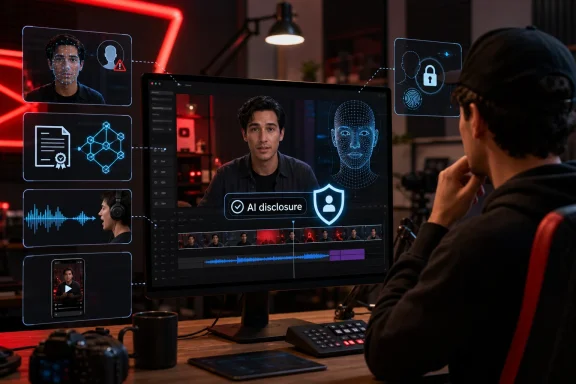 Overview
YouTube entered 2026 with AI embedded across both sides of its platform. Creators are gaining generative production tools, while viewers increasingly encounter automated dubbing, recommendation systems, conversational features, generated backgrounds, synthetic music, and AI-assisted Shorts.In a January 21, 2026 letter outlining the company’s priorities, YouTube CEO Neal Mohan said that more than one million channels used YouTube’s AI creation tools each day on average during December 2025. He also previewed the ability to create a Short using a creator’s own likeness, experiment with music, and produce games from text prompts.
From quiet automation to visible generation
AI is not new to YouTube. Machine learning has long influenced recommendations, moderation, copyright matching, advertising suitability, captions, and video discovery.What has changed is the visibility of the output. A recommendation model operates mostly behind the scenes, but a generated presenter, cloned voice, synthetic performance, or fabricated real-world scene appears directly in front of the audience. That shift raises questions about authenticity, consent, editorial responsibility, and the evidentiary value of video.
Two workflows creators must keep separate
YouTube’s emerging framework creates two related but distinct responsibilities:- Publishing responsibility concerns whether creators must disclose realistic AI-generated or meaningfully AI-altered material in their own uploads.
- Likeness protection concerns finding and responding to other uploads that may use a creator’s face without authorization.
Conflating the two can cause mistakes. Owning or controlling a likeness does not eliminate the duty to tell viewers that a realistic performance was generated, while detecting a face in someone else’s upload does not automatically establish an actionable violation.
How YouTube’s AI Disclosure Standard Works
YouTube’s disclosure requirement focuses on realistic AI content and meaningful AI alterations. It does not require creators to catalog every automated feature used during production.Creators should disclose material that makes a real person appear to say or do something they did not say or do, changes footage of a real place or event in a meaningful way, or generates a realistic scene that never occurred. The rule can apply to an entire AI-generated video or to a small but consequential synthetic element inserted into otherwise authentic footage.
Realism is the primary trigger
The most useful test is whether a reasonable viewer could interpret the result as an authentic recording of a real person, place, action, or event. If the answer is yes, disclosure is likely required.For example, a photorealistic AI avatar of a creator delivering a newly written script is not an actual recording of that performance. Even if the words accurately represent the creator’s opinions, viewers may reasonably believe the creator stood in front of a camera and spoke them.
The same principle applies outside avatar videos. A travel creator who generates convincing footage of a real beach, hotel, city, or attraction may create a false impression that the depicted conditions or events were recorded on location.
Meaningful alteration matters as much as full generation
Creators should not assume the rule applies only to videos generated entirely from prompts. A conventional camera recording can still require disclosure if AI changes the apparent facts.Examples include replacing a person’s words, modifying facial movements to create new speech, adding people to a real event, generating realistic damage at a real location, or making an actual individual appear to participate in an incident that never occurred. A few synthetic seconds can be more consequential than several minutes of routine AI-assisted editing.
This is particularly important for reaction videos, investigative content, political commentary, product demonstrations, and news-adjacent channels. In those formats, viewers often treat footage as evidence rather than illustration.
What Usually Does Not Require Disclosure
YouTube generally distinguishes between synthetic media presented as reality and production assistance that improves how a video is planned, assembled, or delivered. Many familiar creator tools remain outside the mandatory disclosure category.The platform’s examples include assistance with outlines, scripts, titles, thumbnails, infographics, captions, idea generation, image enhancement, sharpening, audio repair, and routine color or lighting adjustments. Minor aesthetic effects typically do not require the AI-use setting either.
Behind-the-scenes assistance
A creator can use AI to generate a list of video topics, summarize research notes, reorganize a script, draft chapter headings, propose thumbnail text, or improve captions without necessarily producing a realistic synthetic representation. These tools affect the workflow but do not inherently falsify the recorded event.That does not remove the creator’s responsibility for accuracy. AI-generated scripts can contain invented facts, nonexistent product features, false quotations, or misleading explanations even when no disclosure label is required.
Disclosure rules and factual standards therefore solve different problems. A video can be free of realistic synthetic media and still be inaccurate, while a properly labeled AI-generated scene can still violate other YouTube policies.
Minor restoration and aesthetic changes
Routine technical work generally falls below the disclosure threshold when it does not change the underlying meaning of the recording. Examples include:- Color correction can improve consistency without changing what occurred.
- Noise reduction can make genuine speech easier to understand.
- Image sharpening and upscaling can restore visibility without inventing a new event.
- Background blur and beauty filters can alter presentation without fabricating a meaningful action.
- Caption generation can improve accessibility while leaving the source performance intact.
The special case of a creator’s own voice
YouTube currently lists cloning one’s own voice for voiceovers or dubbing among examples that generally do not require disclosure. That treatment recognizes practical uses such as localization, accessibility, and replacing difficult recording sessions.However, creators should not read this as permission to disguise the nature of a consequential statement. A synthetic voice delivering medical, financial, political, or accusatory claims may warrant additional context because the audience could interpret the speech as a fresh, personally recorded endorsement.
When an AI Short Must Be Disclosed
Shorts compress context, increase playback speed, and often reach viewers who have no prior relationship with the channel. Those characteristics make transparent presentation particularly important.A small label cannot correct every misleading impression created in the opening seconds. Creators should therefore evaluate the content itself, not merely whether the platform will attach a disclosure notice.
Synthetic performances using your own likeness
YouTube’s plan to let creators make Shorts using their own likeness could support recurring characters, translated versions, promotional updates, education, and rapid visual experimentation. It may also let creators publish without scheduling another studio session.A realistic synthetic version of the creator remains a generated performance. If it appears to be a genuine camera recording, the creator should select the AI-use disclosure even when the face, script, and channel all belong to the same person.
Ownership answers the question of authorization. Disclosure answers the separate question of what the viewer is being shown.
Altered speech and actions
Disclosure is required when AI makes a real person appear to deliver advice, admit wrongdoing, endorse a product, participate in an event, or perform an action that did not occur. Consent from the depicted person may address one risk, but it does not convert generated footage into an authentic recording.Consider four common Shorts scenarios:
- A creator uses a synthetic avatar to repeat words previously recorded on camera. Disclosure is prudent if the resulting clip looks like a new authentic performance.
- A creator generates a new statement using a realistic version of their own face. Disclosure is required because the depicted performance did not occur.
- An editor changes a genuine interview answer while preserving the interviewee’s appearance and voice. Disclosure is required, and the edit may raise additional policy or legal concerns.
- A channel uses an obviously animated caricature of a public figure in a fantastical setting. The content may not require the AI-use setting if no reasonable viewer could mistake it for reality, though impersonation, harassment, and other rules still apply.
Real locations and fabricated events
Creators also need to disclose realistic generated footage that makes something appear to have happened at a real location. A fabricated tornado approaching a real city, a fictional incident inside a recognizable hospital, or generated crowds at an actual protest can materially alter public understanding.The risk becomes higher during breaking news, elections, armed conflicts, public-health emergencies, financial events, and natural disasters. YouTube may display a more prominent player-level label for sensitive material, but creators should also include unmistakable context within the video when confusion could cause harm.
How to Disclose AI Use in YouTube Studio
A description note such as “AI was used in making this video” may be useful, but it does not replace YouTube’s structured disclosure control. The required action occurs during the upload process.The exact wording and interface placement can evolve as YouTube tests product changes. In the current workflow, creators should look under the video’s attributes for the AI use setting.
The upload sequence
A reliable upload process follows these steps:- Open YouTube Studio and begin uploading the video or Short.
- Complete the standard title, audience, visibility, and metadata fields.
- Open the relevant attributes or details area.
- Find the AI-use question.
- Select Yes if the content contains realistic AI-generated or meaningfully AI-altered material.
- Complete the upload and publish according to the intended visibility schedule.
- Watch the published video from a viewer account and confirm that the expected disclosure appears.
Automatic labels and C2PA metadata
YouTube may apply an AI label automatically when content was produced using its own generative tools, contains supported C2PA provenance metadata, or is identified by internal detection systems. The platform can also impose a label after manual review.Creators can correct an inaccurate status in many cases, but not every automatic decision is editable. Labels tied to YouTube’s native AI tools, C2PA information, or manual enforcement may remain locked.
This makes provenance part of the production pipeline. Exporting an asset from a tool that attaches content credentials may affect how YouTube describes the finished video, even if the creator did not manually select the disclosure setting.
YouTube’s native generative effects
Shorts or posts produced with supported YouTube generative features are generally disclosed automatically. Historically, this approach has applied to tools such as Dream Screen and Dream Track, removing the need for a separate creator action for those effects.Third-party tools are different. The creator remains responsible for assessing the result and selecting the correct option during upload.
Disclosure, Monetization, and Enforcement
Many creators fear that selecting an AI disclosure will suppress recommendations or make a video ineligible for revenue. YouTube says disclosure itself does not limit audience reach or affect monetization eligibility.That statement should not be interpreted as a guarantee that every AI-assisted video will monetize. Videos must still satisfy the YouTube Partner Program’s rules, advertiser-friendly guidelines, copyright requirements, and broader Community Guidelines.
A label is not permission
Disclosure is a transparency mechanism, not a safe harbor. A labeled deepfake can still be removed if it violates privacy, impersonation, harassment, misinformation-related safety rules, or another applicable policy.Similarly, an AI-generated video may be eligible for monetization when it contains meaningful original work, but a channel built around repetitive, low-value output can run into YouTube’s systems for spam, clickbait, and inauthentic or mass-produced content. The platform is signaling that AI is acceptable as a tool, not that automation automatically qualifies as creative contribution.
Repeated nondisclosure creates escalating risk
YouTube may apply a disclosure label when a creator fails to do so, especially where realistic media could mislead viewers. Creators who repeatedly omit required disclosures can face more serious consequences.Potential outcomes include:
- YouTube may manually add a label that the creator cannot remove.
- The platform may remove content in serious or repeated cases.
- A channel may face suspension from the YouTube Partner Program.
- Undisclosed material may contribute to wider trust and enforcement concerns around the account.
Likeness Detection in YouTube Studio
YouTube’s Likeness detection feature searches newly uploaded videos for potential visual matches involving enrolled creators. It is designed to surface material in which a creator’s face may have been altered or generated using AI.The company compares the concept to Content ID because both systems scan uploaded material and produce potential matches. The comparison describes the workflow, however, not the legal status or technical certainty of a result.
Eligibility and enrollment
Likeness detection remains experimental and may not be available in every country or account. YouTube has expanded access during 2026, but creators should verify availability directly in Studio rather than assuming that an announcement applies everywhere immediately.Users must be over 18 and hold an appropriate channel role. A Channel Owner or Manager can set up the feature, while other authorized channel roles may be allowed to review matches and submit reports on behalf of an enrolled person.
Enrollment requires identity verification using a government-issued ID and a brief face video. YouTube uses the face video as a reference for finding potential matches and says verification may take several days.
How the scan works
YouTube describes the system as performing a one-time scan of newly uploaded videos for possible matches to an enrolled creator. It currently focuses on visual likeness rather than automatically identifying cloned voices.This creates several limitations:
- The system may miss a convincing face swap or generated face.
- It may flag genuine footage rather than synthetic media.
- It cannot identify a person who has not enrolled and supplied a reference.
- It does not currently provide equivalent automated coverage for voice likeness.
- It is focused on YouTube uploads and does not monitor copies distributed elsewhere.
Reviewing and handling matches
Potential matches appear in the Content detection area of YouTube Studio. Creators can inspect the upload and decide whether to request likeness-based removal, pursue a copyright complaint, or archive the match without taking action.A match is not proof of wrongdoing. The system may surface commentary, parody, satire, licensed material, fair use, genuine footage, or a video in which the resemblance is coincidental or non-infringing.
Privacy, Copyright, and Likeness Are Different Claims
One of the most important practical distinctions is between a privacy complaint and a copyright removal request. They can involve the same video, but they protect different interests.A synthetic depiction may primarily concern identity and privacy. A reupload of genuine footage may primarily concern ownership of the recording.
Privacy complaints for synthetic identity use
YouTube considers multiple factors when reviewing a request involving realistic altered or synthetic media. These can include whether the person is uniquely identifiable, whether the content is disclosed, whether it is parody or satire, whether it concerns a public figure, and whether the depiction involves sensitive conduct.Removal is not automatic merely because someone dislikes a depiction. Context and public-interest considerations can influence the outcome.
Creators should explain precisely what was generated or altered. A focused complaint identifying the synthetic face, fabricated action, misleading speech, and resulting risk is more useful than a general assertion that a video “uses AI.”
Copyright requests for copied footage
If a match contains an unauthorized excerpt from the creator’s original recording, the appropriate route may be copyright rather than likeness removal. The creator must still consider fair use, public domain status, licensing, and other exceptions before sending a legal demand.The distinction can be summarized simply:
- A generated version of a person may support a privacy or likeness complaint.
- A copied recording owned by that person may support a copyright complaint.
- A deceptive channel identity may trigger impersonation or harassment concerns.
- A threatening or abusive depiction may violate Community Guidelines independently of either claim.
The Biometric Data Trade-Off
Likeness detection can save time, particularly for public-facing creators whose faces appear across thousands of uploads, clips, compilations, and impersonation attempts. Its benefits come with a significant enrollment decision: the user must provide identity and facial-reference data.YouTube says it processes the verification video, images from uploaded content, the creator’s legal name, and a generated likeness template to operate the feature. The company also offers an optional choice concerning the use of face and voice templates to improve its likeness-detection models.
Storage and consent
YouTube says the unique identifier attached to the brief face video, legal name, and likeness template may be retained internally for up to three years from the creator’s last YouTube sign-in unless consent is withdrawn or the account is deleted. Government ID information is associated with the user’s Payments Profile and is managed through that system.The company states that the setup data is not used to train Google’s generative AI models without consent. It also says that data associated with nonmatching faces encountered during scans is discarded rather than retained as an identity profile.
These assurances are meaningful, but creators should still make a deliberate decision. Biometric reference data is more sensitive than an email address or ordinary channel preference because a person cannot replace their face as easily as a compromised password.
Team and enterprise governance
Channels managed by agencies, media companies, and corporate teams need tighter controls than an individual hobbyist. Authorized users may be able to see matches, legal names, and complaint-related information connected with enrolled personalities.Enterprises should establish:
- A named owner for likeness enrollment and consent.
- Individual Google accounts rather than shared credentials.
- Channel permissions based on job responsibilities.
- A documented process for reviewing potential matches.
- Legal review before submitting copyright or privacy demands.
- Offboarding steps when an employee, presenter, or contractor leaves.
Building a Defensible AI Shorts Workflow
The easiest time to determine whether disclosure is necessary is during production, not minutes before publication. A structured workflow preserves evidence, reduces errors, and helps multiple editors apply the same standard.Creators should maintain a production record even when YouTube does not require one. That record can explain how a video was made if an automatic label appears, a sponsor asks for confirmation, or a depicted person challenges the upload.
A seven-stage production process
- Preserve the source material. Keep original camera recordings, voice tracks, licensed assets, prompts, and generation settings.
- Mark every synthetic element. Identify generated faces, voices, actions, backgrounds, music, events, and locations.
- Separate assistance from alteration. Distinguish script help, repair, and enhancement from changes to apparent reality.
- Confirm rights and consent. Document permission for every recognizable person, voice, copyrighted asset, and commercial likeness.
- Apply the reasonable-viewer test. Ask whether someone could mistake the result for an authentic recording.
- Review the final render. Check lip synchronization, facial consistency, captions, claims, product demonstrations, and unintended implications.
- Archive the published state. Save the final file, disclosure decision, publication date, description, and evidence of the displayed label.
Sensitive-topic review
Health, finance, elections, news, public safety, and personal accusations deserve an additional editorial review. A realistic synthetic presenter can make weak information appear authoritative because the audience recognizes and trusts the depicted person.Creators in these areas should consider placing plain-language disclosure inside the video itself. A clear opening statement or persistent visual cue can communicate more effectively than a platform label that viewers may never expand.
Consumer and Enterprise Impact
For consumers, YouTube’s approach attempts to preserve a basic distinction between documentation and simulation. That distinction is increasingly important as generated video becomes more convincing and cheaper to produce.Labels can help, but their effectiveness depends on visibility, comprehension, and consistent application. Viewers may also interpret a broad AI label incorrectly, assuming an entire production was generated when only one element was synthetic.
What viewers should understand
An AI label does not necessarily mean a video is false. It may indicate that a realistic component was generated or materially changed.Conversely, the absence of a label does not prove that every frame is authentic. A creator may have failed to disclose, an automated system may have missed the material, or the AI use may fall into a category YouTube does not require creators to label.
Viewers should pay particular attention to videos that purport to document surprising statements, arrests, disasters, medical recommendations, investment claims, or politically significant events. Platform disclosures are one signal, not a substitute for source verification.
What businesses must add
Brands using synthetic presenters need policies that go beyond the upload form. Advertising claims, endorsement rules, labor agreements, model releases, publicity rights, consumer-protection law, and contractual approval processes may all apply.A company should be able to answer who approved the synthetic performance, which model generated it, whether the depicted person consented, how long the likeness may be used, and whether the final statement accurately represents the individual’s endorsement.
Windows-based production teams can support this process with controlled project folders, role-based access, version histories, asset manifests, and secure storage for consent records. The compliance burden is procedural rather than tied to one editing application.
Strengths and Opportunities
YouTube’s emerging framework gives creators substantial room to use AI without forcing a label onto every routine production task. That is important because automated assistance now appears throughout modern editing software.Key opportunities include:
- Faster localization can expand access. Synthetic dubbing and creator-controlled voice tools can help channels serve viewers in more languages.
- Likeness-based Shorts can reduce production overhead. Creators may produce updates, recurring formats, or visual experiments without recreating every studio setup.
- Structured disclosure creates a consistent signal. A standardized upload control is clearer than relying entirely on improvised wording in descriptions.
- Likeness detection can shorten response times. Public-facing creators may discover abusive deepfakes before viewers, sponsors, or relatives encounter them independently.
- Production records can improve quality control. The same documentation used for AI compliance can help with licensing, sponsor approval, corrections, and team accountability.
- Responsible AI use can differentiate channels. Audiences may reward creators who explain synthetic elements clearly and retain visible human editorial judgment.
Risks and Concerns
The policy also leaves unresolved technical and cultural problems. Detection remains imperfect, labels can be misunderstood, and the burden of making the correct decision often falls on the uploader.The principal concerns include:
- False negatives can leave harmful deepfakes undiscovered. Experimental face matching cannot guarantee detection of every synthetic variation.
- False positives can create unnecessary disputes. Genuine footage, lawful commentary, and coincidental similarities may appear in a review queue.
- Voice protection remains incomplete. Visual detection does little for cloned calls, narration, podcasts, or audio-only impersonation.
- Biometric enrollment requires trust. Creators must weigh protection against the sensitivity and retention of identity data.
- Labels may be too broad. Viewers may not know whether AI generated the person, background, music, or only a brief visual element.
- Disclosure can become performative rather than informative. A technically present label may not prevent a misleading first impression.
- Mass production may overwhelm quality controls. Cheap generation can increase repetitive, low-value, or deceptive uploads faster than moderation systems can adapt.
- Legal rights differ by jurisdiction. Platform tools do not replace advice about privacy, publicity rights, copyright, employment agreements, or advertising law.
What to Watch Next
YouTube’s stated 2026 roadmap is broader than a single disclosure checkbox. The company is simultaneously encouraging AI creation, developing provenance signals, expanding likeness monitoring, and trying to reduce repetitive AI-generated material.Those goals can conflict. Making generation easier increases the volume that labeling and enforcement systems must evaluate.
Wider access to likeness detection
Access has expanded during 2026, but availability can still vary by country, account, age, permissions, and rollout status. Creators should look for the Likeness area under Content detection in YouTube Studio rather than relying on screenshots from another account.The planned expansion from face matching to audio will be particularly important. Voice cloning can support legitimate dubbing, but it also enables scams, fabricated endorsements, and false statements without requiring a convincing face.
More prominent and automated labels
YouTube is increasing its use of internal detection signals and provenance metadata. Creators should expect more instances in which the platform applies a label based on tool history, embedded credentials, or system analysis rather than self-reporting alone.That shift may improve coverage, but it will also produce disputes over classification. YouTube will need to explain labels with enough precision that viewers understand which parts of a video were generated or altered.
Pressure on repetitive AI channels
YouTube has acknowledged concerns about low-quality, repetitive AI output and says it is building on systems used against spam and clickbait. The critical question is whether those systems can distinguish low-effort automation from legitimate formats that happen to use templates, synthetic narration, or recurring visuals.Creators should not wait for a clearer enforcement boundary. Original research, meaningful commentary, editorial oversight, and distinctive production remain the strongest defense against being categorized as inauthentic or low value.
The arrival of creator-controlled digital doubles
The ability to generate Shorts using one’s own likeness could become one of YouTube’s most consequential creator features. It may normalize digital doubles for everyday channels rather than limiting them to film studios, celebrities, and enterprise marketing teams.Success will depend on strong consent controls, revocation options, model security, and clear separation between an authentic recording and a synthetic performance. Creators will also need safeguards against staff, former partners, or compromised accounts generating unauthorized statements through an approved likeness model.
As of July 22, 2026, the safest rule for YouTube creators is straightforward: use AI freely for planning, repair, accessibility, and production efficiency, but disclose realistic synthetic media whenever it changes what viewers could believe was genuinely recorded. Keep original assets, document permissions, review every generated performance, and treat likeness detection as a useful but incomplete protection layer. YouTube is moving toward a future in which creators can produce more without always appearing before a camera; maintaining audience trust will require them to be unmistakably clear about when the camera was never there.
References
- Primary source: quasa.io
Published: 2026-07-22T07:02:00+00:00
YouTube AI Tools 2026: Disclosure and Likeness Rules
Learn when YouTube AI Shorts require disclosure, how labels work, and how creators can use likeness detection to manage unauthorized AI depictions.quasa.io
- Official source: support.google.com

Updates to AI content disclosure and labels - YouTube Community
support.google.com
- Related coverage: dexerto.com
YouTube plans to let creators make AI Shorts using their own likeness - Dexerto
YouTube has outlined an expansion of its AI tools, including plans that would allow users to generate Shorts using their own likeness.www.dexerto.com - Related coverage: searchenginejournal.com
YouTube CEO Announces AI Creation Tools, In-App Shopping For 2026
YouTube CEO Neal Mohan previews 2026 priorities: AI tools for Shorts creation, text-to-game features, in-app shopping checkout, and image posts in Shorts.www.searchenginejournal.com