

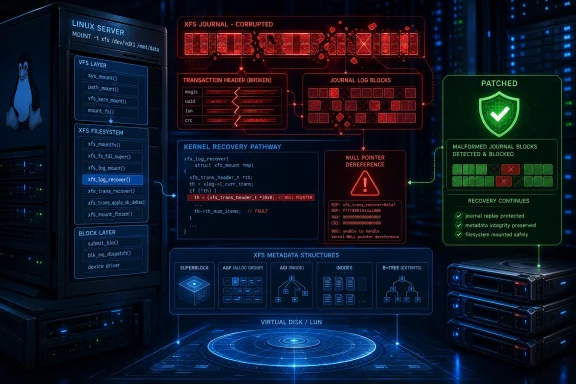
CVE-2026-64187 is a newly published Linux kernel vulnerability that turns a malformed XFS journal into a potential mount-time denial-of-service condition. The flaw does not arise from ordinary XFS activity, and the upstream description is unusually clear that normal runtime transaction commits do not create the invalid state. Instead, the issue appears when XFS recovery is handed a deliberately crafted or otherwise corrupted log containing a committed transaction item with no data regions. On affected kernels, the recovery parser can dereference a NULL pointer while mounting the filesystem, producing a kernel fault before the volume becomes available. The fix is small, but its significance is broader: it hardens a decades-old recovery path that sits between damaged on-disk metadata and a running operating system.
XFS is one of Linux’s most established high-performance filesystems. Originally developed by Silicon Graphics and later integrated into the Linux kernel, it is widely used where large filesystems, high parallel I/O, strong metadata scalability, and predictable operational behavior matter. Enterprise Linux deployments, virtualization hosts, storage servers, media workflows, backup repositories, and cloud infrastructure frequently use XFS because it performs well under workloads that can strain simpler filesystems.
Like other modern journaling filesystems, XFS relies on a log to preserve metadata consistency. Before critical metadata updates are considered complete, the filesystem records transactional information in its journal. If a machine crashes, loses power, or experiences another interruption, XFS replays committed log records during the next mount to bring metadata back to a consistent state.
Whenever privileged kernel code parses complex persistent data, it must assume that the input may be malformed. A recovery routine that trusts a structural invariant without validating it can convert damaged filesystem metadata into a kernel crash, a lockup, or potentially something more serious if memory safety boundaries are crossed.
In the affected state, the item has a region count of zero and lacks the buffer array normally used to identify the type of log item. If the malformed transaction then reaches the commit stage without any later operation adding valid regions, subsequent recovery code attempts to inspect the first buffer anyway. That access becomes a NULL-pointer dereference.
The presence of a transaction header alone does not necessarily mean the log is invalid at that instant. The header can be split across log operation records, and later records may supply the missing regions. Recovery must therefore avoid rejecting an item too early merely because the first fragment contains only a header.
That deferred construction model is reasonable. Filesystem log records may be fragmented, and recovery cannot always make a final validity decision based on a single record. The problem emerges only when the transaction reaches a committed state without ever receiving the regions that would make it a valid replayable item.
The vulnerable routine,
That is why the upstream fix rejects the malformed condition during recovery processing before the reordering and commit handlers inspect the absent first buffer. The change preserves support for legitimately fragmented headers while refusing a transaction that is provably malformed at the point where it becomes actionable.
This timing has practical consequences. A system may boot normally but fail when a specific XFS filesystem is mounted. On a server where the affected volume holds application data, container storage, virtual-machine images, or a home directory tree, the impact can be operationally severe even though the flaw is not necessarily a remote-code-execution vulnerability.
That distinction should prevent unnecessary alarm. Administrators do not need to assume that every XFS volume is quietly generating a crash condition during normal use. The flaw depends on an abnormal on-disk log state.
An attacker who can directly write the journal area of an XFS filesystem already has substantial control over that storage object. But the privilege boundary is not always as simple as it sounds. Cloud images, third-party virtual appliances, forensic media, customer-provided disks, shared storage exports, and restore workflows can all introduce untrusted filesystem content into a privileged mount process.
The security value of this patch is therefore not limited to malicious scenarios. Robust rejection of impossible journal states improves the kernel’s behavior under real-world corruption conditions.
This is a strong example of context-aware defensive programming. Validation that happens too early can reject valid input; validation that happens too late can allow malformed state to reach code that assumes a completed object.
In secure systems engineering, this is preferable to adding scattered NULL checks in every later function. The malformed object should be rejected at the boundary where the parser has enough information to declare it invalid.
The notable detail is that the vulnerability reportedly emerged from an AI-assisted code audit of the recovery parser. That does not mean AI independently proved the flaw or replaced maintainer review. It does illustrate a developing pattern: automated analysis can draw attention to unusual invariant violations, while human kernel developers validate exploitability, correctness, compatibility, and the right fix location.
That is why version-string comparison alone can lead to bad vulnerability inventory results. Administrators should review their distribution’s security bulletin, kernel package release notes, or source RPM changelog, then confirm whether the relevant XFS recovery patch has been incorporated.
Organizations should avoid interpreting an absent score as a low-risk verdict. CVSS is useful for sorting work, but exposure depends on whether the system mounts untrusted XFS content, uses XFS for essential services, and can tolerate a kernel fault or unavailable volume during recovery.
A node that cannot mount an XFS volume may fail to start services, fail a cluster health check, lose access to local container layers, or remain out of rotation until administrators recover the filesystem. In a tightly automated environment, repeated mount retries or reboot loops can further complicate diagnosis.
The risk is especially relevant when privileged hosts or utility VMs automatically mount attached volumes. A malformed journal that only causes a denial of service may still be disruptive if it crashes a recovery appliance, breaks an orchestration task, or interrupts a critical restore operation.
Mounting a damaged XFS image on an unpatched production host is an avoidable risk. Even a read-only mount can invoke journal recovery unless specific recovery-avoidance options are used, and bypassing recovery can leave the filesystem inconsistent. Administrators should choose the workflow based on the evidence-preservation and recovery objective, not simply mount media in the most convenient environment.
The relevant risk begins when Windows is used as the management plane for Linux systems or when Windows-hosted virtualization software runs Linux guests. The vulnerable code exists inside the Linux kernel that mounts the XFS volume, not in Windows storage drivers.
The most likely Windows-adjacent scenario is not an ordinary laptop crash. It is an administrator, developer, or researcher attaching an unfamiliar Linux image to a Linux VM for inspection. Keeping guest kernels current is the appropriate mitigation, just as keeping Windows hosts patched remains essential for the rest of the stack.
Organizations should include recovery appliances, rescue ISOs, maintenance VMs, and golden images in their patch inventory. These tools are frequently overlooked because they are used only during emergencies, yet they are precisely the systems most likely to encounter corrupted or unfamiliar storage.
For XFS, the
This advice is not unique to CVE-2026-64187, but the vulnerability underscores the point. Recovery paths must be treated as both operationally consequential and security-sensitive, especially when corruption may be the result of an attack or a failing storage subsystem.
That model applies outside filesystems as well. Network protocol reassembly, firmware parsing, archive extraction, virtual-disk import, and configuration loading all benefit from clear phase boundaries and explicit validation of the invariants required by the next phase.
At the same time, “only a crafted log” is not a reason to ignore the patch. Security engineering is partly about ensuring that malformed input fails safely, and filesystem images remain a realistic input channel in modern cloud, virtualization, and recovery workflows.
A system that never mounts external media and uses no XFS volumes has a very different exposure profile from a virtual-disk inspection server that routinely mounts customer images. Context is more meaningful than a single numerical score.
The broader Linux storage community will likely continue investing in self-describing metadata, online checking, repair capabilities, fuzzing, and sanitizer-backed test infrastructure. Filesystems are expected to recover from failure, but as storage becomes more portable and virtualized, they must also be resilient against malformed state arriving from outside the machine.
The best response is disciplined rather than dramatic. Patch affected kernels, verify that recovery environments receive the same update, inventory XFS use across production and virtualized systems, and handle unfamiliar filesystem images as untrusted input. The underlying lesson extends beyond one CVE: recovery code must be built to survive not only the failures it was designed to repair, but also the malformed data those failures—or an attacker—can leave behind.
 Background
XFS is one of Linux’s most established high-performance filesystems. Originally developed by Silicon Graphics and later integrated into the Linux kernel, it is widely used where large filesystems, high parallel I/O, strong metadata scalability, and predictable operational behavior matter. Enterprise Linux deployments, virtualization hosts, storage servers, media workflows, backup repositories, and cloud infrastructure frequently use XFS because it performs well under workloads that can strain simpler filesystems.Like other modern journaling filesystems, XFS relies on a log to preserve metadata consistency. Before critical metadata updates are considered complete, the filesystem records transactional information in its journal. If a machine crashes, loses power, or experiences another interruption, XFS replays committed log records during the next mount to bring metadata back to a consistent state.
Why log recovery is security-sensitive
Log recovery is often treated as a reliability feature, but it is also a parser operating on persistent storage data. That distinction matters. A filesystem journal is not merely an internal memory structure; it is an on-disk format that can be corrupted by hardware failures, damaged by software defects, altered through low-level access, or supplied from an untrusted image.Whenever privileged kernel code parses complex persistent data, it must assume that the input may be malformed. A recovery routine that trusts a structural invariant without validating it can convert damaged filesystem metadata into a kernel crash, a lockup, or potentially something more serious if memory safety boundaries are crossed.
The narrow issue behind CVE-2026-64187
CVE-2026-64187 concerns the XFS log recovery code infs/xfs/xfs_log_recover.c. The vulnerable condition occurs when recovery encounters a transaction whose first operation contains only a transaction header and no associated log-data region. The parser creates an in-memory recovery item, but because the record contains no regions, that item remains structurally incomplete.In the affected state, the item has a region count of zero and lacks the buffer array normally used to identify the type of log item. If the malformed transaction then reaches the commit stage without any later operation adding valid regions, subsequent recovery code attempts to inspect the first buffer anyway. That access becomes a NULL-pointer dereference.
How XFS Transaction Recovery Works
The most useful way to understand this vulnerability is to separate the ordinary transaction lifecycle from the exceptional recovery lifecycle. During normal operation, XFS assembles metadata changes into transactions, records them in the journal, and commits them in an ordered manner. The transaction data tells recovery code what needs to be replayed if the system stops unexpectedly.Transactions contain more than a header
An XFS log transaction consists of structured operations. A transaction header establishes the transaction context, while subsequent records contain the actual regions describing metadata changes or intent items. These regions are important because they carry the information the recovery machinery must inspect, reorder, and replay.The presence of a transaction header alone does not necessarily mean the log is invalid at that instant. The header can be split across log operation records, and later records may supply the missing regions. Recovery must therefore avoid rejecting an item too early merely because the first fragment contains only a header.
Recovery reconstructs in-memory state
During journal replay, XFS reads log records and reconstructs transaction state in memory. The function identified in the vulnerability description,xlog_recover_add_to_trans(), adds an item to the recovery transaction queue when it sees the transaction header. Under normal circumstances, later log operations populate the item with regions and buffers.That deferred construction model is reasonable. Filesystem log records may be fragmented, and recovery cannot always make a final validity decision based on a single record. The problem emerges only when the transaction reaches a committed state without ever receiving the regions that would make it a valid replayable item.
Reordering depends on valid item metadata
Before committed items are replayed, XFS recovery may reorder them. This is necessary because log items can have dependencies, and applying metadata changes in the wrong sequence can create inconsistency even if every individual operation is syntactically valid.The vulnerable routine,
xlog_recover_reorder_trans(), identifies an item’s type through a macro that reads data from the first I/O vector buffer. For a properly assembled recovery item, that buffer is present and points to valid logged data. For the malformed no-region item, the buffer array is NULL, so the item-type lookup faults.The Vulnerable Condition in Detail
The CVE description identifies a particularly precise malformed-log sequence. The first operation for a transaction is a bare transaction header whose length matches the size ofstruct xfs_trans_header. This causes the recovery parser to create an item but does not create a corresponding data region.The incomplete item state
After processing that bare header, the recovery item remains on the transaction’s item queue with two critical properties:- Its region count,
ri_cnt, is zero. - Its region-buffer pointer,
ri_buf, is NULL.
The commit boundary changes the meaning
The important validation point is the transaction commit boundary. Once recovery has seen a committed transaction, there is no longer an opportunity for a future operation to complete the previously created item. A committed item with no regions is no longer an incomplete fragment; it is invalid input.That is why the upstream fix rejects the malformed condition during recovery processing before the reordering and commit handlers inspect the absent first buffer. The change preserves support for legitimately fragmented headers while refusing a transaction that is provably malformed at the point where it becomes actionable.
Why the crash appears during mount
The call trace supplied with the CVE shows the fault occurring in the recovery path invoked as XFS mounts the filesystem. The sequence proceeds from transaction reordering through transaction commit handling, log recovery processing, the recovery pass, XFS log mounting, filesystem mounting, and finally the general kernel mount path.This timing has practical consequences. A system may boot normally but fail when a specific XFS filesystem is mounted. On a server where the affected volume holds application data, container storage, virtual-machine images, or a home directory tree, the impact can be operationally severe even though the flaw is not necessarily a remote-code-execution vulnerability.
Why This Is Not a Typical XFS Corruption Bug
The vulnerability is best understood as a parser-hardening defect, not evidence that XFS ordinarily produces invalid committed journal transactions. The upstream analysis explicitly states that the normal runtime commit path does not emit a transaction in this form.Normal workloads are not expected to trigger it
Routine file creation, deletion, renaming, quota updates, extent allocation, and metadata changes should not create a committed log item with no regions. This dramatically narrows the likelihood of accidental exposure in a healthy environment.That distinction should prevent unnecessary alarm. Administrators do not need to assume that every XFS volume is quietly generating a crash condition during normal use. The flaw depends on an abnormal on-disk log state.
Crafted logs remain meaningful attack input
The phrase “crafted log” should not be dismissed. In security terms, crafted persistent storage is still attacker-controlled input when an adversary can influence a disk image, removable drive, virtual disk, snapshot, backup artifact, block device, or storage layer.An attacker who can directly write the journal area of an XFS filesystem already has substantial control over that storage object. But the privilege boundary is not always as simple as it sounds. Cloud images, third-party virtual appliances, forensic media, customer-provided disks, shared storage exports, and restore workflows can all introduce untrusted filesystem content into a privileged mount process.
Corruption can resemble malicious input
Not every malformed log is a deliberate exploit attempt. Storage-device bugs, interrupted writes, controller failures, faulty RAM, software defects, and improper imaging procedures can leave persistent metadata in unexpected states. In those cases, a mount-time crash makes incident response harder precisely when administrators need the system to fail safely and provide diagnostics.The security value of this patch is therefore not limited to malicious scenarios. Robust rejection of impossible journal states improves the kernel’s behavior under real-world corruption conditions.
A Small Patch With an Important Design Lesson
The repair for CVE-2026-64187 is conceptually straightforward: detect the committed recovery item that has no regions and fail recovery before downstream code dereferences the missing buffer. Yet this is exactly the kind of targeted validation that makes complex kernel parsers more resilient.Validate invariants at the last reliable moment
The patch does not reject a bare header as soon as it is read. Doing so would break valid cases where the header is split across operation records and later records provide the data regions. Instead, it validates the invariant when the transaction is committed and no later input can legally repair the state.This is a strong example of context-aware defensive programming. Validation that happens too early can reject valid input; validation that happens too late can allow malformed state to reach code that assumes a completed object.
Preventing the first unsafe consumer
The affected item reachesxlog_recover_reorder_trans(), where item classification expects the first buffer to exist. Commit handlers later in the path also inspect that same buffer. Rejecting the no-region item before those consumers run prevents not just the observed crash but a family of related unsafe accesses.In secure systems engineering, this is preferable to adding scattered NULL checks in every later function. The malformed object should be rejected at the boundary where the parser has enough information to declare it invalid.
KASAN made the failure visible
The report includes a Kernel AddressSanitizer finding for a NULL-pointer dereference in the range beginning at address zero. KASAN is a dynamic memory-error detector used heavily in kernel testing and fuzzing. While this particular case is a NULL dereference rather than a classic out-of-bounds access, sanitizer-assisted testing remains valuable because it turns subtle malformed-input paths into actionable diagnostics.The notable detail is that the vulnerability reportedly emerged from an AI-assisted code audit of the recovery parser. That does not mean AI independently proved the flaw or replaced maintainer review. It does illustrate a developing pattern: automated analysis can draw attention to unusual invariant violations, while human kernel developers validate exploitability, correctness, compatibility, and the right fix location.
Affected Kernel Versions and Fix Availability
The published record indicates that the vulnerable code dates back to Linux kernel version 4.3. That long exposure window is not unusual for obscure recovery-path bugs. Code may remain stable for years because the triggering condition is absent from normal workloads, only becoming visible through targeted auditing, fuzzing, or deliberately malformed test cases.Stable branches with documented fixes
According to the published affected-version information, the issue is addressed in the following kernel release lines:- Linux 6.12: fixed through version 6.12.96.
- Linux 6.18: fixed through version 6.18.39.
- Linux 7.1: fixed through version 7.1.4.
- Linux 7.2 development: fixed beginning with 7.2-rc4.
Distribution kernels often backport fixes
Enterprise Linux vendors commonly retain a long-term kernel version while selectively backporting security and reliability fixes. A machine might report a kernel version that appears older than an upstream fixed release but still include the patch in its vendor-maintained build.That is why version-string comparison alone can lead to bad vulnerability inventory results. Administrators should review their distribution’s security bulletin, kernel package release notes, or source RPM changelog, then confirm whether the relevant XFS recovery patch has been incorporated.
No CVSS score does not mean no impact
At publication, the vulnerability record does not include an NVD CVSS assessment. This is common for newly received CVEs, particularly when the issue has a specialized local or physical attack prerequisite and the final scoring analysis has not yet been completed.Organizations should avoid interpreting an absent score as a low-risk verdict. CVSS is useful for sorting work, but exposure depends on whether the system mounts untrusted XFS content, uses XFS for essential services, and can tolerate a kernel fault or unavailable volume during recovery.
Enterprise Impact: Availability, Recovery, and Trust Boundaries
For enterprises, CVE-2026-64187 is primarily an availability and operational-resilience issue. The affected code runs when XFS recovers a journal, which means the problem can emerge after an unclean shutdown or when mounting a suspect filesystem. These are exactly the moments when infrastructure teams are already dealing with an outage, hardware incident, or data-recovery workflow.Server fleets using XFS deserve priority review
XFS is common on large Linux systems, including data nodes, hypervisors, backup servers, media platforms, and database hosts. Not every such system is equally exposed, but the concentration of important workloads means a mount-time kernel fault can have consequences beyond a single machine.A node that cannot mount an XFS volume may fail to start services, fail a cluster health check, lose access to local container layers, or remain out of rotation until administrators recover the filesystem. In a tightly automated environment, repeated mount retries or reboot loops can further complicate diagnosis.
Virtualization expands the attack surface
Virtual machines make filesystem-image handling routine. Administrators mount snapshots, attach customer-provided disks, test appliance images, import backups, and inspect virtual disks during incident response. If any of those artifacts contain XFS volumes, they should be considered potentially untrusted until mounted in a controlled environment.The risk is especially relevant when privileged hosts or utility VMs automatically mount attached volumes. A malformed journal that only causes a denial of service may still be disruptive if it crashes a recovery appliance, breaks an orchestration task, or interrupts a critical restore operation.
Incident-response systems need safe workflows
Forensic and recovery teams often mount damaged filesystems to extract data or assess the scope of corruption. That practice should already include safeguards such as read-only access, isolated analysis systems, immutable copies, and controlled device attachment. CVE-2026-64187 reinforces the importance of those measures.Mounting a damaged XFS image on an unpatched production host is an avoidable risk. Even a read-only mount can invoke journal recovery unless specific recovery-avoidance options are used, and bypassing recovery can leave the filesystem inconsistent. Administrators should choose the workflow based on the evidence-preservation and recovery objective, not simply mount media in the most convenient environment.
Consumer and Windows-Adjacent Impact
WindowsForum readers may reasonably ask why a Linux XFS CVE matters in a Windows-centered community. The answer is that Windows systems increasingly coexist with Linux filesystems through virtualization, dual-boot configurations, Windows Subsystem for Linux, NAS appliances, backup platforms, container hosts, and cross-platform incident-response tooling.Windows itself does not mount XFS natively
Standard Windows installations do not use XFS as a native filesystem, and this vulnerability does not affect NTFS, ReFS, FAT, or exFAT. A typical Windows desktop user with no Linux virtual machines, no XFS-formatted removable storage, and no Linux infrastructure responsibilities has little direct exposure.The relevant risk begins when Windows is used as the management plane for Linux systems or when Windows-hosted virtualization software runs Linux guests. The vulnerable code exists inside the Linux kernel that mounts the XFS volume, not in Windows storage drivers.
WSL and Linux virtual machines are the practical connection
Users who run Linux distributions in virtual machines, development environments, or WSL-related workflows should identify where their data lives. Many developer systems use ext4 rather than XFS, but XFS can appear in test images, mounted virtual disks, imported containers, or dedicated data volumes.The most likely Windows-adjacent scenario is not an ordinary laptop crash. It is an administrator, developer, or researcher attaching an unfamiliar Linux image to a Linux VM for inspection. Keeping guest kernels current is the appropriate mitigation, just as keeping Windows hosts patched remains essential for the rest of the stack.
Cross-platform backups should preserve trust boundaries
Backup and disaster-recovery products often handle disk images without fully understanding every guest filesystem format. If a recovery environment boots Linux and mounts restored XFS volumes automatically, the kernel version inside that recovery environment matters as much as the kernel on the original production server.Organizations should include recovery appliances, rescue ISOs, maintenance VMs, and golden images in their patch inventory. These tools are frequently overlooked because they are used only during emergencies, yet they are precisely the systems most likely to encounter corrupted or unfamiliar storage.
Practical Mitigation and Administrator Guidance
The definitive remediation is to install a vendor kernel update that includes the upstream XFS recovery fix. Because the issue occurs in kernel code, updating XFS user-space tools alone is not sufficient. The system must boot into the patched kernel before the protection is active.Immediate steps for Linux administrators
Administrators responsible for XFS systems should take the following sequence:- Identify XFS usage by reviewing mounted filesystems, storage templates, backup targets, VM images, and recovery environments.
- Check the running kernel and installed kernel packages against the distribution’s security advisory or changelog.
- Apply the vendor-provided kernel update that incorporates the fix, following normal change-control procedures.
- Reboot or otherwise transition into the updated kernel, because the vulnerable recovery code remains resident until the new kernel is running.
- Update rescue media and recovery images so an emergency workflow does not reintroduce the old vulnerable code.
- Treat unknown XFS images as untrusted input and mount them only in isolated, patched analysis environments.
Do not rely on a simple read-only mount assumption
A common operational mistake is to assume that mounting a filesystem read-only prevents recovery code from running. Filesystem semantics are more nuanced. Depending on mount options and filesystem state, recovery behavior can still be relevant, and options that bypass recovery have their own consistency implications.For XFS, the
norecovery mount option is designed to mount without running log recovery, but it is restricted to read-only use and can expose an inconsistent filesystem if it was not cleanly unmounted. That can be useful for carefully controlled forensic examination, but it is not a general-purpose substitute for applying the kernel fix.Preserve evidence before repair attempts
If a malformed or damaged XFS volume is suspected, create a block-level copy or snapshot before attempting repair. Replaying a journal, running repair tooling, or mounting a filesystem can alter the state that investigators need to understand what happened.This advice is not unique to CVE-2026-64187, but the vulnerability underscores the point. Recovery paths must be treated as both operationally consequential and security-sensitive, especially when corruption may be the result of an attack or a failing storage subsystem.
Strengths and Opportunities
The response to CVE-2026-64187 highlights several encouraging aspects of modern kernel maintenance and filesystem engineering.- The upstream fix is narrowly targeted. It validates the malformed state at the appropriate commit-stage boundary without breaking valid fragmented-header recovery.
- The flaw was discovered before evidence of broad exploitation. The available record describes a crafted-log condition and does not indicate that ordinary XFS activity can trigger it.
- Stable kernel backports are available. Multiple maintained release lines have received the correction, giving distributions a straightforward path to package updates.
- The patch improves corruption handling as well as security. Systems encountering abnormal storage contents should fail recovery cleanly rather than faulting in a later item-processing stage.
- AI-assisted auditing has demonstrated practical value. The reported discovery path suggests that automated code review can help maintainers identify unusual parser assumptions worth human investigation.
- The case strengthens filesystem test design. Recovery fuzzing can specifically exercise incomplete, split, reordered, and committed-but-invalid transaction states.
A useful model for other parsers
Kernel filesystem code is full of structures that are assembled over time: directory records, extent maps, journal transactions, quota metadata, repair queues, and block-level descriptors. CVE-2026-64187 provides a reusable lesson for all of them: an object can be temporarily incomplete during parsing, but it must be fully validated before any downstream subsystem treats it as complete.That model applies outside filesystems as well. Network protocol reassembly, firmware parsing, archive extraction, virtual-disk import, and configuration loading all benefit from clear phase boundaries and explicit validation of the invariants required by the next phase.
Risks and Concerns
The vulnerability is narrow, but several practical concerns remain for organizations that depend on Linux storage infrastructure.- A mount-time failure can delay recovery operations. The timing is especially inconvenient because it may occur after a crash, outage, or storage incident.
- Untrusted disk images can cross administrative boundaries. Virtual disks, snapshots, backup artifacts, and removable media may reach systems with elevated privileges.
- Older long-term deployments may remain exposed. Organizations that defer kernel maintenance or rely on custom builds must verify backports carefully.
- Recovery tooling can be overlooked. Rescue environments and disaster-recovery images often contain older kernels than production servers.
- An absent severity score can distort prioritization. Automated dashboards may downgrade or ignore the issue until CVSS enrichment is complete.
- Bypassing recovery has trade-offs. Mounting with recovery disabled can avoid the immediate parser path but may expose an inconsistent volume and should not be used casually.
The danger of overcorrecting
There is also a risk of treating every XFS incident as evidence of exploitation. The published description identifies a malformed log condition and a NULL-pointer fault, not a demonstrated remote compromise chain. Storage corruption can arise from benign failures, and administrators should preserve evidence rather than make premature conclusions.At the same time, “only a crafted log” is not a reason to ignore the patch. Security engineering is partly about ensuring that malformed input fails safely, and filesystem images remain a realistic input channel in modern cloud, virtualization, and recovery workflows.
What to Watch Next
The most immediate item to watch is downstream vendor adoption. Linux distributions may assign their own advisory identifiers, package versions, severity assessments, and remediation guidance. Organizations should monitor their supported distribution channels instead of waiting solely for central vulnerability databases to fill in every metric.CVSS and exploitability analysis may evolve
As of July 22, 2026, the vulnerability’s public record does not yet carry an NVD-assigned CVSS score. Future enrichment may clarify the expected attack vector, privileges required, user interaction assumptions, and availability impact. Those values will help standardized reporting, but they should complement—not replace—environment-specific assessment.A system that never mounts external media and uses no XFS volumes has a very different exposure profile from a virtual-disk inspection server that routinely mounts customer images. Context is more meaningful than a single numerical score.
Watch for regression testing and related hardening
This fix may lead to additional regression tests around XFS transaction recovery, particularly for fragmented headers, empty item queues, invalid commit records, and malformed region arrays. It would also be unsurprising to see adjacent parser checks reviewed, because a discovered invariant failure often prompts maintainers to inspect nearby assumptions.The broader Linux storage community will likely continue investing in self-describing metadata, online checking, repair capabilities, fuzzing, and sanitizer-backed test infrastructure. Filesystems are expected to recover from failure, but as storage becomes more portable and virtualized, they must also be resilient against malformed state arriving from outside the machine.
Looking Ahead
CVE-2026-64187 is not a reason to abandon XFS or panic over ordinary Linux deployments. It is a focused denial-of-service flaw in a specialized recovery condition, and the normal XFS runtime path does not produce the malformed committed transaction that triggers it. Still, the location of the defect makes it meaningful: journal recovery is invoked when systems are already vulnerable to disruption, and mounting persistent storage is an increasingly important security boundary.The best response is disciplined rather than dramatic. Patch affected kernels, verify that recovery environments receive the same update, inventory XFS use across production and virtualized systems, and handle unfamiliar filesystem images as untrusted input. The underlying lesson extends beyond one CVE: recovery code must be built to survive not only the failures it was designed to repair, but also the malformed data those failures—or an attacker—can leave behind.
References
- Primary source: NVD / Linux Kernel
Published: 2026-07-22T01:01:32-07:00
NVD - CVE-2026-64187
 nvd.nist.gov
- Security advisory: MSRC
Published: 2026-07-22T01:01:32-07:00
Original feed URL
Security Update Guide - Microsoft Security Response Center
 msrc.microsoft.com