

CVE-2026-64205 is a newly published Linux kernel vulnerability with an unusual but important failure mode: an error-handling path in the Intel i801 SMBus driver can corrupt the controller’s hardware state when Linux tries to clean up a transaction it never successfully acquired. The result is not a conventional remote-code-execution scenario, nor is it a Windows vulnerability. Instead, it is a potentially severe availability and reliability issue for affected Linux systems using Intel chipset SMBus hardware, particularly where firmware, ACPI, management tools, sensors, or concurrent workloads contend for the same controller. The Linux kernel CVE team identifies the flaw as introduced in Linux 6.3 and fixed in Linux 6.18.39, Linux 7.1.4, and Linux 7.2-rc1; as of July 22, 2026, NVD has published the record but has not assigned a CVSS score.
On Intel-based systems, the chipset’s SMBus host controller is often handled by the Linux
That sharing arrangement requires the driver to respect hardware ownership. Before initiating a transaction,
CVE-2026-64205 exists because the driver did not fully follow that last rule on one particular error path.
The problematic behavior came immediately afterward. Instead of treating the pre-check failure as a clean “nothing was acquired” result, the error path still ran a hardware register write designed to clear the controller’s in-use and status bits. In effect, Linux could attempt to reset or release hardware state that belonged to firmware or another active transaction.
That is the central distinction in this CVE:
It is not appropriate after the pre-check reports that somebody else owns it. Clearing those bits can interrupt or invalidate the transaction already taking place at the hardware or firmware level. Rather than recovering from a busy condition, the code can turn a temporary contention event into a persistent controller-state failure.
This is why the CVE description refers to hardware state machine corruption. The phrase does not mean that a physical device is permanently damaged. It means the controller’s finite-state logic is pushed into an invalid or inconsistent operational state, leaving subsequent software requests unable to proceed normally.
From a single
A busy SMBus controller should be an ordinary transient condition. A caller receives a failure, retries later if appropriate, or degrades gracefully. But once the incorrect cleanup clears state without ownership, later accesses can repeatedly fail the same initial pre-check.
The visible symptom is an ongoing stream of kernel messages equivalent to “SMBus is busy, can’t use it!” Repeated log messages are not merely cosmetic on a stressed system. They consume CPU time, increase I/O activity, and make diagnosis harder precisely when the host is already misbehaving.
The CVE report describes processes then being delayed while waiting for memory-management locking, eventually leading the hung-task watchdog to report or panic on blocked tasks. This chain matters because it transforms a low-level driver bug into an apparent whole-system hang.
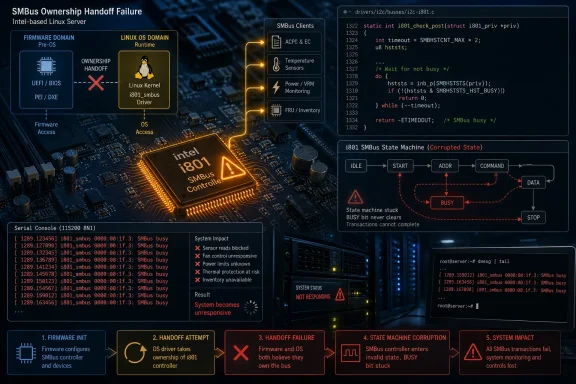
The progression is best understood as a sequence:
That does not make the flaw trivial. For servers with serial consoles, lab machines under fuzzing, industrial systems, or hosts that depend on sensor and board-management access, repeatable hangs are operationally serious. But the absence of a CVSS score as of July 22 should not be mistaken for proof of either low or high exploitability; it simply means NVD’s assessment has not yet been published.
The affected population is therefore narrower than “all Linux systems,” but it includes a broad class of Intel desktop, laptop, workstation, and server platforms. The exact practical exposure depends on whether the driver is present, whether the platform’s controller is supported and enabled, and whether contention with ACPI or firmware can arise under a particular workload.
That history illustrates a recurring kernel engineering challenge. Adding a precondition check can improve correctness in the normal path, but every new early-return branch changes the assumptions made by shared cleanup code. If an
That means developers need to distinguish among:
Administrators should not decide solely from the first portion of
For most organizations, however, manually applying a single commit introduces more risk than it removes. The safer approach is to consume the vendor-maintained kernel update that includes the correction along with related fixes and integration testing.
This is a modest source-code adjustment with a large behavioral consequence. The patch restores the expected contract: a failed pre-check becomes non-invasive. Linux backs away rather than attempting to “repair” a controller state it does not own.
In driver work, the safest recovery often means doing less. The fixed code does not make a busy controller immediately available; it prevents the driver from worsening the condition. That is the correct tradeoff when a resource is legitimately owned elsewhere.
Windows users should therefore avoid a common but misleading conclusion: sharing Intel chipset hardware does not make an operating system bug cross-platform by default. The vulnerable component is Linux’s
The practical message for those environments is clear: do not diagnose an affected Linux host’s recurring SMBus-busy logs, serial-console stall, or hung-task panic as a Windows interoperability failure. This is a Linux kernel update and platform-management issue. Firmware updates may still be valuable for unrelated stability reasons, but they are not substitutes for installing the corrected Linux kernel.
There are exceptions. Device passthrough, specialized lab systems, hardware-assisted management environments, and unusual virtualization designs can change the risk profile. Administrators using direct PCI or controller passthrough should validate the exposed device topology instead of assuming all guest systems are insulated.
Those symptoms are not unique to CVE-2026-64205. A busy SMBus message can also arise from expected firmware behavior, an incompatible monitoring utility, an out-of-tree module, or platform-specific quirks. The CVE becomes especially relevant when repeated failures escalate, the system becomes unresponsive, or the issue corresponds to the affected kernel range.
A sensible diagnostic approach is to reduce variables:
However, users should not mistake that correlation for a replacement for patching. The corrected kernel behavior is still required because it ensures a failed ownership check does not damage the controller’s operational state.
A host that constantly prints an error may appear to be “stuck” in remote management even if the root cause is a driver repeatedly reporting a hardware state problem. Operations teams should consider log-rate limiting and console configuration as secondary defenses, but neither should be viewed as a substitute for the kernel update.
The risk is not necessarily that standard monitoring software is defective. The concern is that systems with more management activity may have more opportunities to encounter controller contention. Organizations should review which agents perform low-level hardware discovery and whether they run with unnecessary frequency or privileges.
For critical hosts, a useful validation sequence is:
That level of detail creates several opportunities:
The patch also reinforces a healthy kernel-development principle: error paths are first-class execution paths. They deserve the same ownership analysis, synchronization scrutiny, and test coverage as successful transfers.
The better approach is contextual prioritization. Consider whether affected Intel Linux systems are bare metal, whether they expose serial consoles, whether they run sensitive management agents, and whether downtime from a hang would create meaningful business impact.
Likewise, disabling the driver may avoid the specific code path, but it can remove legitimate platform functionality. That workaround should be reserved for controlled cases where the operational cost is understood and a patched kernel cannot be deployed immediately.
This distinction prevents an expensive troubleshooting detour. Updating firmware is often prudent, especially when a system vendor recommends it, but the primary correction is a kernel update containing the i801 error-path fix.
Administrators should track their vendor’s advisory language for explicit mention of CVE-2026-64205 or the i801 SMBus fix. The upstream fixed version is useful context, but vendor package status is the authoritative operational answer for a distribution-managed system.
It is also worth watching for reports that clarify whether any particular chipset families, firmware combinations, sensor stacks, or serial-console arrangements make the failure more reproducible. The published advisory establishes the defect; field experience will determine how broadly it appears outside fuzzing and stress conditions.
That should prompt maintainers and vendors to examine related controller drivers for the same pattern: early failures that fall through to cleanup code written under the assumption that hardware initialization already occurred. It is a subtle class of defect with consequences ranging from harmless retries to system-wide liveness failures.
Linux kernel vulnerabilities are often discussed in terms of privilege escalation or memory corruption, but CVE-2026-64205 is a valuable reminder that reliability flaws in platform-management code can be just as disruptive. Its fix is conceptually simple—do not clear hardware state that Linux never acquired—yet the consequences of violating that principle can include persistent SMBus failures, log storms, console livelock, and a hung system. For affected Intel-based Linux machines, especially those with serial management paths or intensive hardware monitoring, the practical response is direct: deploy the vendor kernel update that includes the i801 correction, validate the host’s management and sensor behavior after reboot, and treat recurring SMBus-busy logs as a signal to investigate rather than background noise.
 Background
The quiet importance of SMBus
System Management Bus, usually shortened to SMBus, is a management-oriented derivative of I²C used throughout PCs and servers. It is not the high-bandwidth bus that moves graphics frames or storage traffic, but it remains vital to normal platform operation. Motherboards use SMBus pathways for sensors, thermal monitoring, memory-module SPD information, battery and power-management components, and other low-level devices.On Intel-based systems, the chipset’s SMBus host controller is often handled by the Linux
i2c-i801 driver. That driver supports a long line of Intel platform controller hubs and exposes the controller to kernel components and approved user-space utilities through Linux’s I²C subsystem. A failure there can be subtle: the operating system may continue to run, but hardware-monitoring functions, board-management services, or sensor access can become unreliable.Firmware and the operating system share the machine
Modern PCs are not controlled exclusively by the operating system after boot. Firmware, ACPI methods, embedded controllers, and management components can still perform platform tasks after Linux has loaded. On some systems, BIOS or ACPI code may be using the SMBus controller when the kernel attempts an access.That sharing arrangement requires the driver to respect hardware ownership. Before initiating a transaction,
i2c-i801 performs a pre-check intended to determine whether the controller is available. If the controller is busy, the correct outcome is straightforward: Linux should decline the request, preserve the current controller state, release only its own software-side locks, and allow the existing owner to finish.CVE-2026-64205 exists because the driver did not fully follow that last rule on one particular error path.
What CVE-2026-64205 Actually Fixes
A cleanup operation without successful ownership
The vulnerable path is withini801_access(), the driver routine used to execute SMBus transactions. Before proceeding, it calls i801_check_pre(). If that pre-check fails—for example, because the controller reports that it is in use by BIOS or ACPI—the driver returns an error such as -EBUSY.The problematic behavior came immediately afterward. Instead of treating the pre-check failure as a clean “nothing was acquired” result, the error path still ran a hardware register write designed to clear the controller’s in-use and status bits. In effect, Linux could attempt to reset or release hardware state that belonged to firmware or another active transaction.
That is the central distinction in this CVE:
- The driver’s software locks may have been acquired and must be released.
- The hardware controller may not have been acquired and must not be reset.
- Treating those two categories as identical creates a hardware ownership violation.
The specific register-level mistake
The vulnerable cleanup writes to the SMBus host status register, clearing theINUSE_STS lock and status flags. Such a write is appropriate after a transaction Linux actually initiated or after Linux has clearly established that it owns the controller’s state.It is not appropriate after the pre-check reports that somebody else owns it. Clearing those bits can interrupt or invalidate the transaction already taking place at the hardware or firmware level. Rather than recovering from a busy condition, the code can turn a temporary contention event into a persistent controller-state failure.
This is why the CVE description refers to hardware state machine corruption. The phrase does not mean that a physical device is permanently damaged. It means the controller’s finite-state logic is pushed into an invalid or inconsistent operational state, leaving subsequent software requests unable to proceed normally.
Why an Error Path Became a System-Wide Failure
From a single -EBUSY result to repeated denial
A busy SMBus controller should be an ordinary transient condition. A caller receives a failure, retries later if appropriate, or degrades gracefully. But once the incorrect cleanup clears state without ownership, later accesses can repeatedly fail the same initial pre-check.The visible symptom is an ongoing stream of kernel messages equivalent to “SMBus is busy, can’t use it!” Repeated log messages are not merely cosmetic on a stressed system. They consume CPU time, increase I/O activity, and make diagnosis harder precisely when the host is already misbehaving.
Console livelock is the important escalation
The reported worst case involves a slow serial console. Serial output is dramatically slower than normal memory operations and can be costly enough to dominate execution when the kernel floods it with messages. In that condition, the system may enter what is commonly described as a console livelock: the machine is technically alive, but spends so much time reporting an error that useful work is starved.The CVE report describes processes then being delayed while waiting for memory-management locking, eventually leading the hung-task watchdog to report or panic on blocked tasks. This chain matters because it transforms a low-level driver bug into an apparent whole-system hang.
The progression is best understood as a sequence:
- Firmware or ACPI is using the Intel SMBus controller.
- Linux invokes the i801 driver and its pre-check reports the controller as busy.
- The old error path clears status and in-use bits anyway.
- The controller’s ongoing transaction or state machine becomes inconsistent.
- Later access attempts continuously encounter a busy or invalid state.
- The kernel logs failures at high frequency.
- A slow console turns the log flood into CPU starvation.
- Other kernel and user tasks wait too long, prompting a hung-task report or panic.
Availability, not silent compromise
This distinction is crucial for defenders. The publicly available record describes a denial-of-service and system-reliability problem, not a disclosed path for an unprivileged remote attacker to execute code or directly disclose protected memory. An attacker’s ability to trigger the exact race or contention pattern would depend heavily on system configuration, available local interfaces, loaded drivers, firmware behavior, and access privileges.That does not make the flaw trivial. For servers with serial consoles, lab machines under fuzzing, industrial systems, or hosts that depend on sensor and board-management access, repeatable hangs are operationally serious. But the absence of a CVSS score as of July 22 should not be mistaken for proof of either low or high exploitability; it simply means NVD’s assessment has not yet been published.
The Intel i801 Driver’s Place in the Kernel
Why this is not every Linux I²C device
Linux supports many I²C and SMBus controllers. CVE-2026-64205 is tied specifically todrivers/i2c/busses/i2c-i801.c, the Intel i801-family SMBus host controller driver. It does not automatically apply to systems using AMD’s common SMBus controller driver, ARM SoC I²C controllers, USB bridge devices, or every machine with an I²C peripheral.The affected population is therefore narrower than “all Linux systems,” but it includes a broad class of Intel desktop, laptop, workstation, and server platforms. The exact practical exposure depends on whether the driver is present, whether the platform’s controller is supported and enabled, and whether contention with ACPI or firmware can arise under a particular workload.
A mature driver can still inherit modern concurrency problems
The i801 code is longstanding, but mature code is not immune to defects introduced by later changes. According to the kernel CVE advisory, the issue was introduced in Linux 6.3 by the change that began callingi801_check_pre() from i801_access().That history illustrates a recurring kernel engineering challenge. Adding a precondition check can improve correctness in the normal path, but every new early-return branch changes the assumptions made by shared cleanup code. If an
out label once meant “the transaction was initialized,” it may no longer mean that after a new pre-check can jump there before ownership is established.The deeper lesson: cleanup is conditional
The most portable lesson from this CVE is not specific to SMBus. Error handling in kernel drivers needs to mirror resource acquisition exactly. An exit routine should release only the resources that the current execution path actually obtained.That means developers need to distinguish among:
- A mutex or runtime-power reference acquired in software.
- A hardware lock or controller state acquired from the device.
- An interrupt or DMA operation that was actually initiated.
- A register state that is safe to acknowledge or clear.
- A pointer, buffer, or transaction context that remains valid during asynchronous completion.
Affected Versions and Patch Status
The version boundaries currently published
The Linux kernel CVE advisory states that the issue was introduced in Linux 6.3. It lists the following fixed versions:- Linux 6.18.39 contains the stable-tree fix for the 6.18 branch.
- Linux 7.1.4 contains the stable-tree fix for the 7.1 branch.
- Linux 7.2-rc1 contains the fix in the newer development line.
Distribution kernels require interpretation
Linux distributions do not always ship an upstream version number that maps neatly to vulnerability status. Enterprise distributions commonly backport security and stability fixes into a kernel whose visible version appears older than the upstream fixed release. Conversely, a custom kernel may advertise a recent version while excluding selected stable changes.Administrators should not decide solely from the first portion of
uname -r. The better evidence is the distributor’s security advisory, changelog, source package metadata, or kernel build configuration. The Linux kernel CVE team explicitly recommends updating to a complete supported stable release rather than cherry-picking one patch in isolation.Why cherry-picking is a last resort
The source change itself is small, but kernel patches exist within a larger compatibility and testing context. A local cherry-pick can be appropriate for an experienced vendor kernel team with a controlled build, regression testing, hardware validation, and a defined rollback plan.For most organizations, however, manually applying a single commit introduces more risk than it removes. The safer approach is to consume the vendor-maintained kernel update that includes the correction along with related fixes and integration testing.
The Patch: Small Change, Stronger Ownership Model
Separating the hardware cleanup path
The published correction moves the relevant error label so that a failure fromi801_check_pre() bypasses the hardware register cleanup. The driver still drops its runtime power-management reference and unlocks its mutex, but it no longer writes the status register when Linux never obtained controller ownership.This is a modest source-code adjustment with a large behavioral consequence. The patch restores the expected contract: a failed pre-check becomes non-invasive. Linux backs away rather than attempting to “repair” a controller state it does not own.
Why the fix is appropriately conservative
The corrected behavior does not try to outguess firmware. If BIOS or ACPI is using the SMBus controller, Linux no longer clears the in-use state to force its own access. That restraint is valuable because firmware transactions may involve battery telemetry, thermal policy, power delivery, memory configuration data, or board-specific management logic that the OS cannot safely reconstruct.In driver work, the safest recovery often means doing less. The fixed code does not make a busy controller immediately available; it prevents the driver from worsening the condition. That is the correct tradeoff when a resource is legitimately owned elsewhere.
Why WindowsForum Readers Should Pay Attention
This is not a Windows CVE
CVE-2026-64205 is a Linux kernel issue. It does not mean Windows systems running on Intel hardware are vulnerable through the Windows kernel’s I²C or SMBus stacks. Windows uses different drivers, different ACPI integration paths, different kernel synchronization code, and a distinct platform-driver architecture.Windows users should therefore avoid a common but misleading conclusion: sharing Intel chipset hardware does not make an operating system bug cross-platform by default. The vulnerable component is Linux’s
i2c-i801 driver and its particular error-handling logic.The dual-boot and infrastructure angle
The issue is still relevant to the Windows community because many readers operate mixed environments. A Windows desktop may dual-boot Linux for development, a Windows Server estate may use Linux appliances, and IT teams often administer hypervisors, monitoring systems, storage platforms, build agents, and embedded gateways running Linux on Intel hardware.The practical message for those environments is clear: do not diagnose an affected Linux host’s recurring SMBus-busy logs, serial-console stall, or hung-task panic as a Windows interoperability failure. This is a Linux kernel update and platform-management issue. Firmware updates may still be valuable for unrelated stability reasons, but they are not substitutes for installing the corrected Linux kernel.
Virtual machines are generally a different case
Most ordinary virtual machines do not directly control the host’s physical Intel i801 SMBus controller. Guest operating systems typically see virtualized chipset interfaces rather than raw host SMBus hardware. That makes the direct exposure primarily a bare-metal concern.There are exceptions. Device passthrough, specialized lab systems, hardware-assisted management environments, and unusual virtualization designs can change the risk profile. Administrators using direct PCI or controller passthrough should validate the exposed device topology instead of assuming all guest systems are insulated.
Consumer Linux Impact
Symptoms users may actually see
On a consumer desktop or laptop, the most visible indication may be repeated kernel-log messages about the SMBus controller being busy. Users may notice sensor utilities failing, RGB or motherboard-monitoring applications behaving inconsistently, laptop battery or thermal reporting glitches, or a system becoming sluggish during heavy logging.Those symptoms are not unique to CVE-2026-64205. A busy SMBus message can also arise from expected firmware behavior, an incompatible monitoring utility, an out-of-tree module, or platform-specific quirks. The CVE becomes especially relevant when repeated failures escalate, the system becomes unresponsive, or the issue corresponds to the affected kernel range.
Avoid aggressive sensor polling during diagnosis
The temptation is to install additional hardware-monitoring utilities and poll every available I²C address. That can make an already contentious situation noisier. Tools designed to probe sensors, memory SPD data, fan controllers, lighting controllers, or embedded devices should be used carefully, particularly on laptops and proprietary motherboards.A sensible diagnostic approach is to reduce variables:
- Update to a vendor kernel containing the fix before chasing application-level workarounds.
- Temporarily stop third-party sensor, RGB, or board-management tools that use I²C or SMBus access.
- Inspect the kernel log after rebooting into the updated kernel.
- Re-enable tools one at a time if the issue disappears after the update.
The value of a clean boot comparison
A clean boot without optional hardware-management software can help distinguish a persistent driver or firmware conflict from an application-triggered pattern. If the controller remains stable until a particular sensor or RGB application starts, that application may be increasing contention or exposing a separate compatibility problem.However, users should not mistake that correlation for a replacement for patching. The corrected kernel behavior is still required because it ensures a failed ownership check does not damage the controller’s operational state.
Enterprise and Data Center Impact
Serial consoles amplify operational severity
The CVE description specifically notes that a slow serial console can turn log flooding into console livelock. This is particularly relevant in enterprise environments, where serial-over-LAN, BMC serial redirection, low-baud-rate remote consoles, and centralized console servers remain common.A host that constantly prints an error may appear to be “stuck” in remote management even if the root cause is a driver repeatedly reporting a hardware state problem. Operations teams should consider log-rate limiting and console configuration as secondary defenses, but neither should be viewed as a substitute for the kernel update.
Monitoring stacks can become part of the trigger surface
Servers frequently run node exporters, IPMI-related collectors, thermal monitors, inventory agents, and vendor-specific health-management software. Some interact with SMBus indirectly, while others rely on firmware or BMC pathways that coexist with the host OS.The risk is not necessarily that standard monitoring software is defective. The concern is that systems with more management activity may have more opportunities to encounter controller contention. Organizations should review which agents perform low-level hardware discovery and whether they run with unnecessary frequency or privileges.
Change management needs a hardware-aware test
Kernel patching policies often focus on storage, networking, virtualization, and application compatibility. CVE-2026-64205 is a reminder that low-level bus behavior deserves validation too. A canary rollout should include systems representative of the fleet’s motherboard, chipset, BIOS, BMC, and monitoring-agent combinations.For critical hosts, a useful validation sequence is:
- Boot the updated kernel and verify the intended version is active.
- Confirm
i2c-i801loads only where it is expected to load. - Review boot and runtime logs for repeated SMBus-busy messages.
- Exercise approved sensor, thermal, and management workflows.
- Confirm remote serial-console responsiveness under normal logging.
- Monitor for hung-task warnings, unexpected watchdog events, or sensor-collection failures.
Strengths and Opportunities
The disclosure provides actionable technical detail
This CVE is notable for the clarity of its failure narrative. Administrators are not left with a vague statement that “a race condition was fixed.” The published description explains the ownership failure, the unsafe register write, the repeated error condition, and the escalation route to a hung-task event.That level of detail creates several opportunities:
- Distribution maintainers can identify the exact driver and code path involved.
- Operations teams can correlate log patterns with a specific known kernel defect.
- Kernel developers can review similar early-return and cleanup patterns elsewhere.
- Security teams can classify the issue accurately as a stability and availability concern rather than overstate it as a generic system takeover flaw.
- Platform teams can test firmware-and-OS contention scenarios that conventional functional tests may miss.
Fuzzing continues to uncover real hardware bugs
The issue was observed during concurrent fuzzing, illustrating the value of stress-testing code beyond ordinary hardware validation. Hardware drivers must handle timing-sensitive interactions among interrupts, firmware activity, power management, mutexes, and device registers. Those paths may remain dormant for years until unusual concurrency exposes them.The patch also reinforces a healthy kernel-development principle: error paths are first-class execution paths. They deserve the same ownership analysis, synchronization scrutiny, and test coverage as successful transfers.
Risks and Concerns
NVD scoring is still incomplete
As of July 22, 2026, NVD lists CVE-2026-64205 as published but unscored. Organizations that automatically prioritize only CVEs with a CVSS number may fail to queue the update promptly, while organizations that treat every Linux kernel CVE as equally urgent may overreact.The better approach is contextual prioritization. Consider whether affected Intel Linux systems are bare metal, whether they expose serial consoles, whether they run sensitive management agents, and whether downtime from a hang would create meaningful business impact.
Log suppression is not remediation
Rate limiting kernel logs can reduce the chance that a serial-console flood monopolizes the CPU. It may be a useful resilience measure in general, especially on devices where console output is slow. But it does not restore corrupted SMBus controller state or correct the erroneous hardware write.Likewise, disabling the driver may avoid the specific code path, but it can remove legitimate platform functionality. That workaround should be reserved for controlled cases where the operational cost is understood and a patched kernel cannot be deployed immediately.
Firmware complexity can obscure diagnosis
Because the problem can occur when BIOS or ACPI is actively using the controller, administrators may first suspect a firmware defect. Firmware behavior can indeed influence how often contention occurs, but the CVE’s core flaw is the Linux driver’s response after it detects that contention.This distinction prevents an expensive troubleshooting detour. Updating firmware is often prudent, especially when a system vendor recommends it, but the primary correction is a kernel update containing the i801 error-path fix.
What to Watch Next
Distribution advisories and backports
The most immediate development to watch is how Linux distributions map this upstream CVE into their own kernel packages. Rolling-release distributions may have already moved beyond the vulnerable code, while long-term-support and enterprise vendors may backport the correction under a distribution-specific package revision.Administrators should track their vendor’s advisory language for explicit mention of CVE-2026-64205 or the i801 SMBus fix. The upstream fixed version is useful context, but vendor package status is the authoritative operational answer for a distribution-managed system.
Possible refinement of the vulnerability record
New Linux kernel CVEs can gain additional metadata after publication. NVD may eventually add a CVSS vector, weakness classification, configuration data, or analytical notes. Those updates can be useful for inventory and reporting, though they should not delay remediation on systems where the operational impact is already clear.It is also worth watching for reports that clarify whether any particular chipset families, firmware combinations, sensor stacks, or serial-console arrangements make the failure more reproducible. The published advisory establishes the defect; field experience will determine how broadly it appears outside fuzzing and stress conditions.
Broader scrutiny of related asynchronous paths
The public patch discussion around the i801 driver also highlighted the sensitivity of interrupt-driven SMBus transactions and the danger of stale transaction data after an abort. While CVE-2026-64205 itself is focused on the hardware-state corruption caused by cleanup after a failed pre-check, the surrounding discussion underscores the broader complexity of driver error recovery.That should prompt maintainers and vendors to examine related controller drivers for the same pattern: early failures that fall through to cleanup code written under the assumption that hardware initialization already occurred. It is a subtle class of defect with consequences ranging from harmless retries to system-wide liveness failures.
Linux kernel vulnerabilities are often discussed in terms of privilege escalation or memory corruption, but CVE-2026-64205 is a valuable reminder that reliability flaws in platform-management code can be just as disruptive. Its fix is conceptually simple—do not clear hardware state that Linux never acquired—yet the consequences of violating that principle can include persistent SMBus failures, log storms, console livelock, and a hung system. For affected Intel-based Linux machines, especially those with serial management paths or intensive hardware monitoring, the practical response is direct: deploy the vendor kernel update that includes the i801 correction, validate the host’s management and sensor behavior after reboot, and treat recurring SMBus-busy logs as a signal to investigate rather than background noise.
References
- Primary source: NVD / Linux Kernel
Published: 2026-07-22T01:01:44-07:00
NVD - CVE-2026-64205
 nvd.nist.gov
- Security advisory: MSRC
Published: 2026-07-22T01:01:44-07:00
Original feed URL
Security Update Guide - Microsoft Security Response Center
 msrc.microsoft.com
