

HighPoint Technologies is pushing PCIe switching deeper into the AI infrastructure market with a broad portfolio of PCIe 5.0 peer-to-peer and NVIDIA GPUDirect Storage solutions designed for ordinary white-box servers. The company’s pitch is straightforward but ambitious: place GPUs and dense NVMe storage behind a properly engineered PCIe switch, shorten the path between them, and deliver as much as 64GB/s of aggregate transfer bandwidth without forcing every payload through host memory and the CPU. If the products perform as advertised, regional cloud providers, managed service providers, system integrators, research labs, and edge-computing operators could build high-throughput GPU storage nodes without buying a fully proprietary hyperscale platform.
Modern AI systems are often described in terms of GPU performance, model size, and memory capacity, but the surrounding data path increasingly determines how much of that compute resource can actually be used. A powerful accelerator sitting idle while it waits for checkpoints, embeddings, image batches, sensor streams, or vector indexes is an expensive reminder that infrastructure performance depends on the whole system.
Conventional storage I/O typically moves data from an NVMe device into system memory before software copies or stages it into GPU memory. That route is familiar, broadly compatible, and sometimes entirely adequate, but it consumes CPU cycles, host-memory bandwidth, and memory capacity while adding another step to the transfer.
Instead, GDS reduces unnecessary movement through a CPU-resident bounce buffer. This can lower latency, reduce CPU utilization, and increase sustainable throughput when applications ingest or write large quantities of data.
The physical PCIe topology remains critical. A software stack cannot create an ideal peer-to-peer path if the GPU and storage endpoints sit behind incompatible root ports, restrictive firmware settings, or a motherboard topology that forces transactions through the root complex.
PCIe 4.0 raised the practical throughput ceiling, while PCIe 5.0 doubled the signaling rate again. A PCIe 5.0 x16 link offers roughly 64GB/s of theoretical payload bandwidth in each direction before protocol and implementation overheads are considered, giving vendors enough headroom to connect multiple fast SSDs to one or more accelerators.
HighPoint’s new portfolio treats PCIe not merely as a set of expansion slots but as a composable local data fabric. That distinction explains why the announcement covers switch adapters, dense M.2 cards, cabled NVMe connectivity, external expansion bridges, and GPU enclosures rather than a single storage controller.
A PCIe switch is conceptually similar to a network switch, although the protocols, addressing, configuration, and topology rules differ substantially. It allows several devices to share an upstream connection and, under the right conditions, enables local peer-to-peer transactions that do not need to travel all the way to the CPU root complex.
The upstream link width, downstream lane allocation, SSD performance, GPU ingestion rate, filesystem, transfer size, queue depth, thermals, firmware, and software stack all influence delivered throughput. If eight high-end NVMe drives share one PCIe 5.0 x16 host link, for example, their combined benchmark results can exceed what that upstream connection can carry.
Local P2P paths change the calculation because not every transaction must consume upstream host bandwidth. Nevertheless, architects must map the expected traffic flows rather than treating the switch as a magical source of additional PCIe lanes.
Small random transfers, metadata-heavy operations, fragmented files, insufficient concurrency, and software fallbacks can produce dramatically different results. HighPoint’s claim is therefore best understood as the maximum fabric class, not a guaranteed application result for every server and workload.
The more meaningful promise is that the hardware can provide enough switching capacity to avoid becoming the first bottleneck. Independent testing will still be needed to establish sustained read and write performance, tail latency, CPU utilization, and behavior under mixed workloads.
These designs address different cost, compatibility, and isolation requirements. They also make the portfolio more flexible than a fixed appliance whose internal PCIe layout cannot be changed after purchase.
This design is likely to be the easier upgrade for existing servers. Administrators can retain their motherboard, processors, GPUs, and much of the chassis layout while adding denser NVMe connectivity.
Its performance remains more dependent on the server’s native PCIe map. Two physical slots that look identical from outside the chassis may connect to different CPUs, root ports, or switch branches, especially in dual-socket systems.
This arrangement can make performance more predictable because the crucial relationship between storage and accelerator is defined by the add-in infrastructure rather than by a server vendor’s slot wiring. It may also help integrators reproduce a validated configuration across several otherwise different white-box platforms.
The localized design should not be interpreted as universal immunity from virtualization and security controls. Device assignment, reset behavior, address translation, operating-system support, firmware configuration, and hypervisor policy can still affect whether the final system works correctly.
An eight-drive M.2 card could package a substantial amount of flash capacity into one x16 slot. It also concentrates power and heat in a small area, so chassis airflow becomes a first-class design concern rather than an installation detail.
Sustained AI data loading can keep all drives active for extended periods. Integrators should test drive temperatures, switch-chip cooling, fan behavior, and throttling under continuous workloads instead of relying only on short synthetic benchmarks.
HighPoint positions the Rocket 1628A as a particularly flexible component. Two of its MCIO ports can reportedly be aggregated through the company’s MCIO-to-PCIe x16 Gen5 bridge to provide a full-width GPU connection, while the remaining ports feed as many as 16 NVMe devices through a compatible backplane.
That design effectively turns one host slot into a localized compute-and-storage domain. It is an appealing proposition for dense edge servers, but cabling quality, signal integrity, connector retention, airflow, and auxiliary GPU power must all be handled carefully.
PCIe 4.0 x16 still supplies approximately 32GB/s of theoretical one-way bandwidth. That is enough to support several fast NVMe drives and many inference, media, analytics, and data-logging workloads.
Sixteen M.2 drives on one card can deliver exceptional capacity per slot, but density has operational consequences. Replacing an individual device may require opening the chassis and removing the whole card, and a cooling problem can affect several drives simultaneously.
For archival tiers, checkpoint repositories, large embedding sets, and read-heavy inference data, capacity may matter more than peak Gen5 speed. The Gen4 cards could therefore offer a better price-to-performance balance than the newest hardware.
U.2 and U.3 drives are often easier to cool and service than tightly packed M.2 modules. Enterprise models may also offer stronger endurance, power-loss protection, telemetry, and predictable sustained performance.
The choice between M.2 and enterprise drive formats is therefore not simply about physical size. Builders should evaluate write endurance, failure replacement, hot-service requirements, thermal behavior, firmware qualification, and the cost of downtime.
The associated RocketStor 8631 series is designed to accommodate full-sized PCIe GPUs, including wide dual-slot and triple-slot models. External GPU placement can solve mechanical and thermal problems that become difficult inside compact or storage-heavy servers.
An external enclosure separates the endpoint from the host chassis while preserving native PCIe connectivity. This is different from attaching storage over Ethernet or Fibre Channel because the remote chassis remains part of the PCIe hierarchy.
The approach can help an integrator create modular building blocks: a server for CPU and memory, a storage shelf for NVMe capacity, and an accelerator enclosure for GPUs. Components may then be upgraded independently, subject to compatibility and cable-distance restrictions.
A loose or marginal connection is not merely a performance problem. It can produce link retraining, reduced lane width, corrected errors, intermittent device loss, or instability that appears only during sustained traffic.
System integrators will need validated bills of materials rather than a mix-and-match approach. HighPoint’s value will depend partly on how well it documents cable support, topology limits, enclosure interoperability, diagnostics, and field-service procedures.
GDS cannot make an SSD behave like high-bandwidth GPU memory. It can, however, reduce avoidable overhead when information must move between storage and accelerator memory.
A localized PCIe fabric can allow several NVMe devices to serve one GPU at high speed. Properly implemented asynchronous reads, batching, parallel queues, and double-buffering can overlap storage operations with GPU computation.
The result is not necessarily a dramatic improvement for every model. Workloads that are predominantly compute-bound, or whose active data already resides in GPU memory, will see less benefit than storage-intensive pipelines.
Large model files may be sharded across several NVMe devices to increase parallelism. Yet RAID layout, filesystem support, GDS compatibility, and failure behavior must be validated because not every logical storage configuration receives the same peer-to-peer treatment.
Operators should benchmark complete workflows rather than measuring only raw block throughput. Time to first inference, model-switch latency, requests per second, and accelerator utilization provide a more useful view of business impact.
Robotics, industrial inspection, scientific instruments, transportation systems, and video analytics can generate more information than a remote connection can reliably carry. Processing data close to its source reduces dependence on a wide-area network.
The topology could be particularly useful where several cameras, acquisition cards, NVMe devices, and accelerators must coexist. HighPoint says its matrices can mix standard storage with M.2, E1.S, U.2, U.3, and compatible accelerator modules.
Real-time behavior depends on more than average throughput. Engineers must measure worst-case latency, queue contention, error recovery, garbage-collection pauses inside SSDs, and thermal throttling.
M.2 devices can be attractive where space is scarce, but their connectors and thermal characteristics may require additional mechanical support. External enclosures add modularity while introducing cables and connectors that must be secured.
HighPoint’s portfolio gives integrators more topology choices, but the integrator still owns the engineering needed to convert commercial components into a dependable edge appliance.
The important change is accessibility. A system builder may be able to add a predefined switched topology to a standard server without buying a motherboard whose PCIe fabric was designed specifically around one accelerator configuration.
HighPoint’s cards could help these providers offer GPU-backed storage services, private AI inference, media processing, or data-local analytics. A modular design also allows providers to start with a smaller GPU and storage pool before increasing capacity.
The operational economics will determine adoption. Hardware cost must be weighed against higher GPU utilization, lower CPU overhead, deployment labor, support complexity, and the ability to use less expensive white-box servers.
On the other hand, integrated OEM systems usually provide a single support boundary. A white-box design can involve separate vendors for the motherboard, BIOS, GPU, switch card, SSDs, cables, backplane, operating system, and GDS software.
Procurement savings can be erased by troubleshooting costs if the configuration is not carefully qualified. HighPoint and its channel partners will need to supply validated reference designs, compatibility matrices, firmware guidance, and clear escalation procedures.
Windows users may still benefit from HighPoint’s switched NVMe density, PCIe expansion, and external enclosure capabilities. The storage cards can address workstation use cases such as video production, simulation, content creation, local databases, and large scratch volumes, depending on available drivers and product support.
Recent Linux developments have expanded use of the kernel’s PCI peer-to-peer DMA infrastructure, but support remains configuration-dependent. Features such as NVMe multipathing, software RAID, virtualization, and particular filesystems may introduce limitations or require specialized validation.
Administrators should not assume that a device appearing in the operating system means the optimized path is active. GDS diagnostic tools, topology inspection, application-level benchmarks, and CPU-usage measurements are needed to confirm the system is avoiding a fallback route.
HighPoint argues that placing the endpoints behind one localized switch avoids common motherboard-routed restrictions. That is plausible at the traffic-topology level, but administrators must still evaluate the security model of the complete platform.
A configuration that is suitable for a dedicated bare-metal appliance may be inappropriate for an untrusted multi-tenant cloud. Performance tuning should never be reduced to blindly disabling firmware security features.
AI operators should add workload-specific metrics such as time to load a model, tokens per second, batch completion time, request latency, and recovery duration. Edge users should include dropped-frame rates, acquisition jitter, write endurance, and behavior during network interruption.
A successful design is one that improves the application while staying supportable. If the optimized path adds excessive fragility, its headline bandwidth may not justify the operational burden.
HighPoint’s approach gives builders control over GPU choice, storage media, capacity, chassis, and replacement cycles. It could be substantially more economical when an organization already owns compatible servers or needs an unusual balance of storage and compute.
The trade-off resembles the broader distinction between building a custom workstation and buying an engineered appliance. Component savings are real, but so is the value of integration.
This will not make motherboard engineering irrelevant. The host still needs sufficient power, cooling, mechanical space, upstream lanes, BIOS resources, and device enumeration capacity.
It could, however, encourage a more composable market in which server slots connect to self-contained PCIe domains. Such a shift would benefit specialized infrastructure vendors while giving customers more leverage over system configuration.
Tests should include several transfer sizes, queue depths, filesystems, GPU models, SSD types, and mixed workloads. Results from one carefully chosen sequential-read test will not reveal how the fabric behaves during real inference, checkpointing, or simultaneous capture and analysis.
Driver and firmware maintenance will be equally important. PCIe switching products live at the intersection of motherboard firmware, endpoint behavior, operating-system enumeration, and accelerator software, so long-term update discipline matters.
Buyers should also watch for published compatibility lists covering specific NVIDIA GPUs, server platforms, kernels, hypervisors, and SSD families. Reference configurations would make the portfolio far more approachable to smaller providers.
Management capabilities deserve scrutiny as well. Enterprise operators need health monitoring, temperature data, firmware inventory, error reporting, link-status visibility, and integration with their existing observability tools.
If HighPoint can pair its hardware flexibility with strong qualification and management, the portfolio could occupy a valuable space between do-it-yourself expansion cards and closed, premium-priced AI appliances.
HighPoint’s PCIe 5.0 P2P and GPUDirect Storage lineup reflects a broader shift in AI system design: raw accelerator speed is no longer enough when data cannot reach the GPU efficiently. By combining dense NVMe storage, localized PCIe switching, cabled expansion, and external accelerator support, the company is giving white-box builders more control over the path that increasingly defines real-world performance. The technology will still demand careful topology planning, Linux and GDS expertise, robust cooling, security-aware configuration, and rigorous validation, but it could make high-bandwidth storage-to-GPU architectures accessible to organizations that have previously been priced out of them.
 Background
Modern AI systems are often described in terms of GPU performance, model size, and memory capacity, but the surrounding data path increasingly determines how much of that compute resource can actually be used. A powerful accelerator sitting idle while it waits for checkpoints, embeddings, image batches, sensor streams, or vector indexes is an expensive reminder that infrastructure performance depends on the whole system.Conventional storage I/O typically moves data from an NVMe device into system memory before software copies or stages it into GPU memory. That route is familiar, broadly compatible, and sometimes entirely adequate, but it consumes CPU cycles, host-memory bandwidth, and memory capacity while adding another step to the transfer.
Why GPUDirect Storage matters
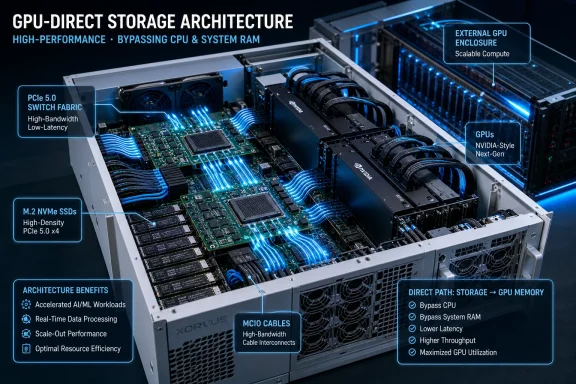
NVIDIA GPUDirect Storage, generally shortened to GDS, establishes a direct-memory-access path between supported storage and GPU memory. The objective is not to remove the CPU from every aspect of an application; the CPU still coordinates software, submits work, manages filesystems, and handles control-plane duties.Instead, GDS reduces unnecessary movement through a CPU-resident bounce buffer. This can lower latency, reduce CPU utilization, and increase sustainable throughput when applications ingest or write large quantities of data.
The physical PCIe topology remains critical. A software stack cannot create an ideal peer-to-peer path if the GPU and storage endpoints sit behind incompatible root ports, restrictive firmware settings, or a motherboard topology that forces transactions through the root complex.
The evolution from faster drives to better fabrics
Early NVMe deployments concentrated on replacing slower SATA and SAS storage. As individual NVMe drives became faster, administrators aggregated several devices through CPU-connected slots, risers, backplanes, and PCIe switch cards.PCIe 4.0 raised the practical throughput ceiling, while PCIe 5.0 doubled the signaling rate again. A PCIe 5.0 x16 link offers roughly 64GB/s of theoretical payload bandwidth in each direction before protocol and implementation overheads are considered, giving vendors enough headroom to connect multiple fast SSDs to one or more accelerators.
HighPoint’s new portfolio treats PCIe not merely as a set of expansion slots but as a composable local data fabric. That distinction explains why the announcement covers switch adapters, dense M.2 cards, cabled NVMe connectivity, external expansion bridges, and GPU enclosures rather than a single storage controller.
The Core Architecture
HighPoint has organized the portfolio around Broadcom PEX89048 PCIe 5.0 and PEX88048 PCIe 4.0 switch silicon. These devices can fan out an upstream PCIe connection into several downstream links while permitting compatible endpoints to exchange traffic through the switch.A PCIe switch is conceptually similar to a network switch, although the protocols, addressing, configuration, and topology rules differ substantially. It allows several devices to share an upstream connection and, under the right conditions, enables local peer-to-peer transactions that do not need to travel all the way to the CPU root complex.
Non-blocking does not mean unlimited
HighPoint describes the architecture as a non-blocking fabric, indicating that the switching layer is designed to avoid an internal bottleneck across its supported port configuration. That is important, but it does not mean every attached SSD can simultaneously run at its individual maximum without encountering another limit.The upstream link width, downstream lane allocation, SSD performance, GPU ingestion rate, filesystem, transfer size, queue depth, thermals, firmware, and software stack all influence delivered throughput. If eight high-end NVMe drives share one PCIe 5.0 x16 host link, for example, their combined benchmark results can exceed what that upstream connection can carry.
Local P2P paths change the calculation because not every transaction must consume upstream host bandwidth. Nevertheless, architects must map the expected traffic flows rather than treating the switch as a magical source of additional PCIe lanes.
Understanding the 64GB/s figure
The headline 64GB/s number corresponds closely to the usable design envelope associated with PCIe 5.0 x16. It represents a major advance over the approximately 32GB/s class associated with PCIe 4.0 x16, but real applications will not automatically sustain the headline rate.Small random transfers, metadata-heavy operations, fragmented files, insufficient concurrency, and software fallbacks can produce dramatically different results. HighPoint’s claim is therefore best understood as the maximum fabric class, not a guaranteed application result for every server and workload.
The more meaningful promise is that the hardware can provide enough switching capacity to avoid becoming the first bottleneck. Independent testing will still be needed to establish sustained read and write performance, tail latency, CPU utilization, and behavior under mixed workloads.
Two Deployment Topologies
HighPoint is offering two primary ways to build a storage-to-GPU path. One uses motherboard-connected compute and dense switched storage cards, while the other places the GPU and NVMe devices behind the same localized switch.These designs address different cost, compatibility, and isolation requirements. They also make the portfolio more flexible than a fixed appliance whose internal PCIe layout cannot be changed after purchase.
Motherboard CPU-routed storage feeders
The first topology is intended for systems where GPUs remain installed in the server’s onboard PCIe slots. HighPoint’s switched add-in cards and adapters aggregate several NVMe devices behind a shared fabric, presenting a high-density storage source to compute devices elsewhere under the appropriate CPU root complex.This design is likely to be the easier upgrade for existing servers. Administrators can retain their motherboard, processors, GPUs, and much of the chassis layout while adding denser NVMe connectivity.
Its performance remains more dependent on the server’s native PCIe map. Two physical slots that look identical from outside the chassis may connect to different CPUs, root ports, or switch branches, especially in dual-socket systems.
Hardware-localized compute and storage loops
The second topology places both the GPU and storage behind the same HighPoint switch adapter. Peer-to-peer traffic can then remain local to that switch instead of traversing the motherboard’s broader PCIe hierarchy.This arrangement can make performance more predictable because the crucial relationship between storage and accelerator is defined by the add-in infrastructure rather than by a server vendor’s slot wiring. It may also help integrators reproduce a validated configuration across several otherwise different white-box platforms.
The localized design should not be interpreted as universal immunity from virtualization and security controls. Device assignment, reset behavior, address translation, operating-system support, firmware configuration, and hypervisor policy can still affect whether the final system works correctly.
PCIe 5.0 Product Line
The PCIe 5.0 portfolio contains both cards with onboard M.2 slots and adapters that expose cabled connections. This division lets customers choose between maximum density inside an add-in card and more serviceable storage mounted in a backplane or enclosure.Rocket 1608A and Rocket 1604A
The Rocket 1608A provides eight onboard M.2 slots, while the Rocket 1604A provides four. Both use PCIe switching rather than depending solely on motherboard bifurcation, which can simplify deployment in systems whose firmware does not offer every desired lane-splitting mode.An eight-drive M.2 card could package a substantial amount of flash capacity into one x16 slot. It also concentrates power and heat in a small area, so chassis airflow becomes a first-class design concern rather than an installation detail.
Sustained AI data loading can keep all drives active for extended periods. Integrators should test drive temperatures, switch-chip cooling, fan behavior, and throttling under continuous workloads instead of relying only on short synthetic benchmarks.
Rocket 1628A and Rocket 1624A
The Rocket 1628A exposes four internal MCIO 8i ports, while the Rocket 1624A supplies four internal MCIO 4i connections. MCIO provides a compact cabled interface for high-speed PCIe lanes and gives builders more freedom to place storage backplanes or other endpoints elsewhere in the chassis.HighPoint positions the Rocket 1628A as a particularly flexible component. Two of its MCIO ports can reportedly be aggregated through the company’s MCIO-to-PCIe x16 Gen5 bridge to provide a full-width GPU connection, while the remaining ports feed as many as 16 NVMe devices through a compatible backplane.
That design effectively turns one host slot into a localized compute-and-storage domain. It is an appealing proposition for dense edge servers, but cabling quality, signal integrity, connector retention, airflow, and auxiliary GPU power must all be handled carefully.
PCIe 4.0 Remains Relevant
The announcement does not abandon PCIe 4.0. HighPoint is retaining a substantial Gen4 range for customers whose servers, GPUs, or storage devices cannot benefit from Gen5 or whose workloads do not justify its added cost.PCIe 4.0 x16 still supplies approximately 32GB/s of theoretical one-way bandwidth. That is enough to support several fast NVMe drives and many inference, media, analytics, and data-logging workloads.
High-density M.2 options
The SSD7749M2 accommodates 16 M.2 devices, making it the portfolio’s density-oriented option. The SSD7749M supports eight M.2 drives, while the Rocket 1508 and Rocket 1504 provide eight- and four-slot configurations respectively.Sixteen M.2 drives on one card can deliver exceptional capacity per slot, but density has operational consequences. Replacing an individual device may require opening the chassis and removing the whole card, and a cooling problem can affect several drives simultaneously.
For archival tiers, checkpoint repositories, large embedding sets, and read-heavy inference data, capacity may matter more than peak Gen5 speed. The Gen4 cards could therefore offer a better price-to-performance balance than the newest hardware.
Cabled and external Gen4 storage
The Rocket 1528D uses four internal SlimSAS 8i connections, supporting cabled storage layouts rather than onboard drives. HighPoint also lists the eight-bay RocketStor 6542AW for U.2 and U.3 media and the four-bay RocketStor 6541AW for M.2 or U.2 configurations.U.2 and U.3 drives are often easier to cool and service than tightly packed M.2 modules. Enterprise models may also offer stronger endurance, power-loss protection, telemetry, and predictable sustained performance.
The choice between M.2 and enterprise drive formats is therefore not simply about physical size. Builders should evaluate write endurance, failure replacement, hot-service requirements, thermal behavior, firmware qualification, and the cost of downtime.
External GPU and Composable Expansion
HighPoint’s Rocket 7638D and Rocket 7634D adapters extend the concept beyond an internal server card. They use external CopprLink connectivity to route PCIe 5.0 lanes between a host and an expansion chassis.The associated RocketStor 8631 series is designed to accommodate full-sized PCIe GPUs, including wide dual-slot and triple-slot models. External GPU placement can solve mechanical and thermal problems that become difficult inside compact or storage-heavy servers.
Why external PCIe matters
Conventional servers have finite slot spacing, power connectors, and airflow. A modern accelerator can occupy several slots even though it electrically uses only one x16 interface, potentially blocking storage, networking, or accelerator expansion.An external enclosure separates the endpoint from the host chassis while preserving native PCIe connectivity. This is different from attaching storage over Ethernet or Fibre Channel because the remote chassis remains part of the PCIe hierarchy.
The approach can help an integrator create modular building blocks: a server for CPU and memory, a storage shelf for NVMe capacity, and an accelerator enclosure for GPUs. Components may then be upgraded independently, subject to compatibility and cable-distance restrictions.
Cabling is part of the system
External PCIe 5.0 is demanding. The connection must sustain very high signaling rates while maintaining signal integrity, and the entire path depends on qualified cables, connectors, adapters, retimers where necessary, and correct clocking.A loose or marginal connection is not merely a performance problem. It can produce link retraining, reduced lane width, corrected errors, intermittent device loss, or instability that appears only during sustained traffic.
System integrators will need validated bills of materials rather than a mix-and-match approach. HighPoint’s value will depend partly on how well it documents cable support, topology limits, enclosure interoperability, diagnostics, and field-service procedures.
Implications for AI Inference
Training receives much of the attention in AI infrastructure, but inference is where many organizations encounter less predictable data movement. Retrieval-augmented generation, multimodal processing, recommendation systems, and large-scale embedding searches can repeatedly fetch information that does not fit in GPU memory.GDS cannot make an SSD behave like high-bandwidth GPU memory. It can, however, reduce avoidable overhead when information must move between storage and accelerator memory.
Keeping accelerators supplied with data
An inference pipeline may combine model weights, key-value cache data, vector indexes, media assets, and user-specific context. If the working set exceeds accelerator memory, storage performance and software scheduling become important to response time and throughput.A localized PCIe fabric can allow several NVMe devices to serve one GPU at high speed. Properly implemented asynchronous reads, batching, parallel queues, and double-buffering can overlap storage operations with GPU computation.
The result is not necessarily a dramatic improvement for every model. Workloads that are predominantly compute-bound, or whose active data already resides in GPU memory, will see less benefit than storage-intensive pipelines.
Model loading and checkpoint movement
Faster storage paths could shorten model startup, replacement, and recovery times. This matters for cloud operators that frequently load different models onto shared accelerators or need to restore services after maintenance.Large model files may be sharded across several NVMe devices to increase parallelism. Yet RAID layout, filesystem support, GDS compatibility, and failure behavior must be validated because not every logical storage configuration receives the same peer-to-peer treatment.
Operators should benchmark complete workflows rather than measuring only raw block throughput. Time to first inference, model-switch latency, requests per second, and accelerator utilization provide a more useful view of business impact.
Edge Processing and Autonomous Data Logging
HighPoint also targets autonomous data logging and real-time edge processing. These applications combine high-rate data capture with local analysis, often under strict space, power, connectivity, or latency constraints.Robotics, industrial inspection, scientific instruments, transportation systems, and video analytics can generate more information than a remote connection can reliably carry. Processing data close to its source reduces dependence on a wide-area network.
Capturing and analyzing simultaneously
An edge node may need to write incoming sensor data while reading earlier samples into a GPU for analysis. A switched storage fabric can support these concurrent paths more effectively than a design in which all traffic competes for a narrow CPU-connected route.The topology could be particularly useful where several cameras, acquisition cards, NVMe devices, and accelerators must coexist. HighPoint says its matrices can mix standard storage with M.2, E1.S, U.2, U.3, and compatible accelerator modules.
Real-time behavior depends on more than average throughput. Engineers must measure worst-case latency, queue contention, error recovery, garbage-collection pauses inside SSDs, and thermal throttling.
Ruggedization remains separate
A high-performance PCIe card does not automatically make a system suitable for harsh environments. Vibration, shock, dust, temperature range, redundant power, cable retention, and remote manageability remain system-level responsibilities.M.2 devices can be attractive where space is scarce, but their connectors and thermal characteristics may require additional mechanical support. External enclosures add modularity while introducing cables and connectors that must be secured.
HighPoint’s portfolio gives integrators more topology choices, but the integrator still owns the engineering needed to convert commercial components into a dependable edge appliance.
Enterprise and Cloud Impact
The strongest commercial argument is not that HighPoint has invented peer-to-peer PCIe. Large server and storage vendors have offered switched accelerator architectures for years.The important change is accessibility. A system builder may be able to add a predefined switched topology to a standard server without buying a motherboard whose PCIe fabric was designed specifically around one accelerator configuration.
Opportunities for MSPs and regional clouds
Regional providers rarely have hyperscaler-level hardware engineering teams. They need repeatable systems that can be assembled, serviced, and expanded without an extensive custom motherboard program.HighPoint’s cards could help these providers offer GPU-backed storage services, private AI inference, media processing, or data-local analytics. A modular design also allows providers to start with a smaller GPU and storage pool before increasing capacity.
The operational economics will determine adoption. Hardware cost must be weighed against higher GPU utilization, lower CPU overhead, deployment labor, support complexity, and the ability to use less expensive white-box servers.
Enterprise deployment considerations
Enterprises may value the ability to install an isolated accelerator-storage domain inside an approved server platform. This could accelerate departmental AI projects where procuring a complete integrated appliance would take longer or exceed the available budget.On the other hand, integrated OEM systems usually provide a single support boundary. A white-box design can involve separate vendors for the motherboard, BIOS, GPU, switch card, SSDs, cables, backplane, operating system, and GDS software.
Procurement savings can be erased by troubleshooting costs if the configuration is not carefully qualified. HighPoint and its channel partners will need to supply validated reference designs, compatibility matrices, firmware guidance, and clear escalation procedures.
Windows and Software Compatibility
WindowsForum readers should note an important distinction: this is PCIe hardware that can operate in many computer platforms, but NVIDIA GPUDirect Storage is primarily associated with supported Linux and CUDA data-center environments. Installing one of these cards in a Windows workstation does not automatically provide a GDS path.Windows users may still benefit from HighPoint’s switched NVMe density, PCIe expansion, and external enclosure capabilities. The storage cards can address workstation use cases such as video production, simulation, content creation, local databases, and large scratch volumes, depending on available drivers and product support.
Hardware capability versus end-to-end support
A successful GDS installation requires more than a compatible switch. The GPU, NVIDIA driver, CUDA and cuFile components, kernel, filesystem, storage path, device driver, firmware, and PCIe topology must all cooperate.Recent Linux developments have expanded use of the kernel’s PCI peer-to-peer DMA infrastructure, but support remains configuration-dependent. Features such as NVMe multipathing, software RAID, virtualization, and particular filesystems may introduce limitations or require specialized validation.
Administrators should not assume that a device appearing in the operating system means the optimized path is active. GDS diagnostic tools, topology inspection, application-level benchmarks, and CPU-usage measurements are needed to confirm the system is avoiding a fallback route.
ACS, IOMMU, and security trade-offs
PCIe Access Control Services can force peer-to-peer transactions toward the root complex, while the IOMMU provides address translation and device isolation. Disabling such mechanisms may improve performance in some bare-metal GDS configurations, but it can also weaken isolation or conflict with virtualization requirements.HighPoint argues that placing the endpoints behind one localized switch avoids common motherboard-routed restrictions. That is plausible at the traffic-topology level, but administrators must still evaluate the security model of the complete platform.
A configuration that is suitable for a dedicated bare-metal appliance may be inappropriate for an untrusted multi-tenant cloud. Performance tuning should never be reduced to blindly disabling firmware security features.
Deployment and Validation
Building a reliable GDS node requires a methodical process. The topology should be designed before hardware is purchased, not reconstructed after the server has been populated.A practical qualification sequence
- Map the server’s PCIe topology. Identify CPU sockets, root ports, slot widths, switch branches, NUMA relationships, and any lanes shared with networking or onboard devices.
- Define the intended data path. Determine which NVMe devices will supply which GPU and whether traffic should remain behind a HighPoint switch.
- Verify the software matrix. Confirm operating-system, kernel, NVIDIA driver, CUDA, cuFile, filesystem, NVMe, and virtualization support.
- Validate every physical component. Use qualified MCIO, SlimSAS, CopprLink, backplane, power, and cooling components for the required generation and lane count.
- Confirm negotiated links. Check that every GPU, SSD, bridge, and switch port runs at the expected PCIe generation and width.
- Test the optimized and fallback paths. Compare GDS-enabled operation with conventional buffered I/O while monitoring CPU load, memory traffic, latency, and throughput.
- Run sustained fault-oriented testing. Include thermal soak, drive failure, cable disturbance, reset, reboot, firmware update, and mixed read-write workloads.
Metrics that reveal the real outcome
Sequential bandwidth is useful but incomplete. Teams should measure tail latency, GPU utilization, CPU consumption, host-memory bandwidth, PCIe replay counters, SSD temperature, power draw, and performance consistency over time.AI operators should add workload-specific metrics such as time to load a model, tokens per second, batch completion time, request latency, and recovery duration. Edge users should include dropped-frame rates, acquisition jitter, write endurance, and behavior during network interruption.
A successful design is one that improves the application while staying supportable. If the optimized path adds excessive fragility, its headline bandwidth may not justify the operational burden.
Competitive Implications
HighPoint enters a field that includes integrated GPU servers, proprietary accelerator platforms, enterprise NVMe arrays, composable infrastructure vendors, and other PCIe expansion specialists. Its competitive angle is modularity combined with conventional server compatibility.White-box flexibility versus integrated appliances
Integrated systems offer validated thermals, firmware, management, service contracts, and known accelerator topologies. They remain attractive for organizations that value predictable deployment more than component-level freedom.HighPoint’s approach gives builders control over GPU choice, storage media, capacity, chassis, and replacement cycles. It could be substantially more economical when an organization already owns compatible servers or needs an unusual balance of storage and compute.
The trade-off resembles the broader distinction between building a custom workstation and buying an engineered appliance. Component savings are real, but so is the value of integration.
Pressure on server design
If add-in switch fabrics become easier to deploy, motherboard slot topology may become less decisive for certain workloads. A localized adapter could provide a consistent accelerator-storage relationship across several server models.This will not make motherboard engineering irrelevant. The host still needs sufficient power, cooling, mechanical space, upstream lanes, BIOS resources, and device enumeration capacity.
It could, however, encourage a more composable market in which server slots connect to self-contained PCIe domains. Such a shift would benefit specialized infrastructure vendors while giving customers more leverage over system configuration.
Strengths and Opportunities
HighPoint’s portfolio addresses a genuine infrastructure problem and does so with a broad set of form factors rather than one narrowly defined appliance.- The localized switch topology can provide a shorter and more predictable path between NVMe storage and a GPU.
- PCIe 5.0 x16 supplies enough fabric bandwidth to aggregate several fast drives without immediately constraining them to Gen4-class throughput.
- Onboard M.2 cards maximize storage density in servers with limited bays or cabling space.
- MCIO and external CopprLink options support more serviceable, modular, and mechanically flexible designs.
- Continued PCIe 4.0 support gives budget-conscious buyers a practical alternative where Gen5 is unnecessary.
- White-box compatibility could lower the entry cost for private AI, regional cloud, research, and edge deployments.
- A localized fabric may help integrators reproduce a validated topology across different host platforms.
- Reduced host-memory staging can free CPU and DRAM resources for application logic and orchestration.
Risks and Concerns
The announcement also raises questions that specifications and topology diagrams alone cannot answer.- The 64GB/s headline must be validated under sustained application workloads, not only ideal sequential transfers.
- Dense M.2 configurations may encounter cooling, throttling, and serviceability challenges.
- GDS compatibility depends on the complete software stack, so hardware installation alone does not guarantee direct transfers.
- ACS and IOMMU tuning can create security or virtualization trade-offs that are unacceptable in multi-tenant environments.
- External PCIe 5.0 cabling increases the importance of signal integrity, connector quality, diagnostics, and qualified components.
- White-box systems can distribute support responsibility across too many vendors.
- RAID, multipathing, filesystems, containers, and hypervisors may alter or disable the intended peer-to-peer route.
- A failure in a shared switch card can affect several drives and an attached accelerator at once.
- Windows customers must distinguish general PCIe and NVMe functionality from Linux-focused NVIDIA GDS support.
What to Watch Next
Independent benchmarks will be the first major test. Reviewers should compare the new cards with direct motherboard attachment, conventional buffered storage, established GDS servers, and competing PCIe switch platforms.Tests should include several transfer sizes, queue depths, filesystems, GPU models, SSD types, and mixed workloads. Results from one carefully chosen sequential-read test will not reveal how the fabric behaves during real inference, checkpointing, or simultaneous capture and analysis.
Availability, pricing, and support
HighPoint has described a comprehensive product matrix, but practical adoption will depend on pricing, regional availability, warranty terms, and access to compatible bridge cards, cables, backplanes, and enclosures. A reasonably priced adapter can become an expensive project if the remaining components are scarce or require custom integration.Driver and firmware maintenance will be equally important. PCIe switching products live at the intersection of motherboard firmware, endpoint behavior, operating-system enumeration, and accelerator software, so long-term update discipline matters.
Buyers should also watch for published compatibility lists covering specific NVIDIA GPUs, server platforms, kernels, hypervisors, and SSD families. Reference configurations would make the portfolio far more approachable to smaller providers.
Evidence of production readiness
The most convincing proof will come from repeatable deployments outside HighPoint’s laboratory. Case studies from cloud providers, AI integrators, scientific facilities, media studios, or industrial edge operators would demonstrate that the architecture can survive continuous production use.Management capabilities deserve scrutiny as well. Enterprise operators need health monitoring, temperature data, firmware inventory, error reporting, link-status visibility, and integration with their existing observability tools.
If HighPoint can pair its hardware flexibility with strong qualification and management, the portfolio could occupy a valuable space between do-it-yourself expansion cards and closed, premium-priced AI appliances.
HighPoint’s PCIe 5.0 P2P and GPUDirect Storage lineup reflects a broader shift in AI system design: raw accelerator speed is no longer enough when data cannot reach the GPU efficiently. By combining dense NVMe storage, localized PCIe switching, cabled expansion, and external accelerator support, the company is giving white-box builders more control over the path that increasingly defines real-world performance. The technology will still demand careful topology planning, Linux and GDS expertise, robust cooling, security-aware configuration, and rigorous validation, but it could make high-bandwidth storage-to-GPU architectures accessible to organizations that have previously been priced out of them.