

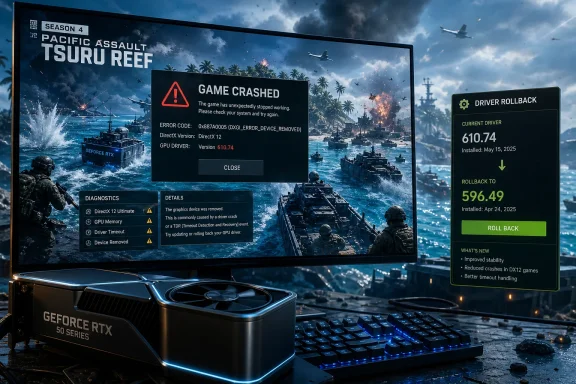
Battlefield 6’s ambitious Season 4 launch has run into an immediate technical problem on PC, with players reporting GPU driver crashes on maps containing large bodies of water—most notably the new Tsuru Reef battlefield. EA and DICE say reports are concentrated among GeForce RTX 50 Series owners using Nvidia’s GeForce Game Ready 610.74 WHQL driver, although not every system is affected and some older GeForce cards may also encounter the failure. While the developers work with Nvidia to identify a permanent solution, the official recommendation for repeatedly affected players is to roll back to driver 596.49, turning what should have been a showcase for Battlefield’s renewed naval warfare into another reminder that major game patches and graphics-driver updates can form a volatile combination.
Battlefield 6 entered Season 4 on July 21, 2026, with Game Update 1.4.1.0 and a substantial package of maps, vehicles, weapons, systems, and balance changes. Marketed as a major expansion of the game’s combined-arms formula, the season shifts attention toward naval warfare without isolating it from infantry, armor, and aircraft combat.
The centerpiece is Tsuru Reef, an expansive Pacific island chain built around a former luxury resort. EA describes it as larger than Railway to Golmud, giving squads room to move between beaches, islands, structures, open water, and vehicle-focused combat spaces.
Tsuru Reef adds another demanding layer: large expanses of dynamically rendered water. Season 4’s water system includes wave behavior intended to make the ocean an active part of the battlefield rather than a flat surface separating infantry areas.
That distinction matters because water rendering can involve reflection data, refraction, geometry displacement, foam simulation, post-processing, changing surface normals, and interaction with vehicles. A failure triggered predominantly on water-heavy maps therefore gives engineers a useful clue, even though it does not prove that the new wave simulation itself is responsible.
Such a message does not automatically identify the guilty component. Windows may report a graphics-driver reset after the game submits an invalid workload, the driver mishandles a legal command, the GPU becomes unstable, or a rendering operation takes too long to complete.
Season 4’s incident is noteworthy because EA has acknowledged a recognizable pattern. The combination of specific maps, Nvidia hardware, and the newer driver branch points toward a compatibility problem rather than a random collection of unrelated PC failures.
The wording is deliberately cautious. EA has not said that every RTX 50 Series card is defective, that driver 610.74 always crashes, or that Tsuru Reef is the only affected map.
There are also isolated reports involving older Nvidia hardware. These accounts suggest that RTX 50 Series concentration should not be interpreted as an absolute hardware boundary, especially while engineers are still collecting data.
The common factors under investigation are:
That uncertainty is important. The final remedy could arrive as a Battlefield client update, an Nvidia hotfix driver, a remotely distributed game profile, a server-side mitigation, or a combination of changes.
Driver 610.74 is associated with many of the new crash reports, while rolling back to version 596.49 has resolved or reduced the problem for a meaningful number of players. That correlation is strong enough for EA to recommend the older release as a temporary workaround.
A game can operate correctly under one branch and expose a failure under another even if neither component changed in an obviously relevant way. Season 4 may simply be submitting a workload that the previous Battlefield build rarely or never generated.
That workload could expose:
Modern graphics drivers are enormous software platforms. They support multiple graphics APIs, video encoding and decoding, machine-learning features, display pipelines, power states, content-creation applications, and years of GPU architectures.
A Battlefield-specific regression can consequently survive general validation. It may only become visible when thousands of players simultaneously access a newly released map under real-world conditions.
This creates a rendering workload that differs substantially from an urban or inland battlefield. The GPU may need to process water across much of the visible scene while also handling distant islands, vegetation, smoke, explosions, vehicles, and reflections.
Large water surfaces also remain visible across long distances. Unlike an interior wall that disappears after the player turns a corner, an ocean may occupy a significant portion of the frame for extended periods.
Season 4’s new wave behavior could influence several GPU workloads:
Graphics settings also matter. One user may enable DLSS, frame generation, ray tracing, and maximum texture quality, while another uses native rendering and lower settings. Both can report “driver 610.74 on an RTX 5080” while producing significantly different rendering workloads.
This variability is why anecdotal fixes must be handled cautiously. Disabling a feature may reduce the likelihood of a crash without identifying or eliminating the underlying defect.
If Windows determines that the GPU is no longer completing work within the expected period, it can reset the graphics driver. The game relying on that graphics context then usually crashes because its device and allocated resources are no longer valid.
The same message can result from very different causes:
A longer timeout may turn a quick crash into an extended freeze. It can also complicate diagnosis by masking the point at which the driver stops responding.
For this incident, the official rollback is a more defensible first step. Players should avoid making speculative system-level changes unless they understand the consequences and can reverse them.
The rollback should be treated as a temporary compatibility measure. Driver 596.49 may lack optimizations or fixes delivered in later releases, so users should reassess the situation after EA or Nvidia announces a permanent correction.
Windows Update can also install graphics drivers under some configurations. Checking the active version after a reboot is therefore more reliable than assuming the rollback remained in place.
Some users have reported continued failures on the older driver, while others say the rollback restored stable play. Those mixed outcomes may represent multiple crash causes that produce similar DirectX messages.
A useful baseline includes:
Players should also record:
Tsuru Reef supports combat across land, sea, and air, while additional marine vehicles and systems reshape how squads approach objectives. The season also introduces new weapons and expands Portal and REDSEC content.
Tsuru Reef appears designed around that principle. Its islands can funnel infantry into dense fights, while open approaches give naval and aerial players room to influence the broader match.
The new wave system is important because it can change visibility, vehicle movement, targeting, and the visual character of engagements. If successful, it makes water feel like terrain rather than empty blue space.
The Battlefield 6 interpretation is being adapted for modern scale and naval warfare while retaining the map’s recognizable identity. Carrier-based headquarters and expanded naval engagements should make the surrounding ocean more strategically relevant than in versions where the island’s distinctive shape dominated nearly every encounter.
That future release raises the stakes of the current investigation. If the fault is genuinely linked to large water surfaces or related rendering features, it must be corrected before another heavily anticipated naval map reaches the live game.
An RTX 50 Series owner may have invested heavily in a system specifically to run demanding games with high settings, DLSS, and frame generation. Being told to use an older driver—or disable flagship features—undercuts the expected premium experience.
Crashes also impose indirect costs. They can interrupt progression, invalidate match time, separate friends, and create uncertainty about whether ranked or competitive play is safe.
The immediate consumer concerns include:
Clear distinctions help prevent wasted effort. A crash affecting one newly updated game on specific maps is not equivalent to a PC that artifacts or resets across multiple applications and stress tests.
If instability appears in many games, during desktop use, or under basic GPU testing, users should investigate broader system health. The Season 4 issue should not become an excuse to dismiss unrelated hardware or power problems.
Changing the display driver to solve one game may alter performance or compatibility elsewhere. Users should consider the whole machine rather than treating the GPU as a Battlefield-only component.
Possible alternatives include waiting for a fix, playing unaffected maps, disabling suspected features, or using a separate Windows installation for testing. None is as convenient as a stable current driver, but mixed-use systems require a different risk calculation from dedicated gaming PCs.
IT administrators overseeing gaming lounges, esports facilities, test labs, or shared workstations should validate the rollback on a small group before deploying it broadly. They should also retain installation packages and document a path back to the organization’s approved version.
Organizations should monitor both EA and Nvidia for updated guidance. Once a corrected release is available and validated, affected systems should return to a supported current branch rather than remaining indefinitely on the workaround.
EA faces an equally significant reputational challenge. Battlefield’s PC audience has endured technically uneven launches and recurring concerns about Frostbite stability, shader compilation, CPU performance, and DirectX errors across the franchise.
The practical question for players is not which company wins the blame argument. It is whether EA and Nvidia can reproduce the fault quickly, identify the failing path, and deliver a fix without introducing another regression.
Cooperation offers several possible remedies:
Still, a high-profile problem concentrated on Nvidia’s newest generation gives AMD and Intel a temporary marketing opportunity. Driver reliability is part of GPU value, particularly when raw performance differences are small or premium prices are difficult to justify.
The advantage will remain limited if Nvidia and EA resolve the issue quickly. If the problem persists into Wake Island’s release, however, it could become a broader narrative about RTX 50 Series compatibility rather than a short-lived Season 4 launch defect.
The distinction may never be fully disclosed. Vendors often describe game-driver fixes in broad terms without publishing the exact failing command sequence or implementation detail.
Once a documented fix appears, players should remove temporary workarounds gradually. They can install the corrected driver, retain stock GPU settings, test Tsuru Reef, and only then restore overlays, tuning profiles, or optional rendering features.
Battlefield 6 Season 4 is attempting something the series does particularly well: merging infantry, armor, aircraft, and naval vehicles into a battlefield where no single environment feels separate from the war around it. Tsuru Reef’s crashes have compromised that achievement for part of the GeForce audience, but the available evidence still points toward a resolvable software interaction rather than a fundamental defect in RTX 50 Series hardware. If EA, DICE, and Nvidia can turn the current rollback advice into a verified game or driver fix before Wake Island arrives, Season 4 may yet be remembered for restoring naval warfare instead of leaving premium Windows gaming PCs stranded at the shoreline.
 Background
Battlefield 6 entered Season 4 on July 21, 2026, with Game Update 1.4.1.0 and a substantial package of maps, vehicles, weapons, systems, and balance changes. Marketed as a major expansion of the game’s combined-arms formula, the season shifts attention toward naval warfare without isolating it from infantry, armor, and aircraft combat.The centerpiece is Tsuru Reef, an expansive Pacific island chain built around a former luxury resort. EA describes it as larger than Railway to Golmud, giving squads room to move between beaches, islands, structures, open water, and vehicle-focused combat spaces.
A technically demanding expansion
Large-scale Battlefield maps have always placed unusual pressure on PC hardware. The engine must simultaneously manage distant terrain, destruction, networking, physics, vehicles, particle effects, complex lighting, and dozens of players whose actions cannot be predicted or fully precomputed.Tsuru Reef adds another demanding layer: large expanses of dynamically rendered water. Season 4’s water system includes wave behavior intended to make the ocean an active part of the battlefield rather than a flat surface separating infantry areas.
That distinction matters because water rendering can involve reflection data, refraction, geometry displacement, foam simulation, post-processing, changing surface normals, and interaction with vehicles. A failure triggered predominantly on water-heavy maps therefore gives engineers a useful clue, even though it does not prove that the new wave simulation itself is responsible.
The shadow of earlier Frostbite errors
Battlefield players are familiar with DirectX failures carrying messages such asDXGI_ERROR_DEVICE_HUNG or warnings that the GPU stopped responding to commands. These errors have appeared across different games, drivers, GPU generations, and Frostbite releases over the years.Such a message does not automatically identify the guilty component. Windows may report a graphics-driver reset after the game submits an invalid workload, the driver mishandles a legal command, the GPU becomes unstable, or a rendering operation takes too long to complete.
Season 4’s incident is noteworthy because EA has acknowledged a recognizable pattern. The combination of specific maps, Nvidia hardware, and the newer driver branch points toward a compatibility problem rather than a random collection of unrelated PC failures.
What EA and DICE Have Confirmed
The official Battlefield communications team says it is investigating GPU driver crashes on PC when players load maps with large bodies of water, including Tsuru Reef. Current telemetry reportedly indicates that Nvidia GPUs account for the affected population, with reports more heavily concentrated on GeForce RTX 50 Series products.The wording is deliberately cautious. EA has not said that every RTX 50 Series card is defective, that driver 610.74 always crashes, or that Tsuru Reef is the only affected map.
The affected configurations
Player reports cover several RTX 50 Series models, including systems built around the GeForce RTX 5070 Ti, RTX 5080, and RTX 5090. Some owners can complete matches normally, while others crash after a few minutes or fail repeatedly on the new map.There are also isolated reports involving older Nvidia hardware. These accounts suggest that RTX 50 Series concentration should not be interpreted as an absolute hardware boundary, especially while engineers are still collecting data.
The common factors under investigation are:
- The crashes occur primarily on PC systems using Nvidia graphics hardware.
- Reports are concentrated among GeForce RTX 50 Series owners.
- Maps containing substantial bodies of water appear more likely to trigger the fault.
- Tsuru Reef is the most visible problem area because it is new, heavily populated, and built around ocean combat.
- GeForce Game Ready driver 610.74 appears frequently in affected configurations.
- Not every player using the same GPU and driver experiences a crash.
What remains unknown
EA has not publicly assigned responsibility to DICE, Nvidia, Frostbite, or any individual graphics feature. It has also not announced a delivery date for a hotfix.That uncertainty is important. The final remedy could arrive as a Battlefield client update, an Nvidia hotfix driver, a remotely distributed game profile, a server-side mitigation, or a combination of changes.
Why Driver 610.74 Is Under Scrutiny
Nvidia’s Game Ready drivers are designed to add game-specific profiles, optimizations, compatibility changes, and support for new releases. The “Game Ready” label does not mean every possible hardware and software configuration has been exhaustively tested, particularly for a live-service game receiving large updates after a driver has already been finalized.Driver 610.74 is associated with many of the new crash reports, while rolling back to version 596.49 has resolved or reduced the problem for a meaningful number of players. That correlation is strong enough for EA to recommend the older release as a temporary workaround.
A branch-level compatibility change
The large jump from the 596 series to the 610 series may reflect broader internal driver changes rather than a simple collection of game profiles. A new branch can alter shader compilation, memory management, scheduling, frame generation, presentation behavior, power handling, or how the driver validates commands from DirectX 12 applications.A game can operate correctly under one branch and expose a failure under another even if neither component changed in an obviously relevant way. Season 4 may simply be submitting a workload that the previous Battlefield build rarely or never generated.
That workload could expose:
- A latent bug in Battlefield’s renderer.
- A regression in Nvidia’s driver.
- An incorrect assumption shared by the game and driver.
- A shader-compilation or cache problem.
- A resource-lifetime error that appears under heavy memory pressure.
- A timing-sensitive fault affected by frame generation or low-latency features.
- A map-specific interaction involving water, reflections, or vehicle effects.
WHQL is not a guarantee of game stability
The WHQL designation means the driver passed Microsoft’s applicable certification process. It does not guarantee that every game, map, graphics setting, GPU, motherboard, Windows build, and background application will work perfectly.Modern graphics drivers are enormous software platforms. They support multiple graphics APIs, video encoding and decoding, machine-learning features, display pipelines, power states, content-creation applications, and years of GPU architectures.
A Battlefield-specific regression can consequently survive general validation. It may only become visible when thousands of players simultaneously access a newly released map under real-world conditions.
Why Tsuru Reef May Be the Trigger
Tsuru Reef is more than a large land map surrounded by decorative ocean. Its layout integrates boats, aircraft, armor, infantry routes, shore assaults, and moving water into the central gameplay loop.This creates a rendering workload that differs substantially from an urban or inland battlefield. The GPU may need to process water across much of the visible scene while also handling distant islands, vegetation, smoke, explosions, vehicles, and reflections.
Water as a rendering stressor
Real-time water is typically assembled from multiple techniques rather than a single simulation. A game may combine animated geometry, normal maps, screen-space reflections, depth information, transparency, refraction, foam, spray, and environment probes.Large water surfaces also remain visible across long distances. Unlike an interior wall that disappears after the player turns a corner, an ocean may occupy a significant portion of the frame for extended periods.
Season 4’s new wave behavior could influence several GPU workloads:
- Geometry and tessellation demands may rise as the surface changes shape.
- Compute shaders may update wave or interaction data.
- Reflection passes may process a wider and more complex scene.
- Naval vehicles may generate wakes, foam, spray, and additional particles.
- Changing visibility may increase resource streaming across islands.
- Aircraft viewpoints may expose unusually large sections of the map at once.
Why some users remain unaffected
Two ostensibly identical gaming PCs are rarely identical in practice. Different BIOS versions, Windows updates, memory configurations, factory GPU overclocks, overlays, power limits, display arrangements, and background monitoring tools can all change timing or memory behavior.Graphics settings also matter. One user may enable DLSS, frame generation, ray tracing, and maximum texture quality, while another uses native rendering and lower settings. Both can report “driver 610.74 on an RTX 5080” while producing significantly different rendering workloads.
This variability is why anecdotal fixes must be handled cautiously. Disabling a feature may reduce the likelihood of a crash without identifying or eliminating the underlying defect.
Understanding the Windows GPU Crash
When Battlefield reports that the GPU will not respond to more commands, Windows is usually reacting to a stalled or failed graphics workload. The operating system includes a mechanism called Timeout Detection and Recovery, commonly abbreviated to TDR, which attempts to prevent a hung graphics task from freezing the entire computer indefinitely.If Windows determines that the GPU is no longer completing work within the expected period, it can reset the graphics driver. The game relying on that graphics context then usually crashes because its device and allocated resources are no longer valid.
Device hung does not mean dead hardware
ADXGI_ERROR_DEVICE_HUNG message sounds alarming, but it does not by itself mean that the graphics card has suffered physical damage. It is a software-visible state indicating that the GPU or driver stopped processing the submitted work as expected.The same message can result from very different causes:
- The game submitted malformed or internally inconsistent commands.
- A driver bug mishandled a valid DirectX operation.
- A shader entered an unexpectedly expensive execution path.
- A factory or manual overclock became unstable under a particular workload.
- VRAM corruption or system-memory instability damaged graphics data.
- An overlay or monitoring utility interfered with presentation or injection.
- Windows reset the driver after a workload exceeded the timeout threshold.
Why registry “fixes” are risky
Some PC troubleshooting guides recommend increasing the Windows TDR delay through the Registry. This can make Windows wait longer before resetting an apparently stalled GPU, but it does not necessarily correct the condition that caused the stall.A longer timeout may turn a quick crash into an extended freeze. It can also complicate diagnosis by masking the point at which the driver stops responding.
For this incident, the official rollback is a more defensible first step. Players should avoid making speculative system-level changes unless they understand the consequences and can reverse them.
How to Roll Back Safely
EA’s recommended workaround is to replace GeForce Game Ready 610.74 with driver 596.49. Before proceeding, players should confirm their current version through the Nvidia app, Nvidia Control Panel system information page, Device Manager, or Windows’ installed-app records.The rollback should be treated as a temporary compatibility measure. Driver 596.49 may lack optimizations or fixes delivered in later releases, so users should reassess the situation after EA or Nvidia announces a permanent correction.
Recommended rollback sequence
- Download the correct 596.49 package for the installed GeForce GPU and Windows edition. Confirm whether the machine is a desktop or notebook because laptop packages and manufacturer requirements can differ.
- Close Battlefield 6, game launchers, recording utilities, monitoring overlays, and GPU-tuning applications. This reduces the chance of a running process interfering with driver replacement.
- Create a Windows restore point or record the current configuration. A restore point is not a substitute for a proper backup, but it provides another recovery option if the installation behaves unexpectedly.
- Run the 596.49 installer and select the clean-installation option when available. This resets driver profiles and can remove settings carried over from the newer branch.
- Restart Windows even if the installer does not appear to require it. A reboot helps ensure that old driver modules are no longer resident.
- Verify that Windows is actually using 596.49 before launching the game. Automatic driver delivery or an incomplete installation can leave a different version active.
- Test Battlefield without restoring overclocks, custom profiles, or third-party overlays. Establishing a clean baseline makes the result more useful.
Preventing an immediate reinstallation
The Nvidia app may offer the newer driver again after the rollback. Players should avoid accepting that update until Battlefield’s support channels indicate that the problem has been resolved.Windows Update can also install graphics drivers under some configurations. Checking the active version after a reboot is therefore more reliable than assuming the rollback remained in place.
What to Try If 596.49 Still Crashes
EA explicitly asks players to report cases that continue after the rollback. That request indicates that version 596.49 is a mitigation rather than a universal cure.Some users have reported continued failures on the older driver, while others say the rollback restored stable play. Those mixed outcomes may represent multiple crash causes that produce similar DirectX messages.
Establish a controlled baseline
Players should remove avoidable variables before concluding that the rollback failed. The objective is not to spend hours applying random tweaks, but to create a reproducible test configuration.A useful baseline includes:
- Return the GPU and VRAM to stock frequencies, including removal of factory-overclock enhancements where practical.
- Disable MSI Afterburner, RivaTuner Statistics Server, capture hooks, and nonessential overlays.
- Temporarily disable frame generation and test with a conventional rendering path.
- Clear the game’s shader cache if EA recommends doing so for the current build.
- Verify Battlefield’s installation files through the relevant launcher.
- Install pending stable Windows updates and restart the PC.
- Check that virtual memory is enabled and that the system drive has adequate free space.
- Test more than one map to determine whether the failure is water-specific.
Record the failure precisely
A high-quality bug report is more valuable than a message stating that the game “keeps crashing.” EA has asked for the GPU model, driver version, affected map, and available crash-report information.Players should also record:
- The exact date and approximate time of the crash.
- The Battlefield game version.
- The Windows edition and build.
- Whether DLSS, frame generation, HDR, and ray tracing were enabled.
- The game mode and map.
- How long the match ran before failure.
- Whether the system returned to the desktop, reset the driver, rebooted, or displayed a blue screen.
- Any DirectX error code shown.
- Relevant Windows Event Viewer entries.
- Whether the same test succeeded on driver 596.49.
Season 4 Is Bigger Than the Crash
The technical problem has overshadowed a meaningful content expansion. Season 4, subtitled Pacific Front, is intended to restore naval combat as a core pillar of Battlefield’s combined-arms identity.Tsuru Reef supports combat across land, sea, and air, while additional marine vehicles and systems reshape how squads approach objectives. The season also introduces new weapons and expands Portal and REDSEC content.
The return of naval warfare
Battlefield has historically excelled when vehicles and infantry share the same strategic space rather than operating as separate minigames. Boats become meaningful when they transport squads, threaten shore positions, contest objectives, and create routes that would not otherwise exist.Tsuru Reef appears designed around that principle. Its islands can funnel infantry into dense fights, while open approaches give naval and aerial players room to influence the broader match.
The new wave system is important because it can change visibility, vehicle movement, targeting, and the visual character of engagements. If successful, it makes water feel like terrain rather than empty blue space.
Wake Island’s planned return
Wake Island is scheduled to arrive later in Season 4. Few maps are as closely associated with Battlefield’s history, having appeared in multiple forms since the franchise’s earliest days.The Battlefield 6 interpretation is being adapted for modern scale and naval warfare while retaining the map’s recognizable identity. Carrier-based headquarters and expanded naval engagements should make the surrounding ocean more strategically relevant than in versions where the island’s distinctive shape dominated nearly every encounter.
That future release raises the stakes of the current investigation. If the fault is genuinely linked to large water surfaces or related rendering features, it must be corrected before another heavily anticipated naval map reaches the live game.
Impact on PC Players
For affected consumers, the timing could hardly be worse. Season launches bring returning players, crowded servers, new progression tracks, and a short window in which the community learns unfamiliar maps together.An RTX 50 Series owner may have invested heavily in a system specifically to run demanding games with high settings, DLSS, and frame generation. Being told to use an older driver—or disable flagship features—undercuts the expected premium experience.
Consumer frustration and lost momentum
Live-service games compete for attention every week. A player blocked from Tsuru Reef may move to another title rather than spend an evening reinstalling graphics drivers.Crashes also impose indirect costs. They can interrupt progression, invalidate match time, separate friends, and create uncertainty about whether ranked or competitive play is safe.
The immediate consumer concerns include:
- Players may lose access to the season’s headline map.
- Repeated driver resets can destabilize other desktop applications running alongside the game.
- Rolling back may reintroduce problems fixed by newer Nvidia releases.
- Users may incorrectly diagnose healthy GPUs as defective.
- Conflicting community advice can encourage unnecessary BIOS, Registry, or hardware changes.
- Content creators may lose recordings or be unable to produce reliable coverage.
A support burden for enthusiasts
Windows enthusiasts frequently become the informal support desk for friends and family. This incident is likely to produce requests involving clean driver installation, Windows Update behavior, shader caches, Event Viewer, and DirectX errors.Clear distinctions help prevent wasted effort. A crash affecting one newly updated game on specific maps is not equivalent to a PC that artifacts or resets across multiple applications and stress tests.
If instability appears in many games, during desktop use, or under basic GPU testing, users should investigate broader system health. The Season 4 issue should not become an excuse to dismiss unrelated hardware or power problems.
Enterprise and Shared-System Implications
Battlefield 6 is a consumer game, but graphics-driver rollbacks can affect systems also used for professional work. Many RTX owners use the same PC for video editing, 3D rendering, local AI workloads, software development, streaming, or remote collaboration.Changing the display driver to solve one game may alter performance or compatibility elsewhere. Users should consider the whole machine rather than treating the GPU as a Battlefield-only component.
Mixed-use workstations need caution
Professionals working against deadlines should avoid casual driver experimentation. If driver 610.74 is required for another application, reverting the entire machine may create a more serious problem than temporarily avoiding Tsuru Reef.Possible alternatives include waiting for a fix, playing unaffected maps, disabling suspected features, or using a separate Windows installation for testing. None is as convenient as a stable current driver, but mixed-use systems require a different risk calculation from dedicated gaming PCs.
IT administrators overseeing gaming lounges, esports facilities, test labs, or shared workstations should validate the rollback on a small group before deploying it broadly. They should also retain installation packages and document a path back to the organization’s approved version.
Security and lifecycle trade-offs
Older drivers may lack later security corrections, application fixes, and device support. Driver 596.49 was released in May 2026, so it is not ancient, but rolling backward should still be considered temporary.Organizations should monitor both EA and Nvidia for updated guidance. Once a corrected release is available and validated, affected systems should return to a supported current branch rather than remaining indefinitely on the workaround.
Competitive Implications for Nvidia and EA
Nvidia’s RTX 50 Series represents its premium gaming platform, and owners expect new games and major updates to work best on current hardware. A visible crash affecting those cards weakens the value of the Game Ready promise, even if the ultimate defect lies partly or entirely in Battlefield.EA faces an equally significant reputational challenge. Battlefield’s PC audience has endured technically uneven launches and recurring concerns about Frostbite stability, shader compilation, CPU performance, and DirectX errors across the franchise.
Shared responsibility in a complex stack
Assigning blame before the investigation concludes would be premature. A modern DirectX 12 game rests on a stack containing the game code, engine, shaders, driver, Windows graphics kernel, firmware, and hardware.The practical question for players is not which company wins the blame argument. It is whether EA and Nvidia can reproduce the fault quickly, identify the failing path, and deliver a fix without introducing another regression.
Cooperation offers several possible remedies:
- Nvidia can adjust the driver’s handling of the problematic workload.
- DICE can modify the rendering path or shader that triggers the failure.
- EA can disable or simplify a feature through a targeted game update.
- Nvidia can distribute a revised application profile.
- Both companies can improve telemetry to capture the failing command sequence.
- Battlefield can add more graceful fallback behavior for unsupported or unstable paths.
AMD and Intel gain a narrow opening
There is no basis for claiming that competing GPUs are universally trouble-free in Battlefield 6. Every vendor encounters game-specific bugs, and isolated user reports should not be mistaken for controlled comparative testing.Still, a high-profile problem concentrated on Nvidia’s newest generation gives AMD and Intel a temporary marketing opportunity. Driver reliability is part of GPU value, particularly when raw performance differences are small or premium prices are difficult to justify.
The advantage will remain limited if Nvidia and EA resolve the issue quickly. If the problem persists into Wake Island’s release, however, it could become a broader narrative about RTX 50 Series compatibility rather than a short-lived Season 4 launch defect.
Strengths and Opportunities
Despite the disruption, the incident contains several positive signals. EA acknowledged the pattern quickly enough to provide a concrete driver version rather than relying solely on generic advice such as reinstalling the game or lowering settings.- The official workaround is specific. Naming driver 596.49 gives affected users a practical action with a measurable outcome.
- EA has narrowed the map pattern. Identifying large bodies of water should help both engineers and players design reproducible tests.
- The companies are reportedly collaborating. Direct cooperation between DICE and Nvidia is more likely to produce a robust fix than isolated troubleshooting.
- Not every RTX 50 Series system is affected. Differences between working and failing configurations can help engineers isolate the relevant setting, code path, or hardware state.
- Season 4 creates a valuable stress test. Tsuru Reef’s demanding workload may expose an issue that could otherwise have surfaced later in Wake Island or another DirectX 12 game.
- Better telemetry can improve future releases. Crash reports collected now could help Battlefield detect driver resets more accurately and communicate tailored guidance in the future.
Risks and Concerns
The largest risk is that the visible Season 4 crash represents more than one bug. If some players improve after rolling back while others continue to fail, EA may need to separate a new 610-series regression from pre-existing device-hung errors.- A rollback may conceal multiple causes. Similar DirectX messages can arise from unrelated engine, driver, memory, and stability problems.
- Community workarounds may create new instability. Registry changes, BIOS modifications, power-limit adjustments, and indiscriminate file deletion can complicate support.
- Older drivers carry trade-offs. Version 596.49 may not include later fixes, profiles, security updates, or compatibility work.
- Feature disabling can become an unofficial permanent solution. Players should not have to abandon frame generation or high-end settings indefinitely to use premium hardware.
- Wake Island could reproduce the issue. Another naval map may invoke the same rendering paths unless the root cause is corrected first.
- Poor communication could magnify reputational damage. Silence after the initial acknowledgment would leave players unsure when it is safe to update.
- Hotfix urgency can weaken testing. A rushed correction could solve Tsuru Reef crashes while creating performance, visual, or stability regressions elsewhere.
What to Watch Next
The next decisive development will be whether EA or Nvidia ships the first correction. A rapid Nvidia hotfix would suggest that the driver team identified a regression or found a safe application-specific workaround, while a Battlefield update could indicate that DICE changed a shader, resource-management path, or water-rendering feature.The distinction may never be fully disclosed. Vendors often describe game-driver fixes in broad terms without publishing the exact failing command sequence or implementation detail.
Key indicators of progress
Players should watch for five concrete developments:- An updated Battlefield advisory should state whether the issue has been reproduced internally. Reproduction is the critical step between collecting reports and validating a fix.
- Nvidia’s next driver notes should mention Battlefield 6, Tsuru Reef, DirectX crashes, or water-heavy maps. A documented fix is preferable to assuming that any newer version is safe.
- EA should clarify whether frame generation, DLSS, reflections, or another setting changes the failure rate. A targeted temporary setting would be easier to manage than a full rollback.
- Testing should include older GeForce generations. Reports outside the RTX 50 family need to be separated from the primary cluster rather than ignored.
- Wake Island’s release readiness should include the corrected rendering path. Launching another naval map before solving the underlying problem would invite a repeat of the same disruption.
When players should update again
Users on 596.49 should not assume that the first newer driver automatically resolves the problem. The safest signal will be explicit confirmation from EA or Nvidia, followed by community testing across several maps and RTX models.Once a documented fix appears, players should remove temporary workarounds gradually. They can install the corrected driver, retain stock GPU settings, test Tsuru Reef, and only then restore overlays, tuning profiles, or optional rendering features.
Battlefield 6 Season 4 is attempting something the series does particularly well: merging infantry, armor, aircraft, and naval vehicles into a battlefield where no single environment feels separate from the war around it. Tsuru Reef’s crashes have compromised that achievement for part of the GeForce audience, but the available evidence still points toward a resolvable software interaction rather than a fundamental defect in RTX 50 Series hardware. If EA, DICE, and Nvidia can turn the current rollback advice into a verified game or driver fix before Wake Island arrives, Season 4 may yet be remembered for restoring naval warfare instead of leaving premium Windows gaming PCs stranded at the shoreline.