

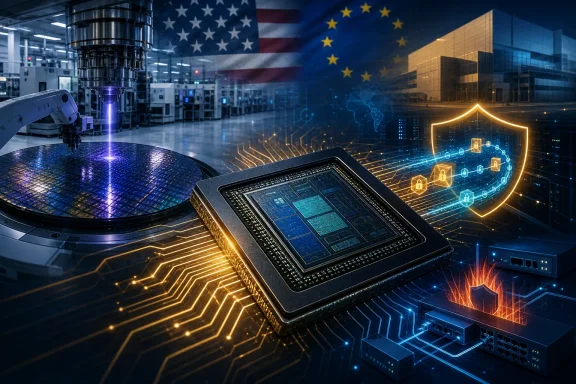
Intel has finally put a recognizable external name beside its foundry business under CEO Lip-Bu Tan, with cybersecurity specialist Fortinet selecting Intel to manufacture the next generation of its purpose-built security silicon. The forthcoming Fortinet SP6 security processor will use Intel 4, a proven extreme-ultraviolet manufacturing process rather than Intel’s newest 18A or planned 14A technology, but the agreement still carries strategic weight: it gives Intel Foundry a credible commercial customer, gives Fortinet a manufacturing relationship rooted in the United States and Europe, and provides both companies with a practical test of whether Intel can become a dependable supplier to chip designers that are not part of Intel itself.
Intel’s effort to become a major contract chip manufacturer is one of the most ambitious corporate transformations in the technology industry. For most of its history, Intel designed and manufactured processors primarily for its own computers, servers, and embedded platforms, using its factories as an integrated competitive advantage rather than offering them broadly to outside customers.
That model began to falter as Intel encountered repeated process delays while Taiwan Semiconductor Manufacturing Company, better known as TSMC, established itself as the preferred manufacturer for leading chip designers. AMD, Nvidia, Apple, Qualcomm, and a growing collection of custom-silicon teams benefited from a foundry ecosystem that separated chip design from fabrication.
Gelsinger also launched the “five nodes in four years” process recovery plan. That sequence moved from Intel 7 through Intel 4, Intel 3, Intel 20A, and Intel 18A, although Intel later adjusted parts of the roadmap and shifted more emphasis toward 18A.
Tan brought extensive experience in semiconductor design software, venture investing, and the wider chip ecosystem. His central challenge has been to convert Intel’s manufacturing roadmap into customer commitments large enough to support the enormous fixed costs of advanced fabrication.
Fortinet is not the marquee 18A or 14A customer that would settle those questions. It is, however, the first named external foundry customer secured during Tan’s tenure, making the agreement an important early marker of his strategy.
Neither company has publicly disclosed expected wafer volumes, financial terms, the production site, the planned launch date, or the detailed architecture of SP6. Those omissions limit the agreement’s immediate financial significance, but they do not erase its value as evidence that an established semiconductor customer is willing to entrust an important product to Intel.
That discretion is understandable, but it creates a communications problem. Investors and prospective customers cannot easily distinguish exploratory design work from a product that is committed to manufacturing.
Naming Fortinet changes the quality of the evidence. It confirms that Intel has progressed beyond discussions and test chips with at least one substantial commercial customer whose product depends on predictable cost, yield, reliability, and supply.
Fortinet must therefore plan around several demanding requirements:
Using an older node may initially appear underwhelming, but node selection is an engineering and commercial decision rather than a contest to claim the smallest number. The best process for an ASIC is the one that delivers the required performance, power, cost, interfaces, yield, and production schedule with acceptable risk.
Those characteristics remain relevant for a security system-on-chip. Fortinet needs sufficient logic density to integrate general-purpose processing, packet acceleration, cryptographic engines, content-inspection functions, memory controllers, switch fabrics, and connectivity blocks without creating an excessively large or power-hungry die.
A more mature process can also offer better-understood yield behavior than a node in its earliest production phase. For a company selling appliances across cost-sensitive enterprise and branch segments, predictable economics may matter more than access to the absolute newest transistor architecture.
Fortinet’s current SP5 was introduced as a 7-nanometer design emphasizing performance per watt and lower system cost. Moving to Intel 4 could provide SP6 with additional transistor capacity and efficiency while avoiding some of the cost and design complexity associated with 18A.
The choice may also reflect design readiness. Intel 4 has established process-design kits, characterized libraries, and production experience, reducing uncertainty for a customer migrating an existing ASIC architecture.
The company divides acceleration work among several classes of security processing units. Network processors handle high-speed packet movement and related functions, content processors accelerate computationally intensive inspection, and integrated security processors combine capabilities for compact products.
Fortinet promoted SP5 as supporting firewalling, next-generation firewall inspection, IPsec encryption, SSL inspection, virtual networking encapsulation, quality of service, secure boot, and distributed denial-of-service protection. It subsequently incorporated the processor into several FortiGate appliance families.
SP6 is likely to extend that architecture rather than replace its underlying philosophy. Although neither company has revealed specifications, a generational security processor would logically target higher throughput, greater inspection capacity, improved energy efficiency, and more simultaneous security services.
At the same time, enterprises are sending more traffic through encrypted channels and AI services. Security appliances must identify applications, enforce policy, inspect content, process threat intelligence, and maintain low latency without becoming network bottlenecks.
SP6 could help Fortinet address that pressure by accelerating several operations:
A successful deployment would put Intel-manufactured silicon into real networks, including environments where uptime, latency, encryption, and threat inspection are operational requirements. That provides Intel with a reference customer whose products must perform under continuous load rather than in a limited pilot.
Security appliances create a useful validation environment because their workloads combine several technical demands:
Every production engagement forces Intel to refine those commercial foundry disciplines. The resulting experience can make subsequent customers easier to onboard, particularly companies developing networking, storage, communications, automotive, defense, or edge-computing ASICs.
Intel 4 is a useful and capable process, but it is several generations behind the company’s newest manufacturing platform. The commercial questions surrounding 18A and 14A therefore remain largely intact.
The strongest signal would include several elements:
That requires a complete ecosystem of reusable interface blocks, memory controllers, high-speed links, design automation tools, verified libraries, packaging options, and manufacturing support. TSMC’s advantage comes partly from years of accumulated customer experience and partner integration, not only from its process specifications.
SP6 may improve Intel’s external-customer execution, but Intel will still need to demonstrate the same discipline on more advanced nodes.
Intel has also performed manufacturing for United States government and defense programs. These engagements can be strategically important, particularly where domestic fabrication, trusted supply chains, and sensitive technology are involved.
Intel is also assisting Tesla and SpaceX with plans for a proposed chip-manufacturing project known as Terafab. That work may deepen Intel’s relationship with Elon Musk’s companies, yet it is distinct from a conventional foundry order placed into Intel’s production network.
Public statements have additionally linked Apple to possible Intel manufacturing in the United States, but neither Intel nor Apple has confirmed a production agreement. Until the companies disclose a specific product, process, or manufacturing commitment, such claims should be treated cautiously.
The next test will be execution. A named customer only becomes a durable reference when working silicon enters qualification, production ramps, and commercial products ship.
Intel’s potential advantage is unusual: it combines advanced logic, mature-node capacity, packaging, processor intellectual property, and factories across the United States and Europe. Its disadvantage is equally clear: it must persuade customers that a company still designing competing processors can behave as a neutral and reliable manufacturing partner.
However, customers do not need Intel to replace TSMC completely for Intel Foundry to become strategically relevant. Companies may use Intel as a second source, assign different products to different foundries, or select Intel where geographic manufacturing and packaging capabilities justify diversification.
Fortinet’s decision suggests that at least one experienced ASIC developer considers Intel 4 a viable option. Additional networking and security customers could turn that isolated win into a recognizable market segment.
The contest may increasingly involve more than transistor density. Packaging capacity, supply resilience, government incentives, export controls, security requirements, and customer support can all influence sourcing decisions.
A FortiGate appliance accelerated by SP6 could sit between Windows devices and external services, enforcing access controls, decrypting permitted traffic for inspection, blocking malicious connections, and coordinating with endpoint and identity systems.
A more capable SP6 could allow Fortinet to raise real-world security performance while controlling electricity and cooling requirements. It could also support higher-speed interfaces and more demanding branch-consolidation scenarios, where one appliance performs routing, SD-WAN, zero-trust access, virtual private networking, and threat prevention.
Enterprises may also value supply-chain diversification. A processor manufactured within Intel’s network could help Fortinet offer customers additional geographic sourcing options, although the final benefit will depend on the specific fabrication, packaging, testing, and assembly locations.
Faster network-security hardware can reduce the performance penalty associated with deeper inspection and more granular policy enforcement. That may improve user experience for Windows 11 devices accessing cloud applications through encrypted tunnels or zero-trust gateways.
Consumers are unlikely to see an immediate change. Over time, however, improved security economics can reach smaller businesses, retail locations, schools, and managed-service providers through more capable entry-level appliances.
Intel operates a manufacturing footprint spanning the United States, Ireland, Israel, and other locations. The company recently committed another €5 billion to expand its Leixlip operations in Ireland, where Intel 4 entered high-volume production in 2023.
Packaging and testing locations will matter as well. A chip can be fabricated in one country, packaged in another, assembled onto a board elsewhere, and integrated into a final appliance at a separate facility.
Customers evaluating supply resilience should therefore consider the complete chain rather than relying on a simple “made in” description. Fortinet’s sourcing disclosures, product documentation, and future regulatory filings may eventually provide more detail.
Intel 4 capacity can therefore retain commercial value even as Intel’s newest processors move to 18A. Networking, security, automotive, industrial, and communications ASICs often remain on mature processes longer than flagship CPUs.
This creates an opportunity for Intel to build a layered foundry business rather than betting exclusively on cutting-edge nodes. The strategy only works, however, if pricing generates acceptable returns and does not merely fill factories with low-margin work.
The most useful answers will concern commercial scale rather than promotional significance. Intel may avoid discussing confidential customer details, but it can still clarify whether external foundry revenue, wafer starts, design wins, and customer prepayments are trending in the right direction.
A product announcement that includes measured firewall, threat-protection, SSL-inspection, and IPsec performance would reveal how much benefit Fortinet gained from moving to Intel 4. Power consumption and price-performance will be just as important as peak throughput.
It would also reveal whether Intel is supplying only wafers or a broader combination of manufacturing, advanced packaging, testing, and related services.
Several such wins would demonstrate that Intel can commercialize older capacity efficiently while pursuing leading-edge customers.
A 14A commitment would be especially important because Intel has connected future capital decisions to external customer demand. Without that demand, the company may need to slow investment, restructure projects, or narrow its manufacturing ambitions.
If SP6 enables materially better performance per watt or lowers the cost of enabling all security services simultaneously, competitors may need to respond with new silicon partnerships or architectural changes. If the gain is modest, Intel’s role may remain strategically interesting without altering security-market dynamics.
The Fortinet SP6 agreement is not the customer victory that definitively secures Intel’s place beside TSMC and Samsung, nor does an Intel 4 ASIC resolve the financial and technical questions surrounding 18A and 14A. It is nevertheless a tangible step in the right direction: an experienced cybersecurity vendor has attached a real product to Intel’s manufacturing platform, giving Lip-Bu Tan a named foundry customer and Intel an opportunity to prove that its factories can serve outside chip designers reliably. The significance will ultimately depend on what follows—working SP6 silicon, competitive FortiGate products, sustained production volume, additional external designs, and, above all, a major advanced-node commitment that turns Intel Foundry from a strategically compelling ambition into a commercially durable business.
 Background
Intel’s effort to become a major contract chip manufacturer is one of the most ambitious corporate transformations in the technology industry. For most of its history, Intel designed and manufactured processors primarily for its own computers, servers, and embedded platforms, using its factories as an integrated competitive advantage rather than offering them broadly to outside customers.That model began to falter as Intel encountered repeated process delays while Taiwan Semiconductor Manufacturing Company, better known as TSMC, established itself as the preferred manufacturer for leading chip designers. AMD, Nvidia, Apple, Qualcomm, and a growing collection of custom-silicon teams benefited from a foundry ecosystem that separated chip design from fabrication.
From integrated manufacturer to commercial foundry
Former CEO Pat Gelsinger responded by creating Intel Foundry Services in 2021 and committing the company to build chips for external customers. The strategy required Intel to act less like a captive manufacturing department and more like a neutral supplier able to protect customer intellectual property, support industry-standard design tools, and manufacture products created outside Intel’s traditional x86 ecosystem.Gelsinger also launched the “five nodes in four years” process recovery plan. That sequence moved from Intel 7 through Intel 4, Intel 3, Intel 20A, and Intel 18A, although Intel later adjusted parts of the roadmap and shifted more emphasis toward 18A.
Lip-Bu Tan inherits the foundry challenge
Lip-Bu Tan became Intel CEO in March 2025 and inherited a foundry operation with considerable technical assets but unresolved commercial questions. Intel had spent heavily on fabrication plants, advanced packaging, process development, and capacity, yet most of Intel Foundry’s reported revenue still came from transactions involving Intel’s own product divisions.Tan brought extensive experience in semiconductor design software, venture investing, and the wider chip ecosystem. His central challenge has been to convert Intel’s manufacturing roadmap into customer commitments large enough to support the enormous fixed costs of advanced fabrication.
Fortinet is not the marquee 18A or 14A customer that would settle those questions. It is, however, the first named external foundry customer secured during Tan’s tenure, making the agreement an important early marker of his strategy.
What Intel and Fortinet Have Announced
Fortinet will use Intel Foundry to manufacture SP6, the successor to its current SP5 security processor. Intel has confirmed that production will use the Intel 4 process, which entered high-volume manufacturing earlier in the decade and introduced extensive EUV lithography into Intel’s production network.Neither company has publicly disclosed expected wafer volumes, financial terms, the production site, the planned launch date, or the detailed architecture of SP6. Those omissions limit the agreement’s immediate financial significance, but they do not erase its value as evidence that an established semiconductor customer is willing to entrust an important product to Intel.
Why the customer’s name matters
Foundry relationships are often confidential because they reveal product plans, sourcing strategies, and sensitive technical details. Tan has previously indicated that multiple companies were engaging with Intel Foundry while maintaining a policy against identifying customers without permission.That discretion is understandable, but it creates a communications problem. Investors and prospective customers cannot easily distinguish exploratory design work from a product that is committed to manufacturing.
Naming Fortinet changes the quality of the evidence. It confirms that Intel has progressed beyond discussions and test chips with at least one substantial commercial customer whose product depends on predictable cost, yield, reliability, and supply.
A production-oriented relationship
Security processors are not disposable demonstrations. They are integrated into appliances that customers may deploy for years across branch offices, campuses, data centers, factories, telecommunications networks, and operational-technology environments.Fortinet must therefore plan around several demanding requirements:
- The processor must meet established performance and power targets across realistic security workloads.
- Manufacturing yields must support competitive appliance pricing.
- Long-term supply must align with enterprise product lifecycles.
- Firmware, drivers, FortiOS, and hardware acceleration paths must operate reliably as one system.
- Intel must manage process changes without undermining product certification or support commitments.
Why Intel 4 Is the Chosen Process
Intel 4 is no longer the company’s leading process. Intel 18A entered production in 2025, while Intel 18A-P has advanced into risk production as a performance-enhanced member of the same process family. Intel is also developing 14A as the next major step in its roadmap.Using an older node may initially appear underwhelming, but node selection is an engineering and commercial decision rather than a contest to claim the smallest number. The best process for an ASIC is the one that delivers the required performance, power, cost, interfaces, yield, and production schedule with acceptable risk.
A mature EUV platform
Intel 4 represented an important technical transition because it used EUV lithography extensively. Intel has said the process offered approximately twice the high-performance logic density of Intel 7 and more than a 20% improvement in transistor performance per watt under comparable conditions.Those characteristics remain relevant for a security system-on-chip. Fortinet needs sufficient logic density to integrate general-purpose processing, packet acceleration, cryptographic engines, content-inspection functions, memory controllers, switch fabrics, and connectivity blocks without creating an excessively large or power-hungry die.
A more mature process can also offer better-understood yield behavior than a node in its earliest production phase. For a company selling appliances across cost-sensitive enterprise and branch segments, predictable economics may matter more than access to the absolute newest transistor architecture.
ASIC economics differ from premium CPU economics
A leading PC processor or AI accelerator can justify expensive wafers because customers pay for maximum performance. A networking ASIC must often fit inside a complete appliance with strict bill-of-materials, cooling, power, and price targets.Fortinet’s current SP5 was introduced as a 7-nanometer design emphasizing performance per watt and lower system cost. Moving to Intel 4 could provide SP6 with additional transistor capacity and efficiency while avoiding some of the cost and design complexity associated with 18A.
The choice may also reflect design readiness. Intel 4 has established process-design kits, characterized libraries, and production experience, reducing uncertainty for a customer migrating an existing ASIC architecture.
What SP6 Could Mean for Fortinet
Fortinet has invested in custom security silicon for more than two decades. Its strategy is based on the premise that commodity CPUs alone cannot deliver optimal networking and inspection performance within the power and cost limits of security appliances.The company divides acceleration work among several classes of security processing units. Network processors handle high-speed packet movement and related functions, content processors accelerate computationally intensive inspection, and integrated security processors combine capabilities for compact products.
Building on the SP5 generation
Fortinet introduced SP5 in 2023 as a fifth-generation system-on-chip for branch, campus, 5G, edge-computing, and operational-technology use cases. The design combined embedded CPU resources with network and content-processing acceleration, including elements derived from Fortinet’s NP7 and content-inspection technologies.Fortinet promoted SP5 as supporting firewalling, next-generation firewall inspection, IPsec encryption, SSL inspection, virtual networking encapsulation, quality of service, secure boot, and distributed denial-of-service protection. It subsequently incorporated the processor into several FortiGate appliance families.
SP6 is likely to extend that architecture rather than replace its underlying philosophy. Although neither company has revealed specifications, a generational security processor would logically target higher throughput, greater inspection capacity, improved energy efficiency, and more simultaneous security services.
The AI-era inspection problem
Artificial intelligence is increasing security workload in two directions. Attackers can use AI to accelerate reconnaissance, social engineering, malware adaptation, and vulnerability discovery, while defenders deploy AI-powered analytics and automated response across larger volumes of telemetry.At the same time, enterprises are sending more traffic through encrypted channels and AI services. Security appliances must identify applications, enforce policy, inspect content, process threat intelligence, and maintain low latency without becoming network bottlenecks.
SP6 could help Fortinet address that pressure by accelerating several operations:
- Cryptographic engines could reduce the cost of decrypting, inspecting, and re-encrypting permitted traffic.
- Pattern-matching hardware could increase malware and intrusion-prevention throughput.
- Packet-processing engines could preserve latency as connection counts rise.
- Integrated AI or vector-oriented blocks could assist with selected classification and inference tasks.
- Improved telemetry processing could feed Fortinet’s security operations and management platforms more efficiently.
Why Fortinet Is a Valuable Customer for Intel
Fortinet lacks the consumer recognition of Apple and the AI-market profile of Nvidia, but it is not a token customer. The company sells security infrastructure globally and competes in a market where product performance directly influences enterprise purchasing decisions.A successful deployment would put Intel-manufactured silicon into real networks, including environments where uptime, latency, encryption, and threat inspection are operational requirements. That provides Intel with a reference customer whose products must perform under continuous load rather than in a limited pilot.
A demanding workload validates more than transistor speed
Foundry credibility depends on more than whether a chip powers on. Intel will need to demonstrate manufacturing consistency across multiple production runs and potentially over a long commercial lifetime.Security appliances create a useful validation environment because their workloads combine several technical demands:
- They process large numbers of concurrent connections.
- They perform sustained packet movement rather than occasional bursts.
- They rely on cryptographic and content-inspection accelerators.
- They must remain within tightly controlled thermal limits.
- They require deterministic behavior and low latency.
- They may remain deployed well beyond the replacement cycle of consumer electronics.
A bridge into a wider design ecosystem
Fortinet could also help Intel improve processes that are less visible than lithography. External foundry customers require design enablement, verification, intellectual-property integration, mask preparation, test development, packaging coordination, and failure analysis.Every production engagement forces Intel to refine those commercial foundry disciplines. The resulting experience can make subsequent customers easier to onboard, particularly companies developing networking, storage, communications, automotive, defense, or edge-computing ASICs.
The Deal Does Not Solve Intel’s 18A and 14A Problem
The Fortinet announcement should not be mistaken for confirmation that Intel Foundry has achieved its most important strategic goal. Intel still needs a major external customer for its advanced process technologies, particularly 14A, to justify continued capital expenditure at the scale envisioned for a globally competitive leading-edge foundry.Intel 4 is a useful and capable process, but it is several generations behind the company’s newest manufacturing platform. The commercial questions surrounding 18A and 14A therefore remain largely intact.
What would count as a marquee win
A transformative customer would probably commit a high-volume processor, accelerator, or chiplet using Intel’s most advanced transistor and packaging technologies. Such a design would require confidence in process performance, yields, intellectual-property libraries, design tools, packaging, capacity, and long-term roadmap execution.The strongest signal would include several elements:
- A recognizable customer would publicly identify Intel as the manufacturer.
- The product would use 18A, 18A-P, or 14A rather than a mature process.
- Production would involve commercially meaningful volume.
- The design would enter a mainstream product rather than remain experimental.
- The relationship would extend across multiple generations.
Advanced nodes require a customer ecosystem
Intel’s most difficult challenge is not simply proving that 18A transistors work. Intel must show that outside engineering teams can design competitive products around the process without relying on internal knowledge available only to Intel’s CPU groups.That requires a complete ecosystem of reusable interface blocks, memory controllers, high-speed links, design automation tools, verified libraries, packaging options, and manufacturing support. TSMC’s advantage comes partly from years of accumulated customer experience and partner integration, not only from its process specifications.
SP6 may improve Intel’s external-customer execution, but Intel will still need to demonstrate the same discipline on more advanced nodes.
Intel’s Existing Foundry Relationships
Intel’s external foundry story already includes several prominent names, although the scope and maturity of those relationships vary. Microsoft announced plans in 2024 to use Intel 18A for a future chip, while Amazon Web Services disclosed plans involving a custom AI fabric chip on Intel 18A and packaging work for other designs.Intel has also performed manufacturing for United States government and defense programs. These engagements can be strategically important, particularly where domestic fabrication, trusted supply chains, and sensitive technology are involved.
Design collaboration is not always wafer production
Other relationships occupy a less direct category. Intel has worked with Google on an infrastructure processing unit, but design assistance does not automatically mean Intel will fabricate the final chip.Intel is also assisting Tesla and SpaceX with plans for a proposed chip-manufacturing project known as Terafab. That work may deepen Intel’s relationship with Elon Musk’s companies, yet it is distinct from a conventional foundry order placed into Intel’s production network.
Public statements have additionally linked Apple to possible Intel manufacturing in the United States, but neither Intel nor Apple has confirmed a production agreement. Until the companies disclose a specific product, process, or manufacturing commitment, such claims should be treated cautiously.
Why Fortinet feels more concrete
The SP6 announcement is comparatively straightforward: Fortinet has identified a chip, and Intel has identified the manufacturing process. That level of specificity makes the relationship easier to evaluate than a broad strategic collaboration or an unspecified future design.The next test will be execution. A named customer only becomes a durable reference when working silicon enters qualification, production ramps, and commercial products ship.
Competitive Implications for the Foundry Market
Intel is entering a foundry market led by TSMC, with Samsung serving as the other major supplier of leading-edge logic. GlobalFoundries and several specialized manufacturers compete strongly on mature and differentiated processes, while regional governments continue encouraging domestic semiconductor capacity.Intel’s potential advantage is unusual: it combines advanced logic, mature-node capacity, packaging, processor intellectual property, and factories across the United States and Europe. Its disadvantage is equally clear: it must persuade customers that a company still designing competing processors can behave as a neutral and reliable manufacturing partner.
Pressure on TSMC will be incremental
A single Fortinet ASIC will not materially weaken TSMC’s market position. TSMC’s customer base, production scale, process portfolio, and design ecosystem remain formidable, and many chip companies have spent years optimizing their development methods around its technologies.However, customers do not need Intel to replace TSMC completely for Intel Foundry to become strategically relevant. Companies may use Intel as a second source, assign different products to different foundries, or select Intel where geographic manufacturing and packaging capabilities justify diversification.
Fortinet’s decision suggests that at least one experienced ASIC developer considers Intel 4 a viable option. Additional networking and security customers could turn that isolated win into a recognizable market segment.
Samsung faces another domestic-manufacturing rival
Samsung is also pursuing external foundry customers and offers both advanced process technology and broad semiconductor capabilities. Intel’s expansion adds another competitor for customers seeking an alternative to TSMC, particularly those interested in manufacturing located in the United States or Europe.The contest may increasingly involve more than transistor density. Packaging capacity, supply resilience, government incentives, export controls, security requirements, and customer support can all influence sourcing decisions.
Enterprise and Consumer Impact
Most Windows users will never interact directly with SP6, and the processor will not appear in a typical desktop PC. Its influence will instead be felt in the infrastructure connecting Windows endpoints, cloud applications, branch offices, data centers, and remote workers.A FortiGate appliance accelerated by SP6 could sit between Windows devices and external services, enforcing access controls, decrypting permitted traffic for inspection, blocking malicious connections, and coordinating with endpoint and identity systems.
What enterprises may gain
For enterprise customers, greater ASIC performance can translate into higher inspection throughput without requiring proportionally larger appliances. That matters because advertised firewall bandwidth often declines when organizations activate intrusion prevention, application control, antivirus scanning, SSL inspection, and other advanced services simultaneously.A more capable SP6 could allow Fortinet to raise real-world security performance while controlling electricity and cooling requirements. It could also support higher-speed interfaces and more demanding branch-consolidation scenarios, where one appliance performs routing, SD-WAN, zero-trust access, virtual private networking, and threat prevention.
Enterprises may also value supply-chain diversification. A processor manufactured within Intel’s network could help Fortinet offer customers additional geographic sourcing options, although the final benefit will depend on the specific fabrication, packaging, testing, and assembly locations.
Indirect effects for Windows environments
Windows administrators increasingly manage security as an integrated stack rather than a collection of isolated products. Endpoint detection, Microsoft Entra identity, Microsoft Defender services, firewalls, SASE platforms, and security information systems exchange telemetry and policy across hybrid environments.Faster network-security hardware can reduce the performance penalty associated with deeper inspection and more granular policy enforcement. That may improve user experience for Windows 11 devices accessing cloud applications through encrypted tunnels or zero-trust gateways.
Consumers are unlikely to see an immediate change. Over time, however, improved security economics can reach smaller businesses, retail locations, schools, and managed-service providers through more capable entry-level appliances.
Manufacturing and Supply-Chain Significance
The agreement also fits a broader effort to diversify semiconductor production geographically. Governments and enterprises have become more conscious of supply concentration after pandemic-era shortages, geopolitical tension, and rapid growth in demand for AI infrastructure.Intel operates a manufacturing footprint spanning the United States, Ireland, Israel, and other locations. The company recently committed another €5 billion to expand its Leixlip operations in Ireland, where Intel 4 entered high-volume production in 2023.
The production location remains important
Intel has not publicly specified where SP6 wafers will be manufactured. Intel 4’s history in Ireland makes Leixlip a plausible candidate, but no conclusion should be drawn without confirmation.Packaging and testing locations will matter as well. A chip can be fabricated in one country, packaged in another, assembled onto a board elsewhere, and integrated into a final appliance at a separate facility.
Customers evaluating supply resilience should therefore consider the complete chain rather than relying on a simple “made in” description. Fortinet’s sourcing disclosures, product documentation, and future regulatory filings may eventually provide more detail.
Capacity utilization helps foundry economics
Semiconductor factories carry enormous fixed costs whether their production lines are full or partly idle. External designs can improve equipment utilization and spread depreciation across a broader revenue base, especially on processes that remain technically useful after Intel’s internal products migrate to newer nodes.Intel 4 capacity can therefore retain commercial value even as Intel’s newest processors move to 18A. Networking, security, automotive, industrial, and communications ASICs often remain on mature processes longer than flagship CPUs.
This creates an opportunity for Intel to build a layered foundry business rather than betting exclusively on cutting-edge nodes. The strategy only works, however, if pricing generates acceptable returns and does not merely fill factories with low-margin work.
Strengths and Opportunities
The Fortinet agreement offers Intel and Fortinet several clear advantages, provided both companies execute successfully.- Intel gains a named and credible external customer. That gives prospective foundry clients more evidence than an anonymous pipeline or an early technical demonstration.
- Fortinet gains access to a mature EUV process. Intel 4 can provide substantial density and performance-per-watt improvements without exposing SP6 to all the risks of a newly launched node.
- The partnership aligns with long-lifecycle infrastructure products. Security appliances can create sustained wafer demand across several years rather than a brief consumer-product cycle.
- Intel can reuse mature capacity more effectively. External ASICs may improve factory utilization as Intel’s internal processors transition toward 18A and later processes.
- Fortinet can deepen its hardware differentiation. A larger transistor budget could support more encryption, inspection, networking, and possibly AI-oriented acceleration.
- Both companies can appeal to supply-chain-conscious customers. Intel’s manufacturing presence in the United States and Europe may be attractive to governments and regulated industries.
- Success could lead to a multi-generation relationship. An SP6 production ramp may create a path toward future Fortinet designs on Intel 3, 18A, or another process.
- Intel can improve its external-customer operating model. Real production work strengthens design support, verification, packaging, quality control, and account-management disciplines.
Risks and Concerns
The announcement also leaves substantial uncertainty, and investors should resist treating it as proof that Intel Foundry’s turnaround is complete.- SP6 volume is unknown. Without shipment forecasts or wafer commitments, the deal’s revenue contribution cannot be estimated reliably.
- Intel 4 is not a leading-edge customer validation. The project says little about whether major external designers will commit high-volume products to 18A or 14A.
- Manufacturing yield remains crucial. A technically successful design can still disappoint if usable dies per wafer do not support Fortinet’s target pricing.
- The production schedule has not been disclosed. SP6 could still be years away from appearing in shipping appliances.
- Fortinet faces concentration risk. Depending heavily on one foundry for a custom processor can create exposure to delays, quality problems, or capacity constraints.
- Intel must manage customer trust. External designers need confidence that their intellectual property, schedules, and commercial data remain protected from Intel’s product businesses.
- Competition will continue advancing. TSMC, Samsung, and other foundries will not stand still while Intel develops its customer base.
- Advanced-node spending remains difficult to justify. Mature-node wins can generate useful business but may not fund the capital intensity required for 14A and later technologies.
- Security silicon has an unusually high reliability burden. A hardware defect could affect encryption, packet handling, secure boot, inspection, or appliance availability across many customers.
Intel’s Upcoming Earnings Test
Intel is scheduled to report its second-quarter 2026 financial results after the market closes on Thursday, July 23. The timing gives investors an immediate opportunity to ask management how the Fortinet engagement fits into the broader foundry pipeline.The most useful answers will concern commercial scale rather than promotional significance. Intel may avoid discussing confidential customer details, but it can still clarify whether external foundry revenue, wafer starts, design wins, and customer prepayments are trending in the right direction.
Questions management needs to address
Analysts are likely to focus on several areas:- How many external designs have moved beyond evaluation into committed production?
- What proportion of foundry revenue comes from truly external customers?
- Is Intel 18A attracting repeatable commercial interest outside Intel’s own product groups?
- Has Intel secured the major 14A customer needed to support future investment?
- How quickly are yields improving across 18A production?
- What capital expenditure level can Intel sustain without damaging cash flow?
- Does Fortinet represent the beginning of a networking-ASIC pipeline or a standalone engagement?
What to Watch Next
The Fortinet announcement should be evaluated as the opening stage of a manufacturing program rather than its conclusion. Several milestones will determine whether it becomes an important foundry success or remains a modest symbolic win.The SP6 product timeline
The first signal will be a more detailed Fortinet roadmap. Investors and customers should watch for disclosure of SP6 specifications, sample availability, appliance families, production qualification, and expected commercial launch.A product announcement that includes measured firewall, threat-protection, SSL-inspection, and IPsec performance would reveal how much benefit Fortinet gained from moving to Intel 4. Power consumption and price-performance will be just as important as peak throughput.
Confirmation of production and packaging locations
Intel or Fortinet may eventually identify the fabrication plant and packaging arrangement. That information would clarify the deal’s geographic supply-chain value and indicate which Intel facilities are benefiting from external demand.It would also reveal whether Intel is supplying only wafers or a broader combination of manufacturing, advanced packaging, testing, and related services.
Additional customers on mature nodes
Intel could build momentum by adding more customers for Intel 4 and Intel 3. Networking, communications, defense, automotive, storage, and edge-computing designs are plausible targets because they often value longevity and predictable power characteristics over access to the newest process.Several such wins would demonstrate that Intel can commercialize older capacity efficiently while pursuing leading-edge customers.
A decisive 18A or 14A commitment
The most important milestone remains a large, named customer committing a mainstream product to Intel’s advanced nodes. Microsoft and Amazon provide meaningful validation, but the market will look for evidence of volume production and continued engagement.A 14A commitment would be especially important because Intel has connected future capital decisions to external customer demand. Without that demand, the company may need to slow investment, restructure projects, or narrow its manufacturing ambitions.
Fortinet’s competitive product response
Fortinet’s rivals will also shape the outcome. Palo Alto Networks, Check Point, Cisco, Juniper, and cloud-based security providers use different combinations of commodity processors, merchant silicon, custom accelerators, and software.If SP6 enables materially better performance per watt or lowers the cost of enabling all security services simultaneously, competitors may need to respond with new silicon partnerships or architectural changes. If the gain is modest, Intel’s role may remain strategically interesting without altering security-market dynamics.
The Fortinet SP6 agreement is not the customer victory that definitively secures Intel’s place beside TSMC and Samsung, nor does an Intel 4 ASIC resolve the financial and technical questions surrounding 18A and 14A. It is nevertheless a tangible step in the right direction: an experienced cybersecurity vendor has attached a real product to Intel’s manufacturing platform, giving Lip-Bu Tan a named foundry customer and Intel an opportunity to prove that its factories can serve outside chip designers reliably. The significance will ultimately depend on what follows—working SP6 silicon, competitive FortiGate products, sustained production volume, additional external designs, and, above all, a major advanced-node commitment that turns Intel Foundry from a strategically compelling ambition into a commercially durable business.
References
- Primary source: CNBC
Published: 2026-07-21T13:00:01+00:00
Loading…
www.cnbc.com - Related coverage: newsroom.intel.com
Loading…
newsroom.intel.com - Related coverage: fortinet.com
Loading…
www.fortinet.com - Related coverage: intel.com
Loading…
www.intel.com - Related coverage: download.intel.com
Loading…
download.intel.com